
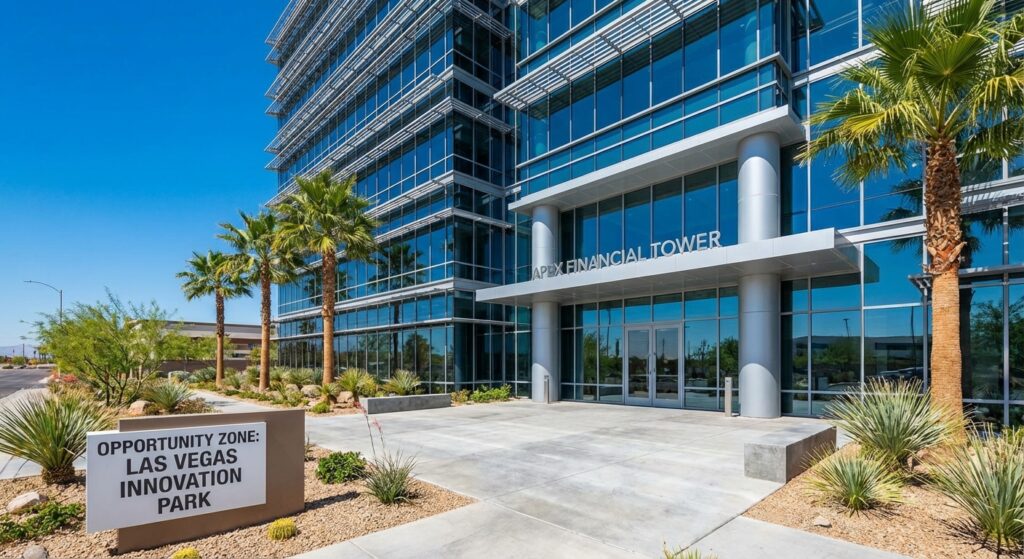
Las Vegas Opportunity Zone 10 Year Hold: Your Complete 2026 Tax Strategy Guide
For the 2026 tax year, Las Vegas opportunity zone 10 year hold investments represent one of the most powerful tax strategies available to real estate investors. Under the One Big Beautiful Bill Act (OBBBA) signed in July 2025, the federal government has made permanent several transformative tax incentives. A Las Vegas opportunity zone 10 year hold allows investors to defer capital gains tax on original investment gains, apply a 20% qualified business income deduction, and leverage 100% bonus depreciation on qualifying property purchases.
Table of Contents
- Key Takeaways
- What Are the Tax Benefits of a Las Vegas Opportunity Zone 10 Year Hold?
- What Types of Investments Qualify for Opportunity Zone Status?
- How Does Capital Gains Deferral Work with a 10 Year Hold?
- What is the Strategy Behind 100% Bonus Depreciation?
- What is the Optimal Entity Structure for Opportunity Zone Investments?
- How Can You Model 2026 Opportunity Zone Tax Savings?
- Uncle Kam in Action: Opportunity Zone Success
- Next Steps
- Frequently Asked Questions
- Related Resources
Key Takeaways
- A Las Vegas opportunity zone 10 year hold enables tax deferral of original capital gains while applying 100% bonus depreciation on property acquisition costs.
- The 20% qualified business income deduction under OBBBA provides permanent tax relief for pass-through entities operating in opportunity zones.
- Section 179 deductions up to $2.5 million allow small business owners to immediately expense equipment and improvements.
- Rolling opportunity zone programs extending through 2027+ offer long-term stability for multi-year investment strategies.
- Proper entity structuring and multiyear tax projections are essential to maximize the interaction of these deductions.
What Are the Tax Benefits of a Las Vegas Opportunity Zone 10 Year Hold?
Quick Answer: A Las Vegas opportunity zone 10 year hold provides three major tax benefits: deferral of original capital gains tax until 2026, exclusion of new appreciation gains after the 10 year hold, and the ability to layer deductions including 100% bonus depreciation and 20% qualified business income deductions.
The foundation of opportunity zone investing is capital gains deferral. When you invest existing capital gains from another asset sale into a designated Las Vegas opportunity zone, you defer the tax liability on those gains. This deferral remains in effect through December 31, 2026 (the original deferral deadline set when the opportunity zone program began).
However, the real power emerges with the 10 year hold requirement. If you maintain your Las Vegas opportunity zone investment for the full 10 year period, any appreciation gains generated within the zone are permanently excluded from federal taxation. This means the tax-free growth compounds year over year, creating substantial wealth accumulation without annual tax drag.
How the 10 Year Hold Creates Tax-Free Appreciation
Under the OBBBA permanent provisions for 2026, the 10 year hold timeline creates a unique tax arbitrage opportunity. Investment gains accrued after your initial capital is deployed into the opportunity zone are excluded from taxation entirely. This is distinct from capital gains deferral, where the tax bill is delayed but eventually due.
Consider a practical scenario: you invest $500,000 in a Las Vegas opportunity zone commercial property. Over 10 years, the property appreciates to $750,000. The $250,000 appreciation gain is completely tax-free. You pay no federal capital gains tax on that growth, eliminating the 15% or 20% federal rate that would normally apply.
Combining Opportunity Zone Benefits with Bonus Depreciation
For 2026, the synergy between opportunity zone benefits and OBBBA’s permanent 100% bonus depreciation creates a powerful tax reduction mechanism. When you purchase qualified real property in a Las Vegas opportunity zone, you can immediately expense 100% of the depreciable basis in the year of purchase.
This means upfront tax deductions that reduce your taxable income in the year of investment, combined with long-term tax-free appreciation after the 10 year hold. Real estate investors using this strategy effectively convert ordinary income into appreciation that never faces federal taxation.
Pro Tip: Document your Las Vegas opportunity zone investment timing carefully. The 10 year hold period is measured from the date you deploy capital into the zone. Maintain detailed records of acquisition dates, investment amounts, and property basis calculations for IRS compliance.
What Types of Investments Qualify for Opportunity Zone Status?
Quick Answer: Las Vegas opportunity zones include residential and commercial real estate, business operations, and business property acquisitions within federally designated census tracts. Check the IRS list to confirm your specific property qualifies.
Not all Las Vegas investments qualify for opportunity zone status. The IRS has designated specific geographic areas throughout the country, including multiple zones in the Las Vegas valley. Your investment property must be located within one of these federally designated census tracts.
Qualified Business Property vs. Real Estate
Two categories of qualifying investments exist for Las Vegas opportunity zone 10 year hold strategies. First, real property: commercial buildings, office space, industrial warehouses, multifamily residential, and land development projects all qualify. Second, qualified business property: machinery, equipment, and business assets used in an active business within the zone.
For 2026, the OBBBA expanded the definitions of qualified business property to include more service businesses and technology operations. This broadens the investment universe beyond traditional real estate, allowing entrepreneurs to direct capital into operating businesses while capturing opportunity zone benefits.
Investment Timing and the 2026 Deadline
A critical milestone approaches for opportunity zone investors. Capital gains from sales prior to January 1, 2018, must be invested in a Las Vegas opportunity zone by December 31, 2026, to qualify for deferral benefits. This creates a compressed timeline for investors holding gains from earlier transactions.
However, rolling opportunity zone programs announced under OBBBA extend funding opportunities through 2027 and beyond, meaning new investment windows continue opening. Plan your Las Vegas opportunity zone deployment across multiple years to optimize the interaction of deferrals, deductions, and appreciation timing.
| Investment Type | Tax Treatment in 2026 | Depreciation Available |
|---|---|---|
| Commercial Real Estate | Capital gains deferral + 10 yr exclusion | 100% bonus depreciation |
| Multifamily Residential | Capital gains deferral + 10 yr exclusion | 100% bonus depreciation |
| Operating Business | Capital gains deferral + QBI deduction | Section 179 + Bonus Depreciation |
| Equipment/Machinery | Capital gains deferral + QBI deduction | 100% bonus depreciation |
How Does Capital Gains Deferral Work with a 10 Year Hold?
Quick Answer: Capital gains deferral allows you to postpone paying tax on gains from prior sales until December 31, 2026. If you hold the Las Vegas opportunity zone investment for 10 years, appreciation gains generated after your initial investment are permanently excluded from federal taxation.
The mechanics of capital gains deferral within a Las Vegas opportunity zone require precise execution. You must invest the full amount of realized gains within 180 days of the sale generating those gains. This 180-day clock starts the moment you close on the original asset sale.
Calculating Deferred Gains and Tax Impact
Suppose you sold commercial property in 2023 for $1.2 million. Your cost basis was $800,000, creating a $400,000 capital gain. Without opportunity zone investment, you would owe federal capital gains tax at 15% or 20%, depending on income. That’s $60,000 to $80,000 in federal tax on the sale.
By deploying the full $400,000 realized gain into a Las Vegas opportunity zone investment by the 180-day deadline, you defer the entire tax bill. The tax remains due on December 31, 2026, unless additional benefits apply. However, if you hold the Las Vegas opportunity zone 10 year hold investment until 2033, the appreciation generated between 2023 and 2033 receives permanent tax exclusion.
The Strategic Value of Deferral Plus Exclusion
Combining deferral with the 10-year hold exclusion creates compound tax efficiency. Your original $400,000 gain is deferred until 2026, freeing up capital to deploy into a higher-growth Las Vegas opportunity zone investment. Meanwhile, if that investment grows from $400,000 to $600,000 over 10 years, the $200,000 appreciation is permanently tax-free.
This creates a 50% tax reduction on the new gains compared to ordinary capital gains treatment. Instead of paying $30,000 to $40,000 in federal tax on the $200,000 appreciation, you pay zero. Combined with the deferral of the original $60,000 to $80,000 tax bill, investors achieve substantial federal income tax reduction.
Pro Tip: For 2026 planning, if you have deferred gains that become due, consider rolling them into a new Las Vegas opportunity zone investment before year-end. This strategy maintains tax deferral while extending the benefits available under OBBBA.
What is the Strategy Behind 100% Bonus Depreciation?
Quick Answer: For 2026, OBBBA makes 100% bonus depreciation permanent for qualified property purchases in Las Vegas opportunity zones. This allows immediate expensing of the entire depreciable basis of real property, generating substantial first-year tax deductions without waiting for depreciation schedules.
Bonus depreciation under OBBBA represents one of the most aggressive tax reduction tools available to opportunity zone investors in 2026. When you purchase qualified property, you can claim depreciation deductions equal to the entire cost of qualifying property components in the year of acquisition.
Calculating Depreciable Basis in Real Property
Land does not depreciate, but building structures and property improvements do. If you purchase a Las Vegas office building for $2 million, and allocate $500,000 to land and $1.5 million to the structure, the $1.5 million building cost qualifies for bonus depreciation.
With 100% bonus depreciation available in 2026, you claim the full $1.5 million deduction in year one. If your taxable income is $2 million, this deduction reduces it to $500,000, generating federal tax savings of $105,000 to $120,000 (at federal rates of 21% for corporations or higher for individuals).
Interaction with 20% Qualified Business Income Deduction
For pass-through entities operating in Las Vegas opportunity zones, the 20% qualified business income deduction compounds the tax benefit of bonus depreciation. The deduction applies to 20% of qualified business income from the property or business.
However, deductions generated by bonus depreciation can interact with the QBI deduction in complex ways. Real estate investors must carefully model the interaction to avoid creating excess losses that generate unused deductions or reduce the QBI deduction below maximum efficiency.
| Tax Year | 100% Bonus Depreciation Status | Permanence |
|---|---|---|
| 2023-2025 | 100% available | Scheduled to phase out |
| 2026+ | 100% available | PERMANENT under OBBBA |
What is the Optimal Entity Structure for Opportunity Zone Investments?
Quick Answer: For Las Vegas opportunity zone 10 year hold investments, pass-through entities such as LLCs, partnerships, and S corporations typically maximize tax efficiency. These structures allow direct deduction of bonus depreciation and application of the 20% qualified business income deduction at individual tax rates.
The entity you choose to hold your Las Vegas opportunity zone investment dramatically impacts 2026 tax outcomes. Should you use an LLC, partnership, C corporation, or S corporation? The answer depends on your income level, reinvestment plans, and the interaction of multiple deductions.
Pass-Through vs. C Corporation Taxation
For most real estate investors, pass-through entities outperform C corporations in Las Vegas opportunity zone structures. A pass-through entity’s depreciation deductions and QBI deductions flow to owners’ individual returns, where they offset personal income at individual rates (up to 37% federal plus state taxes).
A C corporation, by contrast, takes the deductions at the corporate level (21% federal rate). While 21% is lower than individual rates, C corporations lose the ability to leverage the 20% QBI deduction available to pass-through entities.
Consider using our LLC vs S-Corp Tax Calculator for Wheeling to model your specific opportunity zone investment structure. The calculator enables you to compare tax outcomes across entity types and identify the optimal choice for your 2026 investment.
Multi-Entity Strategies for Scale
Investors deploying significant capital into multiple Las Vegas opportunity zone properties may benefit from a tiered entity structure. A holding company at the top owns individual LLCs or partnerships below, each holding a separate property.
This structure provides liability protection (separating each property’s legal risk) while allowing centralized management and tax planning. Distributions and allocations can be optimized across entities to maximize deductions while maintaining compliance with loss limitation rules.
Pro Tip: In 2026, Las Vegas opportunity zone investments are subject to the 80% loss limitation rule under OBBBA. This means operating losses can only offset 80% of taxable income. Structure multiple properties carefully to avoid excess losses that create unusable deductions.
How Can You Model 2026 Opportunity Zone Tax Savings?
Quick Answer: Accurate 2026 tax projections require modeling the interaction of capital gains deferral, bonus depreciation, and the 20% QBI deduction across multiyear projections. Account for the 80% loss limitation rule and evaluate how deductions flow through your chosen entity structure.
Building a multiyear tax projection for your Las Vegas opportunity zone 10 year hold investment is essential to maximum benefit realization. Tax professionals recommend creating detailed spreadsheets that track income, deductions, and tax liability across at least 10 years of ownership.
Key Variables in Opportunity Zone Projections
Your Las Vegas opportunity zone tax projection must account for several variables: initial investment amount, property acquisition basis (building vs. land allocation), projected rental income or operational income, expected annual appreciation rate, the timing of capital gains deferral recognition (December 31, 2026), and the date you achieve the 10-year hold milestone.
Example projection scenario: $1 million investment in 2026, allocated $800,000 to building and $200,000 to land. Assume 3% annual appreciation, 6% cash yield, 100% bonus depreciation in year one, and 20% QBI deduction application. Year one tax savings from depreciation alone would be approximately $168,000 to $192,000 (at 21% to 24% marginal rates).
Using Projections to Optimize Deduction Timing
Multiyear projections reveal opportunities to optimize when you claim deductions. In some cases, deferring bonus depreciation into year two or spreading deductions across multiple years produces better overall tax results than claiming maximum deductions in year one.
This is particularly important for Las Vegas opportunity zone investors with other business interests generating losses. The 80% loss limitation rule requires careful deduction stacking to avoid wasting deductions in any single year.

Uncle Kam in Action: Opportunity Zone Success
Real estate investor Marcus had accumulated $800,000 in unrealized capital gains from prior commercial property sales. By December 2025, he faced a looming tax bill of approximately $120,000 to $160,000 (at combined 15-20% federal capital gains rates plus state taxes).
Rather than paying the tax, Marcus deployed the full $800,000 into a Las Vegas opportunity zone commercial property acquisition in early 2026. The property was a $1.2 million office building in a designated zone, with Marcus providing the $800,000 down payment.
Through careful basis allocation, the property’s depreciable basis was determined to be $960,000. Under OBBBA’s permanent 100% bonus depreciation, Marcus claimed a $960,000 depreciation deduction in 2026, generating approximately $201,600 in federal tax savings (at his 21% marginal rate).
Additionally, by holding the Las Vegas opportunity zone investment through 2036 (the 10-year hold deadline), any appreciation on the $1.2 million property becomes permanently tax-free. If the property appreciates to $1.5 million, Marcus receives $300,000 of tax-free gain—a benefit worth $45,000 to $60,000 in avoided federal capital gains tax.
Uncle Kam’s tax strategy delivered Marcus nearly $250,000 in first-year tax benefits, plus permanent exclusion on long-term appreciation gains. The original $120,000 to $160,000 tax bill was completely eliminated through strategic deferral, combined with aggressive but compliant bonus depreciation.
Result: First-year federal tax savings of $201,600. Long-term capital gains exclusion on appreciation: $45,000-$60,000 permanent tax-free treatment. Total benefit: $250,000+.
Next Steps
Take action on your Las Vegas opportunity zone 10 year hold strategy immediately. The calendar is ticking: deferred gains from 2018 and earlier must be invested by December 31, 2026. Here are three essential action items:
- Identify any realized capital gains from prior property sales. Calculate whether they still qualify for 2026 opportunity zone deferral.
- Research Las Vegas opportunity zone designations. Confirm that your target property is located in a federally designated census tract using the IRS opportunity zone tracker.
- Connect with a tax strategy expert to build a multiyear projection comparing opportunity zone investment scenarios against alternative uses of capital.
Frequently Asked Questions
Can you reinvest opportunity zone gains into another opportunity zone?
Yes. If you sell a Las Vegas opportunity zone investment after the 10-year hold period, any gains generated are tax-free. However, if you wish to reinvest and maintain deferral benefits on any remaining original gains, you must carefully track the allocation of proceeds between gain and basis recovery to properly apply the 180-day reinvestment rule.
What happens if you sell before 10 years?
If you exit a Las Vegas opportunity zone investment before the 10-year hold period expires, you forfeit the permanent exclusion on appreciation gains. However, you retain the benefit of deferred taxation on original capital gains (which become due December 31, 2026, or were already paid). This partial benefit alone can provide substantial tax reduction compared to not investing in an opportunity zone.
How does the 80% loss limitation rule affect my deductions?
Under OBBBA, for 2026 and beyond, business operating losses can only offset 80% of your taxable income. If your Las Vegas opportunity zone investment generates a $100,000 loss and your other taxable income is $200,000, you can offset $160,000 (80%) of the $200,000 income. The remaining $40,000 loss carries forward to future years. Plan entity structures carefully to manage this interaction.
Do rolling opportunity zone programs offer new benefits?
Yes. OBBBA established rolling opportunity zone programs extending through 2027 and beyond, creating new investment opportunities even for those who missed earlier timelines. New capital deployed into these rolling zones can still qualify for capital gains deferral and 10-year hold benefits, though the specific rules and timelines differ. Consult with a tax professional to evaluate whether rolling zones fit your strategy.
Can pass-through entities own opportunity zone investments?
Yes. Partnerships, LLCs, and S corporations can all own qualified opportunity zone investments. The capital gains deferral benefit flows through to individual partners or shareholders, and depreciation deductions carry through to the individual level, where the 20% QBI deduction can be applied. This structure typically maximizes tax efficiency compared to C corporations.
What documentation is required for IRS compliance?
Maintain detailed records of: (1) the original sale generating deferred gains, (2) the exact date of capital deployment into the Las Vegas opportunity zone (must be within 180 days), (3) the property address and confirmation of its designation as an opportunity zone, (4) the initial and current fair market value of the investment, and (5) all depreciation calculations and basis allocations. The IRS has been increasingly focused on opportunity zone compliance, so documentation quality is essential.
Related Resources
- Tax Strategy Services for Real Estate Investors
- Real Estate Investor Tax Planning Guide
- Entity Structuring for Multi-Property Portfolios
- Personalized Tax Advisory for 2026 Planning
- See How Our Clients Saved on Opportunity Zone Taxes
Last updated: February, 2026
Compliance Notice: This information is current as of 2/9/2026. Tax laws change frequently. The details in this article reflect the One Big Beautiful Bill Act (OBBBA) provisions as they stand for the 2026 tax year. Verify all details with the IRS or a qualified tax professional if reading this content after February 2026, as legislation or guidance may have changed.

