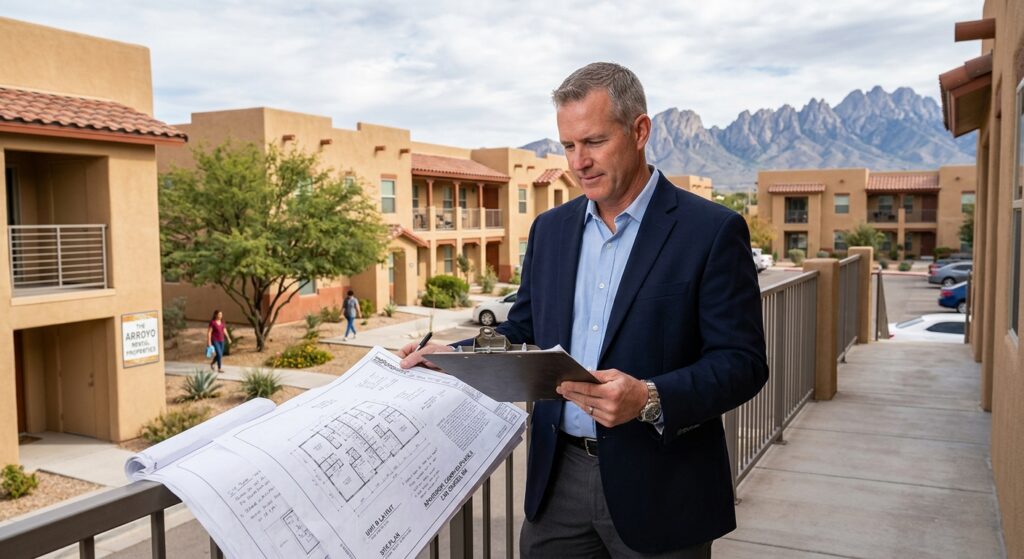
Las Cruces Real Estate Professional Status: The Complete 2026 Tax Guide for New Mexico Investors

Las Cruces Real Estate Professional Status: The Complete 2026 Tax Guide for New Mexico Investors
As a real estate investor in Las Cruces, understanding how to qualify for Las Cruces real estate professional status could transform your 2026 tax obligations dramatically. For the 2026 tax year, meeting the IRS’s strict material participation requirements allows you to deduct real estate losses against your other income sources, a benefit worth thousands in tax savings annually.
Key Takeaways
- Real estate professional status requires 750+ hours annually in real estate activities per IRC Section 469.
- For 2026, qualifying professionals can deduct passive activity losses directly against other income.
- Las Cruces investors must document all hours meticulously and maintain contemporaneous records.
- New Mexico offers state-level tax advantages for real estate professionals managing portfolios strategically.
- Professional status planning for 2026 requires coordination with your CPA to maximize deductions.
Table of Contents
- What Is Real Estate Professional Status?
- The 750-Hour Material Participation Requirement
- How Passive Loss Deductions Transform Your 2026 Taxes
- Documentation and Record-Keeping Essentials
- What Activities Count Toward Your 750 Hours
- Las Cruces Market Advantages for Real Estate Professionals
- Uncle Kam in Action: New Mexico Portfolio Optimization
- Next Steps
- Frequently Asked Questions
- Related Resources
What Is Real Estate Professional Status?
Quick Answer: Real estate professional status is an IRS designation that allows you to treat real estate rental activities as active instead of passive, enabling direct deduction of losses against your other income sources for the 2026 tax year.
Under IRC Section 469, the IRS classifies income and losses as either active or passive. Most rental real estate is considered passive activity. However, if you qualify as a real estate professional, your rental real estate activities become active business activities, which unlocks significant tax advantages for 2026 investors in Las Cruces.
This distinction matters enormously. While ordinary investors can only deduct up to $25,000 in passive real estate losses annually (with phase-out limitations), real estate professionals can deduct unlimited passive real estate losses against any other income source. For a Las Cruces investor with substantial W-2 income or business profits, this means potential savings of thousands per year on your 2026 tax return.
Why Real Estate Professional Status Matters for 2026
The difference between passive and active treatment can be transformational. Consider a Las Cruces investor with $150,000 in rental losses. Without professional status, they can only deduct $25,000, with the remaining $125,000 suspended indefinitely. With professional status, they can deduct the entire $150,000 against their W-2 income for 2026, potentially saving 24-37% in federal income taxes depending on their marginal bracket.
IRS Definition and Legal Framework
The IRS has established strict criteria in IRC Section 469(c)(7) and Treasury Regulations Section 1.469-9 for real estate professional status. You must meet two fundamental requirements: (1) more than half your personal services during the tax year are rendered to real property businesses, and (2) you materially participate in real estate activities. These requirements have been codified since 1986 and remain unchanged for 2026.
The 750-Hour Material Participation Requirement
Quick Answer: For 2026, you must log 750+ hours annually in your real estate professional activities. This is the most commonly used and easiest to prove test for material participation under IRS guidelines.
The 750-hour threshold is the cornerstone of real estate professional status for most Las Cruces investors. This requirement translates to approximately 14-15 hours per week throughout the year, which is achievable for active real estate professionals. The IRS uses this specific threshold because it demonstrates a meaningful investment of personal effort in the business.
For 2026, you cannot simply estimate or round these hours. The IRS expects contemporaneous documentation-that means records created at the time the work is performed, not reconstructed months later during tax preparation. This is critical for surviving an audit.
Breaking Down the 750 Hours
For Las Cruces investors managing multiple properties, the hours accumulate quickly. Here’s a realistic breakdown of activities that count toward your 750 hours for the 2026 tax year:
- Actively managing rental properties: 200-300 hours annually
- Tenant screening, background checks, lease negotiations: 100-150 hours
- Maintenance coordination, contractor hiring, property inspections: 150-200 hours
- Accounting, record-keeping, bookkeeping for rentals: 100-150 hours
- Tax planning and compliance consultation: 50-100 hours
Alternative Material Participation Tests
The IRS offers other material participation tests as alternatives to the 750-hour requirement. For 2026, you can qualify under these tests instead: (1) you materially participated for any 5 of the past 10 years, (2) the activity was a significant participation activity (100+ hours) for 5 of the past 10 years, or (3) you participated 100+ hours and no one else participated more than you. However, the 750-hour test remains the most straightforward for Las Cruces real estate professionals.
How Passive Loss Deductions Transform Your 2026 Taxes
Quick Answer: Once you achieve professional status for 2026, unlimited passive real estate losses become directly deductible against all your income sources, not just passive income.
The transformational benefit of real estate professional status emerges when your rental operations produce losses. Depreciation, maintenance, property taxes, insurance, and mortgage interest often exceed rental income, especially in the early years of property ownership. For ordinary investors in 2026, these losses are trapped by the passive activity rules-only $25,000 can offset ordinary income (with phase-out for higher earners).
Real estate professionals bypass these limitations entirely. Your rental losses flow directly to your Form 1040, offsetting your W-2 wages, business income, and capital gains with no limitations. For a Las Cruces investor with $200,000 in W-2 income and $80,000 in rental losses, achieving professional status for 2026 could generate tax savings exceeding $20,000-$25,000.
Understanding Depreciation Benefits
Depreciation is often the largest component of rental real estate losses. The IRS allows you to deduct the theoretical wear-and-tear on rental buildings over 27.5 years for residential property. For a Las Cruces rental property purchased at $300,000 (with $250,000 attributable to the building), depreciation deductions equal approximately $9,091 annually-a non-cash deduction that reduces your taxable rental income without any actual cash outlay.
When you achieve real estate professional status for 2026, depreciation flows through without limitation. For ordinary investors, the depreciation would be suspended if overall losses exceed $25,000. As a professional, you capture the full benefit.
The Tax Bracket Advantage
Real estate losses offset income at your marginal tax rate. For 2026, if you’re in the 32% federal tax bracket (combined federal and state approximately 37-40 percent), each dollar of deductible real estate loss saves you $0.37-$0.40 in taxes. This multiplier effect makes professional status planning essential for high-income Las Cruces investors.
Documentation and Record-Keeping Essentials
 Free Tax Write-Off Finder
Quick Answer: For 2026, maintain daily logs, property inspection reports, contractor invoices, and time tracking records. Contemporaneous documentation is non-negotiable-the IRS expects proof created during the year, not reconstruction.
This is where many Las Cruces real estate professionals stumble. The IRS doesn’t merely want evidence that you worked in real estate; they want proof created contemporaneously with the work. For 2026, inadequate documentation has led to audit adjustments and complete loss of professional status claim.
Creating Audit-Proof Hour Records
Start now for 2026 by implementing a time-tracking system. Digital solutions like Toggl, Harvest, or even a simple spreadsheet updated weekly work well. Your records should include: (1) the date of the activity, (2) the type of activity (property management, tenant screening, repairs, bookkeeping), (3) the duration in minutes/hours, and (4) the property address or reference. For 2026, aim for monthly time totals showing you’re on pace for 750+ hours.
Property inspection photos and dates strengthen your position. When you photograph a Las Cruces rental property for maintenance planning, date-stamp those photos. Contractor invoices, lease documents, and vendor communications all constitute supporting evidence of real estate professional involvement.
Required Forms and Filings
For 2026, you must file Form 8582 (Passive Activity Loss Limitations) with your Form 1040 tax return. This form reports your passive activity losses and claims professional status treatment. Additionally, maintain copies of your time logs, property management records, and contemporaneous business correspondence for seven years-the typical statute of limitations for real estate tax disputes.
What Activities Count Toward Your 750 Hours
Quick Answer: Activities that directly involve managing, maintaining, or acquiring rental properties count. Passive investment monitoring does not.
The IRS distinguishes between active management and passive investment for 2026. Understanding what counts is essential for Las Cruces investors building toward their 750-hour requirement.
| Activity | Counts? | Explanation |
|---|---|---|
| Managing properties directly | YES | Collecting rent, coordinating maintenance, communicating with tenants. |
| Hiring and supervising contractors | YES | Getting bids, negotiating contracts, inspecting work quality. |
| Tenant screening and leasing | YES | Background checks, interviews, lease negotiation and preparation. |
| Property acquisition analysis | YES | Evaluating properties, analyzing financials, due diligence. |
| Bookkeeping and tax planning | YES | Tracking expenses, categorizing income, consulting with CPAs. |
| Simply monitoring property values | NO | Passive oversight of investments without active management. |
| Attending investment seminars | NO | General education doesn’t replace hands-on property management. |
| Hiring property managers to do all work | MAYBE | Supervising the property manager and making major decisions can count. |
Hours That Do NOT Count for 2026
The IRS explicitly excludes certain activities: (1) time spent providing investment advice or analysis on someone else’s properties, (2) time spent investing in property syndications or partnerships where others manage the assets, (3) passive monitoring of publicly available information, and (4) time in family partnerships where you don’t actively manage. For Las Cruces investors, avoid the trap of counting passive real estate syndication hours-those don’t qualify.
Las Cruces Market Advantages for Real Estate Professionals
Quick Answer: Las Cruces offers lower property prices, strong cash flow relative to purchase price, and New Mexico state tax benefits for real estate professionals achieving 2026 status.
Las Cruces presents a unique opportunity for real estate professional status planning. The city’s real estate market characteristics align perfectly with the 2026 tax strategy considerations. With median home prices significantly lower than national averages and strong rental demand from the university community and military presence at White Sands Missile Range, Las Cruces investors can achieve 750+ hours managing multiple properties while generating substantial rental losses through depreciation.
New Mexico State Tax Considerations
New Mexico imposes a 4.7 percent-5.9 percent state income tax. When you achieve real estate professional status for 2026, you save both federal and state taxes through deductible rental losses. This compounding effect makes New Mexico residence favorable for real estate professionals compared to higher-tax states like California or New York.
Strategic Advantage for Portfolio Growth
For 2026, Las Cruces investors can build larger portfolios without triggering excessive passive loss phase-out rules. A Las Cruces real estate investor achieving professional status with 10-15 properties can deduct accumulated losses that would otherwise be trapped. This accelerates wealth building because tax savings can be reinvested into additional acquisitions.
Pro Tip: Las Cruces investors should coordinate their professional status planning with their tax advisor before year-end for 2026. Some investors benefit from deferring professional status claim until a year with extraordinary property acquisitions or major renovations creating larger deductible losses.
Uncle Kam in Action: New Mexico Portfolio Optimization
Meet Marcus, a Las Cruces business owner with $350,000 in annual business income from his construction company. Marcus had acquired five rental properties over four years, generating approximately $85,000 in rental losses annually through mortgage interest, property taxes, insurance, maintenance, and depreciation. For years, he could only deduct $25,000 of these losses due to passive activity limitations, with $60,000 suspended indefinitely.
In 2025, Marcus engaged Uncle Kam to evaluate his potential for real estate professional status for 2026. We documented that Marcus spent 30+ hours weekly on property management: screening tenants, coordinating repairs, inspecting properties, managing contractors, handling bookkeeping, and planning acquisitions. He easily exceeded the 750-hour threshold.
The Tax Strategy: For 2026, we filed Marcus’s return claiming real estate professional status with supporting contemporaneous documentation of his 780+ hours. His $85,000 in rental losses flowed directly against his business income.
The Results: Marcus’s 2026 taxable income dropped from $350,000 to $265,000. At his 32 percent combined federal and state tax bracket, this generated $27,200 in tax savings on his 2026 return. Additionally, the suspended passive losses from prior years could now be claimed on amended returns (2023 and forward), generating an additional $13,000 in refunds across three prior-year returns.
Fee and ROI: Marcus invested $2,400 in tax planning and compliance services with Uncle Kam. His first-year tax savings of $27,200 plus amended return refunds of $13,000 totaled $40,200 in tax relief. This represents a 1,675 percent return on his tax planning investment, with continued annual savings as long as his professional status is maintained.
Next Steps
Real estate professional status for 2026 requires planning, documentation, and expert guidance. Start by reviewing your current real estate activities and documenting your time commitment. Contact a Las Cruces tax advisor to evaluate your 2026 situation. Schedule a comprehensive tax planning consultation before December 31 to implement proper record-keeping for the remainder of the year. Consider whether your spouse should also claim professional status based on their activities. Finally, work with your CPA on entity structuring to ensure your professional status claim is properly documented and defensible during IRS examination.
Frequently Asked Questions
Can I claim real estate professional status with just two rental properties?
Yes, if you work 750+ hours managing those two properties. The number of properties doesn’t matter-it’s the time investment. A Las Cruces investor with two large multifamily buildings requiring substantial management could easily achieve 750+ hours while someone with six single-family homes managed by a property manager might struggle. The hours must be substantial and documented.
What if my spouse is retired? Can they claim professional status?
Absolutely. Your spouse’s professional status is separate from yours. If your spouse actively manages the Las Cruces properties and logs 750+ hours, they can claim professional status independently. This can be strategic for couples where one spouse is retired and has time for hands-on management while the other works a W-2 job. Both spouses can claim professional status on the same rental properties.
How long must I maintain professional status once claimed for 2026?
Once you claim professional status, you must meet the requirements every year to maintain that status for subsequent years. However, the 750-hour requirement resets annually-your 2026 hours don’t carry forward. You must document 750+ hours in 2027 to maintain professional status for that year. Many investors find this sustainable once systems are in place.
Can I use a property manager and still claim 750 hours?
Yes, but you must actively supervise the property manager and make major decisions. Time spent managing the property manager counts-reviewing reports, approving capital expenditures, addressing tenant complaints. However, time the property manager works does not count toward your 750 hours. You need to document your active involvement with supervisory decisions.
What happens if I’m audited and lack adequate documentation?
The IRS will disallow your professional status claim entirely. All your passive losses will be reclassified and subject to the $25,000 annual limitation. For years with losses exceeding this amount, you’ll owe significant back taxes, interest, and potentially accuracy-related penalties. The IRS takes documentation very seriously-reconstructed time logs created during an audit carry little weight. This is why contemporaneous record-keeping is essential.
Do hours spent learning about real estate investment count?
No. Time spent reading real estate books, attending seminars, or studying market conditions does not count. The hours must be spent directly managing, maintaining, acquiring, or improving real property. For Las Cruces investors, consulting with your CPA about tax implications counts as direct involvement in your business, but general investment education does not.
Should I operate my Las Cruces rentals as an LLC or sole proprietorship for professional status?
The entity structure doesn’t determine professional status-your personal activities do. An LLC, sole proprietorship, partnership, or S-Corp can all qualify. However, entity choice affects other tax considerations. Some investors use LLCs for liability protection, though there’s no tax advantage specifically for professional status. Consult with an entity structuring specialist to optimize your specific situation.
Related Resources
- Real Estate Investor Tax Strategies & Planning
- Comprehensive Tax Strategy Planning Services
- Las Cruces New Mexico Tax Preparation & Advisory
- LLC, S-Corp, & Entity Structure Optimization
- Expert Tax Advisory & Ongoing Tax Planning
Last updated: April, 2026

