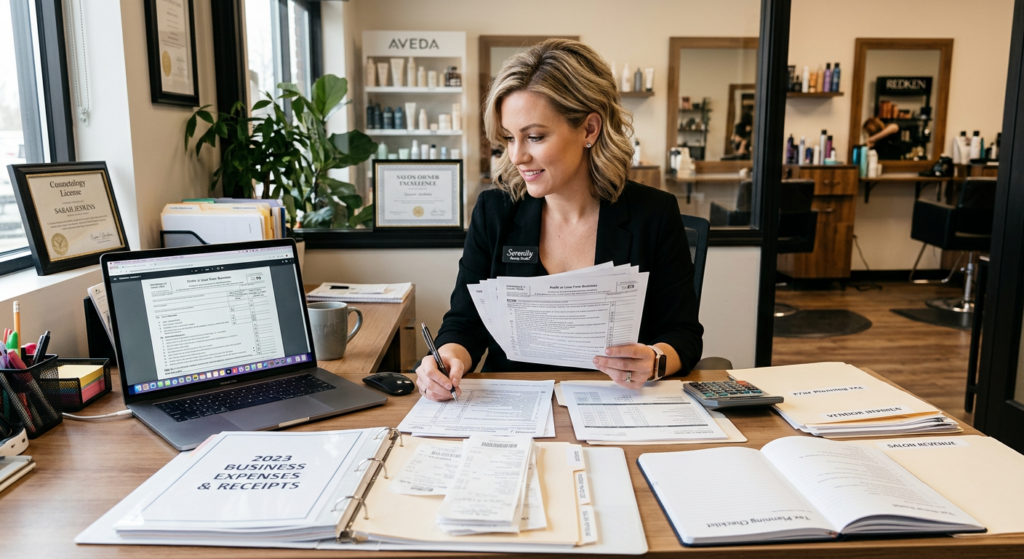
Is Cosmetology License Renewal, CEUs & Hair Shows Tax Deductible in 2026? Complete Guide for Beauty Professionals
For self-employed cosmetologists, salon owners, and independent beauty professionals, understanding what business expenses are tax deductible is essential to maximizing your 2026 tax savings. The critical question many beauty professionals ask is: “Are cosmetology license renewal, CEUs, and hair shows tax deductible?” The answer is yes—when properly documented and directly related to your professional trade. This comprehensive guide explores whether cosmetology license renewal, CEUs & hair shows are tax deductible and how to leverage these deductions for maximum tax efficiency. Under the One Big Beautiful Act of 2025, self-employed beauty professionals now benefit from a permanent 20% Qualified Business Income (QBI) deduction, enhanced bonus depreciation, and expanded business deduction opportunities for the 2026 tax year.
Key Takeaways
- Cosmetology license renewal fees are tax deductible business expenses on Schedule C for self-employed professionals
- Continuing education units (CEUs) required for license renewal are fully deductible if directly related to your professional trade
- Hair shows, trade shows, and professional seminars qualify for tax deductions when they provide business-related education or networking
- The permanent 20% QBI deduction under the 2025 tax law provides additional savings for 2026 for eligible self-employed beauty professionals
- Proper documentation and IRS compliance are critical—keep all receipts, registrations, and proof of attendance for deduction verification
Table of Contents
- What Business Expenses Can Beauty Professionals Deduct on Schedule C?
- Is Cosmetology License Renewal Tax Deductible?
- Are Continuing Education Units (CEUs) Tax Deductible for Cosmetologists?
- Can You Deduct Hair Shows and Trade Shows as Business Expenses?
- How to Report Cosmetology Deductions on Your 2026 Tax Return
- Qualified Business Income (QBI) Deduction for Salon Owners and Independent Stylists
- Documentation Requirements: What Records to Keep
- Uncle Kam in Action: Real Salon Owner Success Story
- Next Steps
- Frequently Asked Questions
What Business Expenses Can Beauty Professionals Deduct on Schedule C?
Quick Answer: Self-employed beauty professionals can deduct ordinary and necessary business expenses on Schedule C. These include salon supplies, equipment, professional services, continuing education directly related to your trade, license renewal fees, and industry-specific training expenses like hair shows and seminars.
For the 2026 tax year, the IRS defines deductible business expenses as ordinary and necessary costs you pay to operate your beauty business. Unlike employees who claim the standard deduction, self-employed cosmetologists, salon owners, and independent stylists file Schedule C (Form 1040) to report their business income and expenses. This schedule is where you claim all professional deductions that reduce your taxable business income.
According to current IRS guidance for 2026, ordinary and necessary business expenses include direct costs to maintain your professional license and operate your beauty business. However, it’s important to note that as of March 2026, the IRS is still clarifying certain deduction rules through updated Form 1040 instructions. For example, the tips deduction for service industry workers was recently updated with new qualifying elements for self-employed filers. This means guidance continues to evolve, and you should stay informed about any updates affecting your specific situation.
Understanding Schedule C and Business Deduction Basics
Schedule C is the IRS form where self-employed individuals report gross business income and subtract allowable business expenses. Your net profit (income minus deductions) is then subject to the 15.3% self-employment tax. However, you’re also eligible for a deduction of approximately 92% of your self-employment tax, which effectively reduces your taxable income. Additionally, the permanent 20% Qualified Business Income (QBI) deduction available for 2026 allows eligible self-employed professionals to deduct up to 20% of their qualified business income, providing substantial tax relief.
The more legitimate business expenses you can document and deduct on Schedule C, the lower your net profit, self-employment tax, and overall income tax liability. This is why understanding which expenses are deductible—specifically professional development costs like license renewal, CEUs, and trade show attendance—is critically important for tax planning in 2026.
Pro Tip: Many beauty professionals underestimate how many expenses are deductible. A salon owner in Nashville calculated deductions for supplies, equipment, continuing education, and professional development. Using our Small Business Tax Calculator for Nashville, she discovered she could reduce her taxable income by $18,000 annually through proper documentation and claiming all qualifying business expenses.
Common Deductible Business Expenses for Beauty Professionals in 2026
- Professional salon supplies (shampoo, conditioner, dyes, styling products)
- Equipment and tools (scissors, blow dryers, styling stations, salon furniture)
- Equipment maintenance and repairs
- Professional liability insurance
- Salon rent and utilities (or portion if home-based)
- Continuing education and professional training
- Professional association memberships
- Marketing and advertising expenses
- Office supplies and bookkeeping expenses
- Business licenses and permits
Is Cosmetology License Renewal Tax Deductible?
Quick Answer: Yes. Cosmetology license renewal fees are fully tax deductible as ordinary and necessary business expenses for self-employed professionals. These fees are required to legally operate your beauty business, making them a clear and defensible deduction on Schedule C.
Cosmetology license renewal fees are among the most straightforward deductions available to beauty professionals. Unlike some gray-area expenses that require interpretation, license renewal is universally recognized by the IRS as an ordinary and necessary business expense. A professional license is required to legally work as a cosmetologist, and the cost to renew that license is a direct expense of maintaining your ability to conduct business.
The specific renewal cost varies by state. Some states charge $200 every two years, while others may charge $500 or more annually. Regardless of your location, the full amount of your license renewal fee is deductible on Schedule C. There is no partial deduction or phase-out—if it’s a legitimate license renewal expense, you can deduct it in full.
How to Document License Renewal Deductions
To claim your cosmetology license renewal fee as a deduction, keep your renewal receipt or confirmation from your state board of cosmetology. The IRS requires documentation showing the license name, date, amount paid, and the license type. Many states provide digital receipts when you renew online. If you renewed in person or by mail, keep the original receipt and any correspondence confirming your renewal was processed.
Record the expense on Schedule C as a professional service or business license expense. Some beauty professionals track all license and permit expenses under one line item for simplicity. The key is consistency—use the same categorization year after year so your tax preparer and the IRS can clearly understand your expense structure.
 Free Tax Write-Off Finder
Are Continuing Education Units (CEUs) Tax Deductible for Cosmetologists?
Quick Answer: Yes, continuing education units (CEUs) required for cosmetology license renewal are tax deductible when they are directly related to your professional trade. This includes courses, workshops, and certifications needed to maintain your license and stay current in your field.
The IRS recognizes that professionals must maintain and improve their skills to remain competitive and compliant with industry standards. For cosmetologists, continuing education is often legally required for license renewal. Most states mandate a specific number of CEU hours every two years or annually. These required CEUs are unquestionably deductible because they are mandatory to maintain your professional license.
Beyond required CEUs, many cosmetologists pursue additional training in specialized techniques like color theory, advanced styling, barbering, nail art, esthetics, or management. These optional courses are also deductible if they are directly related to your current trade or business. The IRS distinguishes between education that prepares you for a new profession (non-deductible) and education that maintains or improves your skills in your current profession (deductible).
What Types of Cosmetology CEU Programs Are Deductible?
- Required CEU courses mandated by your state board for license renewal
- Specialized technique courses (color theory, hair cutting, advanced styling)
- Product-specific training from professional brands
- Salon management and business skills courses
- Chemical safety and health compliance training
- Online cosmetology education programs and platforms
- Professional development seminars and workshops
Documenting CEU Expenses for Tax Deduction
Keep receipts for all CEU courses including course name, provider, cost, and date completed. If your course includes both materials and instruction, itemize this breakdown. Many cosmetology schools and online platforms provide certificates of completion—save these as documentation. Additionally, maintain records of any CEU hours fulfilled through your state board, which typically provides digital transcripts showing courses and hours completed.
For budgeting purposes, estimate your annual CEU costs. Most states require 10-20 hours of continuing education annually, costing between $200-$800 depending on course type and provider. Online courses tend to be less expensive than in-person training.
Can You Deduct Hair Shows and Trade Shows as Business Expenses?
Quick Answer: Yes. Hair shows, trade shows, and professional seminars are tax deductible when they provide business-related education, networking, or product information directly applicable to your cosmetology trade. Registration fees, travel, meals, and lodging are deductible business expenses.
Hair shows and industry trade shows are excellent opportunities for beauty professionals to learn new techniques, discover new products, network with colleagues, and stay informed about industry trends. The good news is that these events qualify as deductible business expenses when they meet IRS requirements. For a hair show or trade show to be deductible, it must be directly related to your cosmetology business and provide education or networking benefits that improve your skills or business knowledge.
Major beauty industry events like international hair shows, salon expos, and professional conventions are clearly business-related and deductible. These events typically feature workshops, product demonstrations, technique showcases, and networking opportunities with other beauty professionals and product manufacturers. Many salon owners budget $2,000-$5,000 annually for attending one or two major industry events, and these costs are fully deductible.
Deductible Hair Show and Trade Show Expenses
When you attend a hair show or industry trade show, several categories of expenses are deductible:
- Registration fees – The admission cost to attend the show or event
- Travel expenses – Airfare, train, or car rental to reach the event
- Lodging – Hotel costs for the nights you’re attending the show (fully deductible)
- Meals – 50% of meal costs during business travel (per IRS rules for 2026)
- Ground transportation – Uber, taxi, rental car parking, or shuttle services at the event location
- Materials purchased – Educational materials, books, or handouts provided at the show
- Samples and products – Professional samples you purchase to learn about new products
Documentation Requirements for Hair Show Deductions
To defend your hair show deductions in an IRS audit, maintain detailed records. Keep the event registration confirmation showing the event name, date, location, and cost. Save your receipt and credit card statement showing payment. For travel, keep airline tickets or reservation confirmations, hotel receipts, car rental agreements, and parking receipts. For meal expenses, keep receipts showing the date, location, and amount spent. Take photos or notes documenting the educational content—note which workshops you attended, what techniques you learned, or which new products you discovered.
The IRS requires that business travel be away from your home for a substantial period. Attending a one-day local hair show might not qualify if you live in the same city. However, if you travel out of town to attend a multi-day beauty industry event, all documented expenses are deductible. When in doubt about the legitimacy of an expense, discuss it with your tax professional before claiming it.
How to Report Cosmetology Deductions on Your 2026 Tax Return
Quick Answer: Report all cosmetology business deductions on Schedule C (Form 1040) for the 2026 tax year. The filing deadline is April 15, 2026. Categorize expenses as supplies, professional services, utilities, or other business expenses depending on their nature.
The filing deadline for individual tax returns, including Schedule C for self-employed cosmetologists, is April 15, 2026. This applies whether you’re an independent contractor, sole proprietor, or partner in a salon business. If you need more time, you can request a six-month extension, but any taxes owed must still be paid by April 15 to avoid penalties and interest.
Using Schedule C to Report Business Expenses
Schedule C is the primary form for reporting self-employed business income and expenses. The form has specific line items for different expense categories. License renewal fees, supplies, and professional services would typically fall under “Office expense,” “Professional services,” or “Other expenses” depending on the nature of the cost.
Create a spreadsheet or use accounting software to track all business expenses throughout the year. Organize expenses by category (supplies, education, travel, equipment, etc.) so you can easily transfer totals to Schedule C. This organization makes tax preparation faster and reduces errors. Many beauty professionals use online accounting platforms like QuickBooks Self-Employed or Wave to track expenses automatically throughout the year.
Pro Tip: Use a dedicated business credit card or bank account to separate business expenses from personal spending. This makes expense tracking effortless and provides clear documentation for the IRS. At year-end, simply review your business account statements to verify all expenses claimed on Schedule C.
Qualified Business Income (QBI) Deduction for Salon Owners and Independent StylistsQuick Answer: The 20% Qualified Business Income (QBI) deduction is now permanent for 2026 under the One Big Beautiful Act of 2025. Eligible self-employed cosmetologists and salon owners can deduct up to 20% of their qualified business income, providing substantial additional tax relief beyond standard business expense deductions.
Quick Answer: The 20% Qualified Business Income (QBI) deduction is now permanent for 2026 under the One Big Beautiful Act of 2025. Eligible self-employed cosmetologists and salon owners can deduct up to 20% of their qualified business income, providing substantial additional tax relief beyond standard business expense deductions.
One of the most significant tax benefits for self-employed beauty professionals in 2026 is the permanent 20% Qualified Business Income (QBI) deduction. This deduction was established in 2017 and was originally set to expire after 2025. However, the One Big Beautiful Act of 2025 made this deduction permanent, removing the sunset clause that had previously created tax planning uncertainty for small business owners and self-employed professionals.
What does this mean for you? If you’re a self-employed cosmetologist with $50,000 in net business income after all deductions, you can deduct 20% of that income ($10,000) from your taxable income. In the 24% tax bracket, this provides $2,400 in tax savings. For salon owners with higher net income, the savings are even more substantial. This deduction applies to all types of pass-through businesses, including sole proprietorships, S corporations, partnerships, and LLCs.
How the QBI Deduction Works for Beauty Professionals
The QBI deduction is calculated on Form 8995 (Qualified Business Income Deduction Simplified Computation) or Form 8995-A (for higher-income earners). Your tax preparer will calculate your QBI deduction, but here’s the basic concept:
Your net business income (total revenue minus all business expenses including the deductible portion of self-employment tax) is multiplied by 20%. This result is your QBI deduction. The deduction cannot exceed the lesser of: (1) your QBI deduction calculated above, or (2) 20% of your taxable income before the QBI deduction.
For example, a salon owner with $100,000 in net business income can claim a $20,000 QBI deduction. This reduces her taxable income from $100,000 to $80,000. If she’s in the 24% federal tax bracket, she saves $4,800 in federal income tax from this deduction alone.
Who Qualifies for the QBI Deduction?
Most self-employed cosmetologists and salon owners qualify for the QBI deduction. The deduction is available to sole proprietors, self-employed individuals, S corporation owners, partnership owners, and LLC owners. However, there are income thresholds and restrictions for certain service businesses, and the rules can become complex for higher-income earners. A tax professional can determine your specific eligibility and calculate your maximum allowable deduction for 2026.
Documentation Requirements: What Records to Keep
Quick Answer: Keep all receipts, invoices, credit card statements, and proof of payment for every business expense claimed on Schedule C. The IRS requires documentation to substantiate deductions, and you must maintain records for at least three years (six if unreported income exceeds 25%).
Proper documentation is essential for defending your deductions in an IRS audit. The IRS requires contemporaneous written substantiation for business expenses—meaning you need to have documentation created at or near the time of the expense, not reconstructed after the fact. For cosmetology license renewal, CEUs, and hair show attendance, maintain these specific records:
| Expense Type | Documentation to Keep |
|---|---|
| License Renewal | State board renewal receipt, digital confirmation, original or copy of renewed license |
| CEU Courses | Course registration confirmation, receipt, certificate of completion, course syllabus |
| Hair Shows/Trade Shows | Event registration confirmation, admission receipt, travel receipts, hotel invoice, meal receipts, event program |
| Supplies & Equipment | Itemized receipts, invoices, credit card statements, proof of business use |
| Travel Expenses | Airfare receipts, rental car agreements, parking receipts, hotel invoices, meal receipts with business purpose noted |
Record Retention Timeline
The IRS typically has three years from your tax filing date to initiate an audit. To be safe, maintain all business expense documentation for at least three years after filing your return. However, if your income is substantially underreported (more than 25%), the IRS can audit back six years. Additionally, if you claim significant business expenses and later face questions, having comprehensive documentation going back five to seven years strengthens your position.
Digital organization is increasingly important. Scan receipts into cloud storage, photograph handwritten records, and maintain digital copies of email confirmations and online registrations. This ensures you have accessible backup documentation if original receipts are lost or damaged.

Uncle Kam in Action: Real Salon Owner Success Story
Client: Sarah, Independent Salon Owner in Nashville, Tennessee
Sarah owns a three-chair salon in Nashville with annual gross revenue of $185,000. She employs two part-time stylists and works as an independent contractor for her own salon. For years, Sarah tracked basic expenses like rent and supplies but overlooked professional development costs. She attended one annual hair show, took three CEU courses per year, and renewed her license every two years but never thought to deduct these expenses.
When Sarah met with a tax strategist at Uncle Kam, the professional conducted a comprehensive expense audit. Working backwards through three years of credit card statements, Sarah discovered she had spent approximately $4,200 annually on business development expenses she never deducted:
- License renewal every two years: $480
- Three annual CEU courses: $900
- Annual hair show attendance (registration, travel, lodging, meals): $2,000
- Professional association membership: $400
- Online business training course: $420
The Uncle Kam Solution: Sarah’s tax strategist established a comprehensive 2026 expense tracking system. Additionally, she calculated Sarah’s eligibility for the 20% QBI deduction on her business income. With documented business deductions of $4,200 annually and the application of the QBI deduction, Sarah’s tax situation improved dramatically:
- 2026 Tax Filing Strategy: After all business expenses including the documented $4,200 in professional development costs, Sarah’s net business income is $92,000. The 20% QBI deduction yields an additional $18,400 deduction, reducing her taxable income to $73,600.
- Tax Savings Achieved: In Sarah’s 24% federal tax bracket, the combined effect of properly deducting business expenses and claiming the QBI deduction generates approximately $5,300 in annual federal income tax savings.
- Return on Investment: Sarah paid Uncle Kam $1,200 for comprehensive tax planning and return preparation. Her first-year tax savings of $5,300 represents a 442% return on her investment, with continued savings in future years.
- Additional Benefit: Sarah’s reduced net income also lowered her self-employment tax liability by approximately $600, providing additional savings beyond income tax reduction.
Sarah’s story demonstrates the power of comprehensive tax planning. Many small business owners in the beauty industry operate profitably but don’t optimize their tax strategies. By identifying all deductible business expenses and leveraging available credits and deductions, Sarah transformed her tax liability from a burden into a manageable, optimized obligation. She now maintains detailed records of all professional development expenses, making future tax preparation faster and more accurate. View more client success stories from Uncle Kam to see how other business owners have achieved similar results.
Next Steps
Now that you understand which cosmetology expenses are tax deductible, take these actionable steps to optimize your 2026 tax position:
- Audit your current expenses: Review your credit card and bank statements from the past year to identify all professional development expenses you may have missed claiming. Calculate your potential tax savings using our comprehensive tax strategy consultation.
- Organize your documentation: Gather all receipts for license renewal, CEU courses, hair shows, and professional development expenses. Scan documents into digital storage and create a spreadsheet tracking each expense by category and date.
- Establish a tracking system: For 2026 and beyond, use accounting software or spreadsheets to track business expenses in real time. This prevents expenses from being forgotten and ensures you claim everything you’re entitled to deduct.
- Consult a tax professional: Schedule a consultation with a CPA or tax strategist experienced in serving beauty professionals. They can review your specific situation and identify additional optimization opportunities for business owners in your circumstances.
- Plan your 2026 professional development: If you anticipate significant business expansion, plan your education and training investments strategically. These costs are fully deductible, and professional development often provides both immediate business benefits and long-term tax savings.
Frequently Asked Questions
Can I write off my cosmetology license renewal on my taxes?
Yes, completely. Cosmetology license renewal fees are ordinary and necessary business expenses required to legally operate your profession. The entire renewal fee is deductible on Schedule C, regardless of the amount. Keep your renewal receipt or digital confirmation from your state board as documentation.
Are CEU courses for cosmetology license renewal tax deductible?
Yes. Required CEU courses mandated for license renewal are fully deductible. Additionally, optional professional development courses directly related to cosmetology (color theory, advanced cutting, salon management, etc.) are also deductible. The key test is whether the education maintains or improves skills in your current profession (deductible) or prepares you for a new profession (non-deductible). For cosmetology professionals, nearly all beauty industry education qualifies as deductible.
How much can I deduct for attending hair shows and trade shows?
You can deduct all reasonable business expenses associated with attending hair shows and trade shows directly related to your cosmetology business. This includes registration fees, travel, lodging, 50% of meal costs, and ground transportation. There’s no maximum deduction amount—deduct all documented business expenses from the event. Track these expenses carefully and maintain receipts to substantiate the business purpose of your attendance.
What’s the difference between a deduction and a credit for business expenses?
A deduction reduces your taxable income, while a credit reduces your tax liability dollar-for-dollar. For example, a $1,000 business expense deduction reduces your taxable income by $1,000, which saves you approximately $240 in federal tax (if you’re in the 24% bracket). A $1,000 tax credit saves you exactly $1,000 in taxes owed. Business expenses are claimed as deductions on Schedule C, not credits. Understanding this distinction helps you appreciate the value of deductions like the permanent 20% QBI deduction available in 2026.
Do I need to itemize deductions to claim business expenses?
No. Business expenses on Schedule C are claimed separately from personal itemized deductions. Self-employed cosmetologists can claim the standard deduction ($24,500 for single filers in 2026) and also deduct all business expenses on Schedule C. These are two different deductions that work together to reduce your overall tax liability. This is one reason self-employed professionals often have significant tax advantages compared to W-2 employees.
How long must I keep records for business expense deductions?
Keep all business expense documentation for at least three years after filing your tax return. This covers the standard IRS audit period. If you want maximum protection, maintain records for five to seven years. For items purchased with significant depreciation (equipment, tools, furniture), keep records longer. The cost of storing digital copies is minimal, so there’s no harm in maintaining comprehensive records indefinitely.
Can salon employees deduct their own continuing education costs?
Generally, W-2 employees cannot deduct personal professional development expenses. The salon owner can deduct employee training costs as a business expense. However, if you’re an independent contractor (1099 employee) with your own business, you can deduct your CEU costs. Understanding your employment classification is crucial for tax planning. If you’re classified as a W-2 employee but function as an independent contractor, discuss potential reclassification with a tax professional—it could significantly impact your tax situation.
What’s the new 20% QBI deduction and who qualifies in 2026?
The 20% Qualified Business Income (QBI) deduction allows eligible self-employed professionals and business owners to deduct up to 20% of their net business income. This deduction is now permanent for 2026 and beyond, thanks to the One Big Beautiful Act of 2025. Most cosmetologists, salon owners, and independent beauty professionals qualify. The deduction is calculated on Form 8995 and can provide substantial tax savings. For a salon owner with $100,000 in net income, the QBI deduction could save $4,800 in federal taxes (if in the 24% bracket).
This information is current as of 3/10/2026. Tax laws change frequently. Verify updates with the IRS or a tax professional if reading this later in the year.
Last updated: March, 2026

