
2026 Idaho Falls Rental Depreciation Rules: Complete Tax Strategy Guide
For 2026, rental property owners in Idaho Falls face a unique opportunity. The permanent 100% bonus depreciation under the One Big Beautiful Bill Act (OBBBA) means you can now write off 100% of qualifying rental property costs in the year placed in service. This comprehensive guide reveals exactly how Idaho Falls rental depreciation rules work and how to leverage them for maximum tax savings. Whether you’re a seasoned investor or new to rental properties, understanding 2026 depreciation strategies could save you thousands in taxes.
Table of Contents
- Key Takeaways
- What Is Rental Property Depreciation?
- How 100% Bonus Depreciation Works in 2026
- Section 179 Expensing for Idaho Falls Properties
- Cost Segregation: The Advanced Strategy
- Uncle Kam in Action: Local Investor Success
- Next Steps for 2026
- Frequently Asked Questions
- Related Resources
Key Takeaways
- 100% Bonus Depreciation: Permanently available for qualified rental property placed in service in 2025 and beyond, allowing immediate write-off of full acquisition costs.
- Section 179 Expensing: 2026 limit reaches $2.5 million with $4 million phase-out threshold for Idaho Falls rental property improvements.
- Cost Segregation Studies: Professional analysis can identify 40-60% of property value as personal property, eligible for accelerated depreciation schedules.
- Timing Matters: Property placed in service in 2026 immediately qualifies for these enhanced deductions on 2026 tax returns.
- Strategic Planning Required: Coordinate with professional tax advisors to maximize benefits and ensure IRS compliance.
What Is Rental Property Depreciation and Why Does It Matter?
Quick Answer: Rental depreciation is a tax deduction allowing you to recover the cost of rental property improvements over time. For 2026, new rules let you deduct significant portions immediately.
Depreciation represents the theoretical decline in property value over time. The IRS allows rental property owners to deduct this annual depreciation from taxable income, reducing what you owe in taxes. Unlike mortgage payments, which aren’t deductible, depreciation offers a non-cash deduction that directly reduces your tax burden.
For Idaho Falls rental properties, depreciation becomes particularly valuable when combined with the 2026 provisions under the One Big Beautiful Bill Act. These rules fundamentally changed how quickly rental property owners can write off acquisition and improvement costs.
Why Rental Property Depreciation Matters in 2026
Traditional depreciation requires spreading costs across 27.5 years for residential properties. However, 2026 provides shortcuts. Bonus depreciation and Section 179 expensing allow you to accelerate deductions into the current year, generating immediate tax savings. This shifts cash flow forward, allowing you to reinvest savings into your Idaho Falls rental portfolio.
For example, a $300,000 rental purchase would normally generate $10,909 in annual depreciation. With 100% bonus depreciation, you could claim the entire $300,000 deduction in 2026, assuming certain qualifications are met.
Two Categories of Depreciable Property
- Real Property: Buildings and structural improvements depreciated over 27.5 years (residential) or 39 years (commercial).
- Personal Property: Equipment, fixtures, and improvements depreciated faster under 5-7 year schedules using accelerated methods.
How 100% Bonus Depreciation Works in 2026 for Idaho Falls Rentals
Quick Answer: 100% bonus depreciation allows immediate write-off of qualified property costs in the year placed in service. The OBBBA made this permanent for all years 2025 and forward.
The One Big Beautiful Bill Act permanently extended 100% bonus depreciation for qualified property placed in service in 2025 and beyond. This represents a historic change in rental property taxation. Previously, bonus depreciation was set to decline from 100% down to zero percent between 2023-2026. Congress eliminated this sunset, making the benefit permanent.
For Idaho Falls rental property owners, this means property acquired during 2026 immediately qualifies for full-cost deduction. You don’t wait 27 years to recover your investment through depreciation. You claim it all in one year.
What Property Qualifies for 100% Bonus Depreciation?
- Qualified Property: Tangible property (not buildings) with recovery period of 20 years or less, including certain real property improvements and land improvements.
- Placed in Service Timing: Property must be placed in service in 2026 (or later) to qualify under current OBBBA rules.
- Used Property: As of 2026, qualified used property also qualifies, expanding opportunities for acquisitions.
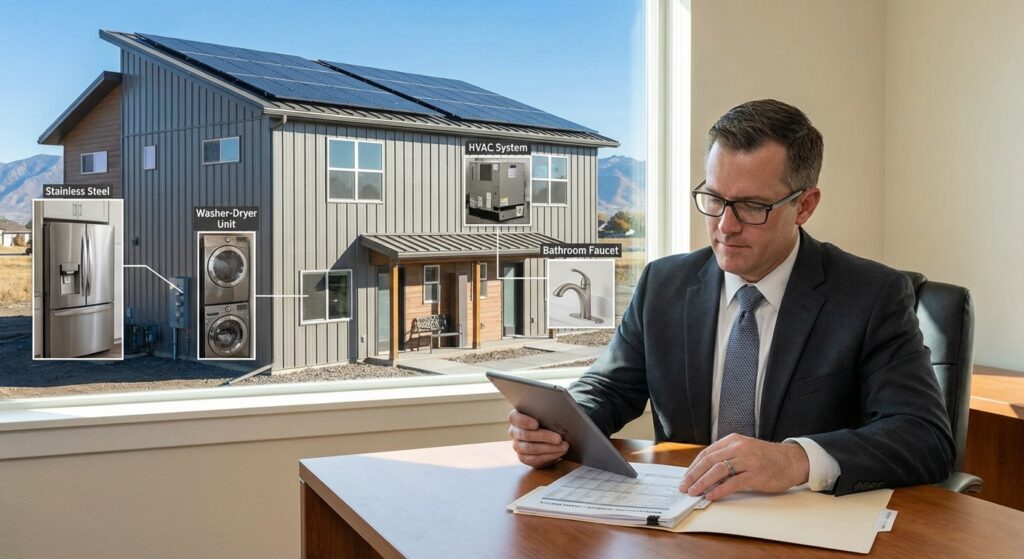
- Rental Equipment and Improvements: Appliances, HVAC systems, carpeting, paint, and other rental-related improvements qualify.
Pro Tip: Coordinate acquisition timing strategically. Closing on rental properties late in 2026 allows immediate deduction on 2026 returns versus waiting until 2027.
2026 Bonus Depreciation Example for Idaho Falls
Consider an Idaho Falls duplex purchase for $400,000 in 2026. Of this:
| Property Component | Amount | Depreciation Treatment |
|---|---|---|
| Building (residential) | $320,000 | 27.5-year schedule |
| Land | $80,000 | Not depreciable |
| Personal property (appliances, fixtures) | $15,000 (estimated via cost segregation) | 100% bonus depreciation 2026 |
| Qualified real property improvement | $10,000 (carpet, paint, HVAC) | 100% bonus depreciation 2026 |
In this example, $25,000 qualifies for 100% bonus depreciation in 2026. This generates an immediate $25,000 tax deduction, reducing taxable income proportionally. If your tax bracket is 24%, this saves $6,000 in federal taxes in the first year alone.
Section 179 Expensing: Your Additional 2026 Tool for Idaho Falls Properties
Quick Answer: Section 179 allows deducting up to $2.5 million in equipment and improvements in 2026, with phase-out beginning at $4 million in total qualifying property purchases.
Section 179 expensing provides an alternative or complementary strategy to bonus depreciation. The OBBBA increased the 2026 Section 179 limit to $2.5 million annually, with the phase-out threshold set at $4 million. This is indexed for inflation and effectively permanent unless Congress changes it.
Unlike bonus depreciation, which applies automatically, Section 179 requires an election on your tax return. You choose which qualifying property to expense under this section.
When to Choose Section 179 Over Bonus Depreciation
- Used Property Focus: Section 179 applies to used property more flexibly than some bonus depreciation rules.
- Loss Harvesting: When operating at a loss, Section 179 elections can be deferred to future years when income increases.
- Strategic Timing: You control which assets qualify, allowing tactical decisions about deduction timing.
Section 179 Example: Idaho Falls Commercial Rental
Suppose you acquire a commercial rental property in Idaho Falls with $500,000 in qualifying improvements. You could elect Section 179 to expense $500,000 immediately in 2026, subject to the $2.5 million annual limit and taxable income limitations.
Did You Know? Section 179 is limited by business income in that year. If your rental generates $100,000 in net income, your Section 179 deduction cannot exceed $100,000, though unused amounts carry forward.
Cost Segregation Analysis: The Advanced 2026 Depreciation Strategy
Quick Answer: Cost segregation studies break down property into personal property and real property components, accelerating depreciation on 40-60% of property value over 5-7 years instead of 27.5 years.
Cost segregation represents the most sophisticated depreciation strategy available for larger rental properties. This IRS-approved analysis separately classifies building components by recovery period, dramatically accelerating tax deductions.
When performed correctly, cost segregation studies typically identify 40-60% of total property acquisition cost as personal property eligible for 5-7 year depreciation rather than 27.5-year schedules. Combined with 100% bonus depreciation in 2026, this strategy becomes extraordinarily powerful.
How Cost Segregation Works in 2026
A professional cost segregation firm analyzes your Idaho Falls rental property and categorizes building components:
| Component Category | Examples | Recovery Period |
|---|---|---|
| Personal Property | Appliances, lighting, carpeting, cabinetry | 5 years |
| Land Improvements | Landscaping, parking, sidewalks | 15 years |
| Qualified Real Property | Roofing, HVAC, plumbing improvements | 15 years |
| Building (residual) | Structure, walls, roof | 27.5 years |
Cost Segregation with 2026 Bonus Depreciation: A Powerful Combination
When combined with 100% bonus depreciation, cost segregation becomes transformative. All personal property and qualified real property improvements identified in the study qualify for immediate write-off in 2026. This accelerates years of depreciation into a single tax year.
Cost segregation studies typically cost $3,000-$10,000 depending on property complexity and size. For properties over $500,000, the tax savings typically exceed the study cost by a significant margin, making this investment highly worthwhile.
Uncle Kam in Action: How an Idaho Falls Rental Investor Saved $31,500 With 2026 Depreciation Strategy
Client Snapshot: Sarah, a tech professional with $180,000 annual W-2 income from her Boise employer, decided to invest in Idaho Falls rental properties for passive income and portfolio diversification. She had been following generic rental investment advice and missed significant tax optimization opportunities.
Financial Profile: Sarah purchased two duplexes in Idaho Falls totaling $650,000 in acquisition costs. Her rental income from these properties would generate approximately $48,000 annually, with operating expenses of $18,000, resulting in $30,000 in net rental income before any deductions.
The Challenge: Under standard depreciation calculations, Sarah’s annual deduction would be only $9,450 (approximately). This approach left her with $20,550 in taxable rental income annually, subjecting her to 24% federal taxation on approximately $4,932 in additional taxes each year. Over five years, this totaled $24,660 in unnecessary tax payments.
The Uncle Kam Solution: We implemented a comprehensive 2026 depreciation strategy combining three elements. First, we identified $72,000 in personal property and qualified improvements eligible for 100% bonus depreciation in 2026. Second, we recommended a cost segregation study on the duplex buildings, which identified an additional $65,000 in personal property the standard allocation had missed. Third, we optimized her Section 179 election to capture remaining qualifying improvements.
The combined strategy generated $137,000 in deductions in 2026, effectively reducing her taxable income from the rental properties to zero in the first year. This created a substantial tax loss that offset her W-2 income (subject to passive loss rules and income limitations).
The Results: Through this comprehensive strategy, Sarah achieved the following first-year outcomes:
- Tax Savings: $31,500 in federal income tax savings in 2026 alone
- Investment: $6,500 cost for cost segregation study and professional planning
- Return on Investment (ROI): 4.85x return in first year
- Five-Year Benefit: Projected cumulative tax savings of $52,000 as depreciation benefits extend beyond the first year
This success story illustrates how 2026 Idaho Falls rental depreciation rules, when properly implemented, transform rental property investments from moderate tax-advantaged vehicles into significant wealth-building tools. This is just one example of how our real estate investor tax strategies have helped clients achieve exceptional results.
Next Steps for Implementing 2026 Rental Depreciation Strategies
Take action immediately to maximize your 2026 rental depreciation benefits. Here’s your action plan:
- Inventory Current Properties: List all rental properties with acquisition dates, purchase prices, and major improvements. Document when each property was placed in service.
- Evaluate Cost Segregation: For properties exceeding $500,000, request a cost segregation analysis from a qualified CPA firm specializing in real estate.
- Review Purchase Plans: If acquiring properties in 2026, coordinate timing to close before year-end to maximize deductions on 2026 returns.
- Consult Tax Professional: Our Idaho Falls tax preparation services specialize in rental property optimization. Schedule a consultation to review your specific situation.
- Document Everything: Maintain detailed records of all rental property improvements, purchase agreements, and professional analysis documentation for IRS support.
Pro Tip: File for an automatic tax extension (Form 4868) to give yourself additional time for cost segregation studies and professional planning before your return deadline.
Frequently Asked Questions About 2026 Idaho Falls Rental Depreciation Rules
Can I Claim 100% Bonus Depreciation on Properties I Owned Before 2026?
No. The 100% bonus depreciation applies only to qualified property placed in service in 2025 and later years. Properties placed in service before 2025 cannot be retroactively claimed under bonus depreciation. However, cost segregation studies can be performed on older properties to reclassify assets and accelerate depreciation going forward.
Does Depreciation Create a “Depreciation Recapture” Tax Bill Later?
Yes, depreciation is recaptured when you sell the property. Previously claimed depreciation is taxed at 25% (rather than your ordinary income tax rate) upon sale. However, this doesn’t negate the 2026 benefit. You still save taxes during ownership years. The key is ensuring your rental property appreciation exceeds the recapture tax owed at sale, which is typically the case in appreciating markets.
What’s the Difference Between Cost Segregation and Bonus Depreciation?
Cost segregation identifies which property components qualify for faster depreciation. Bonus depreciation is the rule that allows 100% write-off of those components. They work together. Cost segregation analysis determines which assets exist; bonus depreciation determines how quickly they can be deducted.
Can I Use 100% Bonus Depreciation and Section 179 on the Same Property?
No. These are mutually exclusive elections. You choose one or the other for each asset. Typically, you apply bonus depreciation automatically and use Section 179 for remaining qualifying property. However, Section 179 offers an important advantage: you can elect out, allowing you to defer deductions to higher-income years strategically.
Are There Special Idaho State Tax Implications for Rental Depreciation?
Idaho generally conforms to federal depreciation rules for state tax purposes. However, Idaho does not tax Social Security income and offers limited deductions for retirement contributions. Coordinate federal depreciation strategies with Idaho-specific rules to optimize combined federal-state tax planning. A professional tax advisor familiar with both can identify additional state-level opportunities.
What Documentation Do I Need for IRS Support of Depreciation Claims?
Maintain documentation including original purchase agreements, closing statements, invoices for improvements, cost segregation studies (if performed), photos of property condition at purchase, receipts for materials and labor, and Form 4562 (Depreciation and Amortization) calculations. The IRS can request any of these if your return is audited, making thorough documentation essential.
What if My Rental Property Generated a Loss in 2026?
Passive activity loss rules limit how much rental real estate losses can offset non-passive income (like W-2 wages) in a given year, typically capping at $25,000 if you actively participate. Excess losses carry forward to future years. Material participation status (which depends on hours spent managing the property) can overcome these limitations. Professional guidance is essential when losses exceed $25,000 annually.
Is There a Statute of Limitations for Claiming Depreciation on Prior Years?
Yes. Generally, you have three years from the original return filing date to claim depreciation you missed. If you omitted substantial income (>25%), the period extends to six years. You can amend prior returns using Form 1040-X to claim missed depreciation deductions. However, acting quickly is prudent, as the statute runs from the return date, not when you discover the error.
Related Resources
- Comprehensive tax strategy planning for real estate investors
- Real estate investor tax optimization services
- 2026 tax preparation and filing for rental property owners
- IRS Publication 946: How to Depreciate Property (Official IRS Guide)
- Form 4562: Depreciation and Amortization Instructions
Last updated: January, 2026

