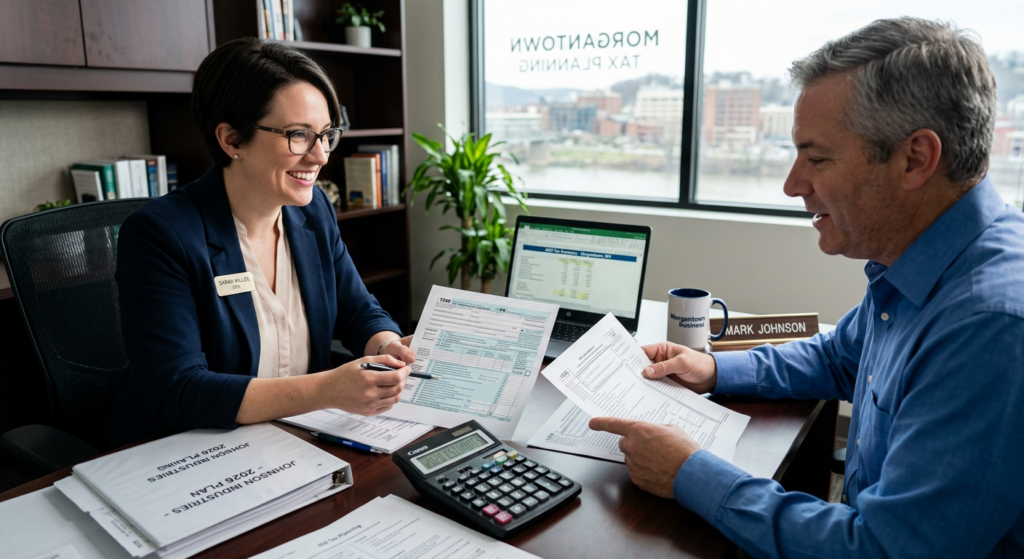
How to Find the Best Morgantown CPA for Your 2026 Tax Strategy


How to Find the Best Morgantown CPA for Your 2026 Tax Strategy
Finding a qualified Morgantown CPA who understands 2026 tax changes is one of the smartest investments you can make as a business owner, real estate investor, or self-employed professional. The tax landscape shifted significantly with the One Big Beautiful Bill Act, introducing new deductions for tips, overtime, and seniors age 65 and older. Your local Morgantown CPA should navigate these changes while identifying opportunities unique to West Virginia tax law. This guide walks you through selecting the right tax professional and maximizing your deductions for 2026.
Table of Contents
- Key Takeaways
- What Changed for the 2026 Tax Year?
- Why Should You Hire a Local Morgantown CPA?
- What Credentials Should Your Morgantown CPA Have?
- How Much Can a Morgantown CPA Save You on Self-Employment Taxes?
- What Deductions Are Business Owners Missing?
- How Can Real Estate Investors Maximize Tax Benefits?
- Uncle Kam in Action: A Morgantown Contractor’s Tax Transformation
- Next Steps
- Frequently Asked Questions
Key Takeaways
- 2026 brings new tax deductions for tips, overtime, and seniors age 65+. A skilled morgantown cpa ensures you claim every eligible benefit.
- Self-employed professionals can reduce self-employment taxes by 15.3% through strategic deductions and entity structuring.
- A qualified morgantown cpa should hold CPA, EA, or enrolled agent credentials and demonstrate local tax expertise.
- Real estate investors can leverage depreciation, cost segregation, and 1031 exchanges to minimize taxable income significantly.
- The standard deduction for 2026 is $32,200 for married couples, $16,100 for singles, and $24,150 for heads of household.
What Changed for the 2026 Tax Year?
Quick Answer: The One Big Beautiful Bill Act introduced no-tax provisions on tips and overtime, expanded senior deductions, and created Trump Accounts for children. Your morgantown cpa must understand these changes to prevent missed opportunities.
The 2026 tax year reflects major changes from legislation enacted in 2025. Understanding these shifts is critical because they directly impact how much you owe the IRS and how much a qualified morgantown cpa can save you. The most significant changes include new deductions for tip income and overtime pay, expanded benefits for taxpayers age 65 and older, and innovative savings vehicles for families with young children.
For those claiming deductions on tips, 2026 allows up to $25,000 in deductible qualified tip income. However, self-employed tip earners face different calculation rules than employees, making professional guidance essential. Similarly, overtime income qualifies for deductions, though the benefit is calculated as a percentage of your tax bracket, not a dollar-for-dollar credit.
Understanding the New Tip and Overtime Deductions
The no-tax-on-tips provision sounds straightforward but contains complex limitations. A morgantown cpa will calculate your net income from the trade or business where you earned the tips, then apply deductions for self-employment tax and retirement plan contributions. This is where many self-employed professionals lose money by claiming the deduction incorrectly.
For overtime income, the deduction works differently. You cannot claim a dollar-for-dollar tax credit. Instead, if you earned $100 in qualified overtime, your tax bill reduction equals $100 multiplied by your marginal tax rate. A taxpayer in the 22% bracket saves $22 on $100 of overtime. Understanding your tax bracket is crucial, and this is where professional morgantown cpa guidance becomes invaluable.
Senior Taxpayer Benefits and Trump Accounts
Taxpayers age 65 and older receive an additional deduction up to $6,000 ($12,000 for joint filers) under 2026 tax law. This benefit applies regardless of Social Security status. Your morgantown cpa should verify income limitations that apply to your filing status.
Additionally, families with newborns born between 2025 and 2028 can open Trump Accounts and receive a one-time $1,000 federal contribution. Funds in these accounts remain locked until the child turns 18, then convert to traditional IRA treatment. While this doesn’t reduce 2026 taxes directly, long-term family tax planning should account for this opportunity.
Why Should You Hire a Local Morgantown CPA?
Quick Answer: A morgantown cpa understands West Virginia-specific tax issues, maintains relationships with local tax authorities, and provides personalized guidance aligned with your business and lifestyle.
While online tax software offers convenience, a local morgantown cpa provides value that no computer can match. Tax professionals in Morgantown understand West Virginia’s specific deduction opportunities, industrial considerations (such as coal industry tax credits in certain regions), and local economic conditions affecting your business or investment properties.
More importantly, a morgantown cpa can engage in year-round tax planning, not just April tax filing. They analyze your income trajectory, recommend entity changes, identify retirement contribution opportunities, and adjust your estimated quarterly tax payments based on actual results. This proactive approach saves business owners and self-employed professionals significant money compared to reactive tax filing.
Local Expertise and Real Estate Considerations
Morgantown’s real estate market, combined with West Virginia property tax law, creates unique opportunities and challenges. A local morgantown cpa knows which rental property expenses qualify for deductions in your jurisdiction. They understand cost segregation analysis benefits for larger commercial properties and can structure investments to minimize depreciation recapture.
Accessibility and Relationship Building
Hiring a morgantown cpa means face-to-face meetings, easier document exchange, and immediate access during tax season. You can build a long-term relationship where your tax professional understands your complete financial picture. This familiarity leads to better tax planning and fewer surprises at filing time.
What Credentials Should Your Morgantown CPA Have?
Quick Answer: Look for CPAs certified by the AICPA, Enrolled Agents (EA), or licensed tax attorneys. Verify credentials and years of experience before hiring your morgantown cpa.
Not all tax preparers hold the same credentials. A true CPA (Certified Public Accountant) has passed rigorous examinations, meets continuing education requirements, and holds a state license. This credential signals expertise and accountability. When searching for a morgantown cpa, verify they display active CPA licensure.
- CPA (Certified Public Accountant): Requires passing the CPA exam, meeting educational requirements, and maintaining continuing education. CPAs can represent clients before the IRS and offer comprehensive accounting services.
- EA (Enrolled Agent): A less stringent but still respected credential. Enrolled agents pass IRS exams and can represent clients, though they may not offer the full accounting scope of a CPA.
- Tax Attorney: Ideal for complex business structures, litigation, or estate planning. Ask if your morgantown cpa collaborates with tax attorneys for specialized situations.
Experience and Specialization
Credentials matter, but experience trumps credentials alone. Ask your potential morgantown cpa how many years they’ve served business owners, whether they specialize in your industry (real estate, construction, retail, etc.), and if they have expertise in entity structuring. A morgantown cpa with 10+ years in your specific business type provides exponentially more value than a generalist.
Technology and Modern Tax Tools
Your morgantown cpa should use modern tax software, cloud-based document sharing, and automated payroll systems. This ensures efficient collaboration, secure file handling, and timely completion. Ask about their technology stack and how they handle client communications. The best morgantown cpa combines traditional expertise with modern efficiency.
Pro Tip: During your initial consultation with a morgantown cpa, ask for references from business owners similar to you. Speaking directly with past clients reveals whether the tax professional truly delivers value and proactively identifies savings opportunities.
How Much Can a Morgantown CPA Save You on Self-Employment Taxes?
 Free Tax Write-Off Finder
Quick Answer: Self-employed professionals pay 15.3% total self-employment tax (12.4% Social Security, 2.9% Medicare). A morgantown cpa reduces this through strategic deductions and estimated tax management, potentially saving thousands annually.
Self-employment tax represents one of the largest tax burdens facing independent contractors, consultants, and small business owners. Unlike employees who split payroll taxes with employers, self-employed individuals shoulder the full 15.3% burden. For someone earning $75,000 in self-employment income, that’s over $11,500 in self-employment taxes alone. A skilled morgantown cpa identifies strategies to reduce this.
The key to lowering self-employment taxes is reducing your net self-employment income through legitimate business deductions. Home office expenses, vehicle mileage, equipment, insurance, and retirement contributions all reduce your net income subject to self-employment tax. Equally important is quarterly estimated tax management, preventing overpayment throughout the year.
Strategic Deductions Every Self-Employed Professional Should Claim
A morgantown cpa knows which deductions self-employed professionals frequently overlook. The home office deduction allows either simplified method ($5 per square foot, maximum 300 square feet) or actual expense method. If you dedicate a 10×12 office space (120 square feet) in your home, simplified method yields $600 annually.
Vehicle expenses claim either standard mileage or actual expenses. For 2026, tracking business miles and calculating against the IRS rate provides significant deductions. Your morgantown cpa also ensures you claim equipment purchases, professional development, insurance premiums, and health insurance deductions available to self-employed individuals.
| Deduction Type | Description | Impact |
|---|---|---|
| Home Office (Simplified) | $5 per square foot, max 300 sq ft | Up to $1,500 annual deduction |
| Vehicle Mileage | Business miles × IRS rate | $0.67+ per mile (varies annually) |
| Equipment & Tools | Bonus depreciation for purchases | 100% deduction in year of purchase |
| Health Insurance | Self-employed health insurance premiums | Full deduction above-the-line |
| Retirement Contributions | SEP-IRA, Solo 401(k), or SIMPLE IRA | Up to $69,000 in 2026 (Solo 401k) |
Retirement Planning and Self-Employment Tax Reduction
Your morgantown cpa should recommend a Solo 401(k) or SEP-IRA for retirement savings. For 2026, a Solo 401(k) allows up to $24,500 in employee deferrals plus up to $45,500 in employer contributions (25% of net self-employment income). This significantly reduces both income taxes and self-employment taxes.
Consider a self-employed consultant earning $150,000. By contributing $69,000 to a Solo 401(k), their taxable income drops to $81,000, reducing self-employment taxes by over $9,400. Your morgantown cpa helps you optimize this strategy based on cash flow and retirement goals. Calculate your self-employment tax impact using our Self-Employment Tax Calculator to model savings scenarios for 2026.
What Deductions Are Business Owners Missing?
Quick Answer: Business owners frequently miss deductions for meals (limited to 50%), entertainment, professional services, and equipment depreciation strategies. Your morgantown cpa identifies these gaps during your 2026 tax planning.
Many small business owners operate with outdated deduction strategies. Traditional meal and entertainment deductions have changed significantly. Additionally, equipment purchases qualify for bonus depreciation, allowing first-year write-offs rather than multi-year depreciation. Your morgantown cpa stays current on IRS rule changes and ensures you maximize every available deduction.
Meals, Entertainment, and Business Travel Expenses
Business meals remain 50% deductible under standard IRS rules (though certain meals qualify for 100% deductions under specific conditions for 2026). Your morgantown cpa helps document meal expenses properly and applies the correct deduction percentage. Documentation requirements include the business purpose, attendees, and amount spent.
Professional development, conferences, and training directly related to your business qualify for deductions. Travel expenses to conferences, client meetings, and business destinations (airfare, hotels, ground transportation) are fully deductible. Your morgantown cpa ensures these costs are properly categorized and documented.
Equipment Depreciation and Bonus Depreciation Strategy
Under current tax law, businesses can claim bonus depreciation on qualifying equipment purchases. Unlike traditional depreciation spread over five or more years, bonus depreciation allows immediate first-year write-off of 100% of qualifying asset cost. This substantially reduces your 2026 taxable income.
Your morgantown cpa analyzes equipment purchases made throughout 2026 and applies bonus depreciation strategically. This strategy works especially well when combined with entity structuring. An S-Corp can deduct equipment purchases differently than a sole proprietorship, making entity choice critical for business owners making significant capital investments.
Pro Tip: If your business plans equipment purchases, discuss timing with your morgantown cpa before December. Year-end timing decisions impact whether purchases qualify for 2026 bonus depreciation or must wait until 2027.
How Can Real Estate Investors Maximize Tax Benefits?
Quick Answer: Real estate investors claim depreciation, mortgage interest deductions, operating expenses, and cost segregation analysis. A morgantown cpa structures deals to minimize taxable income while building long-term wealth.
Real estate investing offers unparalleled tax advantages compared to other investments. Unlike stock market gains, rental property income allows deductions for depreciation, repairs, maintenance, property management, insurance, and financing costs. Your morgantown cpa helps structure investments to maximize these benefits while maintaining rental income.
Depreciation and Cost Segregation Analysis
Depreciation represents the most powerful deduction for real estate investors. Buildings can be depreciated over 27.5 years (residential) or 39 years (commercial). However, cost segregation analysis accelerates depreciation on certain property components like landscaping, parking lots, and interior finishes, moving them from 39-year depreciation to 5, 7, or 15-year schedules.
For a $1 million rental property purchase, cost segregation analysis might identify $150,000 in components depreciable over shorter periods. This creates substantial deductions in years 1-7, reducing taxable income significantly. Your morgantown cpa recommends cost segregation for properties costing $200,000 or more, as the analysis cost ($3,000-$5,000) pays for itself through tax savings.
Operating Expenses and 1031 Exchange Planning
Operating expenses for rental properties include mortgage interest, property taxes, insurance, repairs, maintenance, utilities, HOA fees, and property management. Importantly, mortgage principal payments are not deductible, but interest is. Your morgantown cpa ensures you separate interest from principal when making loan payments.
1031 exchanges allow you to defer capital gains taxes indefinitely by exchanging property into like-kind property. If you’re considering selling a property, discuss 1031 exchange opportunities with your morgantown cpa before listing. Proper planning ensures you execute the exchange correctly and defer substantial tax liability.
| Real Estate Tax Strategy | Tax Benefit | When to Use |
|---|---|---|
| Depreciation (Residential) | 3.64% annual deduction over 27.5 years | All rental properties |
| Cost Segregation | Accelerated depreciation on components | Properties $200,000+ purchase price |
| 1031 Exchange | Defers capital gains indefinitely | When selling investment property |
| Bonus Depreciation | 100% first-year deduction for improvements | Major renovations or new construction |
Uncle Kam in Action: A Morgantown Contractor’s Tax Transformation
Marcus, a residential contractor in Morgantown earning $185,000 annually from his construction business, filed taxes himself for five years using a basic tax software program. He paid approximately $32,000 in federal and self-employment taxes annually, believing that was simply the cost of running his business independently.
When Marcus consulted with a morgantown cpa for 2026 tax planning, the professional discovered significant missed opportunities. Marcus had purchased $45,000 in equipment in 2026 but had been depreciating it over five years instead of claiming bonus depreciation in year one. He wasn’t deducting his home office, claiming vehicle expenses properly, or optimizing his retirement contributions.
The morgantown cpa recommended an S-Corp election effective January 2027, implemented a Solo 401(k) with an immediate $35,000 contribution, claimed bonus depreciation on equipment totaling $45,000, and documented home office and vehicle expenses comprehensively. These changes reduced Marcus’s 2026 taxable income from $185,000 to $118,500.
His tax liability dropped from $32,000 to approximately $18,200—a first-year savings of $13,800. Additionally, the morgantown cpa established quarterly estimated tax payments preventing overpayment throughout the year. The engagement fee of $2,500 paid for itself sevenfold, and future years would generate even greater savings through the S-Corp structure and continued optimization.
Marcus now engages his morgantown cpa quarterly for proactive planning rather than reactive tax filing. This relationship identifies new deductions, adjusts strategy as his business grows, and ensures he never misses tax-saving opportunities. Marcus represents the typical business owner who discovers that professional tax guidance transforms financial results.
Next Steps
Take action now to secure your 2026 tax advantage. First, contact Uncle Kam’s Morgantown tax preparation services to schedule a consultation with a qualified morgantown cpa. Prepare a list of business expenses, income sources, and questions about 2026 tax changes. Second, gather documentation of all 2026 income, deductions, and estimated tax payments paid to date. Third, discuss whether your current business entity structure (sole proprietorship, LLC, S-Corp, partnership) optimizes your tax situation. Your morgantown cpa can model scenarios showing entity election benefits. Fourth, confirm you’re maximizing retirement contributions and self-employment tax deductions. Fifth, if you own real estate, discuss whether cost segregation analysis makes sense for your properties. Finally, establish quarterly check-ins with your morgantown cpa rather than waiting until tax season to avoid missed opportunities.
Frequently Asked Questions
What is the average cost of hiring a Morgantown CPA for 2026 tax preparation?
A Morgantown CPA’s fees vary based on business complexity, entity type, and service scope. Business owners typically pay $1,500-$5,000 for comprehensive tax preparation and planning. Self-employed professionals may pay $500-$1,500, while real estate investors with multiple properties could pay $3,000-$8,000. Request flat fees rather than hourly rates for predictability. The investment pays for itself many times over through tax savings and business optimization advice.
Should I convert my sole proprietorship to an S-Corp in 2026?
S-Corp conversion makes sense for businesses generating consistent profits above $60,000. The savings come from paying yourself a reasonable W-2 salary (subject to 15.3% payroll taxes) and taking the remainder as distributions (avoiding self-employment taxes). Your Morgantown CPA models scenarios specific to your income level, reinvestment needs, and business trajectory. Formation costs ($500-$1,000) plus additional tax prep costs ($300-$500 annually) must be weighed against self-employment tax savings, which typically range from $2,000-$8,000 annually for mid-level earners.
How can I legitimately claim home office deductions without IRS audit risk?
Home office deductions are legitimate when your office space is used exclusively and regularly for business. Document the square footage precisely and maintain records of business activities conducted there. Use the simplified method ($5 per square foot, maximum 300 square feet) for easier compliance, or use actual expense method (utilities, insurance, mortgage interest, depreciation) for higher deductions. Your Morgantown CPA ensures proper documentation and applies the method that maximizes your benefit while maintaining audit compliance.
What retirement accounts should self-employed professionals prioritize for 2026?
Solo 401(k)s offer the highest contribution limits for self-employed individuals ($69,000 maximum in 2026) and provide loan availability. SEP-IRAs are simpler to manage but allow lower contributions (25% of net self-employment income, maximum $69,000). SIMPLE IRAs work for businesses with employees. Your Morgantown CPA recommends based on your income level, expected business growth, and retirement timeline. Contributions are deducted above-the-line and reduce self-employment taxes, making them essential for every self-employed professional.
When should I contact a Morgantown CPA about 2026 tax planning—now or at tax season?
Contact your Morgantown CPA immediately for proactive year-round planning rather than waiting until April 2027. Mid-year consultation allows time to adjust estimated tax payments, implement retirement strategies, consider entity changes effective January 2027, and structure major transactions for tax efficiency. Waiting until tax season means missed opportunities and reactive rather than strategic planning. Your Morgantown CPA’s hourly time is less valuable for planning discussions than for rushed tax preparation.
How does the One Big Beautiful Bill Act affect my 2026 taxes as a business owner?
The One Big Beautiful Bill Act creates new deductions for tip income (up to $25,000 maximum) and overtime income (deductible percentage based on tax bracket). It also provides additional deductions for taxpayers age 65 and older ($6,000 single, $12,000 married filing jointly). Your Morgantown CPA evaluates which provisions benefit your specific situation and ensures you claim every eligible deduction while maintaining proper documentation for IRS compliance.
What records should I keep for the IRS to support deductions?
The IRS expects receipts, invoices, credit card statements, mileage logs, and business purpose documentation for every deduction. Keep receipts for expenses exceeding $75. Maintain a mileage log or app for vehicle expenses, clearly documenting dates, destinations, and business purposes. For meal and entertainment expenses, document attendees and business purpose on receipts. Your Morgantown CPA recommends using accounting software to track all business transactions digitally, creating an audit trail and simplifying tax preparation.
This information is current as of 3/16/2026. Tax laws change frequently. Verify updates with the IRS website or your Morgantown CPA if reading this later.
Related Resources
- 2026 Tax Strategy Planning for Business Owners
- Entity Structuring: LLC vs S-Corp Analysis
- Year-Round Tax Advisory Services
- Real Estate Investor Tax Planning
- Self-Employed Professional Tax Strategies
Last updated: March, 2026

