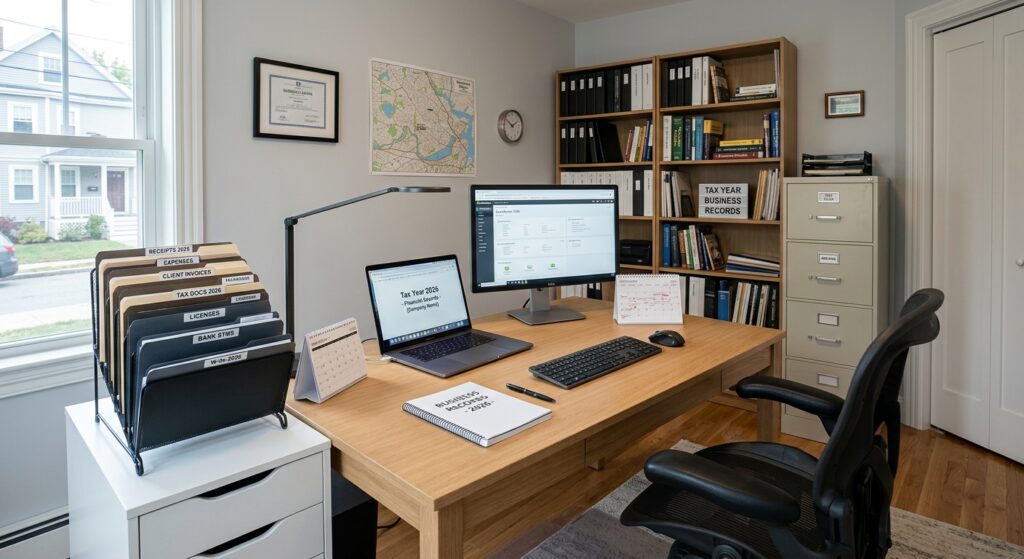
How to Defend Your Somerville Home Office Deduction in a 2026 IRS Audit

How to Defend Your Somerville Home Office Deduction in a 2026 IRS Audit
If you’re self-employed or run a business from your Somerville home office, you know how valuable the home office deduction can be for reducing your tax burden. However, claiming somerville home office audit defense deductions also puts your return at greater risk of IRS scrutiny. In fact, home office expenses rank among the top audit triggers for self-employed professionals and entrepreneurs. For the 2026 tax year, understanding how to properly document and defend your deduction is critical—especially with increased IRS focus on Schedule C deductions. This comprehensive guide will show you exactly how to support your home office claims, what red flags to avoid, and how to successfully navigate an audit if the IRS questions your deduction.
Table of Contents
- Key Takeaways
- What Is the Home Office Deduction?
- How Much Can You Deduct for Your Somerville Home Office?
- What Are the Most Common Home Office Audit Triggers?
- What Documentation Does the IRS Require?
- How Should You Respond if Audited?
- What Red Flags Should You Avoid?
- Uncle Kam in Action
- Next Steps
- Frequently Asked Questions
Key Takeaways
- The home office deduction allows self-employed and business-owning taxpayers to deduct expenses for the portion of their home used exclusively and regularly for business.
- For 2026, the IRS has no fixed dollar limit on the deduction; it’s based entirely on the percentage of your home used for business.
- Home office expenses are a top audit trigger; organizing clear documentation dramatically improves your defense if audited.
- Disproportionate deductions, lack of organization, or inconsistent square footage claims are red flags that invite IRS scrutiny.
- The Somerville area has specific local tax resources available for independent contractors and home-based business owners.
What Is the Home Office Deduction?
Quick Answer: The home office deduction allows self-employed and business-owning taxpayers to deduct home-related expenses based on the percentage of their home used exclusively for business purposes.
The home office deduction is available to anyone who uses part of their home regularly and exclusively for business. This applies to self-employed contractors, freelancers, small business owners, and even W-2 employees in certain situations. When you claim the deduction, you’re essentially allocating a portion of your home expenses to your business.
Understanding Regular and Exclusive Use
The IRS has two strict requirements for claiming a home office deduction: the space must be used regularly and exclusively for business. “Exclusively” means you cannot use that space for personal activities—no watching TV in your office at night or personal hobbies mixed with work. “Regularly” means you use the space consistently, not just occasionally or sporadically.
Two Methods for Calculating the Deduction
For the 2026 tax year, you have two approaches:
- Simplified Method: Claim $5 per square foot of home office space (maximum 300 square feet, or $1,500 maximum deduction).
- Actual Expense Method: Calculate your actual home office percentage and deduct a proportional share of mortgage interest, property taxes, utilities, insurance, repairs, and depreciation.
How Much Can You Deduct for Your Somerville Home Office?
Quick Answer: There’s no fixed dollar limit for 2026. Your deduction is based on your home office percentage and actual expenses, or up to $1,500 under the simplified method.
Let’s walk through the calculation for both methods. If your Somerville home is 2,000 square feet and your dedicated office is 200 square feet, your business use percentage is 10%. Under the actual expense method, you’d deduct 10% of your mortgage interest, utilities, insurance, and other qualifying home expenses.
For self-employed professionals earning $75,000 annually, the actual expense method typically yields larger deductions than the simplified method. Somerville homeowners should use our Self-Employment Tax Calculator for Somerville professionals to estimate total tax savings including home office benefits.
Actual Expense Method Calculation Example
Suppose your total annual home expenses are $24,000 (mortgage interest, property taxes, insurance, utilities, maintenance), and your office is 200 square feet of a 2,000 square foot home (10%). Your deduction would be $24,000 × 10% = $2,400. This is typically more substantial than the $1,000 simplified method deduction (200 sq ft × $5/sq ft).
What Are the Most Common Home Office Audit Triggers?
Quick Answer: Disproportionate deductions, lack of documentation, inconsistent square footage claims, and mixing personal and business use are the biggest red flags that trigger home office audits.
The IRS maintains a relatively low overall audit rate—between 0.2% and 0.5% of tax returns annually—but self-employed returns with Schedule C deductions face higher scrutiny. Home office deductions rank among the most commonly questioned items on self-employed returns for 2026.
Primary Audit Triggers for Home Office Deductions
- Disproportionate Deductions: Claiming home office expenses that far exceed your business income or industry norms.
- Poor Documentation: Unable to produce receipts, photographs, or detailed records supporting your claim.
- Inconsistent Square Footage: Varying office sizes claimed year-to-year without explanation.
- W-2 Employee Claims: W-2 employees rarely qualify; the IRS scrutinizes these claims heavily.
- Personal Expenses Misclassified: Deducting home entertainment, personal utilities, or shared spaces as home office expenses.
Pro Tip: Document your home office setup with dated photographs showing your desk, equipment, and exclusive business use. This single action dramatically strengthens your audit defense for 2026.
What Documentation Does the IRS Require?
 Free Tax Write-Off Finder
Quick Answer: The IRS requires photographs, square footage measurements, home expenses documentation, and clear proof of exclusive business use to support your deduction.
When the IRS examines a home office deduction, they’re looking for organized, clear, and relevant documentation. Simply having a desk in a room isn’t enough—you need proof that the space is used exclusively for business and that your deduction calculations are accurate.
Essential Documentation Checklist
- Photographs: Dated photos showing your office setup, desk, equipment, and layout from multiple angles.
- Square Footage Documentation: Blueprints, property appraisals, or written measurements of your home and office space.
- Home Expense Records: Mortgage interest statements, property tax bills, utility bills, homeowners insurance invoices, and repair receipts.
- Business Use Evidence: Calendar or log showing business activities, client meeting notes, or business correspondence.
- Depreciation Worksheets: If using the actual expense method, documentation of home depreciation calculations.
- Year-Over-Year Records: Tax returns from prior years showing consistent office square footage and deduction amounts.
| Documentation Type | Why the IRS Requires It | How to Organize It |
|---|---|---|
| Photographs | Proves exclusive business use and dedicated workspace | Digital folder with dates and descriptions |
| Square Footage | Verifies percentage calculation accuracy | Written measurement document with signature date |
| Home Expenses | Substantiates actual expense method calculation | Annual folder with categorized receipts and statements |
| Business Use Evidence | Confirms regular business use of the space | Activity log or saved business correspondence |
How Should You Respond if Audited?
Quick Answer: Respond within the required timeframe, provide organized documentation, stay factual, and avoid volunteering information beyond what the IRS specifically requests.
If you receive an IRS audit notice regarding your home office deduction, your first step is to understand the scope and timeline. Most audits are conducted through correspondence (mail), though complex cases may involve in-person examination at an IRS office.
Audit Response Steps
- Step 1: Verify Authenticity – Confirm the notice is genuinely from the IRS (not a scam) and identify which tax years are under review.
- Step 2: Note Deadlines – IRS audit notices give you 30 days to respond initially. Mark your calendar and don’t miss the deadline.
- Step 3: Organize Documentation – Gather all supporting documents (photos, measurements, expense records) in a logical, indexed folder.
- Step 4: Prepare a Written Response – Create a brief cover letter explaining your home office setup and business use. Reference specific documents by page number.
- Step 5: Submit Copies Only – Never submit original documents; always provide clean copies. Send by certified mail with return receipt requested.
Keep your response professional and factual. Answer only what the IRS asks; avoid volunteering additional information that might expand the scope of the audit. If the audit involves significant amounts or complex issues, consider consulting with a tax professional or enrolled agent specializing in Somerville area businesses.
What Red Flags Should You Avoid?
Quick Answer: Avoid round-number deductions, inconsistent year-to-year claims, mixing personal and business expenses, and submitting disorganized documentation.
The IRS uses advanced data-matching tools and audit selection algorithms to identify suspicious returns. Understanding common red flags helps you avoid unnecessary attention to your home office deduction.
Critical Red Flags to Eliminate
- Round-Number Deductions: Claiming exactly $1,500 or $2,000 every year looks artificial. Use calculated actual expenses instead.
- Inconsistent Square Footage: Reporting a 150 sq ft office one year, then 250 sq ft the next without explanation.
- Disproportionate Deductions: Claiming $5,000 in home office expenses on $20,000 business income (25%) vs. typical 10-15%.
- Poor Organization: Submitting a “shoebox” of unorganized documents forces the IRS to sort through everything, increasing audit adjustment risk.
- Overlapping Personal Use: Claiming your home office when family members also use the space or photos show personal items in the office.
Pro Tip: Maintain detailed business activity logs throughout the year. A simple spreadsheet showing the dates you worked in your home office demonstrates regular business use and strengthens your defense if audited.

Uncle Kam in Action: The Successful Home Office Audit Defense
Let me share a real-world example of how proper preparation saves money and stress. One of our Somerville clients, a marketing consultant earning $95,000 annually, received an IRS audit notice regarding her 2025 home office deduction of $4,200. She was understandably anxious—the deduction represented about 4.4% of her income, and she worried the IRS would disallow it entirely.
Here’s what made the difference: Six months before the audit notice arrived, she had organized her documentation system. She had dated photographs of her dedicated home office (a 200 square foot room with desk, computer, and filing cabinets—zero personal items). She had a written measurement document confirming her home was 2,000 square feet and her office was 200 square feet (10%). She had organized folders containing mortgage interest statements, property tax bills, utility statements, homeowners insurance invoices, and repair receipts spanning the year.
When she submitted her response to the IRS audit, she included a clean, professional cover letter explaining her business use, references to her supporting documents by page number, and neatly organized copies of everything requested. The IRS processed her response without adjustment. Her detailed, organized approach—showing 10% of $42,000 in annual home expenses equaled $4,200—was completely defensible and substantiated.
This client saved significant time, stress, and avoided any adjustment. More importantly, she learned that the audit process, while intimidating, becomes manageable when you’re organized and prepared. She now works with our tax advisory team annually to ensure her home office deduction remains compliant and well-documented.
Financial Impact: By successfully defending her $4,200 deduction, she avoided a $1,008 potential tax adjustment (assuming 24% marginal tax rate) plus penalties. Her organized approach paid dividends—not just in this audit, but in ongoing confidence about her compliance.
Next Steps
Don’t wait for an audit notice to organize your home office documentation. Take these actions immediately for 2026:
- Document Your Space Now: Take dated photographs of your home office from multiple angles showing your exclusive business setup.
- Measure and Record Square Footage: Get your home’s total square footage and your office area, then document this in writing with the date and your signature.
- Create an Organized File System: Set up folders for home expenses, business activity, and photographs. File receipts and documents as they arrive throughout the year.
- Schedule a Tax Planning Review: Work with a Somerville-based tax professional to ensure your home office deduction is properly calculated and defensible.
- Maintain Consistent Records: Update your business activity log monthly and organize expenses quarterly to avoid end-of-year scrambling.
Frequently Asked Questions
How far back can the IRS audit my home office deductions?
For the 2026 tax year, the IRS has a standard three-year statute of limitations for audits. This means they can generally examine tax returns filed in 2023 or later. However, if they discover a substantial error (over 25% of reported income), they can extend this to six years. If fraud is suspected, there’s no time limit.
Can I claim a home office deduction if I rent my apartment in Somerville?
Yes, absolutely. Renters can claim home office deductions using the simplified method ($5 per square foot) or actual expense method. For renters, “actual expenses” would include your pro-rata portion of rent, renters insurance, utilities, and any improvements you made. You cannot deduct landlord-provided items, but you can deduct business-specific improvements and furnishings you purchased.
What if I mix personal and business use in one room?
The IRS requires exclusive business use, so mixing personal and business use in one room disqualifies it from the deduction. You cannot claim a bedroom that doubles as an office, or a dining room table used for meals and business work. The space must be dedicated entirely to business. If you absolutely must use a multi-purpose room, you’d need to document the specific square footage used exclusively for business (e.g., the corner desk area only, not the whole room).
Should I use the simplified method or actual expense method for 2026?
This depends on your circumstances. Homeowners with significant mortgage interest, property taxes, and utility expenses typically benefit from the actual expense method. Renters or those with limited home expenses might save time with the simplified method. Calculate both approaches and choose the one that yields the larger deduction. You can change methods year-to-year, though changing from actual expense to simplified has depreciation recapture implications—consult a tax professional before switching.
What if the IRS asks me about my home office but I didn’t keep organized records?
You’ll need to reconstruct your documentation as best you can. Gather mortgage statements, utility bills, and insurance documents for the tax year in question. Request copies from your providers if you don’t have originals. Take new photographs of your office space and document its square footage. While this is more difficult than having organized records from the start, you can still build a credible defense, especially if you can show consistent square footage and business use over multiple years.
Can I claim home office expenses on Schedule C even if I don’t itemize deductions?
Yes. Your home office deduction goes on Schedule C (business income), which is separate from your personal itemized deductions or standard deduction choice. For the 2026 tax year, the standard deduction is $31,500 for married filing jointly and $15,750 for single filers. You can claim your standard deduction AND your home office expenses on Schedule C simultaneously—they don’t compete with each other.
What happens if I disagree with the IRS audit result?
If you disagree with the audit findings, you have options. First, you can request an appeals conference with an IRS Appeals Officer (not the same auditor). Appeals Officers often have more flexibility and may accept partial adjustments. If appeals don’t resolve the issue, you can file a petition with the Tax Court. The IRS must allow you time to respond to the initial audit findings before assessing additional tax, and you have rights under the Taxpayer Bill of Rights.
Should I hire a tax professional to defend my home office deduction?
For straightforward cases with solid documentation, you can often respond to the IRS yourself. However, if the deduction is substantial (over $3,000), involves complex calculations, or if your organized records aren’t available, professional help is wise. A CPA, enrolled agent, or tax attorney can negotiate with the IRS, potentially reducing or eliminating proposed adjustments. For Somerville-based professionals, the cost of professional representation often pays for itself through better audit outcomes.
Last updated: March, 2026

