
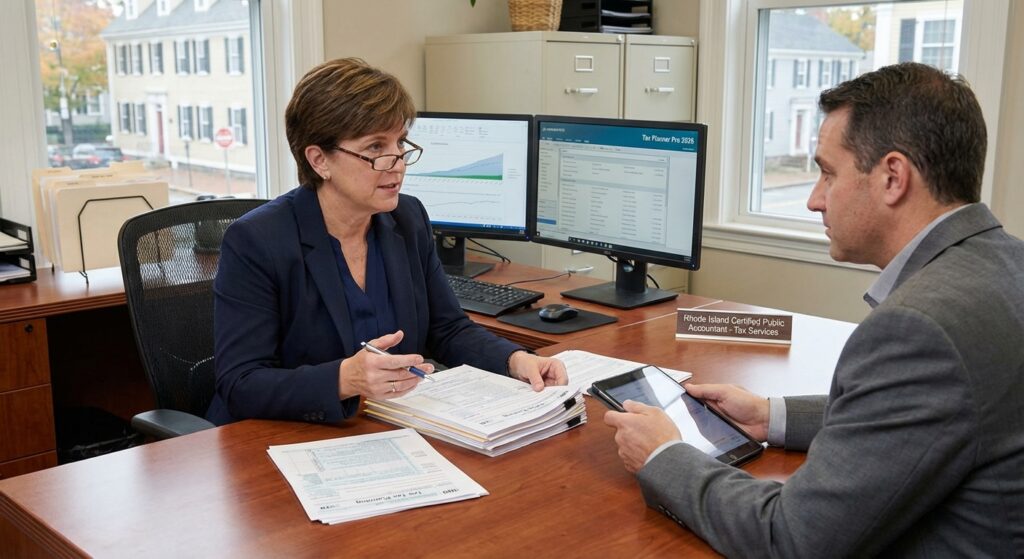
How Much Does a CPA Cost in Rhode Island? 2026 Pricing Guide
Understanding how much a CPA costs in Rhode Island for 2026 is crucial when planning your tax strategy and financial management. Whether you’re a small business owner, self-employed professional, or individual taxpayer, CPA fees vary significantly based on the complexity of your return, the services required, and the provider’s experience level.
This comprehensive guide breaks down CPA pricing in Rhode Island, explains what influences costs, and shows you how to find the right professional for your needs.
Table of Contents
- Key Takeaways
- Average CPA Costs in Rhode Island
- Hourly Rates vs. Flat Fees: What You’ll Pay
- What Factors Affect Your CPA Costs?
- Tax Preparation Service Costs Breakdown
- CPA Specialization and Pricing Models
- How to Compare CPA Costs and Find the Best Value
- Negotiating CPA Fees and Maximizing Value
- Uncle Kam in Action
- Next Steps
- Frequently Asked Questions
Key Takeaways
- Rhode Island CPAs typically charge $150–$250 per hour for tax preparation services in 2026.
- Flat-fee arrangements range from $800–$5,000+ depending on return complexity and tax situation.
- Business complexity, investment income, and deduction documentation significantly impact final costs.
- 2026 brings new tax deductions including tips, overtime, car loan interest, and senior deductions.
- Professional tax planning can save more than the CPA fee through optimized strategies.
Average CPA Costs in Rhode Island
Quick Answer: For 2026, Rhode Island CPAs charge between $150–$250 per hour, with flat fees ranging from $1,500–$3,500 for individual tax returns and $3,000–$7,500+ for small business returns.
CPA costs in Rhode Island vary based on service type and complexity. For a straightforward individual federal tax return with standard deductions, you can expect to pay $800–$1,500 in flat fees. However, if your return involves business income, rental properties, investment portfolio management, or significant itemized deductions, costs can reach $3,000–$5,000 or more.
Rhode Island’s cost of living places CPA fees in the mid-range for New England states. Compared to Massachusetts CPAs who charge premium rates due to Boston’s financial hub status, Rhode Island offers more competitive pricing while maintaining high professional standards.
Why Invest in Professional CPA Services?
Beyond basic tax preparation, Rhode Island CPAs identify tax savings opportunities you’d miss. With the 2026 tax year introducing new deductions for qualified tips (up to $2,500), overtime income (up to $12,500 for single filers), and car loan interest (up to $10,000), professional guidance becomes invaluable. Many clients recover their CPA fees multiple times over through optimized tax strategies.
The standard deduction for 2026 increased to $31,500 for married couples filing jointly and $15,750 for single filers. Understanding whether to itemize or take the standard deduction requires professional analysis, particularly if you’re subject to new income phase-outs or deduction limitations.
Regional CPA Cost Comparison
| Service Type | Rhode Island Average | New England Range |
|---|---|---|
| Simple Individual Return | $1,000–$1,500 | $900–$2,500 |
| Small Business Return (1040 + Schedule C) | $2,000–$3,500 | $2,000–$4,500 |
| Corporate Return (Form 1120) | $3,500–$7,500 | $3,500–$10,000+ |
| Real Estate Investor with 2-4 Properties | $2,500–$5,000 | $2,500–$6,000 |
Hourly Rates vs. Flat Fees: What You’ll Pay
Quick Answer: Hourly rates ($150–$250/hour) work best for ongoing advisory services, while flat fees ($800–$5,000+) are ideal for tax preparation where you want cost certainty.
Understanding pricing models helps you budget effectively and choose the right engagement structure. Rhode Island CPAs typically offer two primary pricing approaches, each with distinct advantages depending on your situation.
Hourly Rate Pricing
Rhode Island CPAs generally charge $150–$250 per hour for tax preparation, advisory services, and consultation work. Staff accountants (non-CPAs) may charge $80–$150 per hour, while partners or specialized tax strategists might charge $250–$400+ per hour. This model works best when you require ongoing consultation, quarterly planning, or if the scope of work is uncertain upfront.
A simple income tax return typically requires 4–8 billable hours at the staff accountant level, resulting in $320–$1,200 in costs. More complex situations involving business deductions, investment income, or multiple properties could require 15–25+ hours, pushing costs to $2,500–$4,000.
Flat Fee Pricing
Most Rhode Island CPA firms offer flat-fee packages for tax preparation to provide cost certainty. You know your exact cost upfront, with no surprises. Flat fees typically follow this structure: simple individual returns ($800–$1,500), returns with self-employment income ($1,500–$3,000), small business returns ($2,500–$5,000), and corporate returns ($4,000–$10,000+).
This model protects both you and the CPA. You budget accurately, and the CPA is incentivized to work efficiently. Many Rhode Island CPAs will increase flat fees for complex situations like multi-state returns, foreign income, or extensive charitable deductions.
What Factors Affect Your CPA Costs?
Quick Answer: Return complexity, business structure, documentation quality, and service scope are the primary drivers of CPA costs.
CPA fees don’t follow a one-size-fits-all model. Several factors determine your actual cost, and understanding these helps you control expenses and negotiate effectively with Rhode Island tax professionals.
Return Complexity
- Simple Returns: W-2 income only, standard deduction, minimal deductions = lower cost ($800–$1,200)
- Moderate Returns: Itemized deductions, rental income, self-employment = moderate cost ($1,500–$3,000)
- Complex Returns: Multiple businesses, investment properties, foreign income, multi-state activity = high cost ($3,500–$10,000+)
Business Structure Impact
Your business entity type significantly affects CPA pricing. A sole proprietor with self-employment income requires Schedule C preparation and self-employment tax calculation, typically adding $300–$800 to individual tax preparation costs. An S Corp requires Form 1120-S filing, payroll tracking, and reasonable salary documentation, costing $1,500–$3,000 more. C Corporations involve separate entity tax returns with different accounting requirements, typically $2,500–$5,000 additional.
Did You Know? Choosing the right business entity can save more in taxes than the CPA’s fee. Many self-employed professionals in Rhode Island save $5,000–$15,000 annually by electing S Corp status with proper entity structure advice from a professional CPA.
Documentation Quality
Well-organized records reduce CPA time and costs. If you provide organized expense categories, clear business income documentation, and proper deduction records, the CPA spends less time organizing. Conversely, unorganized shoebox receipts, missing documentation, and poor categorization require extensive reconstruction work, significantly increasing hourly charges. Providing clean documentation can reduce your CPA costs by 20–30%.
Tax Preparation Service Costs Breakdown
Quick Answer: Individual tax return preparation starts at $800–$1,200, business returns range $2,000–$5,000, and additional services like bookkeeping and consulting cost $100–$300 per hour.
Rhode Island CPAs typically bundle services into packages, though many customize pricing based on your specific needs. Here’s what you can expect to pay for common services in 2026:
| Service | Typical Cost Range |
|---|---|
| Individual Tax Return (1040 + Schedules) | $800–$2,000 |
| Self-Employment/Freelance (Schedule C) | $1,200–$3,000 |
| Rental Property Return (Schedule E) | $1,500–$3,500 per property |
| S Corp Return (Form 1120-S) | $2,500–$5,000 |
| Partnership Return (Form 1065) | $2,000–$4,500 |
| Estimated Tax Quarterly Planning | $500–$1,500/year |
| Bookkeeping Services | $1,500–$5,000/year |
| Business Tax Planning Consultation | $150–$300/hour |
CPA Specialization and Pricing Models
Quick Answer: Specialized CPAs (real estate, business advisory) charge $200–$400/hour; general CPAs charge $150–$250/hour. Specialization often justifies premium pricing through expert tax savings.
Rhode Island CPAs often specialize in specific industries or services, affecting their rates and value proposition. A real estate investor CPA might charge 15–25% more than a general practitioner but save you thousands through cost segregation, depreciation strategies, and 1031 exchange optimization. Similarly, a CPA specializing in businesses might charge premium rates but identify S Corp election benefits worth $10,000–$30,000 annually.
When evaluating CPA costs, factor in the expertise you need. A specialized CPA for your specific situation often provides better value despite higher hourly rates because they work more efficiently and identify opportunities that general practitioners might miss.
CPA Firm Size and Pricing Tiers
Solo practitioners typically charge $120–$180/hour and offer personalized service with lower overhead costs. Mid-size firms (5–20 CPAs) charge $150–$250/hour and provide team resources with specialized expertise. Large regional firms charge $200–$400/hour but offer comprehensive services and institutional stability. Choose based on your complexity and service needs rather than firm size alone.
How to Compare CPA Costs and Find the Best Value
Quick Answer: Get 3–4 written quotes, request detailed service descriptions, ask about fee structure (hourly vs. flat), and evaluate total value including tax savings.
Finding the right CPA at the right price requires careful comparison. Don’t default to the lowest bidder; instead, evaluate total value. Here’s how to compare CPA costs effectively:
Get Multiple Quotes
Contact at least three CPAs in Rhode Island and request detailed written quotes. Provide the same information to each (business structure, estimated revenue, number of properties, etc.) to ensure comparable quotes. Good CPAs will ask clarifying questions before quoting because they understand that fees depend on complexity. Avoid CPAs who quote without understanding your situation.
Evaluate Service Scope
Compare what’s included in each quote. Does it include estimated tax planning? Extensions? Amendment preparation? Follow-up consultations? One CPA at $2,500 that includes comprehensive planning may provide better value than one at $1,800 that’s preparation-only. Make sure quotes are apples-to-apples comparisons of identical services.
Pro Tip: Ask each CPA: “What tax savings do you typically identify for clients in my situation?” The answer reveals whether they proactively search for optimization strategies. A CPA who identifies $5,000 in annual savings justifies higher fees through value creation.
Negotiating CPA Fees and Maximizing Value
Quick Answer: Many CPA fees are negotiable, especially for multi-year retainers, well-organized records, and bundled services. Even a 10–15% reduction adds up to $200–$500 annually.
CPA fees, while professional standards exist, often contain flexibility. Smart negotiation can reduce your costs while maintaining quality service:
Negotiate Multi-Year Retainers
Many CPAs offer 10–15% discounts for multi-year retainers. If you’re confident in a CPA relationship, proposing a two or three-year agreement at a slightly reduced rate benefits both parties. The CPA gains client stability and predictable revenue; you receive a better rate and continuity.
Improve Documentation Standards
Demonstrating that you maintain organized records year-round justifies lower fees. If you provide a properly categorized expense summary, sorted receipts, and organized income documentation, the CPA spends less time on reconstruction, reducing billable hours. Some CPAs will quote lower fees upfront if they know records will be clean and organized.
Bundle Services for Better Rates
Requesting bundled services like tax preparation plus quarterly bookkeeping often receives volume discounts. CPAs can charge $2,500 for preparation and $2,500 for bookkeeping separately (total $5,000), but might offer both for $4,000–$4,500 as a package. Bundles improve firm efficiency and often result in better pricing.

Uncle Kam in Action: Real Estate Investor Saves $8,400 with Professional CPA Strategy
Client Snapshot: Sarah, a Rhode Island real estate investor with four rental properties across the state, was previously preparing her own taxes using DIY software. She earned approximately $120,000 in annual rental income across properties in Providence, Newport, and Warwick.
Financial Profile: $120,000 annual rental income, $380,000 in total property value, managing repairs and maintenance across multiple properties, and holding the properties as individual entities without optimization.
The Challenge: Sarah was paying approximately $18,000 annually in taxes on her rental income while missing significant deduction opportunities. She didn’t understand depreciation strategies, cost segregation benefits, or how to structure her properties for maximum tax efficiency. Her DIY approach meant paying full tax on rental income without the expert optimizations that professional CPAs implement.
The Uncle Kam Solution: Our CPA team conducted a comprehensive analysis of Sarah’s properties and rental structure. We implemented a cost segregation analysis across her four properties, identifying accelerated depreciation opportunities on building components, appliances, and land improvements. We restructured her entities to create a holding company that improved liability protection while optimizing tax treatment. We also ensured she was capturing all permissible deductions for property management, maintenance, insurance, and property taxes.
The Results:
- Tax Savings: $8,400 in first-year tax reduction through optimized entity structuring and depreciation strategies
- Investment: $3,500 annual CPA fee for comprehensive preparation and planning
- Return on Investment (ROI): 2.4x return on investment in the first 12 months, with projected annual savings continuing at $6,500+ in future years
This is just one example of how our proven real estate tax strategies have helped clients save thousands annually. Property owners often underestimate the value of professional guidance, only to discover through professional analysis that they’re leaving significant tax savings on the table.
Next Steps
Take action to optimize your 2026 tax situation and understand your CPA investment value:
- Contact 3–4 Rhode Island CPAs for written quotes detailing services, fees, and qualifications
- Document your financial information (income sources, deductions, business structure) to enable accurate quotes
- Schedule consultation calls to assess CPA communication style and expertise match
- Request professional tax strategy consultation to identify optimization opportunities specific to your situation
- Ask each CPA about the 2026 tax law changes and how they affect your specific situation
Frequently Asked Questions
What’s the average CPA cost in Rhode Island for a small business owner?
Small business owners in Rhode Island typically pay $2,000–$4,000 annually for comprehensive CPA services including tax preparation, quarterly planning, and basic bookkeeping. Costs vary based on business structure (sole proprietor vs. S Corp), revenue level, and complexity of deductions. For 2026, businesses that maximize new deductions (tips, overtime, car loan interest) may incur slightly higher fees due to additional planning required.
Are CPA fees tax-deductible?
Yes. For business owners and self-employed individuals, CPA fees are generally tax-deductible as a business expense reported on Schedule C or your business tax return. For individuals, fees related to business income preparation are deductible, though personal return preparation fees are not. This means your net cost is reduced by your marginal tax rate. If you’re in the 24% tax bracket, a $2,500 CPA fee effectively costs $1,900 after deducting the expense.
Should I choose a CPA or accountant based purely on price?
No. While price matters, the cheapest CPA may not provide the best value. A CPA who identifies $10,000 in tax savings justifies a higher fee than one who provides basic preparation at a lower cost. Evaluate the total value proposition including expertise, service scope, communication style, and proactive tax planning. A CPA investment should return many times its cost through optimization and risk mitigation.
How do Rhode Island CPAs handle the new 2026 tax deductions?
Professional CPAs immediately incorporate new 2026 deductions including qualified tips (up to $2,500), overtime income (up to $12,500 for singles), car loan interest (up to $10,000), and senior deductions (up to $6,000 for singles, $12,000 for couples) into planning. They understand income phase-outs, filing status requirements, and documentation needed. Some CPAs may charge slightly more for initial 2026 returns due to complexity of new provisions, but this typically stabilizes in future years.
What questions should I ask a CPA before hiring?
Ask about their experience with your specific situation (business type, industry, complexity level), their fee structure and what’s included, how they stay current with tax law changes, their approach to tax planning vs. preparation-only, communication frequency, and their average client savings. Request references from clients similar to you. Ask specifically about 2026 tax law knowledge and which new deductions might benefit you.
Can I negotiate CPA fees after receiving a quote?
Yes, many CPA fees are negotiable. After receiving a quote, you can discuss fee reduction for multi-year retainers, bundled services, or well-organized records. However, don’t demand unrealistic reductions—CPAs, like all professionals, have minimum rates based on expertise and market standards. Frame negotiations as partnerships: “If I provide organized records and commit to a two-year engagement, can we discuss fee flexibility?”
Should I use a CPA or tax software like TurboTax for my Rhode Island business?
For simple W-2 income, tax software may suffice. However, business owners, real estate investors, or those with complex situations benefit significantly from CPA expertise. Tax software follows rules but doesn’t identify optimization opportunities like entity restructuring, depreciation strategies, or timing opportunities that CPAs discover. The IRS Free File program is available for taxpayers earning $89,000 or less, but for businesses and complex situations, professional guidance typically provides multiples of the CPA fee in tax savings.
How much does a Rhode Island CPA cost for an S Corp vs. LLC?
An LLC that’s not taxed as an S Corp typically costs $1,500–$2,500 for federal return preparation. An S Corp election (Form 1120-S) costs $2,500–$4,500 due to additional complexity including payroll requirements, reasonable salary documentation, and state filings. However, many business owners save $8,000–$25,000 annually through S Corp tax savings, making the additional CPA fee an excellent investment. The decision should be evaluated in consultation with your CPA based on your specific income situation.
Related Resources
- Professional Tax Strategy Services
- Entity Structuring and Business Formation
- Real Estate Investor Tax Planning
- Official IRS Website for Tax Information
- IRS Directory of Tax Preparers and Professionals
This information is current as of 2/16/2026. Tax laws change frequently. Verify updates with the IRS or your state tax authority if reading this later.
Last updated: February, 2026

