
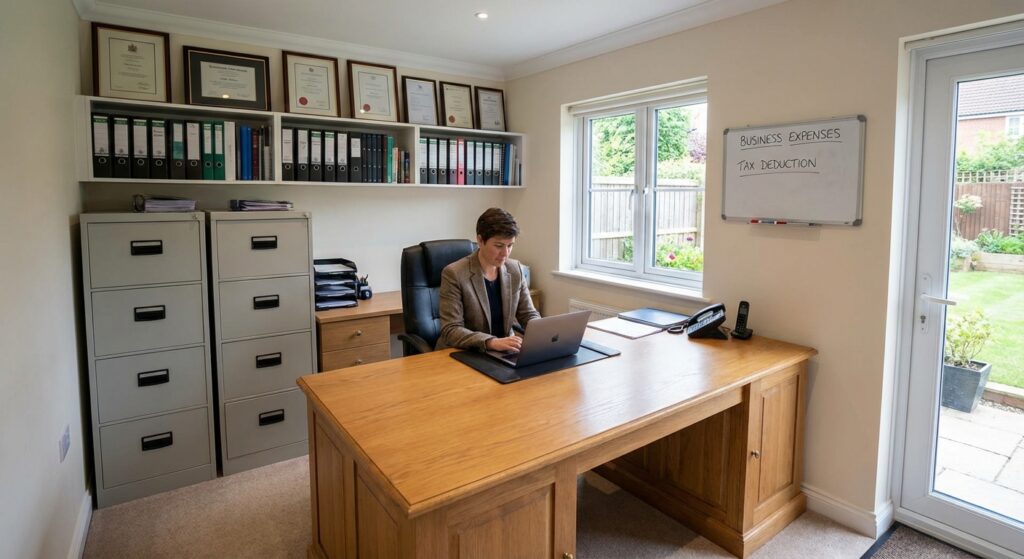
Complete 2026 Home Office Deductions Guide for Business Owners: Maximize Your Tax Savings
For the 2026 tax year, home office deductions represent one of the most valuable opportunities for business owners to reduce taxable income. Whether you operate a full-time consulting business, run a side venture, or manage administrative tasks from your home office, understanding how home office deductions work can unlock significant tax savings. This guide explains the 2026 home office deductions rules, eligible expenses, calculation methods, and documentation requirements you need to maximize deductions while maintaining IRS compliance.
Table of Contents
- Key Takeaways
- What Are Home Office Deductions?
- Who Qualifies for Home Office Deductions?
- What Are the Two Methods for Calculating Home Office Deductions?
- What Expenses Can You Deduct?
- How Do You Document Home Office Deductions?
- Uncle Kam in Action
- Next Steps
- Frequently Asked Questions
- Related Resources
Key Takeaways
- Home office deductions allow business owners to deduct expenses for the space used for business purposes.
- Two calculation methods exist: simplified method ($5 per square foot) and actual expense method.
- For 2026, standard deductions increased to $16,100 (single) and $32,200 (married filing jointly).
- Eligible expenses include utilities, rent, mortgage interest, insurance, and office supplies.
- Proper documentation and recordkeeping are critical for IRS compliance and audit protection.
What Are Home Office Deductions?
Quick Answer: Home office deductions allow you to claim a portion of household expenses as a business deduction if you use part of your home exclusively for business purposes. This reduces your taxable income and can result in significant annual tax savings for business owners operating from home.
Home office deductions have become increasingly important for business owners, entrepreneurs, and self-employed professionals who work from residential spaces. The IRS permits business owners to deduct business-related expenses for home offices as long as the space meets specific requirements. This deduction is reported on Schedule C (Form 1040) for self-employed individuals and sole proprietors, and it can significantly reduce your taxable income.
How Home Office Deductions Work
The fundamental principle behind home office deductions is that business owners can allocate household expenses proportionally to the business space. If your home is 1,000 square feet and your dedicated office is 200 square feet, you can claim 20% of certain household expenses as business deductions. This principle applies whether you own or rent your home, though certain expenses vary based on your ownership status.
The IRS maintains strict guidelines for what qualifies as a home office. You must use the space regularly and exclusively for business purposes. This means the space cannot serve dual purposes—a bedroom that doubles as an office doesn’t qualify. However, a dedicated room, a portion of a room with clear boundaries, or a finished basement section used exclusively for business purposes does qualify. Many business owners operating in 2026 find that home office deductions substantially impact their bottom-line tax liability, often reducing annual taxes by hundreds or thousands of dollars.
Did You Know? According to recent IRS data, fewer than 3 million taxpayers claim home office deductions annually, despite millions of business owners working from home. This represents an opportunity for many entrepreneurs to capture legitimate tax savings they’re currently missing.
Who Qualifies for Home Office Deductions?
Quick Answer: You qualify for home office deductions if you’re self-employed, own a business, or use a dedicated space in your home exclusively for business purposes. Employees working from home may also qualify if their employer requires them to work from home and they don’t have office space at the workplace.
The IRS has established clear eligibility criteria that determine who can claim home office deductions. Your business structure matters—self-employed individuals, sole proprietors, LLC owners, and S Corporation owners can all claim home office deductions. The key requirement is that you must have a dedicated workspace used exclusively for business purposes. This exclusivity requirement is strictly enforced by the IRS. The space cannot be used for personal purposes, entertainment, or hobbies.
Requirements for Qualifying Home Offices
- Business Use: The space must be used for business purposes. This includes running a primary business, managing rental properties, or handling administrative tasks for self-employed work.
- Exclusive Use: The office space cannot serve dual purposes. A guest bedroom that occasionally functions as an office doesn’t qualify. The space must be dedicated exclusively to business.
- Regular Use: You must use the space regularly for business purposes, not occasionally. Daily or frequent use demonstrates that the office is integral to your business operations.
- Principal Place of Business: For self-employed individuals, the home office often serves as the principal place of business where you meet clients, store records, or conduct substantial business activities.
Additionally, you must be operating a legitimate business. Hobbies or casual side projects don’t qualify for home office deductions. The IRS distinguishes between businesses and hobbies by examining whether you conduct the activity in a businesslike manner, maintain detailed records, and have profit as your motive. If your home-based activity generates net loss more than two years out of five, the IRS may reclassify it as a hobby.
Pro Tip: If you’re an employee required by your employer to work from home and have no office space at the company location, you may qualify for home office deductions. Document your employer’s work-from-home requirement and maintain records showing exclusive business use of your office space.
What Are the Two Methods for Calculating Home Office Deductions?
Quick Answer: The simplified method allows you to deduct $5 per square foot (maximum 300 square feet, or $1,500 annually). The actual expense method requires tracking all household expenses and deducting the business-use percentage, potentially yielding higher deductions for larger offices or in high-cost areas.
The IRS provides two approaches for calculating home office deductions, each with distinct advantages depending on your situation. Understanding these methods is crucial because choosing the right approach can mean the difference between a $1,000 deduction and a $5,000+ deduction annually. The simplified method offers ease and certainty, while the actual expense method can yield significantly higher deductions if your household expenses are substantial.
The Simplified Method: $5 Per Square Foot
The simplified method, introduced to reduce administrative burden on taxpayers, allows you to deduct $5 per square foot of office space. This method requires no detailed recordkeeping of actual expenses, making it ideal for business owners who want straightforward tax deductions without extensive documentation. The calculation is simple: measure your office space in square feet and multiply by $5.
However, there’s a maximum limit of 300 square feet, which caps annual deductions at $1,500. For a 200-square-foot home office, the 2026 simplified method deduction would be $1,000 ($200 × $5). This method doesn’t permit deductions for mortgage interest, property taxes, or depreciation—those expenses can only be claimed under the actual expense method. The simplified method is most beneficial for smaller home offices or business owners who prefer minimal recordkeeping complexity.
The Actual Expense Method: Detailed Calculations
The actual expense method requires calculating the exact percentage of your home used for business and applying that percentage to all eligible household expenses. This method demands detailed records and calculations but frequently yields much higher deductions, particularly for owners of larger homes or those in high-cost regions. To use this method, divide your office square footage by your total home square footage to determine your business-use percentage.
For example, if your home is 2,000 square feet and your office is 300 square feet, your business-use percentage is 15%. You then apply this 15% to eligible household expenses including utilities, home insurance, mortgage interest, property taxes, repairs, depreciation, and maintenance. This method requires meticulous recordkeeping but can generate substantially larger deductions, especially if you own your home or live in a high-cost area. Additionally, this method permits depreciation deductions on the office portion of your home, which can provide significant tax benefits.
Pro Tip: If you own your home and paid a substantial mortgage interest and property taxes, the actual expense method typically yields higher deductions than the simplified method. Homeowners with $1,000+ monthly mortgage payments should strongly consider the actual expense method to maximize tax savings.
| Comparison Factor | Simplified Method | Actual Expense Method |
|---|---|---|
| Rate | $5 per square foot | Percentage of household expenses |
| Maximum Annual Deduction | $1,500 (300 sq ft × $5) | Unlimited (based on actual expenses) |
| Recordkeeping Required | Minimal | Extensive documentation |
| Includes Mortgage Interest/Property Taxes | No | Yes |
| Includes Depreciation | No | Yes |
What Expenses Can You Deduct?
Quick Answer: Eligible expenses vary by calculation method. Under the simplified method, you claim the $5 per square foot deduction. Under the actual expense method, you can deduct utilities, mortgage interest, property taxes, insurance, repairs, maintenance, and depreciation based on your business-use percentage.
Understanding which expenses qualify for home office deductions is essential for maximizing your tax benefits. The IRS categorizes expenses into two groups: direct expenses that benefit only the home office, and indirect expenses that benefit your entire home. Direct expenses are fully deductible, while indirect expenses are deductible only in proportion to your business-use percentage. This distinction affects how you calculate deductions under the actual expense method.
Direct Expenses (Fully Deductible)
- Office furniture and equipment (desk, chair, filing cabinets, bookcases)
- Office supplies (paper, pens, ink cartridges, envelopes)
- Office equipment repairs (computer repairs, printer maintenance)
- Paint or decorations exclusively for the office space
- Office equipment and technology (monitors, keyboards, software licenses)
Indirect Expenses (Percentage-Based Deduction)
- Utilities (electricity, gas, water, internet, phone service)
- Mortgage interest (only under actual expense method)
- Property taxes (only under actual expense method)
- Home insurance (homeowners or renters insurance)
- Repairs and maintenance (roof repairs, window repairs, general home maintenance)
- Depreciation on home value (only for homeowners)
It’s critical to understand that some expenses are specifically excluded from home office deductions. You cannot deduct personal expenses like meals, household furnishings that don’t serve a business purpose, or entertainment expenses. Additionally, rent paid as a renter generally cannot be claimed under the actual expense method, though some states have specific rules. When claiming utility deductions, you must calculate the business-use percentage based on square footage allocation.
How Do You Document Home Office Deductions?
Quick Answer: Maintain detailed records including office measurements, utility bills, mortgage statements, insurance policies, receipts for office expenses, and business logs. For the actual expense method, create a spreadsheet calculating your business-use percentage and apply it to household expenses. The simplified method requires minimal documentation beyond space measurements.
Proper documentation is your first line of defense in an IRS audit. The burden of proof rests on you to substantiate every deduction claimed on your tax return. Without adequate documentation, the IRS can disallow your entire home office deduction, resulting in additional taxes, penalties, and interest. Successful home office deduction claims rely on meticulous record-keeping that clearly demonstrates the business use of your home office space.
Essential Documentation for Home Office Deductions
- Office Measurements: Document the square footage of your office space and total home using a measuring tape. Keep written records and photos showing the dedicated office space.
- Utility Bills: Maintain 12 months of utility bills (electric, gas, water, internet) to establish costs and calculate the business-use percentage.
- Mortgage or Lease Documents: Keep your mortgage statement or lease agreement showing your home’s total square footage and annual costs.
- Insurance Policies: Maintain copies of homeowners or renters insurance policies documenting your annual insurance premiums.
- Receipts and Invoices: Keep all receipts for office equipment, supplies, and repairs organized chronologically and by expense category.
- Calculation Worksheet: Create a detailed spreadsheet documenting how you calculated your home office deduction, including business-use percentage and expense allocations.
For the actual expense method, maintain a business expense log that tracks all household expenses claimed for the home office. This should include date, vendor, amount, and business purpose. Digital copies of receipts (photographs or scanned documents) are acceptable and often more convenient than paper records. When calculating your business-use percentage, measure your office space and your entire home’s usable square footage. Be conservative in your calculations—if your office is 250 square feet and your home is 1,800 square feet, your business-use percentage is 13.89%, not 15%. Rounding should be minimal and defensible.
Pro Tip: Use accounting software like QuickBooks or FreshBooks to track business expenses automatically. Many platforms allow you to photograph receipts and automatically categorize expenses, reducing recordkeeping burden and ensuring consistency.
Uncle Kam in Action: Business Owner Captures $4,200 Annual Savings with Home Office Strategy
Client Snapshot: Sarah is a 42-year-old marketing consultant who transitioned from corporate employment to running a full-time consulting business from her home office in 2026. She specializes in brand development for small businesses and generates approximately $85,000 in annual consulting revenue.
Financial Profile: Sarah owns a 2,400-square-foot home with an $8,500 annual mortgage payment. Her annual property taxes are $3,200, homeowners insurance is $1,400, and utilities average $2,400 per year. She dedicated a 240-square-foot spare bedroom exclusively to her consulting business, outfitting it with a desk, filing cabinets, and office equipment totaling $2,500 in 2026.
The Challenge: Sarah initially considered using the simplified method ($5 per square foot × 240 sq ft = $1,200 annual deduction) because it seemed simpler. However, with substantial mortgage interest, property taxes, and utility costs, she realized the actual expense method might yield significantly higher deductions. She was uncertain how to properly calculate her business-use percentage and worried about making mistakes that could trigger an audit.
The Uncle Kam Solution: Our tax strategy team analyzed both methods for Sarah. We calculated her business-use percentage: 240 ÷ 2,400 = 10% of her home used for business. Applying this 10% to her household expenses under the actual expense method for 2026:
- Mortgage interest (10% × $8,500) = $850
- Property taxes (10% × $3,200) = $320
- Homeowners insurance (10% × $1,400) = $140
- Utilities (10% × $2,400) = $240
- Direct office expenses (fully deductible) = $2,500
- Total home office deduction = $4,050
The Results:
- Tax Savings: By electing the actual expense method, Sarah increased her home office deduction from $1,200 to $4,050, reducing her 2026 taxable income by an additional $2,850.
- Investment: Sarah paid a one-time fee of $950 for our tax strategy consultation and documentation system setup.
- Return on Investment (ROI): At a 24% marginal tax rate, Sarah’s additional $2,850 deduction saves $684 in federal taxes. Including state taxes, total savings reach approximately $850 in year one alone, representing a 3.6x return on investment. This is just one example of how our proven tax strategies have helped clients achieve significant savings through proper home office deductions planning.
Sarah also learned that by maintaining detailed records for the actual expense method, she’s better positioned for audit defense. She created a digital documentation system tracking all household expenses with business-use percentage calculations, making future tax filings simpler and more defensible.
Next Steps
- Measure Your Space: Use a tape measure to determine your office square footage and total home square footage. Calculate your business-use percentage (office ÷ total home).
- Compare Deduction Methods: Calculate both the simplified method ($5 per sq ft) and estimated actual expense method. Choose the approach that yields the highest deduction.
- Gather Documentation: Collect 12 months of utility bills, mortgage/lease documents, insurance policies, and receipts for office equipment and supplies purchased in 2026.
- Consult a Tax Professional: Meet with a tax advisor to review your specific situation and ensure you’re maximizing deductions while maintaining IRS compliance.
- Set Up Record Systems: Implement a digital recordkeeping system for tracking business expenses and maintaining organized documentation for future tax years.
Frequently Asked Questions
Can I claim home office deductions if I rent instead of own?
Yes, renters can claim home office deductions under the actual expense method. However, you cannot deduct rent directly as a home office expense. Instead, you calculate utilities and other indirect expenses using your business-use percentage. You can deduct your portion of renter’s insurance and repair expenses if applicable. The simplified method remains available for renters and often yields comparable deductions to the actual expense method without requiring extensive recordkeeping.
What if I use my home office occasionally for personal purposes?
The IRS requires exclusive business use. If you use your office space for personal purposes, you lose eligibility for home office deductions entirely. However, occasional personal use in an otherwise dedicated business office may be overlooked if it’s truly minimal. The best practice is to maintain absolute separation between your business office and personal space. If your office doubles as a guest room or personal workspace, you cannot claim home office deductions—the IRS applies a strict exclusivity test.
How does home office depreciation work?
Under the actual expense method, homeowners can claim depreciation on their home’s business-use portion. The depreciable basis is determined by your home’s original cost (excluding land value). Depreciation is calculated using the Modified Accelerated Cost Recovery System (MACRS) over 39 years for residential property. For example, if your home cost $300,000 (excluding land) and your office represents 10% business use, your depreciable basis is $30,000. Annual depreciation would be approximately $769 ($30,000 ÷ 39 years). Important: taking depreciation creates a taxable gain when you sell your home, so consult a tax professional before claiming depreciation.
Can employees claim home office deductions?
Generally, employees cannot claim home office deductions. However, certain employees required by their employers to work from home and lacking workspace at the company location may qualify. For 2026, this applies primarily to active military members and intelligence community employees working from home. W-2 employees should confirm with their employer’s policies and consult a tax professional before claiming deductions, as strict requirements apply.
What’s the difference between Form 8829 and the simplified method?
Form 8829 (Expenses for Business Use of Your Home) is required for the actual expense method. This form calculates your deductible home office expenses in detail, requiring you to list all household expenses and your business-use percentage. The simplified method requires no form and uses only the $5 per square foot calculation. Form 8829 is more complex but enables higher deductions for most homeowners with substantial household expenses.
Can I change from the simplified method to the actual expense method?
Yes, you can change methods each year. However, switching from the actual expense method to the simplified method after claiming depreciation triggers complicated depreciation recapture rules. The safest strategy is to use the simplified method if unsure, then switch to the actual expense method in subsequent years once you’ve confirmed you prefer higher deductions and proper documentation systems are in place. Consult a tax professional when changing methods to understand recapture implications.
Are there any limitations on home office deductions for business owners?
Home office deductions cannot exceed your net profit from the business. If your business generates $20,000 in revenue but $25,000 in expenses (excluding home office deductions), your net loss of $5,000 becomes your limitation. You cannot claim home office deductions that push your business into a net loss, though you can carry forward disallowed deductions to future years. This limitation prevents business owners from using home office deductions to generate business losses that could offset other income.
Related Resources
- Tax Strategy for Business Owners
- IRS Publication 587: Business Use of Your Home
- Entity Structuring for Tax Optimization
- Form 8829: Expenses for Business Use of Your Home
- Tax Strategy Blog: Latest Updates and Strategies
Last updated: January, 2026

