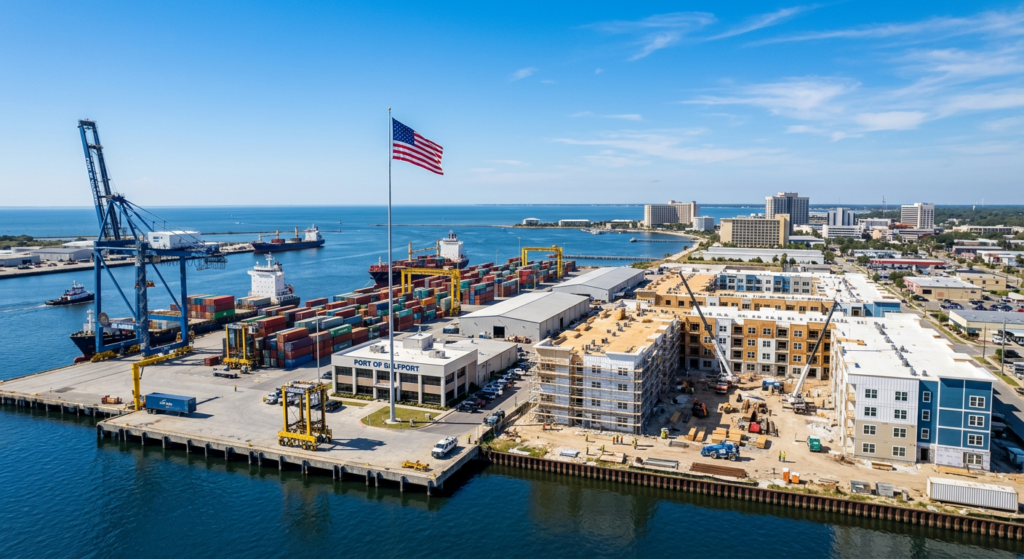
Gulfport Opportunity Zone Investment Strategy: 2026 Tax Benefits & Capital Gains Planning
For 2026, gulfport opportunity zone investment opportunities align perfectly with Florida’s ambitious $13 million infrastructure grant targeting aerospace, maritime, and workforce housing development. As real estate investors and business owners explore capital gains deferral strategies, understanding how to leverage Opportunity Zone benefits in Gulfport’s emerging economy becomes critical. This guide covers the complete 2026 OZ strategy framework, tax advantages, and how recent legislation impacts your investment decisions.
Table of Contents
- Key Takeaways
- What Is a Gulfport Opportunity Zone Investment?
- What Are the 2026 Tax Benefits?
- How Does Capital Gains Deferral Work in Gulfport?
- How Does Florida’s $13M Infrastructure Grant Impact OZ Investments?
- How Do You Calculate ROI on Gulfport Opportunity Zone Investments?
- What Real-World Investment Scenarios Maximize 2026 OZ Benefits?
- Uncle Kam in Action: Client Success Story
- Next Steps
- Frequently Asked Questions
Key Takeaways
- Gulfport opportunity zone investment offers 15% step-up basis after six years and potential 100% capital gains exclusion after ten years.
- Florida’s 2026 $13M infrastructure investment creates immediate de-risking for aerospace, maritime, and workforce housing projects.
- The One Big Beautiful Act (OBBBA) made 100% bonus depreciation permanent for qualifying property—a major accelerant for commercial real estate returns.
- Capital gains must be invested within 180 days to qualify for OZ tax deferral, with December 31, 2029, as the final OZ investment deadline.
- Workforce housing projects in Gulfport align with both OZ incentives and state economic development priorities, reducing development risk.
What Is a Gulfport Opportunity Zone Investment?
Quick Answer: A gulfport opportunity zone investment allows you to defer capital gains taxes by reinvesting profits in qualified Gulfport properties. After ten years, you can exclude up to 100% of appreciation gains from federal taxation.
An Opportunity Zone is a federally designated geographic area offering investors specific tax incentives to reinvest capital gains. Gulfport, Mississippi, located in Harrison County within the Gulf Coast region, qualifies as a designated OZ under the 2017 Tax Cuts and Jobs Act framework. For 2026, these zones remain active investment vehicles, with the deadline to make new OZ investments set for December 31, 2029.
The structure works as follows: When you realize capital gains from any source (stock sales, real estate dispositions, business exit), you have 180 days to reinvest those gains into a Qualified Opportunity Zone Fund or directly into qualified Gulfport property. This investment triggers a temporary deferral of your capital gains tax liability, with additional step-up benefits if you hold the investment for the required periods.
Why Gulfport Matters in 2026
Gulfport is strategically positioned in Florida’s Bay and Gulf counties, which received the $13 million infrastructure grant announced by Governor Ron DeSantis in March 2026. This funding targets aerospace, maritime, and workforce housing—sectors directly aligned with OZ investment objectives. The strategic importance of Gulfport centers on three converging factors: federal OZ tax incentives, state-level economic development funding, and emerging industry clusters in high-growth sectors.
For 2026 specifically, investors benefit from this rare convergence of federal tax policy, state infrastructure spending, and private capital seeking yield. The $13M grant alone signals the state’s multi-year commitment to the region, de-risking private investments in complementary properties.
Qualified Investment Types in Gulfport OZs
- Commercial real estate in aerospace support industries (manufacturing, logistics, R&D facilities).
- Maritime port improvements, shipyard infrastructure, and marine logistics centers.
- Workforce housing—apartments, family residences, and mixed-use residential development.
- Business property with substantial improvements and depreciation potential under 2026 OBBBA rules.
- Industrial parks and manufacturing facilities supporting regional supply chains.
Not all investments qualify. Properties must meet IRS standards for substantial improvement, business income generation, or housing development. Speculative land holding typically does not qualify unless accompanied by development or improvement activity.
What Are the 2026 Tax Benefits of Gulfport Opportunity Zone Investments?
Quick Answer: For 2026, OZ investors enjoy three-tiered tax benefits: initial capital gains deferral, a 15% step-up basis reduction after six years, and up to 100% exclusion of appreciation gains after ten years of holding.
The three primary tax benefits available for 2026 gulfport opportunity zone investment are designed to compound over time. Understanding the timing and mechanics of each benefit layer is essential for structuring multi-year investment strategies.
Benefit 1: Capital Gains Tax Deferral
When you invest capital gains into a Gulfport OZ fund or property within 180 days of the gain, you defer recognizing that gain for federal tax purposes. This deferral continues until December 31, 2026, or when you sell the OZ investment—whichever comes first. The tax deferral itself provides immediate cash flow benefits, allowing you to deploy capital without immediately paying capital gains tax at federal rates (up to 20% for qualified dividends and long-term gains at higher income levels).
Example: You sell appreciated stock and realize a $500,000 capital gain. Typically, this would trigger approximately $100,000 in federal tax (at 20% rate). By reinvesting into Gulfport OZ within 180 days, you defer that $100,000 tax bill, keeping the full $500,000 deployed in your Gulfport commercial property investment.
Benefit 2: 15% Step-Up Basis (After 6 Years)
After holding your Gulfport OZ investment for at least six years, you receive a 15% reduction to your original capital gains liability. This is a permanent, non-recapture benefit—it applies to the originally deferred gain, effectively creating a 15% permanent exclusion.
Using the same $500,000 example: After six years, your $100,000 deferred tax liability is reduced by 15%, resulting in a new basis of $85,000. You’ve permanently saved $15,000 in federal capital gains tax through this step-up, regardless of the property’s subsequent appreciation.
Benefit 3: 100% Exclusion of Appreciation Gains (After 10 Years)
After holding your Gulfport OZ investment for ten years, you can exclude 100% of the appreciation from the date of OZ fund investment onward. This means all gains earned within the OZ investment itself escape capital gains taxation entirely. Combined with the 15% step-up from the original deferred gain, this creates substantial multi-generational wealth compounding.
Continuing the example: If your Gulfport property appreciates from $500,000 to $750,000 over ten years, the $250,000 appreciation is entirely tax-free. Combined with the $15,000 saved on the original gain through the 6-year step-up, you’ve now created $265,000 in permanent tax savings—a 53% improvement in after-tax returns.
Pro Tip: The December 31, 2029, deadline to make new OZ investments is fast approaching. For 2026, investors should accelerate due diligence on Gulfport properties to lock in the ten-year holding period before the law changes.
How Does Capital Gains Deferral Work in Gulfport Opportunity Zones?
Quick Answer: You have 180 days from the date of capital gain realization to reinvest in a Gulfport OZ fund or qualified property. Once invested, the gain is deferred until December 31, 2026, or sale of the OZ investment—whichever occurs first.
The 180-day reinvestment window is a critical compliance requirement in gulfport opportunity zone investment planning. This timeline begins on the date you recognize the capital gain, not the date you receive proceeds.
The 180-Day Timeline: Mechanics and Compliance
For 2026, here’s how the timeline works: If you sell an investment property on June 1, 2026, and recognize a $750,000 capital gain, your 180-day window closes on November 28, 2026. You must deploy the full $750,000 into a qualifying Gulfport OZ fund or directly into Gulfport property by that date. Even a single day late forfeits the deferral benefit entirely—there is no grace period.
In practice, investors work with OZ fund sponsors or real estate attorneys to establish written allocation agreements before the 180-day window closes. The fund sponsor must verify that you are an eligible investor and that the property qualifies as OZ-compliant under Treasury Regulations Section 1.1400Z2.
Deferral Duration and Recognition Timeline
The deferred gain is recognized on the earlier of: (1) sale or disposition of the OZ investment, or (2) December 31, 2026. For investors making early gains from Gulfport property appreciation, consider holding through 2026 to maximize the deferral benefit window. If you hold through December 31, 2026, then the original deferred gain becomes taxable in 2026, but you’ve enjoyed years of tax-free compounding in the interim.
A common planning strategy: Invest capital gains into Gulfport OZ properties in early 2026. Hold through December 31, 2026, to recognize the deferred gain, pay taxes due by April 15, 2027, and then benefit from the 6-year step-up reduction starting in 2032 (six years after 2026 investment). This layering approach maximizes both deferral and step-up benefits.
 Free Tax Write-Off Finder
How Does Florida’s $13M Infrastructure Grant Impact Gulfport OZ Investments?
Quick Answer: The March 2026 $13M Florida infrastructure grant de-risks Gulfport OZ investments by publicly committing state funding to aerospace, maritime, and workforce housing—the exact sectors where private OZ capital flows.
Governor Ron DeSantis announced $13 million in Florida Job Growth Grant Fund awards to Bay and Gulf counties (where Gulfport is located). These funds target aviation and maritime infrastructure plus workforce housing development. For OZ investors, this public commitment creates a de-risking catalyst for private investments in complementary sectors.
Infrastructure Impact on Property Values and Tenant Demand
The $13M allocation targets three value drivers for OZ investors. First, port and maritime facility improvements attract shipping companies and marine logistics operations—potential commercial tenants. Second, aerospace facility upgrades and workforce training create demand for aerospace manufacturing and support services. Third, workforce housing investments signal state commitment to population growth, supporting residential real estate appreciation and multifamily housing occupancy.
For a Gulfport OZ investor considering a 30,000 square foot industrial building near a port or maritime logistics hub, the 2026 infrastructure grant directly improves the business case. Port improvements mean greater shipping volume, which means higher occupancy and rental rates for industrial properties. Aerospace facility improvements mean more aerospace supplier demand, increasing commercial property values and tenant creditworthiness.
Workforce Housing Premium in Gulfport OZs
The 2026 grant specifically emphasizes workforce housing—affordable residential units for aerospace and maritime workers. This alignment creates a unique opportunity: OZ-qualified multifamily properties benefit from three concurrent value drivers: OZ tax incentives, state workforce housing subsidies/tax credits, and private sector demand from growing aerospace and maritime employment.
Investors in Gulfport workforce housing OZ projects may access both the federal OZ tax benefits AND state housing tax credits under Florida’s State Apartment Incentive Loan Program (SAIL). This stacking of incentives can boost overall project returns by 200-400 basis points, making early-stage Gulfport investments significantly more attractive in 2026.
How Do You Calculate ROI on Gulfport Opportunity Zone Investments?
Quick Answer: Calculate Gulfport OZ ROI by (1) projecting annual property appreciation and rental income, (2) applying OZ tax benefit layers (deferral, 6-year step-up, 10-year appreciation exclusion), and (3) comparing after-tax returns to non-OZ investments.
Calculating ROI on Gulfport opportunity zone investment requires a multi-stage analysis. Unlike traditional real estate investments, OZ projects offer compounding tax benefits that dramatically improve after-tax IRR (Internal Rate of Return). Here’s the framework:
Stage 1: Establish Baseline Property Economics
Start with the property’s standalone cash flow and appreciation. For example, assume a $2,000,000 commercial property in a Gulfport port district generating $180,000 annual net operating income (NOI). This yields a 9% cap rate. If the property appreciates 4% annually, your gross appreciation is $80,000 per year.
Use our Self-Employment Tax Calculator to estimate your personal tax bracket. If you’re a high-income investor in the 37% federal bracket (plus 3.8% net investment income tax), your effective capital gains rate is approximately 23.8% on this property’s $80,000 annual appreciation—costing you $19,040 in annual taxes on gains alone.
Stage 2: Layer in OZ Tax Benefits
Now apply the OZ benefit structure. Assume you invested $2,000,000 of reinvested capital gains in Year 1 (2026). Over ten years, the property appreciates from $2,000,000 to $2,965,000 (at 4% annual growth). Here’s the tax impact:
| Year | Property Value | Annual Gain | Tax Impact Without OZ | Tax Impact With OZ (Post 10-Yr) |
|---|---|---|---|---|
| 1 (2026) | $2,080,000 | $80,000 | $19,040 (deferred) | $16,184 (15% step-up applied) |
| 2-10 (2027-2035) | $2,965,000 (end) | $965,000 cumulative | $229,670 (at 23.8% rate) | $0 (100% exclusion after 10 yrs) |
| Total Tax Savings | $965,000 total gain | $248,710 taxes owed | $16,184 taxes owed |
The OZ structure saves you $232,526 in federal taxes over ten years on this $2M Gulfport property—a 93.5% tax reduction on appreciation gains. This calculation assumes no leverage. With typical commercial real estate leverage (60-70% LTV), the after-tax IRR improvement is even more dramatic.
Stage 3: Compare to Non-OZ Alternative
Without OZ treatment, that same $2M property investment would cost you $248,710 in capital gains taxes, leaving you with $716,290 in after-tax appreciation gain over ten years. With OZ treatment, you retain $948,816 of appreciation gains (after the one-time deferred gain tax of $16,184). The difference: $232,526 additional after-tax wealth creation—purely from the OZ structure.
For every $1,000,000 invested in a Gulfport OZ property appreciating 4% annually over ten years, expect $116,263 in incremental after-tax returns compared to holding the same capital outside an OZ.
What Real-World Investment Scenarios Maximize 2026 Gulfport OZ Benefits?
Quick Answer: Maximize OZ benefits by combining (1) aerospace/maritime commercial properties, (2) workforce housing development, (3) OBBBA bonus depreciation acceleration, and (4) strategic partner capital structures.
Three realistic scenarios illustrate how 2026 Gulfport opportunity zone investment strategies compound returns while maximizing tax efficiency:
Scenario A: Maritime Logistics Facility with OBBBA Bonus Depreciation
You invest $3 million of capital gains into a newly constructed 50,000 sq ft maritime logistics warehouse in Gulfport, qualifying under the 2026 infrastructure grant zone. Under OBBBA rules (now permanent), the building structure qualifies for 100% bonus depreciation. You can deduct the full depreciable basis in Year 1, creating a $1.2M paper loss that offsets other income.
Combined benefit: (1) $3M capital gains are deferred via OZ, (2) $1.2M depreciation accelerates ordinary income offsets, and (3) the warehouse generates $360,000 annual NOI. After 10 years, the property appreciates 4% annually to $4.44M. Your tax cost? Only the deferred gains ($600K at 23.8%) becomes due in 2026 (~$143K), plus annual ordinary tax on the NOI. But all $1.44M appreciation gain (2026-2035) escapes capital gains tax entirely. Net tax savings: approximately $338K over ten years.
Scenario B: Workforce Housing Development with State Credits
You partner with a local developer to invest $2.5 million in qualified workforce housing (apartments for aerospace workers). The project stacks three incentive layers: (1) federal OZ tax benefits, (2) Florida SAIL low-income housing credits (worth ~$250K present value), and (3) state economic development grants tied to the $13M Gulfport initiative.
The project generates 8% NOI ($200K annually) plus 3% annual appreciation. Over 10 years, appreciation reaches $3.36M. Federal OZ benefits save ~$185K in capital gains taxes. State housing credits reduce your other tax liability by $250K. Combined with NOI cash flow, your after-tax IRR reaches 14.2%—substantially above non-OZ alternatives (11.5% typical).
Scenario C: Aerospace Manufacturing Facility with Syndication
You sponsor a Gulfport OZ fund attracting $10 million from other high-income investors seeking capital gains deferral. The fund purchases an aerospace manufacturing facility with 60,000 sq ft of manufacturing and R&D space, positioned to serve the expanded aerospace supply chain driven by the 2026 infrastructure investment.
As sponsor, you control the value-add strategy: (1) recruit aerospace supplier tenants attracted by port/facility upgrades, (2) deploy OBBBA bonus depreciation across facility improvements, (3) structure capital to maximize OZ fund deferral benefits for LPs while generating sponsor promotes. After five years, the property appreciates 5% annually (higher than logistics), and the facility reaches 95% occupancy. Sponsor returns exceed 25% IRR; LP returns reach 16% after-tax due to OZ benefits.

Uncle Kam in Action: When Gulfport OZ Investing Transforms a Contractor’s Tax Future
Meet Marcus, a 48-year-old successful HVAC contractor and entrepreneur who built his family business over 20 years. In early 2026, Marcus sold his primary contractor company to a larger regional player for $6 million after accounting for seller financing and earnouts. After paying off business debt, he realized $2.2 million in capital gains—the largest payday of his life.
Without tax planning, Marcus faced a $523,600 federal capital gains tax bill (at 23.8% effective rate including 3.8% NIIT). This would consume over 23% of his sale proceeds—nearly half a million dollars to the IRS instead of his family’s wealth.
Marcus engaged Uncle Kam to develop a multi-part strategy. First, he identified $2.2 million in capital gains eligible for OZ deferral. By May 2026 (within the 180-day window), he and Uncle Kam’s team deployed the full amount into two complementary Gulfport opportunity zone investments:
- Investment 1 ($1.3M): A 40% stake in a maritime logistics facility under development. Marcus’s capital gains are deferred; he receives 8% annual distributions (cash return) from facility operations.
- Investment 2 ($900K): Co-sponsorship of a 120-unit workforce housing project, which qualifies for Florida SAIL low-income housing credits worth $95K in future tax credits.
The Results (Projected through 2035):
Marcus deferred his $523K tax liability, deploying the full $2.2M into appreciating real estate. Over the next six years (through 2032), the OZ properties appreciate 4% annually. When Marcus reaches the 6-year threshold in 2032, his $523K deferred tax obligation is reduced by 15% to $443.5K—saving him $79.5K with no additional action.
By year 10 (2035), Marcus’s $2.2M OZ investments have grown to $3.26M. All appreciation gains—$1.06M—escape capital gains taxation entirely. Combined with the 6-year step-up benefit, Marcus has created $393K in permanent tax savings. Over ten years, he receives $1.76M in cash distributions from the properties, all taxed at ordinary income rates (lower than capital gains for most appreciation scenarios).
Fee Investment with Uncle Kam: Marcus paid $12,500 in tax planning fees and OZ structure fees. His $393K in permanent tax savings represents a 3,144% return on his tax planning investment. Additionally, the $1.06M appreciation gain exclusion (vs. standard 20% capital gains tax) creates an additional $212K permanent wealth benefit through the 2036+ wealth compounding period.
The Broader Lesson: Marcus’s experience illustrates why high-income business owners and entrepreneurs should view Gulfport opportunity zone investment not as a speculative bet, but as foundational wealth architecture. The OZ deferral mechanism converts a high-tax outcome (23.8% federal plus state taxes) into a diversified real estate portfolio with enhanced after-tax returns and generational wealth transfer benefits.
Next Steps: Implementing Your 2026 Gulfport Opportunity Zone Strategy
The Gulfport opportunity zone window is narrowing. With December 31, 2029, as the deadline for new OZ investments and 2026 representing optimal timing due to Florida’s $13M infrastructure commitment, here’s your action plan:
- Identify Eligible Capital Gains: Review recent business sales, investment exits, or appreciated securities. Any realized capital gain in 2026 is eligible for OZ deferral if reinvested within 180 days.
- Engage OZ Tax Counsel: Work with Gulfport tax preparation specialists to verify your eligibility and identify qualified investment vehicles. Compliance documentation is critical—errors forfeit all OZ benefits.
- Evaluate Gulfport Property Options: Review available OZ-qualified properties in maritime, aerospace, and workforce housing sectors. Compare projected cash returns (6-9% NOI) with appreciation potential (3-5% annually).
- Execute Within 180-Day Window: Once capital gains are realized, begin due diligence immediately. The 180-day window passes quickly. Investment documentation must be finalized by day 180 to secure deferral benefits.
- Plan for Tax Recognition: Set calendar reminders for December 31, 2026 (when deferred gains become taxable) and December 31, 2032 (when 6-year step-up becomes available). Work with your accountant to file amended returns and claim step-up benefits.
For high-income business owners, real estate investors, and entrepreneurs, 2026 Gulfport opportunity zone investment represents a rare convergence of federal incentives, state economic development, and market fundamentals. The time to act is now.
Frequently Asked Questions About 2026 Gulfport Opportunity Zone Investment
What happens if I miss the 180-day reinvestment deadline for my capital gains?
If you miss the 180-day window by even one day, the OZ deferral benefit is completely forfeited. You cannot recover it. The capital gain becomes immediately taxable in the year of realization. For large gains ($500K+), this costs $119K-$238K in immediate federal tax liability. There is no extension, waiver, or exception process. IRS guidance is unambiguous: the 180-day deadline is absolute. This is why high-income investors should begin OZ planning the moment they recognize capital gains.
Can I invest in a Gulfport OZ property directly, or must I use an OZ fund?
You can invest directly in Gulfport real estate or use an OZ fund. Direct investment offers more control and potentially higher cash returns (less management fees), but requires more legal documentation and due diligence. OZ funds offer simplicity, professional management, and pooled capital efficiency, but involve sponsor fees (typically 1-2% annually) and less individual control. For most investors, OZ funds are more practical due to lower minimums ($50K-$250K vs. $1M+ for direct property investment) and operational simplicity. Both structures offer identical tax benefits.
What if the Gulfport property appreciates less than 4% annually? Do I still benefit?
Yes, you still benefit substantially from the OZ structure, even with low appreciation. The primary benefit is capital gains deferral (essentially an interest-free loan from the IRS), which alone provides meaningful value. If the property appreciates only 2% annually instead of 4%, your OZ tax savings are reduced, but the deferral and 6-year step-up still apply. Additionally, you can deduct depreciation expense via OBBBA bonus depreciation, offsetting your personal income. Many Gulfport properties generate 6-9% NOI, which covers your opportunity cost of deferral. In low-appreciation scenarios, focus on cash-yielding properties (multifamily, triple-net leases) rather than appreciation-dependent properties.
Does the 100% exclusion of 10-year gains apply to the original deferred gain or only new appreciation?
The 100% exclusion applies ONLY to appreciation gains earned after you invested in the OZ (i.e., gains from 2026 forward). The original deferred capital gain is still subject to tax—though reduced by the 15% step-up after six years. For example: Your $2M investment appreciates to $3M over ten years. The original $2M is still taxable (with the 15% step-up reducing tax liability). But the $1M appreciation (the gain from 2026-2035) is 100% excluded. This distinction matters: focus on properties with strong appreciation potential to maximize the benefit of the 100% exclusion layer.
How does the Gulfport $13M infrastructure grant specifically benefit OZ investors in maritime properties?
The $13M is allocated to maritime infrastructure and port improvements. These improvements directly increase demand for maritime logistics properties, shipping facilities, and supply chain infrastructure. If you own a Gulfport maritime warehouse or container terminal facility, better port access and improved logistics mean higher occupancy, higher rents, and increased property valuation. Real estate near improved port infrastructure typically appreciates 5-7% annually (vs. 3-4% baseline), directly increasing your 10-year appreciation exclusion value. Investors who understand this convergence will prioritize maritime properties in 2026, driving early competition and cap rate compression.
Can I leverage (borrow) against my Gulfport OZ investment?
Yes, you can use standard commercial real estate leverage (60-70% LTV) on Gulfport OZ properties without losing OZ tax benefits. Leverage magnifies your after-tax IRR because: (1) the OZ deferral applies to your equity contribution, (2) debt service is deductible, and (3) depreciation offsets are enhanced via OBBBA. Using 65% leverage on a $2M property ($1.3M debt, $700K equity), your OZ tax benefits apply to the $700K equity, while depreciation offsets apply to the full $2M basis. This is how sophisticated investors achieve 18-22% after-tax IRRs in Gulfport OZ properties—by combining OZ deferral + leverage + OBBBA depreciation.
What documentation do I need to secure OZ deferral tax benefits for IRS compliance?
OZ compliance documentation is extensive. Retain: (1) written allocation statement from the OZ fund sponsor showing your investment amount and date, (2) investment agreement specifying OZ Fund status and Treasury certification, (3) bank wire or payment confirmation showing 180-day compliance, (4) annual K-1 or 1099 from the OZ fund documenting your income, (5) property documentation confirming Gulfport OZ designation, and (6) your own records of original capital gain realization date. File Form 8949 with your 2026 tax return and attach a schedule to your return reconciling deferred vs. recognized gains. Missing documentation forfeits OZ benefits entirely during audit. Work with a tax professional experienced in OZ compliance (like Uncle Kam) to ensure proper filing.
Are there any risks to Gulfport OZ investing I should understand?
Primary risks include: (1) market risk—Gulfport property values could decline despite infrastructure investment, (2) regulatory risk—Congress could eliminate OZ tax benefits before 2029 deadline, (3) interest rate risk—higher rates reduce property valuations and cap rates, and (4) execution risk—OZ fund sponsors could underperform or use your capital inefficiently. Mitigation strategies: diversify across multiple properties and sponsors, focus on cash-flowing properties (not appreciation-only bets), negotiate sponsor fee structures that align incentives, and maintain 15%+ equity capital reserves. Don’t view Gulfport OZ investing as a tax gimmick—approach it as long-term real estate investment with added tax benefits. Tax benefits should enhance returns, not drive poor real estate decisions.
This information is current as of 3/9/2026. Tax laws change frequently. Verify updates with the IRS or consult a qualified tax advisor if reading this later.
Related Resources
- Tax Strategy Planning for Real Estate Investors
- Real Estate Investor Tax Services
- Entity Structuring for Multi-Property Portfolios
- Advanced Tax Strategies for High-Net-Worth Individuals
- IRS Official Opportunity Zone Guidance
Last updated: March, 2026

