
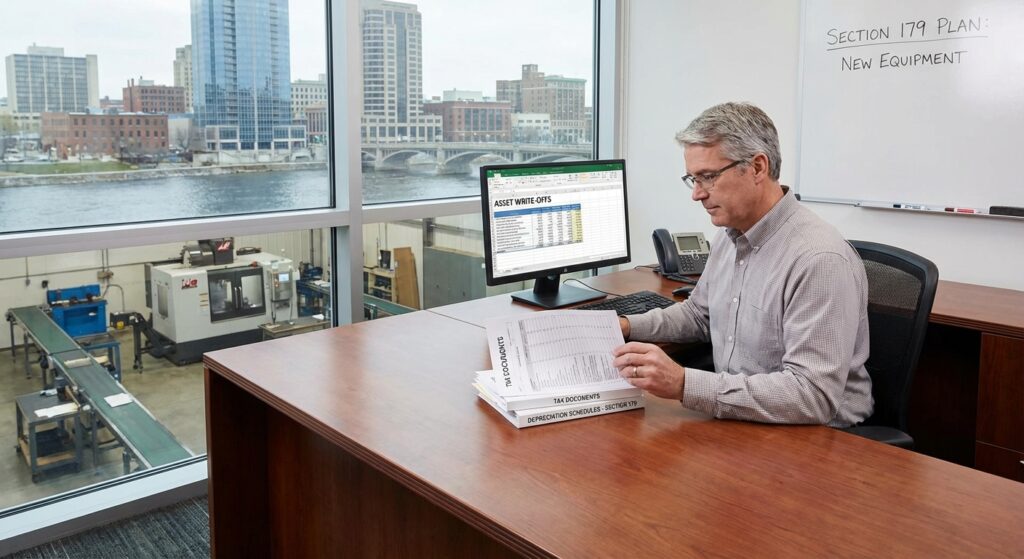
Complete Guide to Section 179 Deductions for Grand Rapids Business Owners in 2026
For 2026, Grand Rapids business owners have access to powerful tax deductions through Section 179 expensing, combined with permanent 100% bonus depreciation. The One, Big, Beautiful Bill (OBBBA) has fundamentally changed how businesses can write off equipment and property investments. This guide reveals the exact rules, limits, and strategies you need to maximize these deductions and significantly reduce your 2026 tax liability.
Table of Contents
- Key Takeaways
- What Is Section 179 Deduction?
- 2026 Section 179 Limits and Thresholds
- Bonus Depreciation: Now 100% Permanent in 2026
- What Property Qualifies for Section 179?
- Section 179 Strategy for Grand Rapids Business Owners
- Uncle Kam in Action
- Next Steps
- Frequently Asked Questions
Key Takeaways
- The 2026 Section 179 deduction limit is $1,160,000 for qualified equipment and property placed in service during the tax year.
- Bonus depreciation is now permanently set at 100% for qualified property acquired after January 19, 2025, thanks to the OBBBA.
- The Section 179 phase-out threshold for 2026 is $4,600,000; deductions decrease dollar-for-dollar above this amount.
- Grand Rapids business owners can combine Section 179 with bonus depreciation for aggressive 2026 tax savings on equipment investments.
- IRS Notice 2026-11 provides interim guidance; businesses can elect out of bonus depreciation if it suits their strategy.
What Is Section 179 Deduction?
Quick Answer: Section 179 is a tax deduction allowing business owners to immediately expense the full cost of qualifying equipment purchases rather than depreciate them over years. This accelerates tax savings into the current year.
Section 179 is one of the most valuable provisions in the Internal Revenue Code for businesses. Instead of spreading the cost of equipment over multiple years (depreciation), Section 179 allows you to deduct the entire cost in the year the property is placed in service. This means immediate tax deductions that directly reduce your taxable income for 2026.
For Grand Rapids business owners, this deduction applies to tangible personal property like machinery, equipment, vehicles, and computers. The benefit is particularly powerful when combined with bonus depreciation, which is now permanently available at 100% under the recent OBBBA legislation.
How Does Section 179 Work?
When you purchase qualifying business property, you have two traditional options: capitalize and depreciate the asset over its useful life (MACRS depreciation), or elect Section 179 expensing to deduct the full cost immediately. Section 179 is an election—you don’t have to use it, but most business owners do because of the immediate tax benefit.
The mechanics are straightforward. You purchase qualifying property (like manufacturing equipment, office computers, or delivery vehicles). At tax time, on your Form 1120-S (S Corp), Form 1065 (Partnership), or Schedule C (sole proprietor), you elect Section 179 expensing. The IRS allows you to deduct up to the annual limit—in 2026, that’s $1,160,000—against your business income.
Why This Matters for 2026
For the 2026 tax year, Section 179 combined with permanent bonus depreciation creates exceptional opportunities. Business owners in Grand Rapids can invest heavily in equipment and realize dramatic tax reductions in the same year. This is particularly valuable for businesses reinvesting profits into operations, technology upgrades, or fleet expansions.
Pro Tip: Timing equipment purchases before year-end can be strategic. Section 179 requires property to be “placed in service” by December 31 to qualify for the 2026 deduction. Plan major equipment investments accordingly.
2026 Section 179 Limits and Thresholds
Quick Answer: The 2026 Section 179 expensing limit is $1,160,000, with a $4,600,000 phase-out threshold. Excess purchases above $4,600,000 reduce the available deduction dollar-for-dollar.
Understanding the numerical limits is essential for tax planning. The IRS adjusts these limits annually for inflation. For the 2026 tax year, the rules are clear and favorable for business owners investing in equipment.
| 2026 Section 179 Metric | Amount | What It Means |
|---|---|---|
| Annual Expensing Limit | $1,160,000 | Maximum you can deduct in 2026 under Section 179 |
| Phase-Out Threshold | $4,600,000 | Property costs exceeding this reduce your available deduction |
| Phase-Out Rate | Dollar-for-Dollar | Each $1 over threshold reduces your $1,160,000 limit by $1 |
How Phase-Out Works: Practical Example
Let’s say you’re a Grand Rapids manufacturing business and purchase $5,000,000 in qualifying equipment in 2026. Here’s how the phase-out applies:
- Total equipment cost: $5,000,000
- Phase-out threshold: $4,600,000
- Amount over threshold: $400,000 ($5,000,000 – $4,600,000)
- Your 2026 Section 179 limit: $760,000 ($1,160,000 – $400,000)
In this example, you can still deduct $760,000 under Section 179, plus claim 100% bonus depreciation on the remaining qualifying property. This layered approach is why combining strategies is so powerful.
Income Limitation: When Section 179 Is Reduced
Section 179 deductions cannot exceed your taxable income from the business. If your business generates $500,000 in income, you can’t use more than $500,000 of your Section 179 election. Any unused amount carries forward to the next tax year, so it’s not lost—it just defers the tax benefit.
Pro Tip: If your business income is limited, coordinate with a tax professional about which tax strategy approach works best. Sometimes it’s better to use regular depreciation and bonus depreciation to spread benefits across multiple years.
Bonus Depreciation: Now 100% Permanent in 2026
Quick Answer: The OBBBA made 100% bonus depreciation permanent for qualified property acquired after January 19, 2025. This is a game-changing provision allowing full first-year expensing of eligible equipment.
The One, Big, Beautiful Bill fundamentally transformed depreciation rules for businesses. Previously, bonus depreciation was phasing down: 80% in 2025, declining by 20% each year. Now, 100% bonus depreciation is permanent, providing exceptional benefits for 2026 and beyond.
Bonus depreciation allows you to deduct 100% of the cost of qualifying property in the year it’s placed in service—before considering any Section 179 election. This applies to tangible personal property (equipment, machinery, vehicles) and certain qualified real property such as qualified sound recording production.
Section 179 vs. Bonus Depreciation: Key Differences
While both accelerate deductions, Section 179 and bonus depreciation work differently. Understanding the distinction helps you optimize your 2026 tax strategy.
| Feature | Section 179 | Bonus Depreciation |
|---|---|---|
| 2026 Rate | Up to $1,160,000 deduction limit | 100% (permanent) |
| Election Required | Yes—affirmative election on tax return | Automatic unless you elect out |
| Income Limit | Capped by business taxable income | No income limitation |
| Property Types | Tangible personal property and certain real property | Qualified property (broader definition) |
| Unused Amounts | Carry forward indefinitely | Carry back or forward |
Why Bonus Depreciation Is Permanent Now
The permanence of 100% bonus depreciation under the OBBBA provides business certainty. Previously, businesses had to plan around phasing-down percentages. Now, for property acquired after January 19, 2025, 100% expensing is guaranteed—a fundamental shift that benefits Grand Rapids business owners through 2026 and beyond.
This stability allows strategic long-term planning. Businesses can confidently invest in equipment knowing they’ll realize full first-year deductions. Per IRS Notice 2026-11, interim guidance clarifies how these rules apply to various property types.
What Property Qualifies for Section 179?
Quick Answer: Section 179 applies to tangible personal property, including machinery, equipment, computers, vehicles, and certain real property improvements. Property must be placed in service in 2026 and used for business.
Qualifying Property Types
Not all business property qualifies for Section 179. Understanding what does—and what doesn’t—is crucial for proper tax planning. Here are the main categories eligible in 2026:
- Machinery and Equipment: Manufacturing machines, industrial equipment, assembly line property
- Vehicles: Delivery vans, work trucks, forklifts (certain restrictions apply to personal-use vehicles)
- Technology and Computers: Servers, workstations, business software, printers
- Furniture and Fixtures: Office furniture, store fixtures, equipment built into real property
- Qualified Improvement Property: Certain interior improvements made to buildings used in business
- Specialized Property: Qualified sound recording production (per OBBBA), qualified motorsports entertainment property
Property That Does NOT Qualify
Certain property types are explicitly excluded from Section 179 expensing:
- Real property (buildings, land) with limited exceptions
- Property used for personal or mixed purposes
- Property used outside the United States
- Property leased to others
- Property held for investment only
Did You Know? The OBBBA expanded Section 179 eligibility for sound recording production, a specialized area. If your Grand Rapids business involves qualified sound recording production acquired after January 19, 2025, you may be eligible for expanded deductions.
“Placed in Service” Requirement
Property must be “placed in service” by December 31, 2026, to qualify for the 2026 deduction. This means more than just purchasing—the property must be ready for use. A machine sitting in a warehouse isn’t placed in service; one that’s installed and operational is. Grand Rapids business owners should plan equipment purchases strategically to meet year-end deadlines.
Section 179 Strategy for Grand Rapids Business Owners
Quick Answer: Maximize 2026 deductions by combining Section 179 with 100% bonus depreciation. Coordinate equipment purchases with tax year-end, evaluate income limitations, and consider multi-year planning strategies.
For Grand Rapids business owners, implementing Section 179 strategically can transform tax planning. The combination of permanent 100% bonus depreciation and generous Section 179 limits creates opportunities to dramatically reduce 2026 taxable income. Here’s how to maximize these benefits:
Strategy 1: Layer Deductions for Maximum Tax Savings
Don’t choose between Section 179 and bonus depreciation—use both. First, claim 100% bonus depreciation on eligible property. If you have remaining equipment costs, elect Section 179 for additional deductions up to $1,160,000. This layered approach maximizes first-year expensing.
Example: You purchase $1,500,000 in qualifying equipment in 2026 with $800,000 business income. Claim $1,500,000 in bonus depreciation first, but your income limit means only $800,000 deduction is available currently. The remaining $700,000 carries forward. Then use Section 179 for the next layer of equipment, if needed.
Strategy 2: Time Equipment Purchases Before Year-End
Strategic timing of equipment purchases can dramatically impact your tax position. If equipment is placed in service by December 31, 2026, you claim the full deduction in 2026. Waiting until January 2027 defers benefits by a full year. Grand Rapids business owners should plan major purchases accordingly.
This timing strategy pairs well with business cash flow planning. Some businesses coordinate equipment replacement cycles to maximize deductions in high-income years while conserving deductions for lower-income years.
Strategy 3: Consider Bonus Depreciation Election-Out
IRS Notice 2026-11 allows businesses to elect out of bonus depreciation if beneficial. Why would you decline free depreciation? Several reasons: if you anticipate higher income in future years, if you’re minimizing deductions to preserve R&D credits or other benefits, or if you need to maintain income for financing purposes.
An election-out is made on your tax return and is binding for that property. Work with a tax professional to evaluate whether electing out aligns with your broader financial strategy. For most Grand Rapids businesses, claiming full bonus depreciation benefits is optimal.
Pro Tip: Partner with professional Grand Rapids tax preparation services to coordinate Section 179 elections with your overall business structure. The difference between optimal and suboptimal planning can exceed $50,000 in annual tax savings.

Uncle Kam in Action: Manufacturing Owner Saves $87,500 with Section 179 and Bonus Depreciation
Client Snapshot: Marcus is the owner of a 15-person precision manufacturing business in Grand Rapids, Michigan. His company designs custom industrial components for automotive suppliers. Annual revenue hovers around $2.8 million, with consistent profitability.
Financial Profile: For 2026, Marcus projected $650,000 in taxable business income. His manufacturing equipment was aging and needed replacement. He planned to invest $1.2 million in new CNC machines, automation equipment, and production software.
The Challenge: Without proper tax planning, Marcus’s equipment investments would have been depreciated over 5-7 years, spreading the tax benefit. While some machines qualified for bonus depreciation, he didn’t understand how to coordinate that with Section 179 expensing. He risked missing substantial 2026 deductions and potentially paying significantly higher taxes.
The Uncle Kam Solution: Uncle Kam’s tax strategy team advised Marcus on layering deductions under 2026 rules. They structured his equipment purchases as follows: $650,000 of the $1.2 million equipment qualified for 100% bonus depreciation (claimed immediately, limited by his $650,000 income). The remaining $550,000 was allocated to Section 179 expensing. Since his business income supported the $550,000 deduction, he claimed it fully. The remaining $600,000 was depreciated traditionally over 5 years but deferred on bonus depreciation election-out to preserve flexibility.
The Results:
- Total 2026 Deductions: $1,200,000 in equipment immediately deducted against projected income
- Federal Tax Savings: $87,500 reduction in federal 2026 tax liability (at effective 35% combined rate)
- Additional Michigan Benefit: Approximately $12,000 in Michigan state tax savings through coordinated depreciation
- Investment in Strategy: Marcus invested $2,500 for the tax planning consultation and implementation
- Return on Investment: A 3,500% return on investment in the first year alone ($87,500 ÷ $2,500)
This is just one example of how our proven tax strategies have helped clients achieve significant savings and business growth. Marcus’s $87,500 tax savings translated directly into additional cash flow, which he reinvested in hiring a new engineer and upgrading his manufacturing software.
Next Steps
Take these actionable steps to maximize Section 179 and bonus depreciation benefits for your 2026 tax year:
- Audit Your Equipment Plans: Review any equipment purchases planned for 2026. Identify items that qualify for Section 179 and bonus depreciation. Prioritize placement in service before December 31.
- Calculate Potential Savings: Work with a tax professional to estimate how Section 179 and bonus depreciation affect your 2026 tax liability. Many business owners are surprised by potential savings.
- Review Your Business Structure: If you operate as a sole proprietor, partnership, or LLC, confirm you’re capturing maximum deductions. Some business structures lose access to certain benefits.
- Coordinate with Professional Advisors: Contact experienced tax strategy professionals to review your specific situation. Custom planning yields better results than generic approaches.
- Plan Equipment Timeline: If major purchases are pending, schedule them strategically within your 2026 tax year. The timing of “placed in service” dates significantly impacts your deduction timing.
Frequently Asked Questions
Can I claim Section 179 on equipment purchased but not yet installed?
No, equipment must be “placed in service” to qualify. This means it’s ready and in use for business purposes. Purchasing is only the first step; the equipment must be delivered, installed, and operational by year-end 2026 to qualify for the 2026 deduction.
What happens if I elect out of bonus depreciation?
If you elect out of bonus depreciation, you claim regular depreciation (MACRS) instead. This is rare but strategic if you’re minimizing income for specific reasons. The election is made on your tax return and is binding for that property class. Consult a tax professional before electing out.
Does Section 179 apply to leased equipment?
Generally, no. Section 179 applies to property you own and use in your business. Property you lease to others does not qualify. However, if you lease equipment to your business, that might be structured as qualifying property. The ownership structure is critical here.
Can I use Section 179 if my business had a loss?
Section 179 deductions cannot exceed your business taxable income. If you had a business loss, Section 179 cannot generate or increase losses. However, unused Section 179 deductions carry forward indefinitely, allowing you to claim them in profitable future years.
How does Section 179 work for vehicle purchases?
Vehicles can qualify for Section 179 if they’re used for business (not personal use). Passenger vehicles have special limits: the maximum Section 179 deduction per vehicle is $13,100 for 2026. Trucks and vans without rear seating have higher limits. Bonus depreciation may also apply to vehicle purchases.
Is Section 179 available for all business types?
Section 179 is available for most business types: sole proprietors, partnerships, S corporations, and C corporations. However, tax-exempt organizations, charitable entities, and individuals who generate investment income (not business income) typically don’t qualify. Confirm your entity type qualifies by consulting a tax professional.
Can Section 179 deductions be carried back to prior years?
Section 179 deductions do not carry back to prior years; they carry forward indefinitely. Unused 2026 deductions apply to 2027 and beyond. Bonus depreciation, however, can carry back to the prior year if you make an election on your current year return, providing a strategic alternative.
What documentation do I need for Section 179 deductions?
The IRS requires documentation of: the date of purchase, cost basis of property, date placed in service, business use percentage (for mixed-use property), and Form 4562 (Depreciation and Amortization) filed with your tax return. Keep receipts, invoices, and photos proving business use and installation dates.
This information is current as of 01/20/2026. Tax laws change frequently. Verify updates with the IRS (IRS.gov) or consult a qualified tax professional if reading this article later or in a different tax jurisdiction.
Last updated: January, 2026

