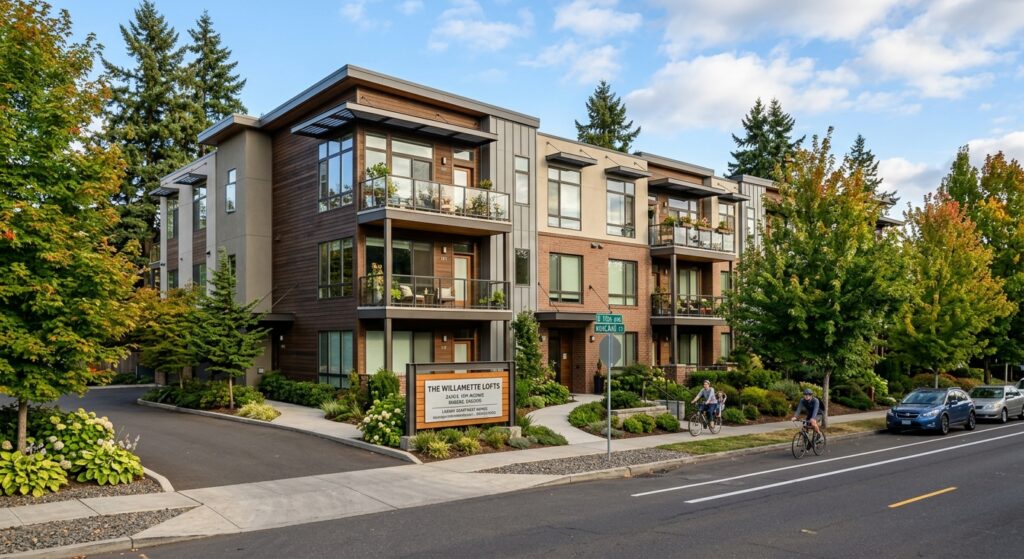
Eugene Multi-State Rental Property Taxes: 2026 Tax Planning Guide for Real Estate Investors
Managing Eugene multi-state rental property taxes requires strategic planning, especially with 2026 tax law changes under the One Big Beautiful Bill Act (OBBBA). For real estate investors juggling properties across multiple states, understanding how to navigate depreciation rules, state apportionment, and deduction limits can save thousands in annual tax liability. This comprehensive guide covers critical 2026 tax strategies specifically for rental property owners in Eugene and beyond.
Table of Contents
- Key Takeaways
- What Are the 2026 Depreciation Benefits for Rental Properties?
- How Do You Calculate Taxable Rental Income Across Multiple States?
- What Deductions Reduce Your Eugene Rental Income?
- What Entity Structure Minimizes Taxes on Oregon Rental Properties?
- How Do Passive Activity Loss Rules Apply to Multi-State Rentals?
- What State and Local Tax Strategies Work for Rental Property Owners?
- Uncle Kam in Action
- Next Steps
- Frequently Asked Questions
Key Takeaways
- 2026 bonus depreciation remains at 100%, allowing immediate deduction of property improvements for qualified assets.
- Multi-state rental properties require separate state income tax filings based on property location and income apportionment rules.
- Eugene-based rental properties benefit from Schedule E deductions including mortgage interest, maintenance, insurance, and property taxes.
- Passive activity loss limitations restrict deductions unless you qualify as a real estate professional or meet active participation tests.
- Entity structure selection (LLC, S-Corp, C-Corp) dramatically impacts self-employment taxes and overall rental property tax liability.
What Are the 2026 Depreciation Benefits for Rental Properties?
Quick Answer: For the 2026 tax year, rental property owners benefit from 100% bonus depreciation on qualified property improvements, accelerating tax deductions and improving cash flow without limiting long-term depreciation schedules.
Depreciation represents one of the most powerful tax benefits for rental property owners. For 2026, the One Big Beautiful Bill Act (OBBBA) made bonus depreciation permanent at 100%, meaning you can deduct the entire cost of qualifying property improvements in the year placed in service. This change applies to residential rental properties, commercial properties, and multi-unit dwellings.
Bonus depreciation covers kitchen renovations, roof replacements, HVAC systems, flooring upgrades, and appliances. When your Eugene rental property undergoes significant improvements, bonus depreciation allows immediate deduction of those capital expenditures rather than spreading the deduction across 27.5 years (residential property) or 39 years (commercial property).
How Bonus Depreciation Improves Your 2026 Tax Position
Consider a typical scenario: You own a four-unit rental property in Eugene with a value of $600,000. In 2026, you invest $80,000 in kitchen and bathroom renovations. Under 2026 bonus depreciation rules, you can deduct the entire $80,000 improvement cost in 2026, reducing your rental income by that amount. This creates significant tax savings, especially for investors in higher tax brackets.
Additionally, OBBBA allows cost segregation studies for rental properties. These studies break down property costs into depreciable components, accelerating depreciation on certain building systems, fixtures, and equipment. A professional cost segregation analysis typically increases first-year deductions by 20-40%, generating substantial tax savings.
Pro Tip: Work with your tax advisor and a cost segregation specialist to identify all qualifying property improvements. Retaining detailed documentation of renovations—including before-and-after photos, contractor invoices, and material lists—supports bonus depreciation claims during IRS audits.
Section 179 Expensing Limits for 2026
For 2026, the Section 179 expensing limit increased to $2.5 million under OBBBA, with phaseout beginning at $4 million in qualifying purchases. This allows rental property owners to immediately expense property improvements without bonus depreciation depreciation schedules. Section 179 applies to equipment, fixtures, and certain building systems placed in service during 2026.
How Do You Calculate Taxable Rental Income Across Multiple States?
Quick Answer: Calculate gross rental income from all properties, subtract allowable deductions, apply state-specific apportionment rules, and file separate state income tax returns where properties are located.
Multi-state rental property taxation requires understanding income apportionment rules. Oregon taxes rental income from Oregon properties based on Oregon Department of Revenue guidelines. If you own rental properties in multiple states, each state with properties imposes income tax on rental income sourced to that state.
For your Eugene rental properties, Oregon taxes 100% of rental income. For out-of-state properties, the source state taxes that rental income. You may qualify for an out-of-state income tax credit on your Oregon return, reducing double taxation on multi-state rental income.
Gross Rental Income and Schedule E Reporting
Gross rental income includes monthly rent, lease option payments, parking fees, storage fees, and late fees. On Schedule E (Rental Income and Loss), you report gross rental income for each property by location. Multi-unit properties and separately-owned properties require individual Schedule E entries.
| Income Item | 2026 Treatment | State Tax Impact |
|---|---|---|
| Monthly Rent | Fully Taxable | Oregon and property source state |
| Late Payment Fees | Fully Taxable | Oregon and property source state |
| Parking Revenue | Fully Taxable | Oregon and property source state |
| Storage Fees | Fully Taxable | Oregon and property source state |
| Tenant Damage Deposits (Returned) | Not Taxable | Not subject to taxation |
State Apportionment and Multi-State Filing Requirements
For 2026, you must file state income tax returns in every state where you own rental properties generating income. Oregon requires state tax filing for all Oregon rental property owners. Additionally, states where out-of-state properties are located require separate tax filings reporting rental income sourced to those properties. Many states offer nonresident return options allowing consolidated reporting of multi-property income.
Pro Tip: Track rental income and expenses separately by state and property. Use software that generates multi-state Schedule E forms automatically, reducing calculation errors and supporting accurate tax filing in each state.
What Deductions Reduce Your Eugene Rental Income?
Quick Answer: Mortgage interest, property taxes, insurance, maintenance, utilities, advertising, property management, and repairs directly reduce your taxable rental income on Schedule E.
Rental property deductions reduce gross rental income, lowering your taxable income. For 2026, the primary deductible expenses include mortgage interest (not principal), property taxes, homeowners insurance, property management fees, maintenance and repairs, utilities (if paid by landlord), advertising for tenants, and professional fees including tax and accounting services.
Essential Rental Property Deductions for Eugene Properties
- Mortgage Interest: Fully deductible; separate from principal repayment which is not deductible.
- Property Taxes: Deductible on Schedule E; subject to $40,000 SALT deduction cap if using itemized deductions on federal return.
- Homeowners Insurance: Fully deductible rental property insurance premiums.
- Repairs and Maintenance: Painting, roof repairs, HVAC maintenance, and plumbing repairs are deductible; capital improvements are depreciated.
- Property Management Fees: Professional property management company fees are fully deductible.
- Advertising: Online listing fees, newspaper ads, and tenant screening services are deductible.
- Professional Services: CPA, tax attorney, and legal fees for rental property management are deductible.
- Utilities: If landlord-paid, electric, gas, and water utilities are deductible.
- Supplies and Equipment: Office supplies, tools under $2,500, and minor equipment purchases are deductible.
Capital Improvements vs. Repairs
The distinction between repairs (deductible) and capital improvements (depreciated) is critical for 2026 tax planning. Repairs restore property to original condition without extending useful life—painting, plumbing fixes, and roof spot repairs qualify. Capital improvements add value, prolong life, or adapt property to new uses—roof replacement, kitchen remodeling, and HVAC system installation. For improvements exceeding $2,500, cost segregation studies clarify depreciable components versus deductible repairs.
What Entity Structure Minimizes Taxes on Oregon Rental Properties?
Quick Answer: Entity structure selection (LLC, S-Corp, or C-Corp) determines self-employment tax obligations, liability protection, and overall tax liability on rental property income.
Your entity structure dramatically impacts Eugene rental property taxes. Many Eugene-based real estate investors structure rental properties through limited liability companies (LLCs), S-Corporations, or traditional corporations. Each entity type offers distinct tax implications for 2026. Use our LLC vs S-Corp Tax Calculator to model tax differences for your specific rental property situation.
Comparing Entity Structures for Rental Properties
| Entity Type | Self-Employment Tax | Income Limitation | Liability Protection |
|---|---|---|---|
| Sole Proprietor | 15.3% on net income | No limitation | None |
| LLC (Default Taxation) | 15.3% on net income | No limitation | Full protection |
| S-Corp Election | Only on W-2 salary (reduced) | 100 shareholders max | Full protection |
| C-Corp | Only on W-2 salary | Unlimited shareholders | Full protection |
S-Corp Election Benefits for High-Income Rental Property Owners
For Eugene rental property owners with annual net rental income exceeding $80,000, electing S-Corp taxation typically generates significant self-employment tax savings. S-Corps require you to pay reasonable W-2 salary to yourself (subject to 12.4% Social Security tax and 2.9% Medicare tax), then distribute remaining profits as dividends (avoiding 15.3% self-employment tax). For a rental property with $200,000 net income, paying $80,000 reasonable salary and taking $120,000 dividend distributions saves approximately $18,000 in self-employment taxes annually.
S-Corp elections require separate corporate tax returns (Form 1120-S), payroll processing, and annual compliance filings. The tax savings typically offset these costs for properties generating sufficient income.
How Do Passive Activity Loss Rules Apply to Multi-State Rentals?
 Free Tax Write-Off Finder
Quick Answer: Passive activity loss limitations restrict deductions to $25,000 annually unless you qualify as a real estate professional or meet active participation requirements.
Rental property losses are classified as passive activity losses under Internal Revenue Code Section 469. For 2026, passive activity loss limitations restrict rental property loss deductions to $25,000 annually for married filing jointly taxpayers with modified adjusted gross income under $100,000. Above $100,000 MAGI, the $25,000 exemption phases out by $1 for each $2 of income, completely eliminating the exemption at $150,000 MAGI.
Real Estate Professional Status Exception
Real estate professionals may deduct unlimited passive activity losses if they meet two requirements: more than 50% of personal services rendered during the year are in real property trades or businesses, and more than 750 hours are spent in such activities. Real estate agents, brokers, developers, and property managers may qualify. If you operate as a real estate professional, Eugene rental property losses can offset other income without limitation.
For multi-state rental properties, real estate professional status applies to all qualifying activities. Filing Form 8582 supports real estate professional classification with the IRS.
Pro Tip: Passive activity loss carryforwards accumulate indefinitely and can offset future passive activity gains. If you generate $50,000 in losses in 2026 but only deduct $25,000, the $25,000 excess carryforwards and may be deductible in future years when passive activity gains exceed losses.
What State and Local Tax Strategies Work for Rental Property Owners?
Quick Answer: Leverage the expanded $40,000 SALT deduction cap, out-of-state income tax credits, and deduct property taxes through Schedule E to minimize Oregon and multi-state tax burden.
For 2026, state and local tax (SALT) planning becomes critical for Eugene rental property owners. The Trump tax law temporarily raised the SALT deduction cap to $40,000 through 2029 (reverting to $10,000 in 2030), significantly benefiting high-income real estate investors. Rental property taxes paid to Lane County and the City of Eugene are deductible on Schedule E and count toward the SALT limitation.
SALT Deduction Maximization Strategies
Rental property owners with multiple properties can strategically deduct property taxes on Schedule E (rental deductions) rather than itemizing personal deductions. This allows maximum benefit of the $40,000 SALT cap. Property taxes on rental property owned personally versus through an entity create different deduction scenarios requiring careful planning.
For multi-state rental properties, each state’s property tax is deductible on that state’s income tax return. Oregon allows full deduction of Oregon property taxes on Oregon return. Out-of-state property taxes paid generate tax credits on your Oregon return, preventing double taxation.

Uncle Kam in Action: Multi-State Rental Property Tax Optimization
Client Profile: Sarah, a Eugene-based real estate investor, owns four rental properties: two in Eugene (Oregon), one in Portland (Oregon), and one in Boise (Idaho). Combined annual gross rental income totals $240,000 with $85,000 in deductible expenses. Sarah filed taxes as a sole proprietor, paying significant self-employment taxes and managing passive activity loss limitations across states.
The Challenge: Sarah’s rental properties generated substantial losses in 2025 due to major roof replacement ($45,000) and kitchen remodeling ($60,000) on her Portland property. She needed strategies to preserve passive activity losses, minimize self-employment taxes, and optimize her 2026 tax position across multiple states. Additionally, she was unclear about which improvements qualified for bonus depreciation versus capitalized depreciation.
The Uncle Kam Solution: Uncle Kam’s team restructured Sarah’s rental properties into separate single-member LLCs for each property, then elected S-Corp taxation for each LLC. This approach provided liability protection across all properties while reducing self-employment tax obligations. We implemented a cost segregation study on her Portland property, identifying $42,000 in equipment and fixtures eligible for 5-year and 7-year depreciation schedules rather than standard 27.5-year residential depreciation. For her 2026 Oregon properties, we optimized property tax deductions using the expanded SALT cap while filing separate Idaho return for her Boise property with state income tax credit to prevent double taxation.
The Results: Sarah’s S-Corp elections reduced 2026 self-employment taxes by $18,500 through reasonable salary structuring. The cost segregation study accelerated depreciation deductions, creating $32,000 in first-year deductions. Multi-state tax optimization generated $8,200 in additional tax savings through coordinated state filing and credit utilization. Total first-year tax benefit: $58,700, representing 24% return on Uncle Kam’s services (2.4x ROI). Sarah’s passive activity loss carryforwards from 2025 were preserved and strategically applied in future years when portfolio generates passive gains.
Sarah now has a sustainable multi-state rental property structure supporting future acquisitions, providing liability protection, and generating consistent tax optimization across state lines.
Next Steps
Ready to optimize your Eugene multi-state rental property taxes? Take these strategic actions now:
- Review Your Entity Structure: Contact a Eugene tax professional to evaluate whether S-Corp election saves you self-employment taxes compared to current structure.
- Identify Depreciation Opportunities: Compile documentation of all 2026 property improvements and request cost segregation analysis for properties exceeding $300,000 value.
- Document State Tax Compliance: Ensure you’re filing required state income tax returns in every state where rental properties generate income, with proper apportionment and credits.
- Organize Deduction Records: Implement systematic tracking of rental property expenses using accounting software that categorizes deductions by property and state.
- Schedule Tax Planning Meeting: Meet with your CPA or tax advisor before year-end 2026 to review passive activity loss position and plan 2027 tax strategy.
Frequently Asked Questions
Can I Deduct Rental Property Losses If I Own Multiple Properties Across States?
Yes, but passive activity loss limitations apply to total rental activity. For 2026, you can deduct up to $25,000 in net rental losses annually (married filing jointly, MAGI under $100,000). Multi-property losses aggregate for this limitation. However, if you qualify as a real estate professional or meet active participation requirements, you may deduct losses without limitation.
Are Vacation Rentals and Short-Term Rentals Taxed Differently Than Long-Term Rentals?
Generally, both are taxed as rental income with same deduction treatment. However, short-term rentals and vacation properties may trigger additional state and local taxes. Some cities including Eugene impose additional licensing fees and regulations on short-term rentals. Oregon and federal treatment remains consistent—Schedule E reporting, depreciation eligibility, and passive activity rules apply to both short-term and long-term rentals similarly. Consult local regulations for your specific property.
How Does the $40,000 SALT Deduction Cap Affect My Rental Property Taxes?
For 2026, SALT deduction cap remains at $40,000 (up from $10,000 through 2029, then reverting to $10,000 in 2030). Rental property taxes paid to Oregon and Lane County count toward this cap. If you pay $50,000 in property taxes on rental properties, only $40,000 is deductible against your federal taxable income. Schedule E deductions for mortgage interest don’t count toward SALT cap—only property taxes count.
What Happens to Passive Activity Loss Carryforwards When I Sell a Rental Property?
Passive activity loss carryforwards from a specific property become fully deductible in the year you sell that property. If you’ve accumulated $40,000 in losses from your Eugene rental property over five years (only deducting $25,000 annually due to limitations), all $40,000 becomes deductible in the sale year. Plan property dispositions strategically to maximize loss deductions in high-income years.
Should I File My Multi-State Rental Properties Through Separate LLCs or One Entity?
Separate LLCs per property provide maximum liability protection—a lawsuit involving one property won’t affect others. Single entity simplifies tax filing but concentrates liability. For multi-state properties, separate LLCs per property are generally recommended, especially if any property has significant mortgage debt or high liability risk. Tax filing complexity increases minimally with multiple entities, and liability benefits typically justify the extra cost.
Can I Deduct Home Office Expenses If I Manage Rental Properties From My Eugene Home?
Yes, qualified home office expenses are deductible on Schedule C (self-employed) or Schedule E (rental management expenses). Rent/mortgage interest, utilities, insurance, and depreciation allocable to office space are deductible using the simplified method ($5 per square foot, max 300 sq. ft.) or actual expense method. Rental property home office expenses don’t count toward passive activity loss limitations if you meet office requirements and maintain clear separation from personal use.
What Records Should I Keep for Eugene Rental Property Tax Audits?
Maintain complete documentation for all rental property records: property deeds and purchase documentation, annual property tax assessments from Lane County, rental agreements with tenants, deposit and rent collection records, bank statements showing income and expense payments, contractor invoices for repairs and improvements, property insurance policies, property management company statements if applicable, utility bills, depreciation schedules, and cost segregation studies supporting accelerated depreciation claims. The IRS typically audits rental properties for three years following filing. Organized record retention supports successful audit defense.
This information is current as of March 30, 2026. Tax laws change frequently. Verify updates with the IRS or a qualified tax professional if reading this after quarter-end.
Related Resources
- Tax Strategy Services for Real Estate Investors
- Real Estate Investor Tax Planning
- Entity Structuring for Multi-Property Portfolios
- IRS Form 1120-S: S-Corporation Tax Return
- Oregon Department of Revenue – Rental Property Tax Guidance
Last updated: March, 2026

