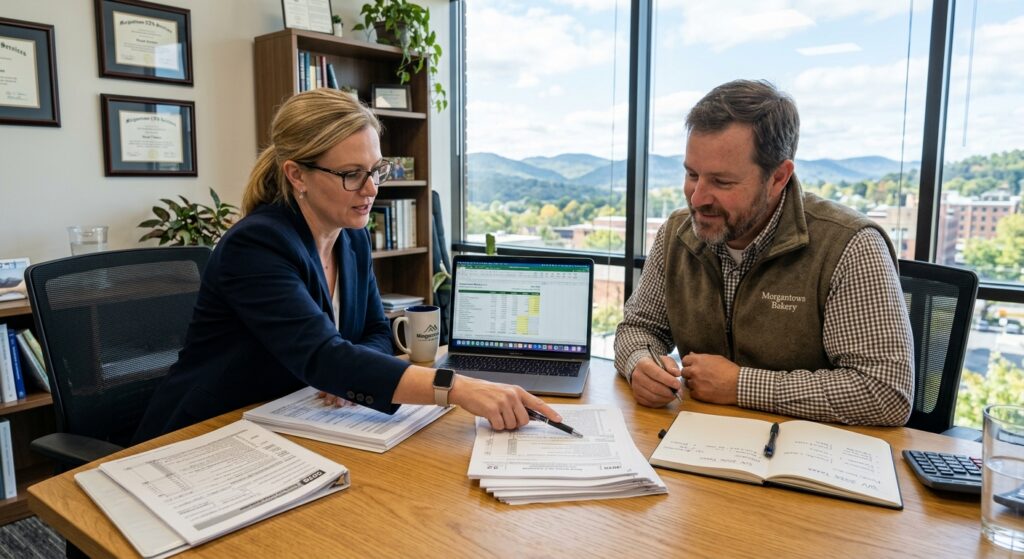
Essential Morgantown CPA Tax Strategies for 2026: A Business Owner’s Complete Guide

Essential Morgantown CPA Tax Strategies for 2026: A Business Owner’s Complete Guide
As a Morgantown business owner navigating the 2026 tax year, you need guidance from a Morgantown CPA who understands current federal and West Virginia tax rules. From choosing the right business structure to maximizing deductions and planning retirement contributions, proactive tax strategy can save you thousands of dollars each year.
Table of Contents
- Key Takeaways
- What Morgantown Businesses Should Focus on for 2026 Taxes
- How to Optimize Your 2026 Retirement Contributions as a Business Owner
- What Are the Tax Benefits of Changing Your Business Structure in 2026?
- How to Maximize Business Deductions and Reduce Your 2026 Tax Liability
- How Should Self-Employed Professionals Handle 1099 Income and Reporting?
- Real Estate Investor Opportunities in 2026: How a Morgantown CPA Can Help
- Next Steps
- Frequently Asked Questions
Key Takeaways
- Working with a Morgantown CPA helps you coordinate federal, West Virginia, and local tax rules that affect your business.
- The way your business is structured (sole proprietor, LLC, S corporation) has a direct impact on how much tax you pay.
- Retirement plans such as SEP IRAs and Solo 401(k)s can significantly reduce taxable income for 2026.
- Detailed recordkeeping and a solid bookkeeping system are essential to capturing every legal deduction.
- Quarterly estimated tax planning can help you avoid penalties and manage cash flow more effectively.
What Morgantown Businesses Should Focus on for 2026 Taxes
Quick answer: For 2026, Morgantown businesses should pay close attention to entity choice, owner compensation, retirement contributions, and tracking deductible expenses. These four levers usually drive most of your tax savings.
Morgantown is home to a wide mix of businesses—professional services, construction, tech, medical practices, and short-term rentals serving West Virginia University visitors. Each faces different tax issues, but most owners share a few common goals: lower taxes, better cash flow, and fewer surprises at filing time.
A local Morgantown tax preparation and planning firm can help you map out a strategy that considers:
- Your mix of W‑2 wages, business income, rental income, and investment income
- Whether you should remain a sole proprietor, form an LLC, or elect S corporation status
- Which deductions and credits apply to West Virginia filers specifically
Coordinating Federal and West Virginia Tax Rules
West Virginia generally starts with your federal taxable income but does not follow every federal rule. A Morgantown CPA can help you understand:
- Which federal deductions pass through to your West Virginia return
- How West Virginia treats business income, retirement income, and certain credits
- What records you should keep in case the state or IRS questions your return
How to Optimize Your 2026 Retirement Contributions as a Business Owner
Quick answer: For many Morgantown owners, the biggest legal tax shelter is a small‑business retirement plan—often a SEP IRA or Solo 401(k). The right plan can let you move tens of thousands of dollars from taxable income into tax‑deferred savings for 2026.
Instead of looking for exotic deductions, many business owners can lower their 2026 tax bill simply by putting more money into retirement. A Morgantown CPA can help compare options such as:
- Traditional or Roth IRA – simpler accounts with relatively modest annual limits.
- SEP IRA – often ideal for solo owners or very small teams, with contributions based on a percentage of compensation or net earnings.
- Solo 401(k) – can allow higher total contributions when you have strong profits.
| Plan Type | Best For | Key 2026 Advantage |
|---|---|---|
| Traditional / Roth IRA | Owners just starting to save | Simple setup; potential deduction for traditional IRA contributions if you qualify |
| SEP IRA | Profitable one‑owner or small businesses | High contribution potential based on a percentage of net earnings |
| Solo 401(k) | Owners with very high income and no full‑time staff (other than spouse) | Employee and employer contributions allow aggressive tax‑deferred savings |
Your Morgantown CPA can run side‑by‑side scenarios for 2026 to show how much each retirement option might cut your current‑year tax bill while building long‑term wealth.
What Are the Tax Benefits of Changing Your Business Structure in 2026?
 Free Tax Write-Off Finder
Quick answer: Moving from a sole proprietorship to an LLC taxed as an S corporation can reduce how much of your profit is subject to self‑employment tax, which may save a successful Morgantown owner thousands per year when done correctly.
Many Morgantown entrepreneurs start as sole proprietors because it is simple and inexpensive. As profits grow, though, that simplicity can become costly. All Schedule C profit is subject to self‑employment tax in addition to income tax.
An LLC with an S corporation election lets you split income between:
- Reasonable salary – subject to payroll taxes (Social Security and Medicare).
- Owner distributions – generally not subject to self‑employment tax if structured properly.
A Morgantown CPA will look at your 2025 and 2026 projected profit, compare sole proprietor vs. S corporation scenarios, and factor in the extra costs (payroll, separate returns, bookkeeping) to see whether an election makes financial sense for you.
Reasonable Compensation and IRS Expectations
The IRS expects S corporation owners who work in the business to pay themselves a salary that is reasonable for the services they provide. Underpaying yourself to avoid payroll tax can create audit risk. Your CPA can help you document your role, industry pay data, and local Morgantown market factors to support a defensible compensation level.
How to Maximize Business Deductions and Reduce Your 2026 Tax Liability
Quick answer: You lower your 2026 tax bill by identifying every ordinary and necessary business expense, tracking it in real time, and keeping support for each deduction. Most savings come from categories like home office, vehicle use, equipment, travel, and professional services.
Many Morgantown owners underestimate how much of their spending is legitimately business‑related. Common deductible categories include:
- Home office expenses – if you use a dedicated space in your Morgantown home regularly and exclusively for business, a portion of rent or mortgage interest, utilities, and insurance may be deductible.
- Vehicle and mileage – trips to clients, job sites, supply stores, and professional events can be deducted based on actual expenses or the IRS standard mileage rate.
- Equipment and software – computers, tools, cloud software subscriptions, and point‑of‑sale systems used for your Morgantown business operations.
- Professional services – fees paid to your Morgantown CPA or tax advisor, attorneys, consultants, and marketing specialists.
A dedicated bookkeeping process—whether in‑house or through an outside accounting and bookkeeping service—makes it much easier to capture deductions consistently instead of trying to rebuild the year from bank statements each March.
How Should Self-Employed Professionals Handle 1099 Income and Reporting?
Quick answer: Whether or not you receive a Form 1099, all self‑employment income is taxable. Keep your own records of client payments, reconcile them against the 1099s you receive, and be sure your Schedule C or business return reports at least that much income.
Morgantown freelancers and independent contractors often work with a mix of local and out‑of‑state clients. Some will issue 1099‑NEC forms; others may pay you through platforms that issue Forms 1099‑K. Common mistakes include:
- Reporting only what is shown on 1099s and forgetting about smaller clients that did not meet reporting thresholds
- Double‑counting income when the same payment appears on both a 1099‑NEC from a client and a 1099‑K from a processor
- Failing to back out refunds or chargebacks that were included in gross payment totals
Your Morgantown CPA can help you reconcile all 1099 forms with your books so you report income accurately and still pay the lowest legal amount of tax.
Real Estate Investor Opportunities in 2026: How a Morgantown CPA Can Help
Quick answer: Rental property owners and short‑term rental hosts around Morgantown can use depreciation, expense grouping, and careful recordkeeping to soften the tax impact of rental income—and, in some cases, offset other income.
Between university‑related rentals, football‑weekend short‑term stays, and long‑term housing, real estate remains a major part of the Morgantown economy. A CPA who regularly works with local landlords can help you:
- Separate the value of land vs. buildings for depreciation purposes
- Decide whether short‑term rental activity is treated as a business or as rental income
- Track repairs vs. improvements, which are deducted differently for tax purposes
Good planning can turn your 2026 rental portfolio into both a cash‑flow and tax‑efficient investment rather than a year‑end tax headache.
Next Steps for Morgantown Business Owners
To put these ideas to work for 2026, consider the following action plan:
- Schedule a mid‑year review with a Morgantown CPA to review your entity type, projected profit, and estimated taxes.
- Implement or upgrade your bookkeeping system so every 2026 business expense is captured as it occurs.
- Map out a retirement contribution target for 2026 and set up automatic transfers where possible.

Frequently Asked Questions
How can a Morgantown CPA help me lower my 2026 taxes if I already use tax software?
Tax software is designed to file a return based on numbers you enter. A CPA is trained to help you change the numbers legally—by adjusting your entity structure, timing of income and expenses, owner compensation, and retirement strategy. Most meaningful savings come from decisions made during the year, not when you hit “submit” in April.
When should a Morgantown sole proprietor consider becoming an LLC or S corporation?
There is no single income threshold that fits everyone, but many owners revisit their structure once they consistently net at least tens of thousands of dollars per year from their business. At that point, the potential tax savings and liability protection can justify the extra costs and paperwork. A local CPA can model different scenarios using your actual 2025–2026 numbers.
Do I really need to pay quarterly estimated taxes in 2026?
If you expect to owe at least a modest amount of tax that is not being covered by wage withholding, the IRS and West Virginia both expect you to make estimated payments. Quarterly planning with your CPA helps you avoid underpayment penalties and prevents a large surprise balance due at filing time.
What records should I keep for my Morgantown business in case of an audit?
Maintain bank and credit card statements, invoices, receipts, mileage logs, payroll reports, and copies of prior‑year returns. Digital storage is fine as long as the images are legible and complete. Keep business and personal accounts separate; this makes it much easier for your CPA to defend deductions if the IRS or state asks questions.
This article provides general information only and is not a substitute for personalized advice. Always consult a qualified Morgantown CPA or tax advisor about your specific situation.

