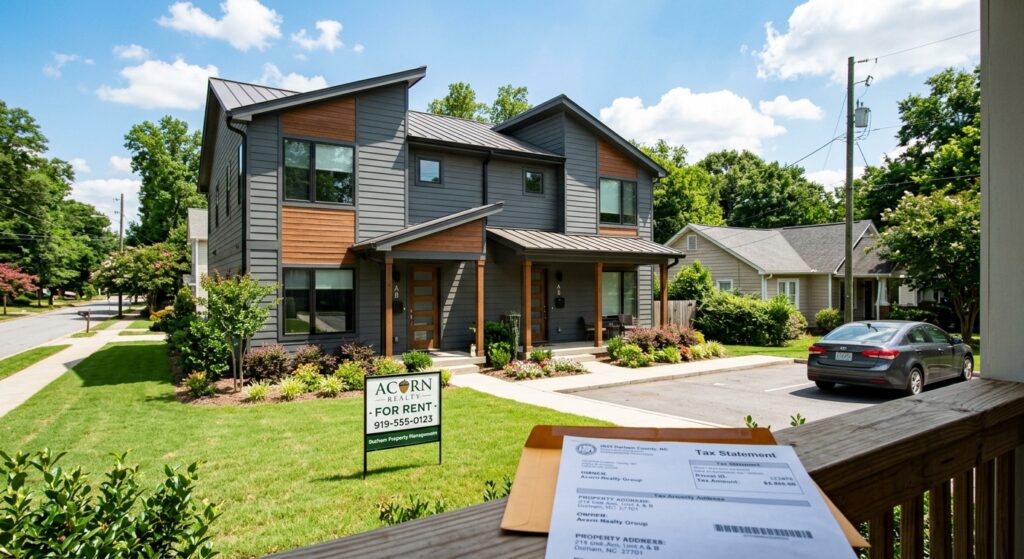
Durham Rental Property Taxes 2026: Complete Tax Strategy Guide for Landlords
For Durham rental property owners in 2026, navigating Durham rental property taxes requires understanding both federal changes and state-specific rules. The 2026 tax year brings significant changes under the One Big Beautiful Bill Act (OBBBA), including new deduction opportunities worth thousands of dollars and critical reporting changes that affect how you file Schedule E. This comprehensive guide walks you through every deduction available to Durham landlords, explains the new vehicle loan interest deduction ($10,000 maximum), and shows you exactly how to optimize your rental income reporting to minimize your tax burden.
Key Takeaways
- The One Big Beautiful Bill Act (OBBBA) introduces vehicle loan interest deduction (up to $10,000 annually) and overtime pay deductions ($12,500 individual; $25,000 joint) for 2026.
- Schedule E rental deductions include mortgage interest (unlimited), property taxes, HOA fees, repairs, depreciation on residential properties (27.5-year recovery period), and management fees.
- New W-2 reporting for qualified tips and overtime compensation creates separate filing requirements that interact with rental income planning.
- Durham landlords must understand how federal deductions apply to North Carolina state returns, where some states conform to OBBBA while others require add-backs.
- Proper documentation and strategic timing of deductions can reduce taxable rental income by $15,000-$40,000+ annually depending on property portfolio size.
Table of Contents
- Key Takeaways
- What Are 2026 Schedule E Deductions for Durham Rental Properties?
- How Does the $10,000 Vehicle Loan Interest Deduction Work in 2026?
- How Does OBBBA Change W-2 Reporting for Landlords?
- What Depreciation Rules Apply to 2026 Rental Property?
- How Do Durham Property Taxes Interact With Federal Deductions?
- Uncle Kam in Action
- Next Steps
- Frequently Asked Questions
What Are 2026 Schedule E Deductions for Durham Rental Properties?
Quick Answer: Schedule E allows unlimited deductions for mortgage interest, property taxes, HOA fees, repairs, utilities, insurance, depreciation, and management fees. For 2026, these deductions combine with new OBBBA provisions to create significant tax-saving opportunities for Durham landlords managing multiple properties.
Schedule E (Supplemental Income and Loss) is the IRS form where Durham rental property owners report all rental income and claim deductions. Unlike personal residences, rental properties enjoy broad deduction opportunities that directly reduce taxable income dollar-for-dollar. For the 2026 tax year, understanding what qualifies ensures you capture every available deduction.
Unlimited Mortgage Interest and Property Tax Deductions
Unlike owner-occupied properties where mortgage interest deductions cap at $750,000 of debt (for loans taken after 2017), rental property mortgage interest carries no deduction limit. If you have a $500,000 mortgage at 6% interest on your Durham rental property, you can deduct approximately $30,000 in mortgage interest annually on Schedule E. North Carolina landlords may also deduct 100% of property taxes paid during the year. These two deductions alone often reduce taxable rental income by 40-60% depending on your mortgage balance and property value.
A Durham landlord with $400,000 in annual rental income, a $300,000 mortgage balance, and property taxes of $4,000 could potentially deduct $18,000 in mortgage interest plus $4,000 in property taxes, reducing taxable rental income to approximately $378,000 through these two deductions alone.
HOA Fees, Repairs, Insurance, and Utilities
Homeowners Association (HOA) fees are 100% deductible for rental properties on Schedule E. Repairs (not capital improvements) to maintain the property in rentable condition qualify. Property insurance premiums are fully deductible. Utilities paid by the landlord reduce taxable income. Lawn maintenance, common area maintenance, and tenant screening costs all qualify as deductible business expenses. These operating expenses, combined with mortgage interest and property taxes, typically reduce taxable rental income by 50-75% on well-managed properties.
Pro Tip: Keep detailed receipts for all repairs, maintenance, and operating expenses. The IRS distinguishes between repairs (fully deductible) and capital improvements (depreciated over time). A new roof is capital; replacing damaged shingles is repair. Documentation separates these correctly.
How Does the $10,000 Vehicle Loan Interest Deduction Work in 2026?
Quick Answer: For the first time in nearly 40 years, personal vehicle loan interest is tax deductible up to $10,000 annually through 2028. The vehicle must be brand new, U.S.-assembled, under 14,000 pounds, for personal use, and the loan must have started after December 31, 2024 to qualify for this 2026 deduction.
The One Big Beautiful Bill Act introduced an unprecedented opportunity: deducting up to $10,000 in vehicle loan interest annually. This applies to brand new vehicles only—not used vehicles or leased vehicles. The vehicle must weigh less than 14,000 pounds, have its final assembly in the United States, and be used primarily for personal purposes (more than 50% personal use). A Durham landlord purchasing a new Tesla or Ford for personal transportation could deduct up to $10,000 in loan interest, potentially saving $2,000-$3,500 in federal taxes annually depending on tax bracket.
Qualification Requirements for Vehicle Interest Deduction
- Vehicle must be brand new (not used or previously owned)
- Vehicle weight under 14,000 pounds (most sedans, SUVs, and pickup trucks qualify)
- Final assembly location must be United States (check vehicle identification number on IRS VIN decoder)
- Vehicle must be used for personal purposes more than 50% of the time
- Loan must have started after December 31, 2024 (applies to 2025+ loans)
- Deduction available through 2028 (expires December 31, 2028)
Critically, this deduction does not apply to vehicles used primarily for business or rental purposes. If you use a vehicle to drive tenants or manage properties, you claim mileage deduction instead (standard mileage rate for 2026). However, if you purchase a new vehicle primarily for personal use and happen to drive 15% of miles for rental property management, you qualify for the $10,000 deduction.
Calculating Your Vehicle Interest Deduction
If you financed $35,000 at 5.5% interest over 72 months, your first-year interest would be approximately $1,875. Since this is below the $10,000 cap, you claim the full $1,875. In subsequent years, interest paid decreases as principal grows, but the maximum annual deduction remains $10,000. A Durham landlord who takes advantage of this provision over the three available years (2026-2028) could reduce federal taxable income by approximately $5,500-$6,500 total, generating $1,500-$2,300 in total tax savings depending on federal tax bracket.
How Does OBBBA Change W-2 Reporting for Landlords?
Quick Answer: Beginning in 2026, Form W-2 now includes separate lines for qualified tips and overtime compensation. Landlords must track and report these amounts correctly, and understand how they integrate with rental income tax planning since they appear on employee wages, not rental income (Schedule E).
The One Big Beautiful Bill Act introduced a landmark change: qualified tips are now excluded from federal income tax, and overtime compensation receives new deduction treatment. These changes affect Form W-2 reporting beginning with the 2026 tax year. While this primarily impacts W-2 wage earners (not Schedule E rental income), it affects landlords who are also W-2 employees with tips or overtime income.
Impact on Landlord Tax Planning
A Durham landlord who receives $80,000 in rental income but also works as a hospitality manager earning $50,000 in wages plus $8,000 in tips now faces different tax treatment. The W-2 will show qualified tips separately, and the employer must withhold and report them correctly. However, the landlord can also claim an overtime pay deduction up to $12,500 (individual filers) or $25,000 (joint filers) if they earned overtime compensation. These changes don’t directly affect Schedule E rental property reporting, but they reduce overall taxable income when combined with rental property deductions.
North Carolina follows federal W-2 reporting requirements, so both federal and state returns reflect these new separate line items. Tax professionals recommend running separate tax scenarios for 2026 to compare total tax liability under old rules versus new OBBBA provisions.
What Depreciation Rules Apply to 2026 Rental Property?
 Free Tax Write-Off Finder
Quick Answer: Residential rental properties use a 27.5-year depreciation recovery period under MACRS (Modified Accelerated Cost Recovery System). For 2026, you deduct approximately 3.64% of the property’s basis annually, creating significant deductions that do not require actual cash outlay.
Depreciation is the most powerful deduction available to rental property owners because it reduces taxable income without reducing cash flow. When you purchase a Durham rental property for $400,000, you allocate approximately 80% ($320,000) to the building structure and 20% ($80,000) to the land (land cannot be depreciated). Using the 27.5-year MACRS recovery period, you deduct approximately $11,636 annually ($320,000 ÷ 27.5 years), reducing taxable rental income by this amount every year for 27.5 years regardless of whether the property appreciates or depreciates in value.
Maximizing Depreciation Strategy for 2026
Consider this scenario: A Durham landlord purchases a $500,000 duplex in 2026 with $400,000 allocated to the building. Annual depreciation deduction = $400,000 ÷ 27.5 = $14,545. Combined with mortgage interest ($18,000), property taxes ($5,000), and operating expenses ($8,000), total deductions reach $45,545 against potentially $60,000 in annual rental income. The landlord shows a tax loss of -$14,455 on Schedule E despite receiving positive monthly cash flow. This is legal tax planning—the depreciation deduction shelters rental income from taxation, though depreciation recapture applies when you sell the property.
| Deduction Category | Annual Amount | Taxable Impact |
|---|---|---|
| Mortgage Interest (27-year loan, 5.5%) | $18,000 | Reduces income by $18,000 |
| Property Taxes (Durham County average) | $5,000 | Reduces income by $5,000 |
| Depreciation (27.5-year, $400K basis) | $14,545 | Reduces income by $14,545 |
| Operating Expenses (insurance, repairs, HOA) | $8,000 | Reduces income by $8,000 |
| Total Deductions | $45,545 | Total reduction: $45,545 |
How Do Durham Property Taxes Interact With Federal Deductions?
Quick Answer: Durham property taxes are 100% deductible on Schedule E for rental properties with no cap. Federal deductions (mortgage interest, taxes, depreciation) apply to Schedule E reporting. North Carolina state taxes follow federal conformity for most provisions, though some OBBBA provisions require separate state treatment.
Durham County property taxes on rental properties are fully deductible federal deductions on Schedule E. Unlike personal residences where property taxes count toward the $40,000 SALT (State and Local Tax) deduction cap, rental property taxes carry no limitation. A Durham landlord with $60,000 in annual property taxes across a four-property portfolio deducts all $60,000 against rental income, reducing federal taxable income by $60,000.
North Carolina State Tax Treatment
North Carolina generally conforms to federal rental property deduction rules, meaning Schedule E deductions flow through to state returns similarly. However, North Carolina’s Department of Revenue has indicated that more than 20 states have introduced varying legislation addressing OBBBA provisions, particularly around tips, overtime, and vehicle loan interest deductions. Durham landlords who also have W-2 wages with tips or overtime need to verify NC’s specific treatment of these new deductions versus federal treatment. Some states conform fully; others require add-backs to income, creating a patchwork compliance environment requiring professional guidance to ensure accuracy on both state and federal returns.
Pro Tip: Work with a tax professional experienced in North Carolina rental property taxation. Verify current NC conformity status for OBBBA provisions, particularly regarding vehicle interest, overtime, and tip deductions. NC tax treatment of depreciation remains aligned with federal treatment, so rental property depreciation continues to reduce NC state taxable income dollar-for-dollar with federal treatment.

Uncle Kam in Action: Sarah’s Durham Multi-Property Investment Tax Plan
Sarah, a Durham real estate investor, owned four rental properties generating $180,000 in annual gross rental income. She had multiple mortgages totaling $900,000 with average interest rates of 5.5%, accumulated property taxes of $18,000 annually across all four properties, and managed her properties partly herself with professional management for two properties.
The Challenge: Sarah faced a potential federal tax liability exceeding $40,000 on her rental income. She had recently purchased a new vehicle for personal use and wanted to understand how 2026 OBBBA provisions could reduce her overall tax burden while ensuring compliance with new W-2 reporting requirements she encountered through her part-time hospitality consulting work.
Uncle Kam’s Solution: We conducted a comprehensive analysis of Sarah’s rental property deductions for 2026. Here’s what we optimized:
- Mortgage Interest Deduction: $49,500 (on $900,000 average balance at 5.5%)
- Property Taxes: $18,000 (fully deductible, no SALT cap for rentals)
- Depreciation Deduction: $52,364 (27.5-year recovery on $1,439,880 building basis across four properties)
- Operating Expenses: $24,500 (insurance, repairs, management fees, HOA where applicable)
- Vehicle Interest Deduction: $3,200 (on new vehicle loan, within $10,000 OBBBA cap)
Total Deductions: $147,564
Against her $180,000 gross rental income, Sarah reported a Schedule E loss of -$32,436. Combined with her consulting income (where we optimized new OBBBA overtime deductions), her overall federal taxable income reduced by over $45,000. Based on Sarah’s 24% federal tax bracket (from her consulting wages plus rental income), the total 2026 federal tax savings exceeded $10,800 through optimization of 2026 deductions alone.
Additional Value: We ensured Sarah’s W-2 consulting income correctly separated tips and overtime per OBBBA, verified North Carolina conformity on all deductions, and documented depreciation recapture liability on Schedule E to prepare for eventual property sale. Sarah also adjusted her estimated quarterly tax payments for 2026 to reflect the lower estimated tax liability, improving her monthly cash flow.
Investment = Uncle Kam tax planning fee of $2,400
Return = First-year federal tax savings of $10,800 (4.5x return)
Next Steps: Optimize Your 2026 Durham Rental Property Taxes
1. Document All Rental Property Expenses: Gather receipts for mortgage interest, property taxes, HOA fees, repairs, insurance, and management fees. Separate capital improvements (depreciated) from repairs (immediately deductible). For Durham landlords, this documentation directly supports Schedule E deductions reducing federal and North Carolina state taxable income.
2. Review Vehicle Financing for OBBBA Eligibility: If you purchased a brand new, U.S.-assembled vehicle after December 31, 2024 with less than 14,000 pounds, calculate your 2026 interest deduction (capped at $10,000). Factor this into overall tax planning alongside rental property deductions.
3. Verify W-2 Reporting for Tips and Overtime: If you have employment income beyond rental properties, confirm your employer correctly reports qualified tips and overtime compensation separately on your 2026 W-2. These interact with rental income planning and may affect your ability to claim new OBBBA deductions.
4. Connect with Uncle Kam for 2026 Durham rental property tax optimization. Our specialized Durham tax team understands both federal OBBBA implications and North Carolina conformity issues. We model your complete tax picture—rental income, W-2 wages, vehicle deductions, and depreciation strategies—to maximize deductions and minimize 2026 liability.
Frequently Asked Questions
Can I Deduct Depreciation on Schedule E Even If My Property Appreciated in Value?
Yes, absolutely. Depreciation deduction on Schedule E is a non-cash deduction based on the building’s original basis divided by 27.5 years. Market appreciation or depreciation does not affect your annual depreciation deduction amount. If your Durham rental property appreciated 8% during 2026 while you deducted $14,545 in depreciation, you still claim the full depreciation deduction. When you eventually sell the property, you will owe depreciation recapture tax on the total cumulative depreciation claimed, but for 2026 and each year of ownership, you claim the full deduction reducing current-year taxable income.
Does North Carolina Allow the Same Schedule E Deductions as Federal?
North Carolina conforms to federal rental income rules for Schedule E deductions. Mortgage interest, property taxes, depreciation, and operating expenses deduct similarly at state level. However, OBBBA provisions (vehicle interest, overtime, tips) have varying state treatment across the nation. North Carolina’s current position requires verification with a tax professional specializing in NC returns, as conformity status may have changed. Your 2026 Schedule E deductions on your federal return should flow through to your NC D-400 state return, but overlay OBBBA-specific deductions carefully with current NC guidance.
What Qualifies as a Repair Versus a Capital Improvement on Schedule E?
IRS regulations distinguish repairs (immediately deductible) from capital improvements (depreciated over time). Replacing a broken window is a repair. Installing all new windows throughout the property is a capital improvement. Patching roof shingles is a repair; replacing the entire roof is a capital improvement. Repainting walls is a repair; installing new drywall is capital. The key test: Does the expense restore the property to its original condition (repair) or improve it beyond original condition (capital improvement)? When in doubt, consult your tax professional. Misclassification can trigger IRS audit, so proper documentation and conservative classification of borderline expenses protects your deductions.
Can I Claim the Vehicle Interest Deduction if I Use the Vehicle Partially for Rental Management?
The OBBBA vehicle interest deduction (up to $10,000 annually) specifically requires that the vehicle be used for personal purposes more than 50% of the time. If you use your new vehicle primarily for personal commuting and errands, but drive 20% of miles to manage rental properties, you still qualify for the deduction because personal use exceeds 50%. However, do not claim both the vehicle interest deduction and mileage deduction simultaneously—that constitutes double-dipping. Choose the method generating larger deduction: either the interest deduction up to $10,000 or the standard mileage deduction (cents per mile for business use). Calculate both for 2026 and claim whichever benefits you most.
How Does Depreciation Recapture Work When I Sell My Durham Rental Property?
Depreciation recapture is a catch-up provision. Every dollar of depreciation you deducted on Schedule E while owning the property is recaptured (taxed) when you sell. If you owned a Durham property 10 years, deducting approximately $145,450 total in depreciation across that decade, when you sell you must pay tax on that $145,450 as recapture income at a 25% rate (Section 1250 property rate). This is in addition to any capital gains tax on property appreciation. For example, if your property appreciated $150,000 and you deducted $145,450 in depreciation, you would owe capital gains tax on the $150,000 appreciation plus recapture tax on $145,450, totaling approximately $74,000 in federal tax liability (at 24% combined rates). Planning for this eventual tax liability when you purchase Durham rental properties ensures you understand the full cost of the depreciation deduction benefit.
Is My Rental Income Subject to Self-Employment Tax?
No. Schedule E rental income is not subject to self-employment tax on the federal level. You do not pay Social Security and Medicare taxes (approximately 15.3% combined) on rental property income. This is a significant advantage of passive rental income versus self-employed income (Schedule C). A Durham landlord earning $100,000 in rental income owes no self-employment tax. By contrast, a self-employed consultant earning $100,000 pays approximately $15,300 in self-employment tax before accounting for income tax. However, North Carolina does have a net income tax on all sources of income including rentals, so state treatment differs from federal treatment on this point. Verify current NC treatment with a professional, as state law changes periodically.
| 2026 Scenario Comparison | Schedule E Rental Income | Schedule C Self-Employed Income |
|---|---|---|
| Gross Income | $100,000 | $100,000 |
| Self-Employment Tax (15.3%) | $0 | $15,300 |
| Income Tax (24% bracket) | $24,000 | $24,000 |
| Total Federal Tax | $24,000 | $39,300 |
| Tax Savings (Rental vs Self-Employed) | $15,300 advantage | Baseline for comparison |
This comparison illustrates why passive rental income carries significant tax advantages over self-employed income. A Durham landlord earning identical gross income avoids $15,300 in self-employment taxes annually when rental income flows through Schedule E rather than Schedule C.
Last updated: April, 2026

