
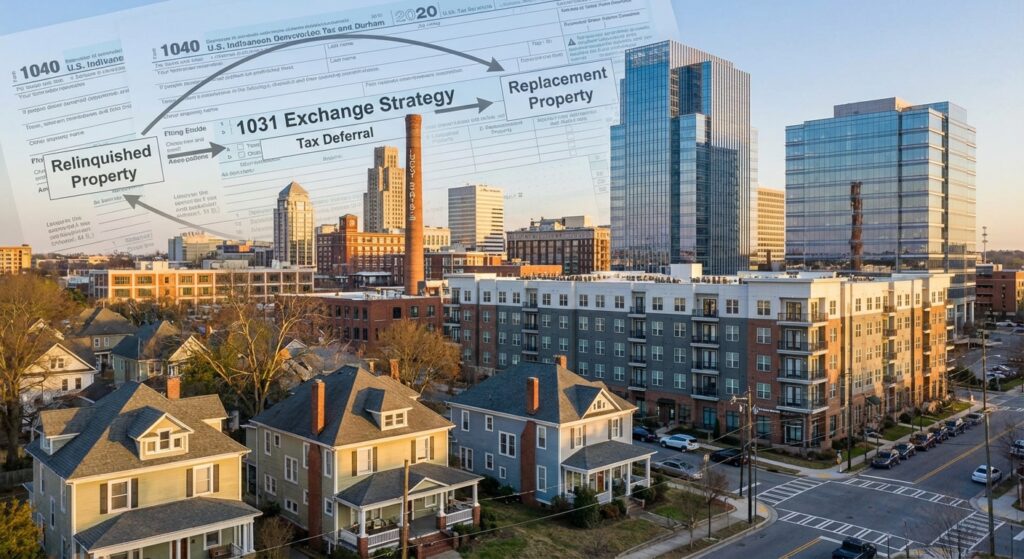
Durham 1031 Exchange: Complete 2026 Tax Strategy Guide for Real Estate Investors
For Durham, NC real estate investors, the 1031 exchange remains an invaluable strategy for deferring capital gains tax and compounding wealth in 2026. Section 1031 of the IRS code allows property owners to sell investment property and reinvest the proceeds in similar (like-kind) property—without immediate tax on capital gains. Let’s break down how Durham property owners can use a 1031 exchange to keep more of their money working for them and ensure strict compliance with 2026 regulations.
Table of Contents
- Key Takeaways
- What Is a 1031 Exchange?
- 45-Day and 180-Day Deadlines
- Qualified Intermediary Requirements
- What Qualifies as Like-Kind in 2026?
- Real Tax Benefits Illustrated
- Uncle Kam Success Case Study
- Next Steps
- Frequently Asked Questions
Key Takeaways
- A Durham 1031 exchange lets you defer capital gains taxes by reinvesting in like-kind property.
- Strict 45-day identification and 180-day closing deadlines are enforced by the IRS for 2026.
- You must use a qualified intermediary—touching proceeds yourself voids the exchange.
- 1031 exchanges apply to investment or business property only—not your primary residence.
What Is a 1031 Exchange?
Quick Answer: A 1031 exchange enables Durham investors to reinvest the proceeds from a sale of real property into similar real property and defer the recognition of taxable capital gain.
Named for Section 1031 of the Internal Revenue Code, this exchange is sometimes called a “like-kind exchange.” In 2026, the IRS maintains that almost any business or investment real estate (except your primary residence) can be exchanged for other business/investment real estate. This makes the 1031 exchange perfect for Durham investors looking to upgrade their rental portfolio, diversify assets, or consolidate holdings for larger commercial properties.
How a Durham 1031 Exchange Works in 2026
- Sell your Durham investment property (“relinquished property”).
- At closing, a qualified intermediary receives the proceeds.
- You identify replacement property within 45 days (must be like-kind).
- You close on replacement property within 180 days of the original sale.
- If all IRS rules are satisfied, you pay no capital gains taxes upon the sale.
You can repeat 1031 exchanges indefinitely, compounding your tax savings and reinvesting more capital each time.
45-Day and 180-Day Deadlines
Quick Answer: You have 45 days from the sale to identify replacement property and 180 days to complete the purchase. The deadlines are non-negotiable, and missing them means immediate tax liability.
45-Day Identification Rule
- Written identification of up to three properties (any value).
- Alternatively, identify any number of properties as long as their combined value is up to 200% of the relinquished property value.
180-Day Exchange Rule
- Acquisition (closing) of the new property must occur within 180 days of selling the original property.
Did You Know? If the deadlines fall on a weekend or legal holiday, they shift to the next business day for 2026.
Qualified Intermediary Requirements
Quick Answer: You cannot touch the proceeds from your property sale; they must be held by a qualified intermediary, or the entire exchange is disqualified and taxes are due.
A qualified intermediary (QI) in 2026 is usually a title company, specialized exchange company, or sometimes a lawyer/CPA who has no pre-existing relationship with you. The qualified intermediary prepares required documentation (replacement property identification, escrow instructions, and IRS forms), and holds the funds between your sale and purchase. You must have a QI in place before closing on your sale.
What does the Qualified Intermediary do?
- Receives sale proceeds and ensures you don’t have direct access.
- Monitors 45/180-day deadlines and receives written replacement property identification.
- Prepares closing documents for the replacement property.
- Supplies documentation for IRS Form 8824.
Any handling of funds outside a QI (e.g., by your real estate broker, attorney, or family member) voids the exchange. For tax preparation assistance or QI recommendations, contact a Durham tax strategy professional.
What Qualifies as Like-Kind in 2026?
Quick Answer: Most business or investment real estate qualifies as like-kind: you can exchange apartments, offices, rental homes, retail, land, and more (but not your primary residence).
| Property Type | Qualifies for 1031 in 2026? |
|---|---|
| Single-family rentals | Yes |
| Multifamily/apartment buildings | Yes |
| Office/commercial real estate | Yes |
| Retail/shopping centers | Yes |
| Vacant land held for investment | Yes |
| Primary residence | No |
| Flips/property held for resale | No |
| REITs, stocks, securities | No |
Durham’s 2026 rules allow “upgrading” property types—for example, exchanging rental homes for an apartment building or land for a retail space. Personal-use property never qualifies.
Real Tax Benefits Illustrated
Quick Answer: Deferring tax with a 1031 means you keep more money working for you, compounding returns. North Carolina investors save both at federal and state levels.
Example—Sell a Durham rental property for $600,000, with a $300,000 capital gain. Without 1031: federal tax (20%) is $60,000 and state tax (4.75%) is $14,250; total tax = $74,250. With 1031: tax is deferred, and you reinvest the entire $600,000. Over years and repeated exchanges, the compounding benefit multiplies. When you pass away, heirs may receive a stepped-up basis, permanently erasing deferred tax.
Deferred Tax Comparison Table
| Scenario | Reinvested Amount | Tax Immediately Owed |
|---|---|---|
| No Exchange | $525,750 | $74,250 |
| 1031 Exchange | $600,000 | $0 (tax deferred) |
Uncle Kam Success Case Study
A Durham investor owned two single-family rentals (total value: $800,000, basis: $360,000). Wanting to purchase a $900,000 apartment building, they structured a 1031 exchange with an Uncle Kam partner as qualified intermediary. With successful replacement property identification and acquisition, $104,500 in taxes were deferred—and the full $800,000 was rolled into a higher-value asset, generating greater cashflow and appreciation. Read more success stories.
Next Steps
- 1. Consult an experienced North Carolina tax advisor before you list your property for sale.
- 2. Engage a qualified intermediary (QI) before closing.
- 3. Identify potential replacement properties early.
- 4. Work closely with your tax strategist and attorney to ensure all IRS timelines and paperwork are met.
For tailored tax planning regarding your Durham property, request a strategy session with Uncle Kam’s local tax team.

Frequently Asked Questions
Can I do a 1031 exchange with my primary Durham residence?
No, personal-use property including your primary home never qualifies. Only business or investment real estate is eligible.
What if I miss the deadline?
Missing the 45- or 180-day deadlines voids the exchange, and tax is owed immediately on all gain. Extensions (even for hardship) are not granted by the IRS.
Can I buy property outside North Carolina?
Yes! Like-kind refers to real estate use, not location. Sell in Durham, buy in another state, or vice versa.
Are there special forms to file?
You must complete IRS Form 8824 (Like-Kind Exchanges) and file it with your annual federal return for 2026.
Is there a minimum or maximum property value?
No IRS minimum or maximum exists, but exchanges nearly always make sense with at least $25,000 in taxable gain.
What documentation do I need?
Keep closing statements, QI instructions, property identification letters, and proof of business or investment use.
How much does a 1031 exchange cost?
Qualified intermediary fees typically range $800–$2,000 in North Carolina. Strategy consulting may be extra, but yields much larger tax savings.
Last updated: January 2026. Confirm IRS and North Carolina Department of Revenue updates if reading later.

