
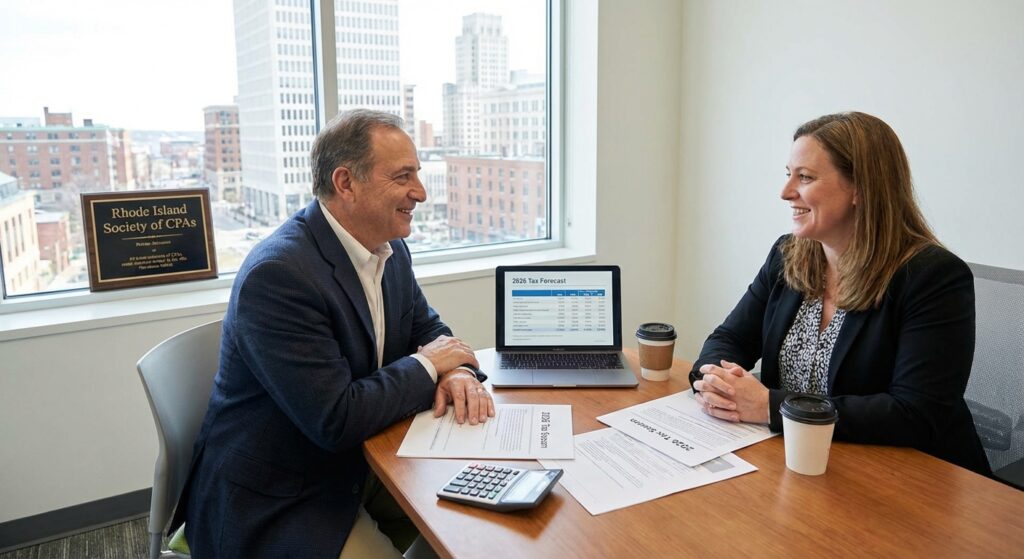
CPA Fees in Rhode Island 2026: Complete Cost Guide & What To Expect This Tax Season
The 2026 tax season is poised to be one of the most complex in recent years. With new tax law changes from the One Big Beautiful Bill Act now in effect and the IRS operating with significant budget cuts, understanding CPA fees in Rhode Island has become more important than ever. Whether you’re a small business owner, self-employed professional, or high-income individual, working with a qualified CPA can mean the difference between missing substantial tax savings and keeping thousands of dollars in your pocket.
Table of Contents
- Key Takeaways
- What Are Typical CPA Fees in Rhode Island for 2026?
- What Factors Affect CPA Pricing in Rhode Island?
- How Do CPA Fees Compare to Other Tax Services?
- Why Is 2026 a Critical Year for CPA Services?
- What Should You Ask a CPA Before Hiring?
- Uncle Kam in Action
- Next Steps
- Frequently Asked Questions
Key Takeaways
- CPA fees in Rhode Island typically range from $200 to $2,500+ annually, depending on complexity, business size, and service scope.
- The 2026 tax season is expected to be turbulent due to new tax deductions and IRS budget constraints affecting processing times.
- New OBBBA deductions for tips, overtime, and senior taxpayers create both opportunities and compliance risks for tax filers.
- Working with a professional CPA typically saves taxpayers far more than the cost of professional fees through optimized deductions and credits.
- Proactive tax planning with a CPA can help you navigate the new tax law changes and avoid costly IRS mistakes in 2026.
What Are Typical CPA Fees in Rhode Island for 2026?
Quick Answer: CPA fees in Rhode Island vary widely based on complexity. Individual returns typically cost $250-$750, while business returns and tax planning services can range from $1,000-$5,000+ annually.
CPA fees in Rhode Island follow regional pricing patterns similar to other New England states. Individual taxpayers with straightforward W-2 income and standard deductions can typically expect to pay between $250 and $500 for basic tax preparation and filing. However, fees increase substantially for those with multiple income sources, investment income, or rental properties.
Business owners and self-employed professionals face different pricing structures. A CPA handling a small business tax return (sole proprietorship or LLC) generally charges between $500 and $1,500 for tax year-end preparation. S Corporation and partnership returns cost $1,000-$3,000 due to increased complexity and required documentation. C Corporations with employee payroll can range from $2,000-$5,000+.
Hourly Rates vs. Flat Fees
Rhode Island CPAs typically charge using one of two methods. Hourly rates range from $150-$350 per hour, depending on the CPA’s experience level and firm size. Flat fee arrangements are common for straightforward individual returns, ranging from $300-$600. For complex business and tax planning services, CPAs may combine both approaches or offer value-based pricing tied to specific tax savings achieved.
The choice between hourly and flat fee arrangements depends on your specific situation. Straightforward returns benefit from flat fees that provide budget certainty. Complex or variable situations may be better served by hourly billing, which reflects the actual time invested in your return.
Tax Planning and Consulting Costs
Beyond tax preparation, many Rhode Island CPAs offer proactive tax planning and year-round advisory services. These engagements typically start at $1,000-$3,000 annually for small business owners and can exceed $10,000 for complex multi-entity structures. Monthly or quarterly advisory engagements with CPAs generally range from $500-$2,000 per month, depending on scope and complexity.
| Service Type | Fee Range (2026) | Typical Use Case |
|---|---|---|
| Individual Tax Return (Simple) | $250-$500 | W-2 income, standard deduction |
| Individual Tax Return (Complex) | $500-$1,000 | Investments, rental income, multiple states |
| Sole Proprietorship/Schedule C | $500-$1,500 | Self-employed, freelancers |
| S Corporation Return | $1,500-$3,000 | Pass-through entity with employees |
| Tax Planning (Annual) | $1,000-$5,000 | Proactive strategies, optimization |
| Monthly Advisory Services | $500-$2,000/month | Year-round planning and compliance |
Pro Tip: Get fee quotes from at least three Rhode Island CPAs before making a decision. Many offer free initial consultations where they can assess complexity and provide accurate cost estimates.
What Factors Affect CPA Pricing in Rhode Island?
Quick Answer: Return complexity, business structure, number of income sources, state tax requirements, and the CPA’s experience level are primary factors determining fees.
Understanding what drives CPA fees helps you negotiate fair rates and identify where you can reduce costs through better organization. The primary factors affecting CPA fees in Rhode Island include return complexity, business structure, income sources, and documentation quality.
Return Complexity and Documentation
Complexity is the single largest driver of CPA fees. A return with W-2 income only, claiming the standard deduction, takes minimal time and therefore costs less. Returns requiring Schedule C (self-employment), multiple rental properties, investment accounts, or itemized deductions require substantially more analysis and cost proportionally more.
Documentation quality also affects pricing. Well-organized clients with receipts, income records, and expense documentation allow CPAs to work more efficiently, resulting in lower fees. Disorganized situations requiring reconstruction of records or hunting for documentation drive costs significantly higher.
Business Structure and Entity Type
Your business structure directly impacts CPA costs. A sole proprietor with one income source pays far less than an S Corporation owner with employees, inventory, and payroll. Multi-entity structures (holding companies, investment entities) require coordination and cost substantially more than single-entity returns.
For the 2026 tax year, Rhode Island businesses need to understand how the new OBBBA deductions for tips, overtime, and other items apply to their situation. CPAs will need additional time to properly implement these provisions, potentially increasing fees.
State and Local Tax Considerations
Rhode Island taxpayers with multistate income or property require additional CPA work for state tax allocation and nexus analysis. Real estate investors with rental properties in multiple states, remote workers, or business owners with out-of-state operations typically pay premium fees for this complexity.
The new 2026 OBBBA SALT deduction changes (increasing the deduction cap to $40,000 with income-based limits) require additional planning and documentation that CPAs must factor into their fees.
How Do CPA Fees Compare to Other Tax Services?
Quick Answer: CPAs typically cost more than software or tax preparers but provide significant value through compliance protection, tax optimization, and strategic planning that DIY solutions cannot match.
When evaluating CPA fees in Rhode Island, many taxpayers naturally compare them to DIY tax software, tax preparers, and enrolled agents. Understanding these distinctions helps you make an informed decision aligned with your situation complexity and needs.
CPA vs. Tax Software
Tax software like TurboTax or H&R Block costs $50-$150 per return. This is significantly cheaper than CPA fees but comes with substantial tradeoffs. Tax software can miss deductions, fails to optimize for tax planning, provides no IRS representation if audited, and offers no ongoing advisory support.
A CPA earning you $2,000 in additional deductions or credits through tax planning more than covers the entire fee difference. Moreover, CPA-prepared returns receive enhanced scrutiny protection and can be amended quickly if issues arise.
CPA vs. Tax Preparers and Enrolled Agents
Tax preparers and enrolled agents (EAs) typically charge $300-$1,000 and fall between software and CPAs. They provide professional tax preparation without CPA-level liability protection or audit defense rights. CPAs offer additional value through their comprehensive tax strategy services, continuing education requirements, and professional liability insurance that provides greater client protection.
Did You Know? CPAs undergo continuing education requirements of 40 hours annually, including mandatory ethics training, while tax preparers have minimal ongoing education requirements. This credentialing difference reflects significantly different expertise levels.
Why Is 2026 a Critical Year for CPA Services?
Quick Answer: The 2026 tax season brings new deductions, IRS processing delays, and significant compliance risks that make professional CPA services more valuable than ever.
The 2026 tax season is shaping up to be one of the most complex in recent years. The IRS workforce has been reduced by 26%, and the agency’s budget for fiscal year 2026 is approximately $11.2 billion, down roughly 9% from 2025. This combination creates processing delays, increased audit backlogs, and heightened compliance risks for taxpayers who prepare returns incorrectly.
New OBBBA Tax Deductions and Credits
The One Big Beautiful Bill Act (OBBBA) enacted in 2025 introduced several new deductions effective for 2026 tax returns. These include qualified overtime deductions (up to $12,500 for individuals, $25,000 for married filing jointly), qualified tips deductions (up to $25,000 annual maximum), auto loan interest deductions, and an expanded senior deduction of $6,000 (or $12,000 for married couples filing jointly) for taxpayers age 65 and older.
These new provisions create both opportunities and risks. Taxpayers who fail to claim them miss substantial tax savings. Those who claim them incorrectly face audit risk and potential penalties. A qualified CPA using systematic tax optimization methods ensures you claim all eligible deductions while maintaining audit-safe documentation.
IRS Processing Delays and Compliance Risk
Tax experts and former IRS commissioners have warned that the 2026 filing season will be characterized by filing delays and processing backlogs. With a reduced workforce implementing complex new tax law changes simultaneously, the IRS faces extraordinary challenges. Incorrectly filed returns face higher audit risk and longer processing delays.
CPAs protect you in this environment through proper documentation, correct form completion, and maintaining audit-ready records. The IRS specifically recommends e-filing with a professional preparer for optimal processing speed and accuracy verification.
| 2026 Tax Season Factor | Impact on CPA Value |
|---|---|
| IRS Workforce Down 26% | Longer processing times, greater compliance risk |
| New OBBBA Deductions | Missing $2,000-$5,000+ in tax savings if not claimed correctly |
| 400(k) Limit Increase to $24,500 | Planning opportunities to reduce taxable income |
| Senior Deduction ($6,000) | New deduction strategy for age 65+ taxpayers |
| Expected Larger Refunds | Accurate filing required to receive expected refunds |
What Should You Ask a CPA Before Hiring?
Quick Answer: Ask about their 2026 tax law knowledge, fee structure, audit representation rights, and whether they offer proactive tax planning beyond compliance.
Before hiring a CPA in Rhode Island, ask critical questions that reveal their expertise and approach. These questions separate experienced professionals from mediocre preparers and ensure your CPA provides real value.
Essential Vetting Questions
- How will you handle the new 2026 OBBBA deductions? Listen for specific examples. A good CPA can explain tips deductions, overtime deductions, and senior deductions with concrete application to your situation.
- Do you represent clients in IRS audits? Some CPAs only prepare returns; others can defend you before the IRS. Confirm they offer audit representation if your return is selected.
- What’s your continuing education focus for 2026? Reputable CPAs have invested in training on new tax laws. Vague answers signal less engagement with current law changes.
- Will you proactively identify tax-saving opportunities? Some CPAs only prepare returns filed for that year. Look for those offering year-round planning to optimize your tax situation.
- What’s your pricing model and can I get a fixed fee quote? Ask for a detailed, written quote that’s binding. Avoid CPAs who can’t estimate costs accurately.
Pro Tip: Ask your CPA to explain one specific 2026 tax law change as a vetting test. Those genuinely trained on new laws provide detailed, accurate explanations. Unprepared CPAs give vague or incorrect answers.
 Uncle Kam in Action: Rhode Island Business Owner Saves $18,500 Through CPA Tax Planning
Client Snapshot: Sarah, a 42-year-old Rhode Island independent consultant with annual revenue of $185,000, was filing her own taxes using software. She had been paying roughly $28,000 in federal taxes annually and assumed this was unavoidable.
The Challenge: Sarah’s business had grown significantly over three years, but her tax strategy hadn’t evolved. She was operating as a sole proprietor, paying full self-employment tax on all net income. She wasn’t utilizing retirement savings opportunities, taking advantage of home office deductions, or structuring her business optimally. Additionally, she was unaware that the new 2026 OBBBA changes might create opportunities she was missing.
The CPA Solution: Working with a Rhode Island-based professional tax strategist, Sarah received comprehensive planning that addressed her entire tax picture. The CPA recommended converting to an S Corporation election for the current year, which would allow her to split income between W-2 wages and distributions, reducing self-employment tax exposure. Additionally, the CPA identified that Sarah could establish a Solo 401(k) and contribute the maximum $72,000 for 2026, which would significantly reduce her taxable income. The CPA also helped Sarah implement detailed home office and business expense documentation to capture deductions she’d previously missed.
The Results: By implementing S Corporation taxation and maximizing retirement contributions, Sarah reduced her federal tax liability from approximately $28,000 to $9,500 in the following year. The combination of entity structure optimization and retirement contribution maximization generated $18,500 in tax savings annually. Sarah’s total investment in CPA fees and planning was $4,200. This represents a 4.4x return on investment in just the first year, with continued benefits projected for future years. Beyond the immediate tax savings, Sarah gained an ongoing advisory partner who helps her navigate quarterly estimated payments, maintain compliance, and optimize her business structure as her revenue grows.
This is just one example of how our proven tax strategies have helped clients achieve substantial tax savings and financial confidence. The difference between DIY tax filing and professional CPA services often translates to five, six, or even seven-figure savings over a business owner’s career.
Next Steps
- Schedule free consultations with 2-3 Rhode Island CPAs this month to gather fee quotes and assess their 2026 tax law knowledge.
- Gather all 2025 tax documents (W-2s, 1099s, receipts, deduction records) to present during your CPA consultations for accurate fee estimates.
- Ask each CPA about business owner tax planning strategies specific to your situation and their track record with similar clients.
- Request a written fee agreement before engaging any CPA to avoid surprises and ensure clarity on services included.
- Plan to have your 2025 return completed and filed by April 15, 2026, to avoid penalties and utilize any refunds quickly.
Frequently Asked Questions
What is the average CPA fee for an individual tax return in Rhode Island for 2026?
For a straightforward individual return with W-2 income and standard deductions, expect to pay between $300-$500. Returns with investment income, rental properties, or itemized deductions typically range from $500-$1,000. Complex returns with multistate income, business ownership, or significant deductions can exceed $1,500.
Can I deduct my CPA fees on my tax return?
Generally, the portion of CPA fees related to business tax preparation or tax planning can be deducted as a business expense. The portion allocable to personal return preparation (Form 1040) cannot be deducted for 2026 under current tax law. Discuss allocation with your CPA to maximize deductible fees.
Do CPAs offer payment plans for their fees?
Many Rhode Island CPAs offer payment plans allowing you to split fees into monthly installments. Some accept credit cards, which may offer their own payment plan options. Ask about payment flexibility when obtaining fee quotes.
What happens if the IRS audits my return prepared by a CPA?
CPAs can represent you before the IRS in an audit if they have power of attorney signed by you. This is called audit representation. Confirm your CPA offers this service and understands the costs involved. Many include modest audit representation in their engagement letter for straightforward issues.
How early should I hire a CPA for the 2026 tax season?
Ideally, hire a CPA by March 2026 to allow time for thorough review and optimization. However, even April filing gives CPAs time to properly prepare your return. Waiting until after April 15 means late filing penalties if you owe taxes. The IRS begins accepting returns on January 26, 2026, so early engagement is possible.
Should I use a large national CPA firm or a local Rhode Island CPA?
Both have advantages. Large firms offer broader expertise and specialization but may charge premium rates. Local Rhode Island CPAs provide personalized service and understand local business conditions. Choose based on complexity, preferred service style, and fees. Request references from similar clients before deciding.
Will my CPA fees increase due to the new 2026 tax law changes?
Potentially. CPAs will spend additional time implementing new OBBBA deductions, understanding how they apply to your situation, and ensuring proper documentation. Complex implementations may trigger higher fees. Discuss this upfront and negotiate fees based on your specific situation complexity.
What’s the difference between a CPA and an accountant?
CPAs are licensed professionals who have passed rigorous exams and maintain continuing education requirements. Accountants may not hold CPA licenses. CPAs provide higher liability protection, can provide audit representation, and are held to stricter professional standards. When hiring for tax services, specifically request a CPA credential.
Can I switch CPAs mid-year or after filing?
Yes. You can change CPAs at any time. If switching after filing, ensure your new CPA can access prior year files and discuss whether any amendments are beneficial. Some CPAs charge fees for reviewing another CPA’s work, so clarify this upfront.
This information is current as of 01/26/2026. Tax laws change frequently. Verify updates with the IRS (IRS.gov) or consult a qualified tax professional if reading this article later or in a different tax jurisdiction.
Related Resources
- Comprehensive Tax Strategy Services for Optimization
- Tax Planning Resources for Business Owners
- Complete Tax Guides and Resources
- IRS Official Website for Tax Forms and Publications
- Real Client Success Stories and Tax Savings Examples
Last updated: January, 2026

