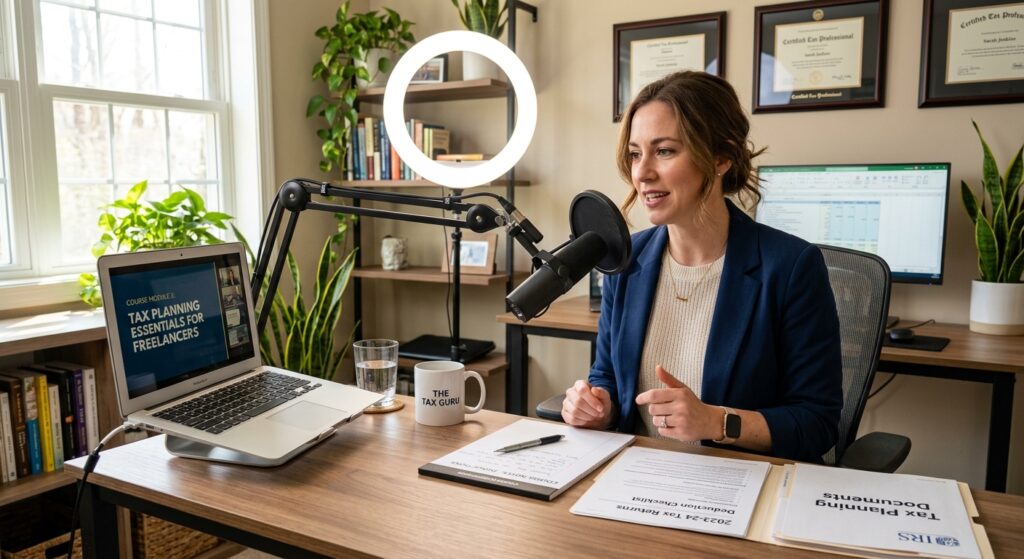
Contractor Online Course Development: 2026 Tax Guide
If you earn income from contractor online course development, the 2026 tax year brings real opportunities to keep more of what you make. Contractor online course development — building, selling, or delivering training content as a self-employed professional — qualifies for a powerful stack of IRS-recognized deductions. Thanks to the Working Families Tax Cuts (the rebranded One Big Beautiful Bill Act), independent course creators now benefit from a permanent 20% Qualified Business Income (QBI) deduction, reduced 1099 reporting burdens, and more tools to invest in their own skills. This guide shows you exactly how to use them.
Table of Contents
- Key Takeaways
- What Counts as Contractor Online Course Development for Tax Purposes?
- What Education Expenses Can Contractors Deduct in 2026?
- How Does the 20% QBI Deduction Help Course Creators?
- How Do You Structure Your Business for Online Course Income?
- What Technology and Equipment Can You Deduct?
- How Do New 2026 Tax Laws Affect Contractor Course Developers?
- Uncle Kam in Action: Freelance Trainer Saves $14,200
- Related Resources
- Next Steps
- Frequently Asked Questions
Key Takeaways
- Contractor online course development qualifies as a Schedule C trade or business in 2026.
- The 20% QBI deduction is now permanent under the Working Families Tax Cuts.
- Course-related education, software, and equipment are fully deductible business expenses.
- The 1099-NEC/MISC reporting threshold rose to $2,000, reducing your paperwork burden.
- Self-employment tax remains 15.3% — but deductions shrink the taxable base significantly.
What Counts as Contractor Online Course Development for Tax Purposes?
Quick Answer: Any paid activity in which you independently design, build, host, or deliver training content counts as contractor online course development. The IRS treats this as a self-employed trade or business reported on Schedule C.
The term “contractor online course development” covers a wide range of activities. You might build courses for corporate clients, sell self-paced digital programs, or deliver live virtual workshops. Regardless of the format, the IRS focuses on one central question: are you regularly and continuously engaged in this activity with a profit motive?
If the answer is yes, you report income on Schedule C of Form 1040. You deduct ordinary and necessary business expenses. Therefore, every dollar you spend running the course business — from software subscriptions to internet costs — reduces your taxable income. That is a major advantage over being a W-2 employee.
Types of Contractor Course Activity the IRS Recognizes
The following activities all qualify as contractor online course development for tax purposes:
- Freelance instructional design for corporate learning management systems
- Self-published courses on platforms like Udemy, Teachable, or Kajabi
- Live virtual coaching or group training under a 1099 arrangement
- Curriculum writing and e-learning content development on contract
- Video-based skills training for workforce development organizations
- Membership sites that bundle courses with community access
Hobby vs. Business: What the IRS Looks For
The IRS uses a profit presumption rule. If your course activity generates a profit in at least 3 of the last 5 years, the IRS presumes it is a business — not a hobby. However, even newer course creators can qualify as a business from day one. You simply need to show business intent. Keep separate bank accounts, market actively, and track expenses carefully. These steps prove you are running a real enterprise.
For 2026, this distinction matters more than ever. As a legitimate business, you access the full range of self-employed tax strategies — including the permanent 20% QBI deduction under the Working Families Tax Cuts. Hobbyists lose that advantage entirely.
Pro Tip: Open a dedicated business checking account for all course income and expenses. This one step makes it far easier to prove business intent to the IRS.
What Education Expenses Can Contractors Deduct in 2026?
Quick Answer: Self-employed contractors can deduct education costs that maintain or improve skills required in their current trade. You report these deductions on Schedule C as ordinary business expenses — there is no dollar cap for business education deductions.
One of the most powerful benefits of contractor online course development is the ability to invest in your own skills — and write it all off. As a self-employed professional, you are not limited to the small educator expense deduction that W-2 teachers claim. Instead, you use IRS Publication 535 business expense rules, which are far more generous.
The rule is straightforward. Education spending is deductible when it maintains or improves skills in your current field. However, it cannot be used to qualify for a new career. For example, a freelance instructional designer who buys an advanced e-learning authoring course is clearly improving existing skills. Therefore, that cost is deductible in full on Schedule C.
Examples of Deductible Education for Course Developers
Many course development expenses qualify. The following are common examples:
- Online courses in video production, course platform use, or learning design
- Annual subscriptions to industry-specific learning platforms (LinkedIn Learning, Coursera for Business)
- Workshops, webinars, or virtual conferences related to your subject matter
- Books, digital resources, and reference materials for course content development
- Professional certifications in instructional design or e-learning
- Mastermind groups, coaching programs, or mentorship fees tied to your business
Education That Does NOT Qualify
Not every learning expense passes the IRS test. You cannot deduct education that qualifies you for a new profession. For example, a web developer who decides to become a licensed healthcare trainer cannot deduct medical licensing courses. Similarly, personal development courses with no direct business link do not qualify. When in doubt, ask: does this education make me better at the business I already run? If yes, it is likely deductible.
Pro Tip: Keep receipts for every education purchase. Document the connection between the course and your existing business. A brief written note explaining business relevance protects you in an audit.
Education Expense Comparison: W-2 Employee vs. Self-Employed Contractor
| Scenario | W-2 Employee | Self-Employed Contractor (2026) |
|---|---|---|
| Education deduction method | Generally NOT deductible (suspended under TCJA) | Fully deductible on Schedule C |
| Annual dollar cap | $350 educator deduction (K-12 teachers only) | No cap — deduct all ordinary/necessary costs |
| Platform subscriptions | Not deductible | Fully deductible as a business expense |
| Coaching fees | Not deductible | Deductible if business-related |
| Conference attendance | Not deductible | Fully deductible including travel |
The advantage is clear. If you spend $4,000 per year on courses, certifications, and masterminds, you deduct the full $4,000 from your Schedule C income. A contractor in the 22% federal bracket saves $880 in federal income tax alone — plus reduces self-employment tax exposure.
How Does the 20% QBI Deduction Help Course Creators?
Quick Answer: The Qualified Business Income (QBI) deduction lets eligible self-employed contractors deduct up to 20% of net business income from federal taxable income. Thanks to the Working Families Tax Cuts, this deduction is now permanent for 2026 and beyond.
The 20% QBI deduction under Section 199A is one of the biggest tax wins available to independent course developers. The deduction was set to expire, but the Working Families Tax Cuts — signed into law on July 4, 2025 — made it permanent. More than 25.9 million small businesses now rely on this deduction, and course developers are no exception.
Here is how it works in practice. Suppose you earn $80,000 in net Schedule C profit from your contractor online course development business in 2026. You may be able to deduct 20% — or $16,000 — directly from your taxable income. That deduction is on top of your business expense deductions. Furthermore, it reduces the income subject to your regular federal income tax rate.
Explore your potential savings using the Small Business Tax Calculator for New York City to model how the 20% QBI deduction affects your 2026 tax liability.
Is Course Development a Specified Service Trade or Business (SSTB)?
This is a critical question for course creators. Certain high-income professionals in fields like law, consulting, and financial services face income phase-out limits on the QBI deduction. These are called Specified Service Trades or Businesses (SSTBs).
Most general course development and instructional design businesses are NOT classified as SSTBs. If you create and sell courses about technical skills, fitness, marketing, or business topics, you typically qualify for the full QBI deduction at any income level. However, if your content is primarily professional consulting — such as legal strategy or investment advice — the SSTB rules may apply. Consult a tax advisor if you are unsure about your classification.
QBI Deduction Example for a Course Developer
Consider this straightforward scenario:
- Gross course revenue (2026): $95,000
- Business expenses (software, education, home office, etc.): $18,000
- Net Schedule C profit: $77,000
- Half of self-employment tax deducted (above-the-line): approximately $5,445
- QBI deduction (20% of approximately $71,555): approximately $14,311
- Total federal taxable income reduction from QBI alone: $14,311
- Total federal taxable income reduction from QBI alone: $14,311
This is money that never gets taxed at your ordinary income rate. For a contractor in the 22% bracket, a $14,311 QBI deduction saves roughly $3,148 in federal taxes. That is significant money that compounds every year.
Learn more about optimizing your 2026 tax strategy for self-employed professionals at Uncle Kam.
How Do You Structure Your Business for Online Course Income?
Quick Answer: Most new course developers start as sole proprietors on Schedule C. However, as income grows above roughly $40,000 to $50,000 in net profit, an LLC or S Corp structure may reduce your overall 2026 tax burden significantly.
Business structure is one of the most important decisions you make in your contractor online course development career. The right structure depends on your current income, growth trajectory, and risk tolerance. Let us walk through the most common options.
Sole Proprietor: Simple but Costly at Scale
When you file a Schedule C, you are a sole proprietor by default. All net profit is subject to the 15.3% self-employment tax — 12.4% for Social Security and 2.9% for Medicare. This covers both the employer and employee share of payroll taxes. Additionally, all profit flows directly to your personal tax return.
For newer course developers earning under $40,000 in net profit, the sole proprietor structure is often perfectly fine. The simplicity saves on accounting costs. However, as your income scales, the 15.3% self-employment tax becomes a major drag on your wealth.
LLC: Liability Protection Without Added Complexity
Forming an LLC for your course business adds a layer of legal protection. However, a single-member LLC is taxed exactly like a sole proprietor by default. You still file Schedule C. Therefore, an LLC alone does not reduce your taxes — but it does protect your personal assets from business liabilities.
An LLC is a wise move for contractors doing course development work, especially if you hold licensing agreements, intellectual property, or client contracts. See how entity structuring for self-employed professionals can protect and optimize your business.
S Corp Election: The Sweet Spot for Growing Course Businesses
Once your net course income consistently exceeds $50,000 per year, an S Corp election often saves meaningful money on self-employment taxes. With an S Corp, you pay yourself a reasonable salary. Social Security and Medicare taxes apply only to that salary. The remainder of your business profit passes through as a distribution — avoiding the 15.3% self-employment tax on that portion.
For example, suppose you earn $110,000 in net course income. You pay yourself a $55,000 salary. The remaining $55,000 flows as a distribution. You avoid self-employment tax on that $55,000. At 15.3%, that is $8,415 in annual tax savings — often more than enough to cover S Corp administration costs.
Pro Tip: The S Corp election filing deadline for 2026 has passed, but you can plan ahead. File IRS Form 2553 by March 15, 2027 to elect S Corp status for the 2027 tax year. Start planning now for maximum savings.
Business Structure Comparison Table for Course Developers
| Structure | SE Tax Applied To | Best For | 2026 QBI Eligible? |
|---|---|---|---|
| Sole Proprietor | 100% of net profit | Under $40K net profit | Yes |
| Single-Member LLC | 100% of net profit | Liability protection + growth | Yes |
| S Corp (via LLC or Inc.) | Salary only | $50K+ net profit | Yes (on distributions) |
| C Corp | Salary only | Rarely ideal for solo creators | No |
What Technology and Equipment Can You Deduct for Course Development?
 Free Tax Write-Off Finder
Quick Answer: Course developers can deduct computers, cameras, microphones, software subscriptions, internet costs, and home studio equipment. In 2026, Section 179 expensing lets you deduct up to $2.5 million in qualifying property in the year you place it in service.
Technology is the backbone of contractor online course development. The good news is that nearly every tool in your workflow may qualify as a deductible business expense. Furthermore, the Working Families Tax Cuts dramatically expanded Section 179, raising the maximum expense deduction to $2.5 million — up from $1.25 million previously. This change benefits course creators who invest in significant production equipment.
Commonly Deductible Technology Expenses in 2026
The following technology costs are typically fully deductible for course developers:
- Course hosting platforms (Teachable, Kajabi, Thinkific monthly fees)
- Video editing software (Adobe Premiere, Camtasia, Final Cut Pro)
- E-learning authoring tools (Articulate Storyline, Adobe Captivate)
- Screen recording software and virtual classroom platforms
- Microphones, cameras, ring lights, and audio mixers used for course production
- Laptop or desktop computer (business-use percentage applies)
- Cloud storage and project management subscriptions
- Email marketing platforms (ConvertKit, ActiveCampaign)
- Business portion of internet service
Home Office Deduction: Two Methods
If you work from home — which most course developers do — the home office deduction further reduces your taxable income. The IRS offers two methods for calculating this deduction.
First, the simplified method allows $5 per square foot of your dedicated work space, up to 300 square feet. That means a maximum deduction of $1,500 per year with virtually no recordkeeping requirements. Second, the regular method calculates the actual percentage of your home used for business. For example, if your home office is 200 square feet in a 1,500-square-foot home, you use 13.3% of your rent, mortgage interest, utilities, and insurance as a deduction. This method often yields a higher deduction but requires detailed records.
To qualify, the space must be used exclusively and regularly for business — and it must be your principal place of business. For most full-time course developers, this test is easy to pass.
Pro Tip: Take a photo of your home office space today. Detailed notes and photos create a strong audit trail if the IRS ever questions your home office deduction.
How Do New 2026 Tax Laws Affect Contractor Course Developers?
Quick Answer: The Working Families Tax Cuts (formerly the One Big Beautiful Bill Act) permanently extended lower tax rates and the 20% QBI deduction. It also raised the 1099 reporting threshold to $2,000, reducing administrative burden for independent contractors in 2026.
The 2026 tax landscape for independent contractors changed significantly when President Trump signed the One Big Beautiful Bill Act (Working Families Tax Cuts) on July 4, 2025. For contractor online course development professionals, several provisions are especially important to understand.
Key 2026 Tax Law Changes for Course Developers
Here is a summary of the most impactful changes:
- Permanent 20% QBI Deduction: The Section 199A deduction is now permanent — not temporary. Course creators can count on this benefit year after year for long-term planning.
- Raised 1099-NEC/MISC Threshold: The old $600 reporting threshold is gone. The new threshold for 2026 is $2,000. This means fewer clients need to send you a 1099-NEC for smaller contract payments — although you still owe tax on all income you earn.
- Section 179 Expansion: The maximum equipment expense deduction doubled to $2.5 million. This benefits course creators who invest in professional-grade equipment or software.
- Bonus Depreciation Restored: 100% bonus depreciation has been reinstated under the Working Families Tax Cuts. You can write off qualifying property fully in the year you buy it.
- Permanently Lower Tax Rates: The individual income tax brackets from the 2017 Tax Cuts and Jobs Act are now permanently locked in. This gives contractors certainty for long-term income planning.
How the 1099 Threshold Change Affects Your Recordkeeping
The raised 1099 threshold is a welcome change — but it does not change your tax obligation. You must still report every dollar of course income on Schedule C, regardless of whether a client sends you a 1099. As a result, your own recordkeeping becomes even more important. Track all course sales, coaching fees, and platform payouts diligently. Review your records against IRS guidance for self-employed individuals at the start of each quarter.
Furthermore, platforms like Udemy, Teachable, and Kajabi may still issue 1099-K forms if your annual receipts through their payment processing exceed $5,000. Always reconcile platform payouts against your own records to avoid discrepancies.
Did You Know? Over 25.9 million small businesses claimed the permanent 20% QBI deduction for the first time this year, according to the National Federation of Independent Business. Course creators who have not yet filed for 2026 estimated payments should factor this deduction into their quarterly planning.
Quarterly Estimated Taxes for Course Developers
Because no employer withholds taxes from your course income, you must make estimated tax payments to the IRS. The 2026 quarterly payment due dates are April 15, June 16, September 15, and January 15, 2027. Missing these deadlines triggers penalties. Therefore, set aside at least 25–30% of each payment you receive to cover federal income tax and self-employment tax.
Use IRS Form 1040-ES to calculate and submit your quarterly payments. Consider working with a tax advisor who specializes in self-employed income to model your estimated payments accurately and avoid underpayment penalties.
This information is current as of 4/16/2026. Tax laws change frequently. Verify updates with the IRS at IRS.gov if reading this later.

Uncle Kam in Action: Freelance Trainer Saves $14,200
Client Snapshot: Marcus is a 38-year-old freelance corporate trainer based in New York. He specializes in contractor online course development for HR compliance and leadership skills programs. In 2025, he built and sold five self-paced online courses and delivered four live virtual workshops under 1099 contracts.
Financial Profile: Marcus brought in $112,000 in gross course revenue for the year. However, he had filed as a simple sole proprietor for three years without maximizing his deductions. He had never claimed a home office deduction, wrote off very few software costs, and had no entity structure in place. His previous accountant had never discussed the QBI deduction or S Corp election.
The Challenge: Marcus came to Uncle Kam frustrated. He was paying over $22,000 per year in combined income and self-employment taxes, despite running a lean business from his home office. He felt like he was constantly working to pay the IRS. He had heard about the 20% QBI deduction and S Corp election but did not know how to use them.
The Uncle Kam Solution: Uncle Kam implemented a comprehensive strategy for Marcus’s 2026 tax year. First, we documented his home office — a 180-square-foot dedicated studio he uses exclusively for course production. Using the regular method, this deduction alone was worth $2,800. Second, we catalogued every software subscription, equipment purchase, and course investment he had made — totaling $9,600 in overlooked business expenses. Third, we helped him elect S Corp status for 2026, setting a reasonable salary of $56,000. The remaining profit of approximately $38,000 flowed as a distribution, avoiding self-employment tax on that portion. Fourth, we modeled his QBI deduction under the now-permanent 20% rule.
The Results:
- Tax Savings: $14,200 in combined federal and self-employment tax reduction
- Investment: $2,800 in Uncle Kam advisory fees
- First-Year ROI: More than 5x return on his investment
Marcus now has a clear, repeatable system for managing his course business taxes. He knows exactly what to track, when to make quarterly payments, and how to maximize his deductions each year. Stories like his are why Uncle Kam exists. See more real results in our client results gallery.
Related Resources
- Self-Employed Tax Strategies for 1099 Contractors
- 2026 Tax Strategy Guide for Independent Professionals
- LLC vs. S Corp Entity Structuring for Course Creators
- Tax Preparation and Filing for Self-Employed Professionals
- Uncle Kam Tax Guides for Independent Contractors
Next Steps
Use this checklist to take action on your contractor online course development taxes for 2026:
- Step 1: Confirm your business filing status — sole proprietor, LLC, or S Corp — for the 2026 tax year.
- Step 2: Document all business expenses: software, equipment, education, and home office costs.
- Step 3: Estimate your 2026 QBI deduction using current net profit projections.
- Step 4: Schedule 2026 quarterly estimated tax payments using IRS Form 1040-ES (next payment due June 16, 2026).
- Step 5: Estimate your total 2026 tax bill using the Small Business Tax Calculator for New York City to plan ahead and avoid surprises.
- Step 6: Schedule a consultation with Uncle Kam’s tax advisory team to build a full 2026 tax strategy.
Frequently Asked Questions
Is contractor online course development income taxed as self-employment income?
Yes. If you operate as a sole proprietor or single-member LLC, all net profit from contractor online course development is subject to the 15.3% self-employment tax. This covers the Social Security and Medicare contributions that employers normally split with employees. However, you can deduct half of the self-employment tax as an above-the-line deduction on Form 1040, which reduces your adjusted gross income.
Can I deduct the courses I take to improve my content as a contractor?
Yes — as long as those courses maintain or improve skills in your existing trade. A course developer who buys a video scripting course, an instructional design certification, or a platform-specific training program is clearly upgrading existing skills. These costs are deductible as ordinary business expenses on Schedule C. You cannot deduct courses that qualify you for an entirely different career. See IRS Publication 970 for detailed guidance on education-related tax benefits.
How does the permanent 20% QBI deduction work for course creators in 2026?
Under Section 199A, eligible self-employed contractors can deduct up to 20% of qualified business income from their federal taxable income. The Working Families Tax Cuts made this deduction permanent starting in 2026. Most general course development businesses are NOT classified as Specified Service Trades or Businesses, so there are typically no income-based phase-outs limiting this deduction. Always verify your classification with a qualified tax advisor, especially if your courses are tied to professional consulting or financial advice.
What is the new 1099 reporting threshold for independent contractors in 2026?
The Working Families Tax Cuts raised the IRS Form 1099-NEC and 1099-MISC reporting threshold to $2,000 for 2026. This means clients who pay you less than $2,000 per year are no longer required to file a 1099 for those payments. However, this does not change your tax obligation. You must still report all course income on Schedule C, regardless of whether a client issues you a 1099. Keep your own detailed income records for every client and platform you use.
Should I form an S Corp for my online course business?
An S Corp election makes financial sense once your net course income regularly exceeds $50,000 per year. By paying yourself a reasonable salary and taking remaining profits as distributions, you avoid self-employment tax on the distribution portion. For example, on $100,000 in net income with a $50,000 salary, you could save approximately $7,650 in self-employment taxes annually. However, S Corps come with additional administrative requirements — including payroll, state filings, and a separate business bank account. Weigh the savings against the costs carefully. Explore entity structuring options with Uncle Kam before making this decision.
What records should I keep for my course development business?
Good recordkeeping is essential for any contractor online course development business. Keep the following for at least three years (and up to seven years for major purchases):
- All invoices, contracts, and payment records from clients
- Receipts for every software, equipment, and education purchase
- Platform payout statements from course marketplaces
- Home office measurements and photos
- Quarterly estimated tax payment confirmations from IRS.gov
- Mileage logs if you travel to client sites or conferences
A simple spreadsheet or accounting software like QuickBooks Self-Employed works well for most solo course developers. Start with a system that fits your current scale, then upgrade as your business grows. Review the Uncle Kam FAQ library for more guidance on contractor tax management.
Last updated: April, 2026

