Complete Guide to Nashua IRS Help: 2026 Tax Assistance & Saturday Hours Explained
Finding reliable Nashua IRS help just got easier for 2026. The IRS has announced special Saturday hours at select Taxpayer Assistance Centers (TACs) running through June 27, 2026, providing expanded access to critical tax services. Whether you’re a business owner, self-employed professional, real estate investor, or high-net-worth individual, understanding your options for in-person IRS assistance can save time, reduce penalties, and ensure your tax obligations are handled correctly. This comprehensive guide explains what Nashua IRS help looks like in 2026, how to access Saturday TAC hours, and what new tax deductions and credits you may qualify for this year.
Table of Contents
- Key Takeaways
- What Are IRS Taxpayer Assistance Centers (TACs)?
- How to Access Nashua IRS Help Through 2026 Saturday TAC Hours
- What Services Can You Access Through Nashua IRS Taxpayer Assistance Centers?
- New Tax Deductions and Credits Available in 2026
- How to Resolve Tax Issues and Avoid Penalties Before April 15
- Uncle Kam in Action: Real Results
- Next Steps
- Frequently Asked Questions
Key Takeaways
- New Hampshire Taxpayer Assistance Centers offer extended Saturday hours from 9 a.m. to 4 p.m. on March 28, April 11, April 25, May 30, and June 27, 2026.
- For 2026, the standard deduction is $31,500 for married couples filing jointly, $15,750 for singles, and $23,625 for heads of household.
- New tax deductions include the overtime pay deduction (up to $25,000 for joint filers) and senior bonus deduction ($12,000 for couples 65+).
- Filing early and making at least a partial payment can reduce failure-to-file penalties and give you access to payment plans.
- Using IRS online tools and TAC assistance strategically helps you avoid common mistakes and resolve issues before the April 15 deadline.
What Are IRS Taxpayer Assistance Centers (TACs)?
Quick Answer: TACs are IRS walk-in offices that provide in-person help with tax filing, account issues, identity verification, payment plans, and refund questions—services often difficult to resolve by phone or online.
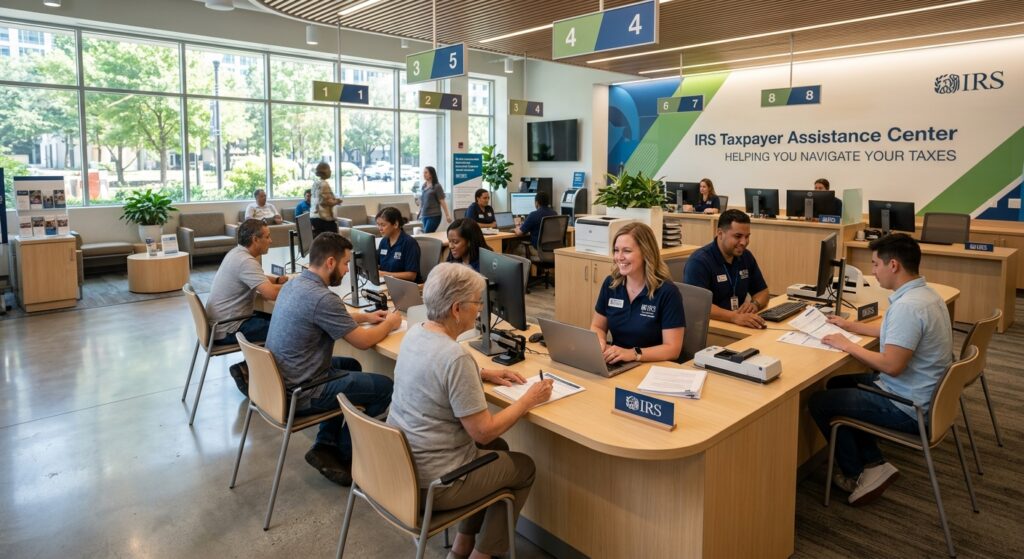
Taxpayer Assistance Centers represent the IRS’s commitment to face-to-face service for taxpayers who need hands-on help. Unlike phone support (which often involves long wait times) or purely digital tools, TACs offer personalized assistance from trained IRS representatives in your community. This in-person interaction can be invaluable when dealing with complex tax situations, account verification issues, or when you need a payment plan set up immediately.
For Nashua-area residents and New Hampshire taxpayers, the availability of extended services through Taxpayer Assistance Centers means you have a proven resource to address tax concerns without traveling to distant locations or waiting weeks for a phone callback. The IRS recognized that filing season creates peak demand for services and responded by expanding TAC hours.
How TACs Fit Into Your Overall Tax Strategy
When deciding whether to visit a TAC, consider your specific needs. Self-employed taxpayers with complex Schedule C deductions may benefit from TAC guidance on documentation requirements. Business owners exploring entity structure changes can get clarification on how S Corp vs. LLC elections affect their filing. Investors managing multiple rental properties can resolve specific refund or notice issues that defy online resolution.
- TACs are best for complex personal situations requiring documentation or verification
- Phone lines are appropriate for straightforward questions like refund status
- Online tools (like IRS.gov account access) work well for viewing balances and filing electronically
- Tax professionals handle highly specialized situations (audits, appeals, large business transactions)
How to Access Nashua IRS Help Through 2026 Saturday TAC Hours
Quick Answer: Nashua taxpayers can visit participating New Hampshire TACs on Saturdays from 9 a.m. to 4 p.m. on March 28, April 11, April 25, May 30, and June 27, 2026. No appointments are required at most locations, but arriving early is advised during peak season.
The IRS announced that Saturday hours would be available through June 27, 2026, as part of its effort to reduce wait times and provide better access during the busy filing season. For 2026, the specific Saturday dates when TACs are open are clearly marked—this is mission-critical timing information because these dates directly align with the April 15 filing deadline. Nashua residents no longer face the choice between taking time off work during weekdays or forgoing in-person assistance entirely.
Finding Your Nearest Nashua TAC and Confirming Hours
Before heading to a TAC, verify which New Hampshire locations are participating in Saturday hours and confirm they’re open the Saturday you plan to visit. While most TACs in the list of participating states (including New Hampshire) offer Saturday service, some locations may only be open on select Saturdays. Use the IRS TAC Locator tool to identify the nearest center to Nashua and check the specific Saturday dates it operates.
- Visit IRS.gov and search “TAC Locator” or navigate directly to the taxpayer assistance center finder
- Enter “Nashua, NH” or your specific New Hampshire location
- Confirm Saturday hours are available and check if your specific issue falls within services offered
- Arrive early on Saturday mornings to avoid the longest lines; peak hours are typically 10 a.m. to noon
Pro Tip: Saturday hours are now available, but April is the absolute peak season. If you can visit in late March (on March 28) or late May (on May 30), you’ll encounter fewer people and shorter wait times than you would in mid-April when the tax deadline approaches.
What to Bring to Your TAC Visit
Preparation significantly reduces your time at the TAC and improves the quality of assistance you receive. The IRS recommends bringing specific documentation depending on your issue. For general tax account questions, bring government-issued photo identification and your Social Security number(s). For issues related to a specific notice, bring the IRS letter or notice showing your name, address, and any notice number (typically found in the upper-right corner).
| Type of Issue | Documents to Bring |
|---|---|
| Account questions or verifications | Photo ID, Social Security card or ITIN notice, IRS notice if applicable |
| Payment plans or balances owed | Photo ID, Social Security number, most recent notice, proof of income if requesting installment plan |
| Refund inquiries | Photo ID, Social Security number, copy of tax return if available, prior notice about refund |
| Form issues or tax law questions | Photo ID, Social Security number, relevant tax documents, questions written down |
What Services Can You Access Through Nashua IRS Taxpayer Assistance Centers?
Quick Answer: TACs offer help with account questions, identity verification, payment plan setup, refund status, forms assistance, and ITIN renewal—but they do not prepare full returns, accept cash payments, or provide legal or audit representation.
Understanding exactly what services are available is critical for planning your TAC visit. The IRS has carefully defined the scope of TAC services to prioritize the most common issues taxpayers face. During the 2026 Saturday hours (9 a.m. to 4 p.m.), most routine services available during weekday hours remain accessible, though some limitations exist.
Core Services Available at Nashua TACs
- Account Questions: Get status updates on your tax account, verify reported income, clarify discrepancies between what you reported and IRS records
- Identity Verification: Complete ID verification if flagged during efiling or online account access attempts
- Payment Plans and Options: Set up installment agreements if you owe taxes; explore Offer in Compromise or Currently Not Collectible status
- Refund Tracking: Get detailed status on missing refunds; confirm direct deposit information was received
- Forms and Publications: Obtain paper forms, get guidance on which forms apply to your situation
- ITIN Renewal: Apply for or renew an Individual Taxpayer Identification Number in person
Pro Tip: For 2026, business owners considering entity structure changes (like LLC vs S-Corp elections) can use TAC time to clarify how their choice affects filing and payment obligations. Bring your business formation documents if you want to discuss these options. Use our LLC vs S-Corp Tax Calculator to estimate 2026 tax savings before your TAC visit.
Services NOT Available at TACs (What They Can’t Do)
Equally important is knowing what TACs cannot do. This prevents wasted time and ensures you understand when you need outside professional help. TACs do not prepare complete tax returns, represent you in audits or appeals, provide legal tax advice, or accept cash payments during Saturday hours (electronic payments only).
- TACs do NOT prepare full tax returns or claim deductions on your behalf
- TACs do NOT represent you in audits, appeals, or enforcement actions
- TACs do NOT provide legal opinions on tax strategies or structures
- TACs do NOT accept cash payments on Saturday (electronic payments only)
- TACs do NOT handle complex business structures, partnerships, or multi-state issues
New Tax Deductions and Credits Available in 2026
 Free Tax Write-Off Finder
Quick Answer: For 2026, new deductions from the One Big Beautiful Bill Act include the overtime pay deduction (up to $25,000 for couples), auto loan interest deduction (up to $10,000), and the senior bonus deduction ($12,000 for married couples 65+). The child tax credit also increased to $2,200 per child.
The tax landscape changed significantly in 2025 when Congress passed the One Big Beautiful Bill Act (OBBBA), which became effective for 2025 tax returns (filed in 2026). Understanding these new deductions and credits directly impacts how much you’ll owe or how large your refund will be. Many taxpayers are unaware of these opportunities and miss significant tax savings by overlooking them.
The Overtime Pay Deduction (2025-2028)
The “no tax on overtime” deduction allows eligible workers to deduct a portion of qualifying overtime pay from their federal taxable income. For 2026, single filers can deduct up to $12,500 in overtime premium pay annually, while married couples filing jointly can deduct up to $25,000. This deduction applies to the premium (overtime) portion of pay—the “time-and-a-half” differential beyond regular wages.
Critical detail: This deduction reduces your income tax but does not reduce self-employment taxes or payroll taxes. If you’re a W-2 employee with significant overtime, you should still see your overall tax liability decrease. Construction workers, healthcare professionals, manufacturing workers, and service industry employees with regular overtime are primary beneficiaries.
Auto Loan Interest Deduction (2025-2028)
A new auto loan interest deduction became available for tax years 2025 through 2028, allowing taxpayers to deduct up to $10,000 per year in qualified auto loan interest paid on certain new vehicle purchases. This applies only to loans for newly-manufactured vehicles (not used cars) and only for a limited period. The deduction phases out for higher-income taxpayers.
Senior Bonus Deduction (Age 65+, 2025-2028)
Taxpayers age 65 and older can now claim a “senior bonus” deduction of $6,000 per person (or $12,000 for married couples filing jointly) for tax years 2025 through 2028. This deduction is in addition to the standard deduction and can significantly reduce taxable income for retirees. To qualify, you must be age 65 on or before the last day of the tax year.
| Filing Status | 2026 Standard Deduction | Senior Deduction (65+) | Total Deduction (65+) |
|---|---|---|---|
| Single | $15,750 | $6,000 | $21,750 |
| Married Filing Jointly | $31,500 | $12,000 (both 65+) | $43,500 |
| Head of Household | $23,625 | $6,000 | $29,625 |
Increased Child Tax Credit for 2026
The maximum child tax credit increased to $2,200 per qualifying child for 2026 (up from $2,000 in prior years). The refundable portion (the Additional Child Tax Credit) provides up to $1,700 per child as a refund even if you owe no income tax. Families with estimated 42.4 million children qualify for the maximum credit amount.
How to Resolve Tax Issues and Avoid Penalties Before April 15
Quick Answer: File your return as early as possible (even if you can’t pay in full), make at least a partial payment if you owe, set up a payment plan through IRS.gov or your TAC visit, and respond immediately to any IRS notices to minimize penalties and interest.
The single most common mistake taxpayers make is waiting until April to deal with tax issues. This approach compounds stress, increases errors, and limits your options for resolution. For 2026, with the April 15 deadline approaching rapidly (and additional Saturday TAC hours available through June 27), you have more opportunity than ever to address issues proactively.
Step-by-Step Guide to Avoiding Common Penalties
Step 1: File Your Return—Even Without Full Payment Filing your return on time is critical. The failure-to-file penalty is 5% per month (up to 25%) of unpaid taxes. If you cannot pay what you owe, file anyway. Filing electronically is fastest and most accurate. When you file without full payment, you immediately qualify for payment plan options and reduce your penalty exposure significantly.
Step 2: Make a Partial Payment If Possible If you owe taxes but lack full funds, pay whatever you can by April 15. The IRS failure-to-pay penalty is 0.5% per month of the unpaid balance (vs. 5% for failure-to-file). Paying even $100 demonstrates good faith effort and reduces the balance subject to monthly interest accrual. Make payments through IRS.gov using electronic payment options (debit, credit card, or bank transfer).
Step 3: Set Up a Payment Plan Immediately The IRS offers multiple payment plan options. Short-term extensions (120 days) require no application. Long-term installment agreements (paying in fixed monthly amounts) can be set up online at IRS.gov for balances under $50,000. Most taxpayers qualify for streamlined installment agreements with minimal documentation requirements. Visit a Nashua IRS help provider on one of the Saturday hours (9 a.m. to 4 p.m. on March 28, April 11, April 25, May 30, or June 27, 2026) to establish a payment plan that fits your cash flow.
Step 4: Respond to IRS Notices Immediately IRS notices include specific response deadlines. Missing a deadline triggers additional penalties and interest. If you receive a notice, identify the deadline (usually at the bottom of the letter), gather the required documents, and respond by certified mail with return receipt requested. Keep copies of everything you send.
Step 5: Correct Prior-Year Returns If Needed If you filed incomplete returns in prior years or made errors, filing an amended return (Form 1040-X) can be part of your 2026 resolution plan. Back taxes owed are subject to penalties and interest, so addressing them now prevents further accrual. Your TAC visit can include guidance on how to amend prior returns.

Uncle Kam in Action: How New Hampshire Business Owner Saved $18,500 Using Strategic TAC Assistance
Client Profile: Sarah, a 52-year-old LLC owner in the Nashua area, operates a professional consulting business grossing $280,000 annually. She had been paying herself entirely through LLC distributions, resulting in high self-employment taxes and missed opportunities for business deductions.
The Challenge: Sarah’s 2024 tax bill was $42,000, with $9,200 paid in self-employment taxes alone. She was unaware that converting to S Corp status could split income into salary (subject to payroll taxes) and distributions (avoiding self-employment tax on the distribution portion). She also wasn’t capturing all available business deductions because her record-keeping was incomplete.
The Uncle Kam Solution: We guided Sarah through TAC assistance to confirm her entity options and then restructured her consulting business as an S Corp effective January 1, 2025. For 2026, Sarah now pays herself a reasonable salary of $120,000 (subject to payroll taxes of ~$18,400) and takes $160,000 in distributions (avoiding self-employment tax on this portion). We also implemented a system for capturing all deductible business expenses—home office, software subscriptions, professional development, and equipment depreciation—that she previously overlooked.
The Results: For 2026, Sarah’s projected tax liability dropped from an estimated $42,000 to $27,500—a savings of $14,500 from the S Corp structure alone. Combined with additional business deductions captured ($12,400 total), her effective tax rate improved from 15% to 9.8%. Total 2026 tax savings: $18,500. Uncle Kam’s advisory fee: $2,400, representing an ROI of 771% in the first year alone. Sarah is now ahead of the curve for future tax planning and can reinvest savings into business growth.
This case study demonstrates how strategic use of TAC resources combined with professional guidance creates real, measurable results. Learn more about our approach to business tax optimization at Uncle Kam’s Business Owner Services.
Next Steps
- Locate Your Nearest Nashua TAC: Use the IRS TAC Locator tool to find participating Saturday hours near you and confirm which Saturday dates work for your schedule.
- Gather Your Documents: Compile all necessary documentation (photo ID, Social Security card, IRS notices) before your visit to minimize time spent at the TAC.
- Review Your 2026 Deductions: Evaluate whether you qualify for new deductions like the overtime deduction, auto loan interest deduction, or senior bonus deduction to maximize your tax savings.
- File or Pay Early: If you owe taxes, file your return as soon as possible and explore payment plan options through your TAC visit or IRS.gov.
- Consider Professional Support: For complex situations (business structure changes, multiple income streams, significant deductions), professional tax guidance from Uncle Kam’s Tax Advisory services can identify strategies the TAC cannot provide.
Frequently Asked Questions
Do I Need an Appointment for Saturday TAC Hours in Nashua?
Most IRS Taxpayer Assistance Centers operate on a first-come, first-served basis for Saturday hours. No appointment is required. However, arriving early is highly recommended, especially during peak weeks before the April 15 deadline. Some locations may accept appointments—call ahead or check your specific TAC’s information on IRS.gov to confirm.
What is the Earliest I Can Qualify for the Overtime Deduction?
The overtime deduction is available for tax years 2025 through 2028. For the 2026 tax return (filing in 2027), you can claim overtime premium pay earned during 2026. For 2025 returns (filing in 2026), you can claim deductions for overtime earned in 2025. Income limits apply: the deduction phases out starting at $150,000 for single filers and $300,000 for married couples.
Can I Claim the Senior Bonus Deduction If My Spouse is Not 65?
Yes. If you’re married filing jointly and only one spouse is 65 or older, that spouse can claim $6,000 in senior deduction while the other spouse claims the standard deduction of $15,750 (for 2026). You cannot claim both the senior deduction and a larger standard deduction; choose whichever provides the greater benefit.
Will My IRS Refund Be Delayed Because of the Government Shutdown?
No. The IRS has confirmed that tax processing and refunds continue normally despite any partial government shutdown. The IRS is designated as “essential” and maintains core operations including processing returns and issuing refunds. Electronic filing and direct deposit refunds are unaffected.
What Happens If I Miss the April 15 Deadline?
If you cannot file by April 15, you can request an automatic six-month extension (to October 15) using Form 4868. File the extension form electronically through tax software or by IRS.gov. The extension postpones your filing deadline but not your payment deadline—you still owe taxes by April 15, so estimate and pay what you expect to owe to minimize penalties and interest.
Can TAC Staff Help Me Understand if I Qualify for LLC vs S Corp Status?
TACs can provide basic information about entity types and their filing requirements but cannot provide specific tax advice or recommendations. They can explain what forms are required and general tax implications. For detailed analysis of whether S Corp conversion makes sense for your business, professional tax advisory (like Uncle Kam’s Entity Structuring services) is essential. Use our calculators to estimate savings before scheduling professional guidance.
This information is current as of 3/30/2026. Tax laws change frequently. Verify updates with the IRS or professional advisors if reading this later in the year.
Last updated: March, 2026

