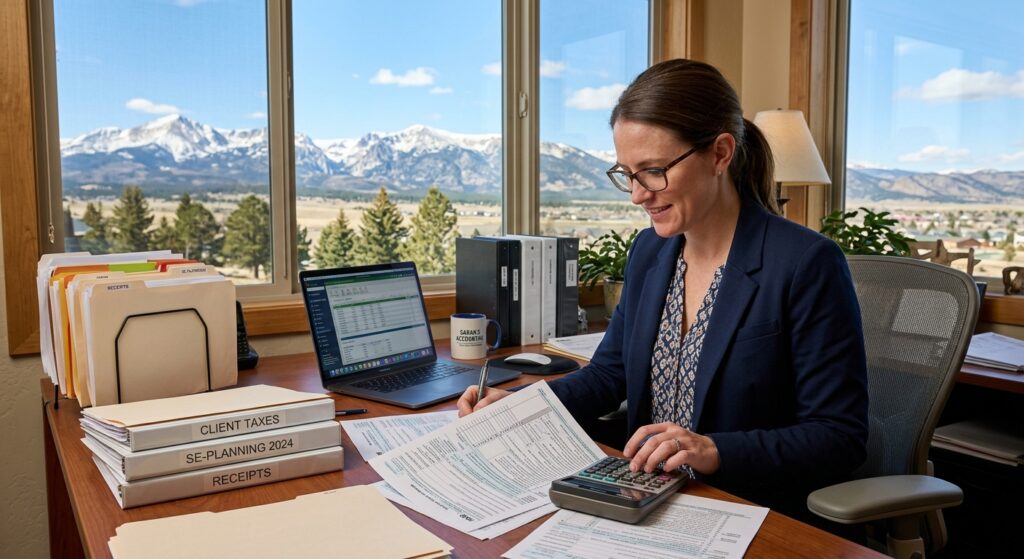
Complete Guide to Laramie Self-Employed Taxes for 2026: Maximize Deductions & Minimize Liability
Laramie self-employed taxes require strategic planning and careful attention to federal deadlines, deductions, and quarterly payments. For 2026, the landscape has shifted with new deduction opportunities, updated contribution limits, and critical quarterly filing requirements that self-employed individuals in Wyoming must understand to avoid penalties and maximize tax savings.
Table of Contents
- Key Takeaways
- Understanding Self-Employment Tax in 2026
- What Schedule C Deductions Can You Claim in 2026?
- When and How to Pay Quarterly Estimated Taxes
- Maximizing Home Office and Vehicle Expense Deductions
- Should You Consider an S Corp Election in Laramie?
- New Federal Deductions Available for 2026 Tax Year
- Uncle Kam in Action: Laramie Success Story
- Next Steps
- Frequently Asked Questions
Key Takeaways
- Self-employment tax remains 15.3% on net earnings above $400, with deadlines of January 15, April 15, June 15, and September 15 for quarterly payments in 2026.
- Wyoming has no state income tax, providing significant tax savings for self-employed individuals compared to neighboring states.
- Schedule C deductions can include home office (simplified or actual expense method), vehicle mileage, equipment, supplies, and professional services.
- New 2026 deductions include overtime pay ($12,500 single/$25,000 joint), auto loan interest ($10,000), and expanded Section 179 expensing ($2.5 million).
- S Corp election may reduce self-employment taxes by 15.3% to 2.9% through salary planning and distributions strategy.
Understanding Self-Employment Tax in 2026
Quick Answer: Self-employment tax is 15.3% (12.4% Social Security + 2.9% Medicare) on net earnings of $400 or more. You’ll pay this on your 2026 tax return based on profits from Schedule C, plus you must make quarterly estimated payments.
Self-employment tax is one of the largest expenses for Laramie self-employed individuals. Unlike W-2 employees who split the 15.3% Social Security and Medicare tax with their employer, self-employed taxpayers pay the entire amount themselves. This tax applies to net business income exceeding $400 and is calculated on Schedule C (Form 1040), which you file alongside your main tax return.
For 2026, if you expect to owe $1,000 or more in self-employment taxes (or total taxes), you’re required to pay quarterly estimated taxes. These payments are due on January 15, April 15, June 15, and September 15, 2026. Missing these deadlines triggers penalties and interest charges that compound quickly.
Why Quarterly Payments Matter for Laramie Self-Employed Professionals
The IRS requires quarterly payments to smooth tax obligations throughout the year rather than creating a massive bill in April 2027. If you don’t make these payments and owe more than $1,000, you’ll face an underpayment penalty. The safe harbor is to pay either 90% of your 2026 tax liability or 100% of your 2025 liability (110% if 2025 adjusted gross income exceeded $150,000).
Pro Tip: Use IRS Form 1040-ES to calculate quarterly payments. Pay through IRS Direct Pay, EFTPS, or a tax professional’s payment portal to avoid late fees and ensure proper documentation of payments made.
Consider using IRS payment options like direct debit from your business bank account for quarterly estimates. This prevents missed payments and creates a clear audit trail showing timely compliance.
What Schedule C Deductions Can You Claim in 2026?
Quick Answer: Schedule C deductions reduce your net profit and self-employment tax. Common deductions include office supplies, professional services, equipment under $2,500, vehicle mileage (standard rate or actual), home office expenses, insurance, and utilities allocable to business use.
Schedule C is where self-employed Laramie professionals report business income and expenses. The key principle: you can deduct any ordinary and necessary business expense. The more accurately you track and claim deductions, the lower your taxable profit and self-employment tax burden.
Essential Schedule C Deductions for 2026
- Office supplies and materials: Paper, pens, software subscriptions, website hosting, domain names.
- Professional services: Accounting, legal, bookkeeping, design, consulting fees related to business.
- Equipment and tools: Items under $2,500 (items over this threshold may require depreciation via Form 4562).
- Advertising and marketing: Social media ads, business cards, website development, Google Ads.
- Business insurance: Liability, health, disability insurance premiums tied to business.
- Utilities and rent: If you rent dedicated office space or allocate home utility costs to an office area.
- Continuing education: Courses, certifications, conferences required to maintain professional competency.
The IRS requires that deductions be “ordinary and necessary” for your specific business. Restaurant owners can deduct menu printing but not personal clothing. A contractor can deduct truck expenses but not personal vehicle insurance. Keep detailed records proving each deduction’s business purpose.
Common Schedule C Deduction Mistakes to Avoid
Many Laramie self-employed professionals leave money on the table by missing legitimate deductions. The most common mistakes include not deducting home office expenses, underreporting vehicle mileage, and failing to deduct professional development costs. Conversely, the IRS audits excessive deductions that don’t align with industry standards for your business type. A one-person consulting business claiming $50,000 in vehicle expenses raises red flags compared to a home-based freelancer claiming $3,000.
When and How to Pay Quarterly Estimated Taxes
Quick Answer: Quarterly estimated taxes are due January 15, April 15, June 15, and September 15 for 2026. Use Form 1040-ES to calculate your quarterly amount, then pay via IRS payment portal or through a tax professional.
Quarterly estimated tax payments are mandatory for self-employed individuals expecting $1,000 or more in tax liability. These payments prevent underpayment penalties and ensure the IRS receives tax revenue throughout the year rather than as a lump sum in April 2027.
2026 Quarterly Estimated Tax Payment Schedule
| Quarter | Income Period | Payment Due Date |
|---|---|---|
| Q1 | January 1 – March 31, 2026 | January 15, 2026 |
| Q2 | April 1 – May 31, 2026 | April 15, 2026 |
| Q3 | June 1 – August 31, 2026 | June 15, 2026 |
| Q4 | September 1 – December 31, 2026 | September 15, 2026 |
If the due date falls on a weekend or holiday, payment is due the next business day. The safe harbor rule states you must pay either 90% of your 2026 estimated tax or 100% of your 2025 tax liability. High-income earners (those with 2025 adjusted gross income above $150,000) must pay 110% of 2025 liability to avoid penalties.
Did You Know? Overpaying estimated taxes actually creates a refund when you file your 2026 return in April 2027. If your income fluctuates, paying more in high-income quarters and less in slow quarters reduces underpayment penalties.
Maximizing Home Office and Vehicle Expense Deductions
 Free Tax Write-Off Finder
Quick Answer: Home office deduction is available using the simplified method ($5 per square foot, up to 300 sq ft = $1,500 maximum) or actual expense method. Vehicle deductions use either the 2026 standard mileage rate or actual expense tracking.
Home office and vehicle deductions are the largest Schedule C deductions for Laramie self-employed professionals. The IRS is scrutinizing these areas closely, so documentation is critical. You must prove that your home office is used “regularly and exclusively” for business.
Home Office Deduction Options for 2026
Simplified Method: Multiply your home office square footage by $5. If your office is 150 square feet, the deduction is $750 per year. Maximum deduction is $1,500 (300 square feet). This method is easiest but typically results in lower deductions than the actual expense method.
Actual Expense Method: Calculate the percentage of your home devoted to business (office square footage divided by total home square footage), then deduct that percentage of mortgage interest/rent, property taxes, utilities, insurance, and repairs. A 200 sq ft office in a 2,000 sq ft home is 10% deductible. If your annual mortgage interest and property taxes total $12,000, your deduction would be $1,200 plus utilities and other allocable expenses.
Vehicle Expense Deductions for Self-Employed Laramie Professionals
Two methods exist for deducting vehicle expenses. The standard mileage rate (set annually by the IRS) applies to business miles driven in a personal vehicle. For 2026, track every business mile on a contemporaneous log. Alternatively, use the actual expense method: total all vehicle expenses (gas, maintenance, insurance, depreciation) and deduct the business-use percentage.
If you drove a vehicle 10,000 business miles in 2026 using the standard mileage rate, your deduction would be approximately $6,200 (assuming the 2026 rate is $0.62 per mile). Using actual expenses, if total vehicle costs were $15,000 and 70% was business use, the deduction is $10,500. Choose the method that results in the larger deduction, but you must keep meticulous records either way.
Pro Tip: The IRS requires contemporaneous documentation of mileage. Use a mileage log app like MileIQ or TripLog, or maintain a handwritten log showing date, miles, destination, and business purpose for audit defense.
Should You Consider an S Corp Election in Laramie?
Quick Answer: S Corp election reduces self-employment tax from 15.3% to 2.9% on distributions if you pay reasonable W-2 salary. Savings typically exceed $2,000 annually for businesses earning $60,000+. Use our LLC vs S-Corp Tax Calculator to estimate your specific savings.
An S Corp election (available to LLCs and S Corps) is one of the most powerful tax strategies for self-employed professionals in Laramie. Instead of paying 15.3% self-employment tax on all net profit, you split income into W-2 salary and distributions. W-2 salary is subject to 2.9% Medicare tax (already withheld), while distributions avoid self-employment tax entirely.
Here’s how it works: Suppose your LLC earns $100,000 net profit. As a sole proprietor, self-employment tax is $14,300 (15.3% of $93,500 after the deduction adjustment). With S Corp election, pay yourself $60,000 W-2 salary and $40,000 distribution. W-2 Medicare tax is $1,740 (2.9% of $60,000), saving you $12,560 annually compared to sole proprietor status.
Is S Corp Election Worth It for Your Laramie Business?
S Corp election typically makes sense for businesses earning $60,000+ in net profit. Below this threshold, additional accounting and payroll costs ($1,500-$3,000 annually) may exceed tax savings. Consider S Corp election if you’re a Laramie-based professional service provider, consultant, or contractor with consistent six-figure income.
New Federal Deductions Available for 2026 Tax Year
Quick Answer: New 2026 deductions include overtime premium pay ($12,500 single/$25,000 joint), auto loan interest ($10,000), Section 179 expensing expansion ($2.5 million), and bonus depreciation for qualified property.
The 2026 tax year brings several new deduction opportunities enacted through recent legislation. These temporary provisions (available through 2028) can significantly reduce your taxable income if your business qualifies.
New Deductions for Self-Employed Individuals in 2026
- Overtime premium deduction: If you worked overtime, deduct $12,500 (single) or $25,000 (joint) of qualifying overtime premium pay through 2028. Phases out above $150,000 (single) or $300,000 (joint) income.
- Auto loan interest deduction: Deduct up to $10,000 of qualified auto loan interest for new vehicles purchased 2025-2028. Vehicle must be U.S.-assembled and for personal use.
- Section 179 expensing: Increased to $2.5 million for 2026, with phaseout at $4 million in purchases. Allows immediate deduction of qualifying property instead of depreciation.
- Bonus depreciation: 100% bonus depreciation allows immediate deduction of qualifying property acquired and placed in service during 2026.
These deductions are particularly valuable for Laramie business owners making equipment purchases or vehicle investments in 2026. Section 179 expensing and bonus depreciation essentially allow you to “front-load” deductions, reducing taxable income in years when you make significant investments.

Uncle Kam in Action: How a Laramie Freelancer Saved $18,400 in Self-Employment Taxes
Client Profile: Sarah, a marketing consultant based in Laramie, had been operating as a sole proprietor for three years with annual revenue of $280,000 and net profit of $120,000. She was paying 15.3% self-employment tax on approximately $115,000 (after the one-half SE tax deduction), resulting in $17,645 annual SE tax burden. Sarah worked with Uncle Kam to implement a comprehensive 2026 tax strategy.
The Challenge: Sarah was concerned about her rising tax liability and wasn’t sure if she was capturing all available deductions. Her previous “tax preparer” spent minimal time reviewing her business operations and filed her return with generic deductions that didn’t reflect her actual business expenses.
The Uncle Kam Strategy: Uncle Kam implemented three primary changes: First, they converted Sarah’s sole proprietorship to an LLC taxed as an S Corp, reducing self-employment tax from 15.3% to 2.9% on distributions. Second, they implemented a comprehensive home office deduction using the actual expense method (rather than simplified method), capturing $8,200 in additional annual deductions. Third, they documented and maximized vehicle deductions through systematic mileage tracking and actual expense method, adding $6,500 in deductions.
The Results: The S Corp election alone saved Sarah $9,200 in self-employment taxes (paying $8,445 instead of $17,645). The enhanced home office and vehicle deductions reduced taxable profit by $14,700, resulting in approximately $4,700 in federal income tax savings and $4,500 in self-employment tax savings through lower net profit. Total first-year savings: $18,400. After paying $2,800 for LLC formation, accounting setup, and payroll processing, Sarah’s net savings were $15,600 in 2026 alone.
Ongoing Benefits: Sarah’s annual accounting and payroll processing costs are $2,400 going forward, but her ongoing annual tax savings remain approximately $13,600. Over a five-year period, Sarah will save $68,000 in taxes using the S Corp strategy combined with optimized Schedule C deductions. Visit our client results page for additional success stories from Laramie business owners.
Next Steps
Take immediate action to optimize your 2026 Laramie self-employed taxes:
- Calculate quarterly estimated tax liability: Use IRS Form 1040-ES or work with a professional to ensure payments meet January 15 deadline.
- Audit your business deductions: Review all 2025 Schedule C entries and identify missed deductions (home office, vehicle, professional development, software subscriptions).
- Evaluate S Corp election: If your business earns $60,000+ in profit, request a cost-benefit analysis comparing sole proprietor, LLC, and S Corp tax impacts for your specific situation.
- Implement record-keeping systems: Start tracking mileage daily, maintain receipts for all business expenses, and document home office allocation for audit defensibility.
- Schedule a Laramie tax strategy consultation: Get a personalized 2026 tax plan addressing your unique business structure and goals.
Frequently Asked Questions
How much does self-employment tax cost in 2026?
Self-employment tax is 15.3% (12.4% Social Security + 2.9% Medicare) on net self-employment income above $400. You get a deduction for one-half of the SE tax paid, reducing the effective rate slightly. For a $60,000 net profit, approximately $8,100 in self-employment taxes applies after the half-deduction adjustment.
What if I miss a quarterly estimated tax payment?
Missing quarterly payments triggers IRS underpayment penalties calculated daily at current interest rates (approximately 8% annually). If you miss January 15 payment, you owe penalties from January 16 through your next payment date. File your return and pay the full balance by April 15, 2027, to stop penalty accrual, though you’ll owe penalties for all prior months.
Can I deduct my entire home office as a business expense?
No. The IRS requires that your home office is used “regularly and exclusively” for business. You can only deduct the percentage of home expenses that corresponds to your office square footage. If your office is 200 sq ft and your home is 2,000 sq ft, only 10% of applicable expenses are deductible.
Should every self-employed person elect S Corp status?
No. S Corp election makes financial sense when self-employment taxes exceed the cost of implementing and maintaining the S Corp structure. For businesses earning less than $60,000 annually, the accounting and payroll costs typically exceed tax savings. High-income professionals ($100,000+ annual profit) almost always benefit from S Corp election.
Are vehicle expenses deductible if I use my car for personal and business purposes?
Yes, but only for business miles. You must track actual business miles and exclude personal mileage. If you drove 20,000 miles total in 2026 and 8,000 were business miles, you can deduct 40% of vehicle expenses using actual expense method, or 8,000 miles times the standard mileage rate.
What happens if the IRS audits my Schedule C return?
IRS audits typically occur 12-36 months after filing. The IRS will request documentation supporting claimed deductions. If you cannot prove a deduction’s business purpose or legitimacy, the IRS will disallow it, increase your taxable income, and assess back taxes plus interest and penalties (typically 20% of underpayment). Contemporaneous documentation (receipts, mileage logs, business invoices) is essential for audit defense.
How do I know if I should hire a tax professional for my Laramie self-employed taxes?
Consider professional help if your business structure is complex (LLC, S Corp), you have multiple income sources, you’re considering the S Corp election, or your profit exceeds $75,000. A tax professional’s fees typically range from $1,500-$4,000 annually but often generate savings exceeding their cost through optimized deductions and tax strategy.
This information is current as of March 30, 2026. Tax laws change frequently. Verify updates with the IRS or a tax professional if reading this after mid-2026, as additional legislation may have affected self-employed tax rules, deduction limits, or quarterly payment requirements.
Last updated: March, 2026

