
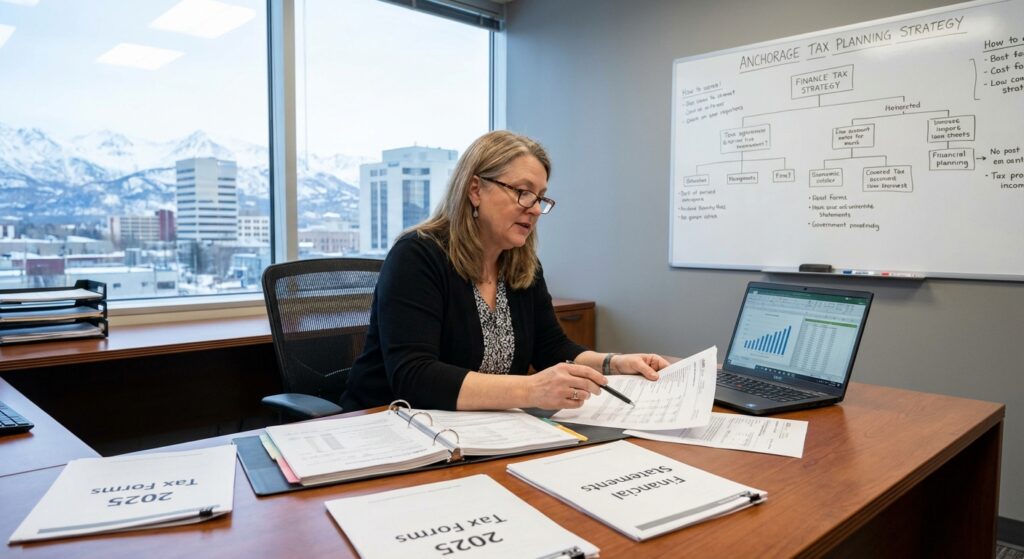
Complete Anchorage Tax Planning Guide for 2025: Strategies to Maximize Savings
For Anchorage residents and business owners, the 2025 tax year brings significant changes from the One Big Beautiful Bill Act (OBBBA), including higher standard deductions, new deductions for seniors and overtime workers, and expanded tax credits. Effective anchorage tax planning requires understanding these updates and implementing strategies before year-end to reduce your tax liability and maximize after-tax wealth. This comprehensive guide walks you through the most impactful 2025 tax changes and provides actionable steps you can take today.
Table of Contents
- Key Takeaways
- What’s New in 2025 Standard Deductions for Anchorage Taxpayers?
- How Can You Maximize Your 2025 Retirement Contributions?
- What New Deductions Should You Claim in 2025?
- How Do 2025 Tax Brackets Impact Your Anchorage Tax Planning?
- What Capital Gains Strategies Should You Use Before Year-End?
- What Tax Strategies Work Best for Anchorage Business Owners?
- Uncle Kam in Action: Real Anchorage Tax Savings
- Next Steps
- Frequently Asked Questions
Key Takeaways
- 2025 Standard deductions increased significantly: Singles get $15,750 (up from $14,600), married couples filing jointly get $31,500 (up from $29,200)—use these to reduce taxable income immediately.
- New $6,000 senior deduction is available: If you’re 65 or older by December 31, 2025, and earn under $75,000 ($150,000 for joint filers), claim this on top of your standard deduction—it expires after 2028.
- Child tax credit jumped to $2,200: The permanent increase from $2,000 means larger refunds for families—verify eligibility before year-end.
- SALT deduction cap increased to $40,000: Anchorage taxpayers can now deduct up to $40,000 in state and local taxes (temporary through 2029)—up from the previous $10,000 limit.
- Year-end tax planning can save thousands: Proactive strategy now prevents higher taxes in April 2026—act before December 31, 2025.
What’s New in 2025 Standard Deductions for Anchorage Taxpayers?
Quick Answer: The 2025 standard deduction increased for all filing statuses due to inflation adjustments. Single filers now deduct $15,750, married couples filing jointly $31,500, and heads of household $23,625. These increases directly reduce your taxable income and lower your federal tax bill.
The Internal Revenue Service adjusts the standard deduction annually based on inflation, and the 2025 increases are substantial. For Anchorage residents preparing to file their 2025 tax returns in 2026, understanding these higher deductions is fundamental to effective tax planning.
2025 Standard Deduction Amounts by Filing Status
| Filing Status | 2025 Standard Deduction | 2024 Amount | Increase |
|---|---|---|---|
| Single | $15,750 | $14,600 | +$1,150 |
| Married Filing Jointly | $31,500 | $29,200 | +$2,300 |
| Head of Household | $23,625 | $21,900 | +$1,725 |
These amounts apply to income earned during the 2025 tax year. When you file your return in early 2026, you’ll use these 2025 standard deductions. The increases reduce your taxable income dollar-for-dollar, which means immediate federal tax savings.
Should You Itemize or Take the Standard Deduction?
For most Anchorage taxpayers, the standard deduction is the better choice because it’s simpler and often yields greater tax savings. However, if you have significant deductible expenses—such as mortgage interest, charitable contributions, or the new expanded state and local tax deduction—you should calculate itemized deductions and compare. The 2025 increase in the SALT cap to $40,000 makes itemization more attractive for high-income filers in Alaska.
Pro Tip: If your mortgage interest, property taxes, state income taxes, charitable donations, and other deductible expenses add up to more than the standard deduction for your filing status, itemizing could save you thousands. Request a tax organizer from a CPA to calculate both options before year-end.
How Can You Maximize Your 2025 Retirement Contributions?
Quick Answer: For 2025, contribute up to $23,500 to a traditional 401(k) (or $31,000 if age 50+) or $7,000 to a traditional IRA ($8,000 if age 50+). These contributions reduce your taxable income and grow tax-deferred, making them powerful anchorage tax planning tools.
Retirement account contributions provide an immediate tax deduction while building long-term wealth. For employees with access to employer 401(k) plans, maximizing contributions is one of the most effective tax planning strategies. The contribution limits for 2025 remain steady from 2024, giving you the full benefit of tax-advantaged savings.
2025 Retirement Contribution Limits by Account Type
- Traditional 401(k): $23,500 (plus $7,500 catch-up at age 50+)
- Traditional IRA: $7,000 (plus $1,000 catch-up at age 50+)
- Roth IRA: $7,000 (subject to income phase-out limits)
- SEP IRA (self-employed): Up to 25% of net self-employment income
- Solo 401(k) (self-employed): Up to $69,000 total ($76,500 with catch-up)
If you’re self-employed or a business owner in Anchorage, a Solo 401(k) or SEP IRA allows you to contribute as both employee and employer, dramatically increasing your tax deductions. For example, a self-employed consultant earning $100,000 can contribute up to $25,000 to a SEP IRA and reduce taxable income accordingly.
Timing Your Contributions for Maximum Tax Benefit
For 2025 contributions to reduce your 2025 tax bill, employee 401(k) contributions must be deducted from your paycheck by December 31, 2025. Traditional IRA contributions for 2025 can be made until April 15, 2026, when you file your return. If you’re self-employed, Solo 401(k) contributions must be made by December 31, 2025, but SEP IRA contributions can wait until your tax return deadline.
Did You Know? Many Anchorage business owners miss December 31 deadlines for 401(k) contributions. If you haven’t fully funded your account for 2025, contact your plan administrator today to ensure payroll deductions are processed in time.
What New Deductions Should You Claim in 2025?
Quick Answer: The One Big Beautiful Bill Act introduced three major new deductions for 2025: a $6,000 senior deduction (age 65+), a $12,500 overtime pay deduction, and an above-the-line $1,000 charitable deduction. Anchorage residents should verify eligibility before year-end to claim these valuable tax breaks.
The OBBBA fundamentally changed the tax landscape for certain Anchorage residents. These new deductions represent thousands of dollars in potential tax savings for qualifying taxpayers. Let’s examine each one in detail.
The New Senior Deduction: $6,000 (or $12,000 for Joint Filers)
If you’re age 65 or older by December 31, 2025, you can claim an additional $6,000 deduction on top of your standard deduction. Married couples filing jointly with both spouses age 65+ can deduct $12,000. This deduction phases out for higher-income filers: the benefit reduces for singles earning over $75,000 and joint filers earning over $150,000, disappearing completely at $175,000 (single) or $250,000 (joint).
This means an Anchorage senior couple filing jointly could have a combined standard deduction of $31,500 plus $12,000 senior deduction, totaling $43,500 in deductions before any itemized deductions. This is a temporary provision expiring after the 2028 tax year, so Anchorage retirees should maximize it while available.
Overtime Pay Deduction: Up to $12,500 ($25,000 Joint)
Anchorage workers earning overtime can now deduct up to $12,500 in qualifying overtime compensation (or $25,000 for joint filers). The deduction applies only to the amount earned above your regular wage at the overtime rate. For example, if you typically earn $20 per hour and receive $30 for overtime, only $10 per hour is deductible. The benefit phases out for higher earners over $150,000 (single) or $300,000 (joint).
Charitable Deduction: $1,000 (or $2,000 Joint)
A permanent “above-the-line” charitable deduction allows you to deduct $1,000 in donations ($2,000 for joint filers) even if you take the standard deduction. This is a game-changer for charitable-minded Anchorage residents who previously couldn’t deduct donations without itemizing.
How Do 2025 Tax Brackets Impact Your Anchorage Tax Planning?
Quick Answer: The seven federal tax brackets for 2025 range from 10% to 37%, with specific income thresholds for each filing status. Understanding where your income falls helps you plan charitable donations, business structure decisions, and retirement contributions to minimize your effective tax rate.
The Tax Cuts and Jobs Act provisions making lower tax rates permanent were preserved by the OBBBA. These seven brackets apply to all 2025 Anchorage taxpayers, and knowing your marginal bracket is essential for effective tax planning.
2025 Federal Tax Brackets and Thresholds
| Tax Rate | Single Filer | Married Filing Jointly | Head of Household |
|---|---|---|---|
| 10% | $1 – $11,925 | $1 – $23,850 | $1 – $17,000 |
| 12% | $11,926 – $48,475 | $23,851 – $96,950 | $17,001 – $64,850 |
| 22% | $48,476 – $103,350 | $96,951 – $206,700 | $64,851 – $103,350 |
| 24% | $103,351 – $197,300 | $206,701 – $394,600 | $103,351 – $197,300 |
| 32% | $197,301 – $250,525 | $394,601 – $501,050 | $197,301 – $250,500 |
| 35% | $250,526 – $626,350 | $501,051 – $751,600 | $250,501 – $626,350 |
| 37% | $626,351+ | $751,601+ | $626,351+ |
Strategic Tax Planning Using Bracket Thresholds
If your Anchorage household is approaching a higher tax bracket, strategic deductions can keep you in a lower bracket. For example, a single filer earning $49,000 is in the 12% bracket. By contributing an additional $525 to a traditional IRA, you drop to $48,475, staying in the 12% bracket and avoiding the 22% rate on income above the threshold. This bracket management is central to effective anchorage tax planning.
What Capital Gains Strategies Should You Use Before Year-End?
Quick Answer: Anchorage investors can realize long-term capital gains at a 0% tax rate if taxable income stays below $48,350 (single) or $96,700 (married filing jointly) for 2025. Tax gain harvesting—strategically selling profitable investments in low-income years—can unlock tax-free profits while staying below these thresholds.
The preferential capital gains tax treatment creates a powerful planning opportunity. If your 2025 taxable income is projected to be below these thresholds, you can sell appreciated investments without owing federal income tax on gains. This is particularly valuable for Anchorage retirees and early-retired investors managing portfolio transitions.
How to Execute a Tax Gain Harvesting Strategy
- Step 1: Calculate taxable income Subtract standard deductions and all deductions from your adjusted gross income to find where you stand relative to the 0% bracket threshold.
- Step 2: Identify available room Determine how much additional capital gains you can realize before entering the 15% bracket ($48,350 for singles, $96,700 for MFJ).
- Step 3: Execute trades before year-end Sell appreciated positions within your 2025 gains “room” by December 31, 2025, to lock in the 0% rate.
- Step 4: Rebalance if desired After harvesting gains, purchase replacement investments to maintain your desired portfolio allocation.
Pro Tip: Be aware of surprise year-end distributions from mutual funds or ETFs. These could push you over the 0% bracket threshold unexpectedly. Contact your fund managers by mid-December to understand potential 2025 distributions and adjust your gain harvesting accordingly.
What Tax Strategies Work Best for Anchorage Business Owners?
Quick Answer: Anchorage business owners benefit most from maximizing business deductions (equipment, vehicles, home office), establishing retirement plans (Solo 401(k) or SEP IRA), and implementing professional anchorage tax planning early in the year. Before year-end, accelerate deductible expenses and verify income timing to minimize 2025 tax liability.
Business owners in Anchorage have unique tax planning opportunities unavailable to W-2 employees. The self-employment tax benefit, ability to deduct business expenses, and flexibility in retirement contributions make year-end planning critical.
Essential Year-End Business Deductions to Claim
- Equipment and technology: Purchase qualifying business equipment before December 31 and claim Section 179 expensing (up to $1,160,000 in 2025) or bonus depreciation for immediate deductions.
- Home office deduction: Calculate actual expenses (utilities, rent, insurance proportional to office space) or use the simplified $5 per-square-foot method (up to $300 annually).
- Vehicle expenses: Anchorage business owners can deduct mileage at 67.5 cents per mile (2025 rate) or actual operating expenses. Track all business mileage meticulously.
- Contract labor and subcontractor payments: Pay invoices owed to independent contractors before year-end to deduct them in 2025.
- Health insurance and retirement contributions: Anchorage self-employed individuals can deduct 100% of health insurance premiums and maximize Solo 401(k) contributions.
Timing Business Income and Expenses
Cash-basis businesses (most small Anchorage operations) can shift timing of income and expenses. If you’re projected to have a high-income year, consider deferring client billing to January 2026 or paying deductible expenses early. Conversely, in lower-income years, accelerate client billings and defer discretionary expenses. This timing strategy directly reduces 2025 taxable income and can save thousands in taxes.
Did You Know? The OBBBA made immediate R&D expensing (Section 174) permanent. Anchorage technology companies and engineers can now expense research and development costs immediately rather than amortizing over five years, creating substantial tax deductions in 2025.

Uncle Kam in Action: Real Anchorage Tax Savings
Client Snapshot: Sarah Chen, an Anchorage-based consultant and single business owner, earned $95,000 in gross revenue from her consulting practice in 2025. She wasn’t using professional tax planning and was projecting a significant tax bill on her 2025 return.
Financial Profile: Solo business owner with $95,000 annual revenue, no employees, operating from a home office. Previous tax planning was minimal—she simply filed her Schedule C with basic expense tracking.
The Challenge: Sarah calculated she’d owe approximately $18,500 in federal income tax plus self-employment tax of $13,400, totaling over $31,900 in 2025 tax liability. She knew she was missing strategies that could reduce this burden but didn’t know what to do. A referral to Uncle Kam’s Anchorage tax planning services changed everything.
The Uncle Kam Solution: Our tax strategists implemented a comprehensive plan. First, we established a Solo 401(k) and maximized Sarah’s employer-side contribution of $14,750 based on her 2025 net income. Second, we identified $8,200 in deductible home office expenses (utilities, office equipment, internet). Third, we calculated her actual vehicle mileage (12,000 business miles) worth $8,100 in deductions at the 2025 rate of 67.5 cents per mile. Finally, we reviewed her professional development expenses, client entertainment, and subscriptions—finding an additional $3,400 in overlooked deductions. Combined with her standard deduction of $15,750, Sarah’s taxable income dropped to just $29,408.
The Results:
- Tax Savings (Federal Income Tax): Reduced from $18,500 to $3,527 (on her lower taxable income of $29,408)—a savings of $14,973
- Self-Employment Tax Savings: The Solo 401(k) contribution reduced self-employment tax by approximately $2,087
- Total 2025 Tax Savings: $17,060
- Professional Investment: Uncle Kam’s comprehensive tax planning and filing service cost $2,500
- Return on Investment: Sarah’s 6.8x ROI in the first year, plus ongoing Solo 401(k) contributions that build retirement savings
This is just one example of how our proven anchorage tax planning strategies help Anchorage business owners maximize savings and build long-term financial security. Sarah’s proactive approach to 2025 tax planning prevented thousands in unnecessary tax payments while strengthening her retirement savings through the Solo 401(k).
Next Steps
Effective anchorage tax planning requires action. Don’t wait until April 2026 when filing your return—the most valuable strategies must be implemented before December 31, 2025. Here are your immediate action items:
- Calculate your 2025 taxable income projection: Add all income sources, subtract deductions, and determine which tax bracket you’re in. This is the foundation for all other planning.
- Maximize 401(k) contributions: If you have access to an employer plan, increase deferrals immediately. If self-employed, establish a Solo 401(k) or SEP IRA before December 31.
- Conduct a tax organizer review: List all potential deductions (charitable donations, business expenses, state taxes, mortgage interest) and determine if itemization beats your standard deduction.
- Schedule a tax planning consultation: Connect with Uncle Kam’s professional tax planning team for a personalized strategy before year-end. Time is running out—act this week, not in January.
- Execute year-end transactions: Sell appreciated investments for tax gain harvesting, pay business expenses owed, and finalize charitable donations before December 31.
Frequently Asked Questions
What if I miss the December 31 deadline for anchorage tax planning?
Some strategies cannot be implemented after year-end. For example, 401(k) contributions must be deducted from payroll by December 31 to reduce 2025 taxes. However, traditional IRA contributions, Solo 401(k) contributions for self-employed individuals, and SEP IRA contributions can wait until April 15, 2026, when you file your return. Don’t let the December deadline prevent you from taking any action—even late strategies are better than none.
How do Alaska’s lack of income tax and SALT deduction changes affect my anchorage tax planning?
Alaska has no state income tax, which is a tremendous advantage. However, the 2025 increase in the federal SALT deduction cap to $40,000 primarily benefits high-income filers with significant property taxes or state sales taxes. Since Alaska has no income tax, Anchorage residents benefit more from maximizing other deductions like retirement contributions and business expenses than from the SALT deduction increase.
Can I claim the new senior deduction if I’m 64 in 2025 but turn 65 in 2026?
Unfortunately, no. The senior deduction requires you to be age 65 or older by December 31 of the tax year. If you turn 65 on January 1, 2026, you cannot claim the deduction for 2025. However, you’ll be eligible to claim it on your 2026 return, which you file in 2027.
What is the best entity structure for an Anchorage business: LLC, S Corp, or C Corp?
The answer depends on your specific situation. An S Corporation election can save substantial self-employment taxes if you take a reasonable W-2 salary and distribute the rest as dividends. An LLC taxed as an S Corp often provides the best combination of liability protection and tax savings. A C Corporation is rarely optimal for small Anchorage businesses due to double taxation. Consult with a tax strategist to model your specific scenario—the savings can exceed $5,000+ annually for businesses with net income over $60,000.
How much should I set aside for estimated taxes if I’m self-employed in Anchorage?
The IRS requires self-employed individuals to pay estimated quarterly taxes if they expect to owe $1,000 or more. Estimate your 2025 net profit, subtract half your anticipated self-employment tax, subtract your expected standard deduction, and apply your marginal tax rate (likely 12% for Anchorage self-employed earning $50,000-$100,000). Divide by four for quarterly payments due April 15, June 15, September 15, and January 15. Underpayment penalties apply if you underpay significantly.
When should I hire a professional tax strategist for anchorage tax planning?
You should consult a tax strategist if: (1) you’re self-employed or own a business, (2) your household income exceeds $75,000, (3) you have investment income or significant capital gains, (4) your situation is complex (rental properties, multiple income sources, recent business formation), or (5) you want to minimize taxes proactively. The investment in professional planning typically pays for itself many times over through tax savings and strategic planning that a DIY approach misses.
What documentation do I need to gather for effective anchorage tax planning?
Gather: (1) all W-2 and 1099 forms, (2) business revenue and expense records (organized by category), (3) mortgage statements and property tax bills, (4) investment statements showing gains/losses, (5) charitable donation receipts, (6) health insurance premium documentation, (7) retirement contribution statements, (8) vehicle mileage log (if business use), and (9) rental property income and expenses (if applicable). The more detailed your documentation, the more opportunities your tax strategist can identify.
This information is current as of 12/21/2025. Tax laws change frequently. Verify updates with the IRS or a tax professional if reading this later.
Related Resources
- 2025 Comprehensive Tax Strategy Guide
- Tax Planning Solutions for Anchorage Business Owners
- Self-Employed Tax Deductions and Strategies
- Uncle Kam’s MERNA™ Tax Method Explained
- LLC vs S Corp vs C Corp Tax Comparison
Last updated: December, 2025

