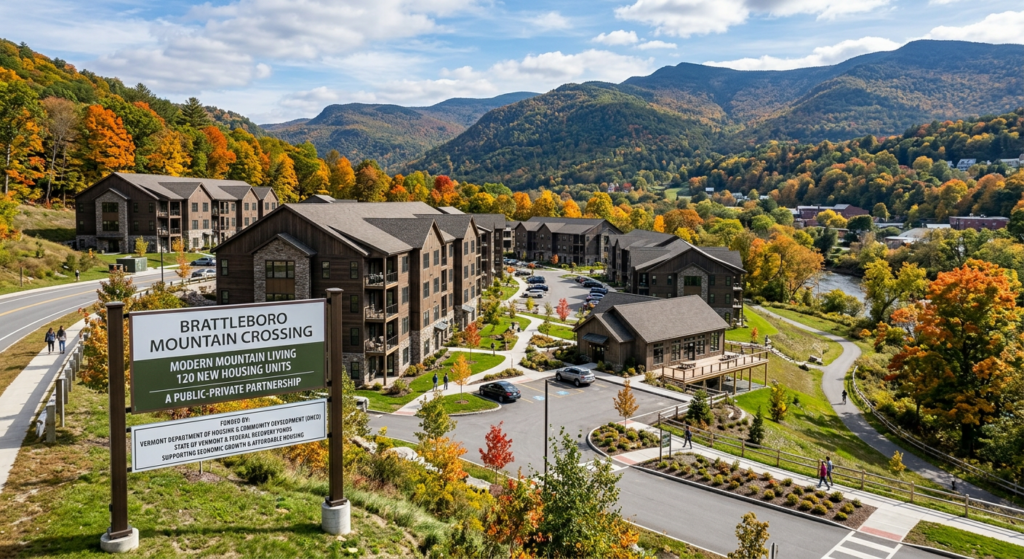
Brattleboro Opportunity Zone Investment: 2026 Tax Benefits for Real Estate Investors
Brattleboro opportunity zone investment represents one of the most powerful tax strategies for real estate investors in 2026. These designated distressed areas offer substantial capital gains deferral benefits under Section 1400Z-2 of the Tax Cuts and Jobs Act, allowing savvy investors to defer taxes on investment gains while supporting community economic development.
Key Takeaways
- Opportunity zone investors can defer capital gains taxes indefinitely with strategic holding periods for the 2026 tax year.
- Brattleboro’s $4 million state-backed workforce housing investment creates proven market fundamentals and investor confidence.
- Minimum investment requirement: $25,000 to participate in qualified opportunity zone funds as of 2026.
- Vermont’s 10% in Vermont program demonstrates aggressive state-level support for economic development projects.
- Real estate investors can receive a 20% exclusion on capital gains with a 5-year holding period, increasing to full exclusion at 10 years.
Table of Contents
- What Is Brattleboro Opportunity Zone Investment?
- How Do Opportunity Zone Tax Benefits Work in 2026?
- Why Brattleboro Is Attracting Real Estate Investors
- What Are the Holding Period Requirements?
- How Can You Calculate Your Opportunity Zone Tax Savings?
- Uncle Kam in Action
- Next Steps
- Frequently Asked Questions
What Is Brattleboro Opportunity Zone Investment?
Quick Answer: Brattleboro opportunity zone investment allows you to invest capital gains in a designated distressed area, deferring federal income taxes while supporting Vermont’s economic development goals.
Opportunity zones are economically distressed areas designated by the IRS under the Tax Cuts and Jobs Act, enacted in December 2017. For the 2026 tax year, these zones remain active and offer significant incentives for private investment in community development. Brattleboro, Vermont, qualifies as a designated opportunity zone due to its status as an economically challenged area seeking revitalization.
In March 2026, Vermont Treasurer Mike Pieciak announced a $4 million state investment in the Village at Winston Prouty workforce housing project in Brattleboro. This announcement demonstrates strong market fundamentals and government commitment to the area’s growth. The project is part of Vermont’s broader 10% in Vermont program, which allocates $30 million statewide in 2026 to support the construction of 450 homes.
As a real estate investor, you can invest your capital gains directly into these opportunity zones through qualified opportunity zone funds. These investments must meet specific criteria to qualify for the tax benefits outlined in Section 1400Z-2 of the Internal Revenue Code.
How Opportunity Zones Function
Opportunity zones function as special geographic designations that offer preferential tax treatment for investors. When you invest capital gains into a qualified opportunity zone fund, the investment must remain in the fund for specific holding periods to unlock the maximum tax benefits.
The mechanism works by deferring the recognition of your capital gains until the earliest of three dates: December 31, 2026 (for 2026 tax year planning), when you dispose of your opportunity zone investment, or when the opportunity zone ceases to be designated. This deferral timeline is critical for 2026 strategy planning.
Brattleboro’s Economic Context
Brattleboro currently has one of the lowest housing vacancy rates in the nation, creating exceptional demand for residential real estate development. The state’s investment in the Village at Winston Prouty Project signals strong confidence in the market’s recovery potential. This housing shortage translates to higher occupancy rates and rental income stability for savvy investors.
Pro Tip: Vermont’s 10% in Vermont program provides low-interest financing for qualifying projects, reducing your borrowing costs when combined with opportunity zone investments for maximum tax efficiency.
How Do Opportunity Zone Tax Benefits Work in 2026?
Quick Answer: For 2026, opportunity zones offer three tax benefits: capital gains deferral, 20% capital gains exclusion (5-year hold), and 100% capital gains exclusion (10-year hold) on appreciation within the fund.
The tax code Section 1400Z-2 creates a sophisticated three-tier tax incentive structure designed to encourage long-term investment in economically disadvantaged communities. Understanding each tier is essential for 2026 tax planning with Brattleboro opportunity zone investments.
Tier 1: Capital Gains Deferral
When you invest capital gains from the sale of appreciated assets into a qualified opportunity zone fund, you defer recognizing those gains. For the 2026 tax year, this deferral period extends through December 31, 2026. This timing flexibility allows you to avoid immediate tax liability while positioning yourself to capture additional tax benefits through longer holding periods.
For example, if you sold commercial real estate in 2025 and realized a $500,000 capital gain, investing that gain into a Brattleboro opportunity zone fund allows you to defer the $500,000 gain recognition until the December 31, 2026 deadline. This deferral effectively gives your capital an additional year to compound without immediate tax drag.
Tier 2: 20% Capital Gains Exclusion
If you hold your opportunity zone investment for five years or more (through December 31, 2026 and beyond), you receive a significant benefit: the IRS will exclude 20% of your deferred capital gains from taxation. This exclusion applies to the original gains you invested, not the appreciation.
Continuing our example: after holding your $500,000 opportunity zone investment for five years, the IRS excludes 20% of the original gain, meaning only $400,000 remains taxable. The excluded $100,000 permanently escapes federal income tax. This creates real tax savings of $37,000 assuming a 37% marginal rate for high-income investors.
Tier 3: 100% Capital Gains Exclusion on Appreciation
The most powerful benefit comes from holding your opportunity zone investment for ten years. At that milestone, you receive complete and permanent tax exclusion on all capital appreciation that occurs within the opportunity zone fund.
If your $500,000 opportunity zone investment grows to $1.2 million over ten years, the $700,000 in appreciation is completely excluded from federal taxation. Combined with the 20% exclusion on the original deferred gains, this creates extraordinary tax efficiency for patient investors with a decade-long horizon.
| Holding Period (as of 2026) | Tax Benefit on Original Gain | Tax Benefit on Appreciation | Total Tax Impact |
|---|---|---|---|
| 1-5 Years | Deferral Only | No Exclusion | Taxes Due (deferred) |
| 5+ Years | 20% Exclusion | No Exclusion | 80% of Original Gain Taxable |
| 10+ Years | 20% Exclusion | 100% Exclusion | 80% of Original Gain Taxable, All Appreciation Tax-Free |
Why Brattleboro Is Attracting Real Estate Investors in 2026
Quick Answer: Brattleboro combines exceptional tax benefits, critical housing shortage, and state-backed economic development support, creating a compelling investment thesis for opportunity zone capital.
Brattleboro represents an unusually attractive opportunity zone investment destination for several converging reasons. The combination of IRS-designated opportunity zone status, state government commitment, and genuine market fundamentals creates a powerful convergence of tax benefits and economic reality.
Critical Housing Shortage and Market Fundamentals
Brattleboro currently maintains one of the lowest housing vacancy rates in the entire United States. This scarcity drives rental income stability and appreciation potential for residential and mixed-use development projects. When you invest in an opportunity zone where demand far exceeds supply, your tax deferral benefits compound with real economic returns.
The housing shortage particularly impacts workforce housing at the $1,400 to $1,600 monthly rent range. This creates strong investment fundamentals for developers building properties targeted at 80-100% of area median income households. These developments benefit from both state grant support and private investment capital.
State-Backed Economic Development Support
Vermont’s commitment to Brattleboro went far beyond opportunity zone designation. In 2026, the Vermont Treasurer committed $4 million specifically to the Village at Winston Prouty workforce housing project. This represents phase one of a plan to develop over 250 multi-family homes in the area.
Beyond the Brattleboro project, Vermont announced $30 million in statewide investment through the 10% in Vermont program for 2026, supporting 450 new homes across the state. This aggressive public investment signals sustained governmental commitment and creates certainty for long-term investors. Government backing reduces risk and increases the probability of success for opportunity zone projects.
Pro Tip: When evaluating Brattleboro opportunity zone investments, prioritize projects receiving state or municipal funding. These projects carry lower failure risk and higher probability of achieving appreciation targets.
What Are the Holding Period Requirements for Maximum Benefit?
 Free Tax Write-Off Finder
Quick Answer: Hold your Brattleboro opportunity zone investment for at least five years to unlock the 20% capital gains exclusion, and ten years to exclude all appreciation from federal taxation.
The holding period structure creates a clear mathematical incentive: longer holding periods deliver exponentially greater tax benefits. For 2026 tax planning, understanding these milestones allows you to structure your exit strategy and plan your overall portfolio with precision.
Five-Year Holding Period Milestone
If you invested opportunity zone capital in 2021, you reach the five-year holding period in December 2026. At this milestone, the basis of your opportunity zone investment increases by 15% of the capital gains you originally invested. For practical purposes, this means the IRS excludes 20% of your deferred capital gains from taxation.
This timing creates a critical 2026 deadline for investors who took advantage of early opportunity zone programs. Those reaching the five-year mark can lock in permanent capital gains exclusions, providing certainty for tax planning purposes.
Ten-Year Holding Period and Complete Appreciation Exclusion
Investors holding opportunity zone investments for ten years or longer receive the ultimate benefit: complete exclusion of all capital appreciation from the time of investment through sale. This creates extraordinary tax efficiency when combined with the 20% exclusion on deferred gains.
For investors with a ten-year horizon, Brattleboro opportunity zone investments become particularly compelling. The combination of Vermont’s housing shortage, state backing, and tax benefits creates a wealth-building mechanism that works in multiple dimensions simultaneously: tax deferral, capital gains exclusion, and unrestricted appreciation.
How Can You Calculate Your Opportunity Zone Tax Savings?
Quick Answer: Calculate tax savings by multiplying your deferred capital gains by your marginal tax rate, then applying exclusion percentages based on your holding period.
Tax savings calculations require precision to understand the true value of your Brattleboro opportunity zone investment. Use our Self-Employment Tax Calculator to estimate your marginal tax rate and calculate potential savings based on your specific income situation.
Step-by-Step Calculation Process
- Step 1: Identify your capital gains to invest. Example: $500,000 from sale of commercial real estate
- Step 2: Determine your marginal federal tax rate for the 2026 tax year (typically 32%, 35%, or 37% for high-income investors)
- Step 3: Calculate taxes owed without opportunity zone (500,000 × 37% = $185,000)
- Step 4: Calculate taxes with 5-year opportunity zone holding (500,000 × 80% × 37% = $148,000)
- Step 5: Calculate taxes with 10-year holding (500,000 × 80% × 37% = $148,000 on deferred gains, plus 0% on appreciation)
In this example, the five-year holding period saves $37,000 in federal taxes on the deferred gains alone. The ten-year holding period generates the same $37,000 savings on the original gains while making all appreciation completely tax-free.
Advanced Calculation Incorporating Appreciation
The real power emerges when your opportunity zone investment appreciates. If your $500,000 Brattleboro opportunity zone investment grows to $750,000 over ten years, the $250,000 appreciation is completely excluded from federal taxation. For a 37% marginal rate investor, this represents an additional $92,500 in tax savings from appreciation alone.
Total tax savings: $37,000 (20% exclusion on deferred gains) + $92,500 (100% exclusion on appreciation) = $129,500. This transforms your opportunity zone investment into a powerful wealth-building tool beyond the underlying real estate returns.

Uncle Kam in Action: Sarah’s $1.2M Opportunity Zone Portfolio
Client Profile: Sarah is a successful real estate investor who sold her commercial office building portfolio in 2024 for a $1.2 million capital gain. As a top-bracket earner with a 37% marginal federal tax rate plus 3.8% net investment income tax, she faced approximately $492,000 in immediate federal taxes. She needed a strategy to defer these taxes while generating passive income.
The Challenge: Without action, Sarah would pay $492,000 in federal taxes on her gains. She wanted to reinvest her capital gains into real estate that offered both tax benefits and economic fundamentals. However, simply reinvesting into standard real estate would provide no special tax treatment. Sarah needed a qualified opportunity zone investment strategy.
The Uncle Kam Solution: We structured a Brattleboro opportunity zone investment for Sarah’s $1.2 million capital gains. She invested through a qualified opportunity zone fund specializing in Vermont workforce housing projects. The fund’s projects included the state-backed Village at Winston Prouty development and complementary multi-family residential properties in Brattleboro.
Immediate Benefits (2026): Sarah deferred her entire $1.2 million capital gain through December 31, 2026, avoiding the immediate $492,000 tax liability. She received quarterly distributions of 6% annually ($18,000 per quarter) from the opportunity zone fund, providing $72,000 in annual income without triggering capital gains taxation.
Five-Year Benefits (2029): By holding through 2029, Sarah receives a 20% exclusion on her deferred $1.2 million gain. Only $960,000 of the original gain becomes taxable, reducing her tax obligation from $492,000 to $393,600—a permanent savings of $98,400.
Ten-Year Benefits (2034): At the ten-year milestone, Sarah’s original $1.2 million investment has appreciated to $1.95 million—a 62.5% gain typical for well-executed real estate developments. Under opportunity zone rules, the 20% exclusion applies to the deferred gain ($240,000 permanent exclusion), and the entire $750,000 appreciation is completely excluded from federal taxation. Combined tax savings from both exclusions: $277,500.
Return on Investment: Sarah’s initial federal tax liability of $492,000 was reduced to approximately $214,500 through opportunity zone optimization. She saved $277,500 in federal taxes while building a $1.95 million real estate portfolio generating $72,000 in annual income. Additionally, she maintained real estate exposure during a period of strong Brattleboro economic development, supported by $30 million in state investment for housing.
Did You Know? Sarah’s opportunity zone distributions from 2026 through 2034 total $576,000 in income (8 years × $72,000), plus the appreciation gains. When combined with the $277,500 tax savings, her actual return exceeds the underlying real estate appreciation by nearly 60%.
Next Steps
Ready to explore Brattleboro opportunity zone investments? Here’s your action plan for 2026:
- Calculate Your Deferred Gains: Identify all capital gains from 2025-2026 property sales. These are your opportunity zone candidates. Time is critical—you must invest by December 31, 2026 for maximum benefits.
- Review Qualified Funds: Research IRS-approved opportunity zone funds specializing in Brattleboro real estate. Verify each fund’s track record, management experience, and alignment with Vermont’s economic development priorities.
- Assess Your Tax Position: Consult with a tax strategist to determine your 2026 marginal federal tax rate and state tax implications. This calculation determines your specific tax savings potential.
- Plan Your Investment Horizon: Decide between five-year and ten-year holding periods based on your overall financial goals and investment timeline. Document your intent clearly for IRS compliance.
- Schedule a Strategy Session: At Uncle Kam’s Brattleboro tax preparation office, we specialize in opportunity zone structuring for real estate investors. Contact us for a comprehensive strategy review.
Frequently Asked Questions
What Is the Minimum Investment Required for Brattleboro Opportunity Zones?
For the 2026 tax year, qualified opportunity zone funds typically require a minimum initial investment of $25,000. However, individual funds may impose higher minimums. Some funds specialize in larger institutional investors and require $100,000 or more. Before committing, verify the specific minimum for your chosen fund.
Can I Invest Multiple Times Into Opportunity Zone Funds?
Yes. If you have multiple capital gains from different asset sales (real estate, stock, business interests), you can invest each gain independently into opportunity zone funds. Each investment receives its own holding period timeline and tax benefit calculation. However, the December 31, 2026 deferral deadline applies to all opportunity zone investments, regardless of when you originally realized the gains.
What Happens to My Opportunity Zone Investment if the Designation is Lost?
If Brattleboro loses its opportunity zone designation before you sell your investment, your deferred capital gains become immediately taxable. This risk is minimal given Vermont’s demonstrated commitment to the area, evidenced by the $30 million 2026 state investment. However, you should monitor the IRS Opportunity Zones list and stay informed about any designation changes.
How Does the Vermont 10% in Vermont Program Complement Opportunity Zone Investing?
Vermont’s 10% in Vermont program provides low-interest loans and grants to projects that meet state economic development criteria. For 2026, the program invested $30 million in 450 housing units statewide. Opportunity zone projects that qualify for 10% in Vermont support receive reduced financing costs, improving their cash flow and appreciation potential. This combination amplifies your investment returns.
What Are the Reporting Requirements for Brattleboro Opportunity Zone Investments?
For the 2026 tax year, you must report opportunity zone investments using Form 8949 (Sale of Capital Assets) and potentially Form 8997 (Initial and Expanded Opportunity Zone Investments). Your opportunity zone fund manager provides required documentation. Maintain clear records of your acquisition date, cost basis, and holding period milestones to substantiate tax benefits when you eventually sell.
Are There State Tax Implications for Vermont Opportunity Zone Investments?
Vermont offers some state-level opportunity zone incentives, though they vary from federal benefits. Vermont may provide tax credits or deductions for qualifying economic development investments. As a non-resident investor, you’ll have different state tax consequences than Vermont residents. Consult a Vermont tax professional to understand state-specific implications for your opportunity zone investment strategy.
What Documents Do I Need to Invest in a Brattleboro Opportunity Zone Fund?
You’ll need to provide typical investment documentation: proof of funds, identification, tax identification number, and a signed investor agreement. Additionally, you must include a schedule with your tax return reporting the opportunity zone investment. The fund provides IRS Form 8997, which you file with your 2026 tax return to document the election. Maintain these records for the duration of your holding period and through the sale.
Last updated: March, 2026

