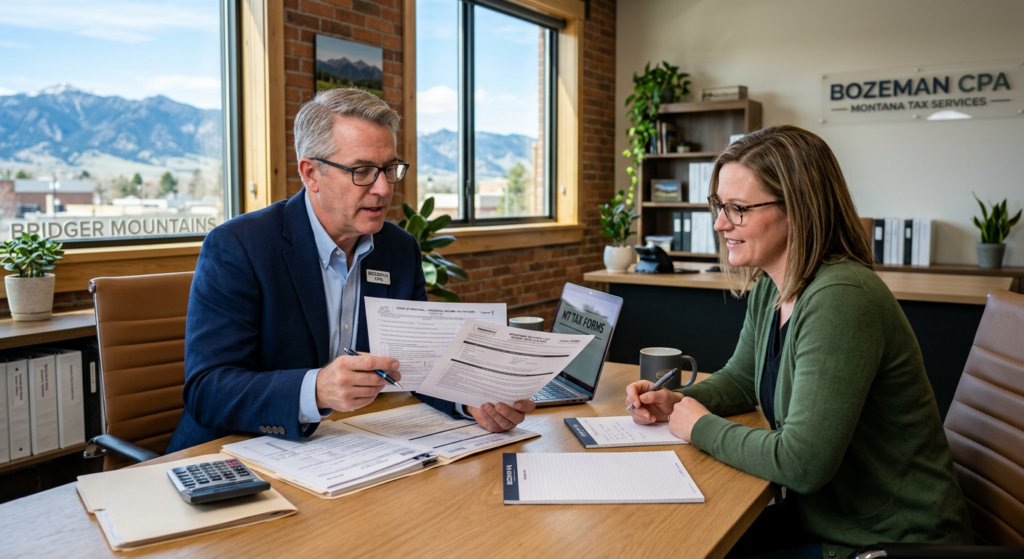
Bozeman CPA Tax Strategies for 2026: Complete Guide for Montana Entrepreneurs & Business Owners
Finding the right Bozeman CPA for tax preparation can save Montana business owners thousands of dollars in unnecessary taxes. For the 2026 tax year, new federal tax breaks under the One Big Beautiful Bill Act combined with Montana’s expanded property tax relief programs create unprecedented planning opportunities. Whether you’re a freelancer, small business owner, real estate investor, or high-income professional, understanding these changes is critical to maximizing your after-tax income.
Table of Contents
- Key Takeaways
- Why Work With a Bozeman CPA for 2026 Tax Planning?
- What Federal Tax Changes Affect Bozeman Entrepreneurs in 2026?
- How Can You Benefit from Montana’s 2026 Property Tax Relief?
- How Should Bozeman CPAs Calculate Self-Employment Tax Obligations?
- What Business Deductions Can You Maximize in 2026?
- How Should You Optimize Retirement Savings for Tax Benefits?
- Uncle Kam in Action
- Next Steps
- Frequently Asked Questions
Key Takeaways
- Working with a Bozeman CPA ensures you capture all 2026 federal tax breaks worth thousands in savings.
- Montana’s extended property tax relief deadline (March 20, 2026) requires immediate action for eligible homeowners.
- The One Big Beautiful Bill Act provides new deductions for tips, overtime, and enhanced senior deductions.
- Self-employed individuals face changing tax obligations requiring strategic quarterly payment planning.
- Optimized retirement contributions can reduce taxable income by up to $8,600 annually.
Why Work With a Bozeman CPA for 2026 Tax Planning?
Quick Answer: A Bozeman CPA understands local Montana tax incentives, federal 2026 changes, and develops personalized strategies that maximize your legitimate deductions while ensuring full compliance with the latest IRS requirements.
Montana entrepreneurs face unique tax challenges. Unlike larger cities, Bozeman’s business community includes many seasonal operations, real estate investors, and remote workers who need specialized tax planning. A qualified Bozeman CPA brings three critical advantages: deep knowledge of Montana-specific tax laws, expertise in the new 2026 federal provisions, and access to planning strategies unavailable to DIY filers.
The 2026 tax landscape has fundamentally shifted. New deductions, expanded credits, and Montana property tax relief programs require coordinated planning. Without expert guidance, many Bozeman business owners miss thousands in legitimate tax savings. A Bozeman CPA ensures your tax return reflects your actual financial situation, not just what you think you owe.
What Makes Professional CPA Services Worth the Investment?
Professional CPA services deliver measurable value through tax savings that exceed service fees. A comprehensive tax strategy prepared by a Bozeman CPA can identify overlooked deductions, optimize entity structure, and coordinate federal and state tax planning. The average business owner working with professional CPAs saves between $2,500 and $10,000 annually compared to self-filing—more than enough to justify the investment.
Beyond tax preparation, professional advisors provide strategic tax planning that considers your entire financial picture. They monitor changing tax laws throughout the year, flag filing deadlines, and implement proactive strategies that minimize your tax burden legally and ethically.
Why Should You Plan Before April 15, 2026?
Waiting until April to work with a Bozeman CPA severely limits available strategies. The 2026 tax year is already underway. Decisions made now—about retirement contributions, business structure, estimated tax payments, and deduction timing—directly impact your final tax liability. Professional planning starting in early 2026 allows time to implement strategies before year-end decisions become locked in.
April filing deadlines are already approaching for partnerships and S-corporations (March 16, 2026). Waiting means missing opportunities to make qualifying retirement contributions, prepay business expenses, or adjust estimated tax payments.
What Federal Tax Changes Affect Bozeman Entrepreneurs in 2026?
Quick Answer: For 2026, the standard deduction increased to $31,500 (married filing jointly) and $15,750 (single). New tax breaks include tips deductions, overtime pay deductions, and enhanced senior deductions. Working with professional CPAs in Bozeman ensures you capture all eligible benefits.
The One Big Beautiful Bill Act (OBBBA), enacted in 2025, introduced substantial changes effective for the 2026 tax year. Understanding these provisions is essential for maximizing your tax position. Your Bozeman CPA should guide you through each new benefit and how it applies to your specific situation.
Higher Standard Deductions for 2026
The 2026 standard deduction increased significantly under OBBBA. For married couples filing jointly, the standard deduction is now $31,500. Single filers benefit from a $15,750 standard deduction. Heads of household get $23,625. These amounts represent substantial increases from prior years, benefiting nearly 90% of taxpayers who claim the standard deduction.
Additionally, seniors aged 65 and older qualify for an extra $6,000 deduction ($12,000 for married couples where both spouses are 65+). This bonus deduction applies whether you take the standard deduction or itemize, providing significant relief for retirees.
Pro Tip: If you’re nearing 65, schedule a year-end tax planning meeting with your Bozeman CPA in December to optimize strategies for claiming the senior deduction in your first eligible year.
New Deductions for Tips and Overtime Compensation
For the first time, the 2026 tax code provides a deduction for qualified tips. If you received tips as a credit card transaction (not cash), you can deduct up to $12,500 annually (single) or $25,000 (married filing jointly). This provision benefits service industry workers, delivery drivers, and other tip-earning employees.
Additionally, overtime compensation earned by W-2 employees now qualifies for a deduction up to $12,500 (single) or $25,000 (married). These deductions significantly reduce taxable income for affected workers and represent a substantial benefit for Bozeman residents earning overtime pay.
Expanded State and Local Tax (SALT) Deduction
The SALT deduction cap increased from $10,000 to $40,000 for 2026. This benefit is particularly valuable for Montana property owners facing increased property taxes. Homeowners can now deduct up to $40,000 in property taxes, mortgage interest, and certain other state and local taxes. For Bozeman residents with high property values, this increased cap provides meaningful tax relief.

Free Tax Write-Off Finder
| 2026 Federal Tax Changes Summary | Single Filer | Married Filing Jointly |
|---|---|---|
| Standard Deduction | $15,750 | $31,500 |
| Senior Bonus Deduction (65+) | $6,000 | $12,000 |
| Tips Deduction Limit | $12,500 | $25,000 |
| Overtime Deduction Limit | $12,500 | $25,000 |
| SALT Deduction Cap | $40,000 | $40,000 |
How Can You Benefit from Montana’s 2026 Property Tax Relief?
Quick Answer: Montana enacted Senate Bill 542 and House Bill 231 providing property tax relief through primary residence exemptions, graduated tax rates, and rental property classifications. Applications must be submitted by March 20, 2026 at homestead.mt.gov.
Bozeman property owners face significant property tax implications from recently enacted state legislation. The 2025 Montana legislative session addressed escalating residential property taxes through targeted relief programs. Your Bozeman CPA should help you evaluate eligibility and file timely applications to capture available benefits.
Primary Residence Tax Reduction
If your Bozeman home is your primary residence (where you live majority of the year), you qualify for reduced property tax rates under House Bill 231. The legislation provides a graduated rate structure benefiting owner-occupied principal residences. Residential properties not designated as primary residences face higher tax rates, potentially increasing bills by 50% or more.
This relief is not automatic. Homeowners must file applications at homestead.mt.gov. The application deadline was extended to March 20, 2026. Failure to apply means missing significant tax savings. Your Bozeman CPA should ensure your applications are filed correctly and timely.
Pro Tip: If you own second homes or investment properties in Montana, work with your Bozeman CPA to evaluate whether long-term rental property designations provide tax advantages over standard residential rates. A preliminary analysis indicated that unclassified properties could see 50% tax increases in 2026.
Rental Property Tax Classification
Real estate investors should evaluate the rental property tax classification benefits available under the Montana statute. Long-term rental properties (12+ months) may qualify for lower residential tax rates compared to properties taxed at the default higher rate. Documentation of rental income and expenses is essential for claiming this benefit.
If you operate Airbnb properties, short-term rentals (STRs), or traditional long-term rental homes in Bozeman, applications must be filed at homestead.mt.gov showing rental income and expenses. This paperwork demonstrates qualified rental operation status. Your Bozeman CPA can prepare supporting documentation and guide the application process.
How Should Bozeman CPAs Calculate Self-Employment Tax Obligations?
Quick Answer: Self-employed individuals pay 15.3% self-employment tax on net Schedule C income. Use our Self-Employment Tax Calculator to estimate quarterly obligations. File quarterly estimated taxes by April 15, June 15, September 15, and January 15 to avoid penalties.
Self-employed Bozeman business owners face unique tax obligations. Unlike W-2 employees with employers withholding payroll taxes, self-employed individuals must calculate and pay quarterly estimated taxes directly to the IRS. Many business owners misunderstand these obligations, resulting in underpayment penalties and interest.
Understanding Self-Employment Tax Rate
Self-employment tax includes Social Security and Medicare taxes totaling 15.3% (12.4% Social Security + 2.9% Medicare). This rate applies to net self-employment income calculated on Schedule C. Unlike employees who pay half with employers covering the other half, self-employed individuals pay the full amount.
For example, if your net Schedule C income is $50,000, your self-employment tax obligation is approximately $7,065. Add this to your income tax liability, and your total federal obligation could easily exceed $12,000+. Professional quarterly planning through your Bozeman CPA prevents cash-flow surprises at tax time.
Quarterly Estimated Tax Payment Strategy
The IRS requires self-employed individuals to pay quarterly estimated taxes or face penalties. Payments are due April 15, June 15, September 15 (for current year), and January 15 (for prior year). Your Bozeman CPA should establish a quarterly payment schedule based on projected annual income.
Many self-employed professionals make equal quarterly payments, but this approach works best when income is consistent. If your income varies seasonally—common for Bozeman ski instructors, summer guides, and seasonal contractors—work with your CPA to make larger payments in profitable quarters and smaller payments when business is slow.
What Business Deductions Can You Maximize in 2026?
Quick Answer: Business owners can deduct ordinary and necessary expenses including home office, vehicle costs, health insurance, retirement contributions, and professional services. Work with your Bozeman CPA to ensure all legitimate deductions are claimed on your Schedule C and documented properly for IRS audit protection.
Maximizing legitimate business deductions directly reduces your taxable income and tax liability. Many self-employed individuals leave thousands in deductions unclaimed because they’re unaware of what qualifies. Your Bozeman CPA should conduct a comprehensive deduction analysis, ensuring every eligible expense is properly documented and claimed.
Home Office Deduction Strategy
If you operate a business from home, you qualify for a home office deduction. The simplified method allows $5 per square foot (maximum 300 square feet = $1,500 annually). The regular method deducts a percentage of home expenses (mortgage interest, property taxes, utilities, repairs, depreciation) based on office square footage relative to total home square footage.
For example, a 500-square-foot home office in a 3,000-square-foot home qualifies for 16.67% of all home expenses. If annual mortgage interest is $12,000 and property taxes are $3,000, your home office deduction equals $2,500 annually (16.67% of $15,000). Your Bozeman CPA should help choose the method maximizing your specific deduction.
Vehicle Expense and Mileage Deductions
Self-employed individuals can deduct business vehicle expenses using two methods: actual expense or standard mileage. The 2026 standard mileage rate is approximately 67 cents per mile for business driving. Track business miles separately from personal driving. Your Bozeman CPA should maintain detailed mileage logs documenting business trips, destinations, and business purpose.
The actual expense method deducts fuel, insurance, maintenance, depreciation, and registration. Choose the method yielding the largest deduction. Many business owners find standard mileage simpler, but actual expenses often produce larger deductions for vehicles driven extensively for business.
How Should You Optimize Retirement Savings for Tax Benefits?
Quick Answer: Maximize 2026 retirement contributions: $7,500 to IRAs ($8,600 if age 50+) and $24,500 to 401(k)s. Contributions reduce taxable income dollar-for-dollar, delivering immediate tax savings while building retirement security. Self-employed individuals can contribute to SEP-IRAs or Solo 401(k)s.
Retirement contributions offer the most tax-efficient way to save. Unlike regular savings, retirement account contributions reduce your current year income tax while building long-term wealth. The 2026 contribution limits provide significant planning opportunities.
IRA Contribution Strategy
For 2026, the annual IRA contribution limit is $7,500 ($8,600 if age 50 or older). This applies to traditional IRAs, Roth IRAs, and SEP-IRAs combined. Traditional IRA contributions are tax-deductible if you don’t participate in an employer retirement plan. If covered by a 401(k) or pension, deduction eligibility phases out based on modified adjusted gross income.
Roth IRA contributions offer no immediate deduction but provide tax-free withdrawals in retirement. If your income exceeds $153,000 (single) or $241,000 (married), Roth eligibility phases out. Your Bozeman CPA should model both options to determine the best strategy based on your income and retirement timeline.
Self-Employed Retirement Plans
Self-employed individuals can establish SEP-IRAs or Solo 401(k)s, allowing much larger contributions. A Solo 401(k) permits employee deferrals up to $24,500 plus employer contributions up to 25% of net self-employment income. This combination allows total contributions exceeding $70,000 in high-income years.
SEP-IRAs are simpler to administer, allowing contributions up to 25% of net self-employment income (maximum $69,000 for 2026). Your Bozeman CPA should evaluate your specific situation to recommend the optimal retirement plan strategy.
| 2026 Retirement Contribution Limits | Under Age 50 | Age 50+ |
|---|---|---|
| Traditional/Roth IRA | $7,500 | $8,600 |
| Solo 401(k) Employee Deferral | $24,500 | $30,500 |
| SEP-IRA (25% of net SE income) | Up to $69,000 | Up to $69,000 |

Uncle Kam in Action: Bozeman Real Estate Investor Saves $18,400 Through Strategic Tax Planning
Client Profile: Sarah, a Bozeman real estate investor with three rental properties totaling $2.1 million in value, was filing her own taxes using a basic tax software program. Her 2025 return showed $156,000 in rental income with $89,000 in claimed expenses, resulting in $67,000 net taxable income.
The Challenge: Sarah was unfamiliar with Montana property tax relief programs and hadn’t optimized her deductions. She missed depreciation calculations, failed to claim the home office deduction for her property management activities, and hadn’t implemented cost segregation strategies. Her estimated federal and state tax bill exceeded $22,500, leaving her with minimal cash flow despite successful rental operations.
The Uncle Kam Solution: Our Bozeman CPA team conducted a comprehensive tax analysis. We identified $18,400 in overlooked deductions including:
- Building depreciation: $8,200 annually
- Home office deduction: $3,600 annually
- Vehicle mileage for property management: $4,100 annually
- Property tax relief application filing: $2,500 in state tax savings
We also filed her Montana primary residence property tax relief applications, reducing her residential tax liability. Additionally, we optimized her retirement contributions, establishing a Solo 401(k) allowing $42,000 in 2026 contributions.
The Results: Sarah’s revised 2025 tax liability decreased from $22,500 to $4,100—a $18,400 annual savings. Her 2026 Solo 401(k) contribution further reduced taxable income by $42,000. Combined federal and state tax savings for 2026 exceeded $14,200 through retirement planning alone. The professional CPA fee of $1,200 delivered an immediate 1,433% return on investment while positioning her for ongoing annual tax savings.
Ongoing Value: Sarah now receives quarterly tax planning reviews ensuring she stays on track. She’s learned how to properly document business expenses, understand Montana property tax rules, and coordinate federal and state tax strategies. Her relationship with our business owner tax advisors provides ongoing guidance as her portfolio grows.
Next Steps
Take action immediately to maximize your 2026 tax position. Schedule a consultation with a Bozeman tax preparation specialist by March 15, 2026 to ensure timely filing and strategy implementation. Specific action items include:
- File Montana property tax relief applications by March 20 deadline
- Calculate quarterly estimated tax payments to avoid penalties
- Establish or maximize retirement plan contributions
- Gather comprehensive business expense documentation
- Review your tax advisory relationship to ensure year-round planning
Frequently Asked Questions
What is the deadline for filing my 2025 tax return with a Bozeman CPA?
Individual tax returns are due April 15, 2026. Partnership and S-corporation returns are due March 16, 2026. You can request an extension to October 15, 2026, but this extends payment deadlines only if you owe taxes. Working with a Bozeman CPA ensures timely filing and proper extension handling if needed.
How much does a Bozeman CPA charge for tax preparation?
Fees vary based on return complexity. Simple 1040s may cost $500–$800. Self-employed returns with Schedule C cost $1,000–$2,000. Rental property owners and business entities typically pay $2,000–$5,000+ depending on number of properties and complexity. Most CPAs provide value far exceeding fees through tax savings and liability protection.
Can I deduct all my home office expenses?
Only a portion of home expenses qualify for the home office deduction. The space must be used regularly and exclusively for business. Personal use disqualifies the deduction. The simplified method deducts $5 per square foot (maximum 300 sq ft = $1,500). The regular method deducts proportional expenses based on office square footage versus total home square footage.
What documents should I provide to my Bozeman CPA?
Gather all income documents (W-2s, 1099s, K-1s, rental income statements), itemized deductions (property taxes, mortgage interest, charitable contributions), business expense records, and prior-year tax returns. Maintain organized receipts, invoices, and mileage logs. Your Bozeman CPA will specify needed documents during your initial consultation.
How do I qualify for Montana property tax relief?
Montana residents can claim primary residence exemptions under House Bill 231 by filing applications at homestead.mt.gov by March 20, 2026. The property must be your primary residence (where you live majority of the year). Applications require proof of ownership and residency documentation. Rental properties may qualify for alternative tax classifications. Your Bozeman CPA can help determine eligibility and file required documentation.
What is self-employment tax and how is it calculated?
Self-employment tax covers Social Security and Medicare taxes for self-employed individuals, totaling 15.3% (12.4% Social Security + 2.9% Medicare). It applies to net Schedule C income. For example, $50,000 net self-employment income generates approximately $7,065 in self-employment taxes. You can deduct half your self-employment tax from gross income, but you must pay estimated quarterly payments to avoid penalties.
Should I elect to be taxed as an S Corporation instead of a sole proprietorship?
S-corporation elections offer tax advantages by allowing you to pay yourself a reasonable salary (subject to payroll taxes) with remaining profits distributed as dividends (avoiding 15.3% self-employment tax). However, administrative costs increase, and you must maintain separate business accounting. This strategy typically benefits business owners with net income exceeding $60,000–$80,000. Your Bozeman CPA should analyze your specific situation to determine if S-corporation election makes sense.
Can I claim deductions for business meals and entertainment?
Business meal expenses are 50% deductible if they’re directly connected to your business and documented with date, location, attendees, and business purpose. Entertainment expenses are generally non-deductible except in limited circumstances. Keep detailed records and receipts for all claimed business meals. Your Bozeman CPA should review your documentation to ensure IRS compliance.
What happens if I miss my quarterly estimated tax payment deadline?
Missing estimated tax payments results in underpayment penalties and interest assessed at tax filing. The IRS charges interest on late payments starting April 16, 2026. If you miss a quarterly deadline, make up the payment as soon as possible and contact your Bozeman CPA to adjust future quarterly payments. Consistent underpayment can result in penalty assessments exceeding $1,000 annually for self-employed individuals.
Related Resources
- Entity Structuring Guide for Montana Business Owners
- Complete Self-Employment Tax Planning Guide
- Advanced Tax Strategies for High-Net-Worth Individuals
- Business Tax Solutions and Automation Services
- The MERNA Method: Proven Tax Optimization Framework
Last updated: March, 2026

