
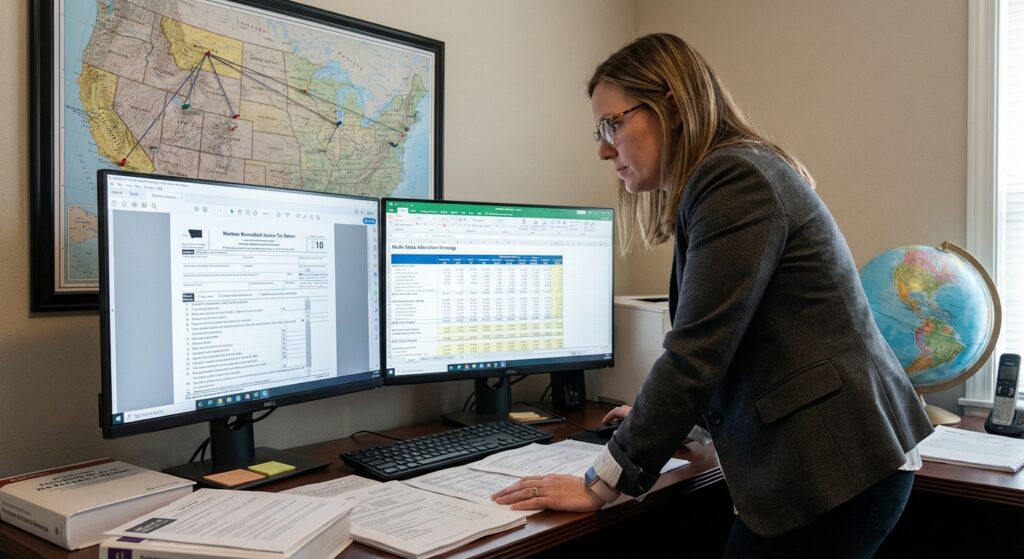
Billings Nonresident Tax Filing: Complete 2026 Guide to Compliance & Deductions
For the 2026 tax year, nonresident professionals and business owners working in Billings, Montana face unique filing obligations that differ significantly from traditional resident tax returns. Whether you’re an independent contractor, remote worker, or business owner conducting work in Billings while maintaining residency in another state, understanding billings nonresident tax filing requirements is critical to avoid penalties and maximize your deductions. This comprehensive guide walks you through the 2026 compliance landscape, available tax strategies, and actionable steps to reduce your overall tax burden.
Table of Contents
- Key Takeaways
- What Is Nonresident Status in 2026?
- What Are the Billings Nonresident Filing Requirements for 2026?
- What Montana State Tax Obligations Apply to Nonresidents?
- What Deductions Can Nonresidents Claim in 2026?
- How Do Estimated Tax Payments and Deadlines Work for Nonresidents?
- How Should You Strategize Multi-State Tax Filing?
- Uncle Kam in Action
- Next Steps
- Frequently Asked Questions
- Related Resources
Key Takeaways
- Nonresident status in 2026 is determined by your physical presence and domicile in your home state, not where you work.
- Billings nonresident professionals must file federal returns and separate Montana nonresident returns if income exceeds thresholds.
- Strategic apportionment of income between states can substantially reduce multi-state tax liability.
- Claiming allowable deductions for business expenses and home office costs is critical to offset nonresident income.
- Estimated quarterly payments for 2026 must be made on time to avoid penalties and interest charges.
What Is Nonresident Status in 2026?
Quick Answer: Nonresident status means you earn income in one state (like Montana) but maintain your legal domicile and permanent home in another state for the 2026 tax year.
Understanding what constitutes nonresident status is the foundation for all billings nonresident tax filing decisions. The IRS and state tax authorities define nonresident status based on factors beyond just your work location. Your status determines which tax returns you must file, which deductions you can claim, and how your income is taxed across multiple states.
Physical Presence and the 183-Day Test
The 183-day test is a critical threshold used by many states. If you spend 183 days or more in a state during the tax year, you may be considered a resident. For billings nonresident tax filing purposes in 2026, this means counting every day you physically spent working in Billings or Montana. Days spent traveling to Montana for work, attending client meetings, and time in Billings for business activities all count toward this threshold.
However, Montana uses a different residency test. The state focuses on domicile—your permanent home and the state where you intend to return. You can work in Billings for more than 183 days and still be considered a nonresident if your permanent home and domicile remain in another state.
Domicile: Your Permanent Home
Domicile is the single most important factor determining nonresident status for billings nonresident tax filing in 2026. Your domicile is your permanent home—the place where you maintain a residence and where you intend to return. To establish nonresident status in Montana, you must prove your domicile is in another state.
Strong evidence of domicile outside Montana includes maintaining a primary residence in your home state, registering to vote there, holding a driver’s license from that state, and banking in that state. If you maintain a family residence in Colorado while working on a project in Billings, your domicile likely remains in Colorado, establishing nonresident status for Montana tax purposes.
Pro Tip: Document your domicile evidence carefully in 2026. Keep records showing your primary residence address, voter registration, driver’s license, and utility bills from your home state. These documents support your nonresident status if audited.
What Are the Billings Nonresident Filing Requirements for 2026?
Quick Answer: Nonresidents earning Billings-source income must file a federal Form 1040 and a Montana Form 2 (nonresident tax return) if income exceeds Montana’s reporting threshold.
Federal requirements for billings nonresident tax filing in 2026 are clear: if you have taxable income, you must file a federal return. For 2026, the standard deduction for single filers is $16,050. If your total income exceeds this amount, you’re required to file. This applies equally to residents and nonresidents—your filing location doesn’t change your federal obligation.
Federal Filing Obligations for Nonresidents in 2026
The IRS considers you required to file if your gross income exceeds the standard deduction for your filing status. For the 2026 tax year, here are the filing thresholds:
- Single: $16,050 or more in income
- Married Filing Jointly: $31,900 or more
- Head of Household: $24,150 or more
- Self-employed with net earnings of $400 or more
For billings nonresident professionals, even if you earn below the standard deduction threshold, filing may be strategic to claim refundable credits or to establish a paper trail of legitimate nonresident status during an audit.
Montana Nonresident Return Requirements
Montana requires nonresidents to file a tax return on Form 2 (Montana Nonresident Income Tax Return) if they have income sourced to Montana. The filing threshold for Montana is lower than the federal threshold. If you earned any income in Billings or Montana during 2026, you likely must file even if federal filing isn’t required.
Montana Form 2 is filed separately from your federal return. The form requires you to report only your Montana-source income, then calculate your Montana tax liability on that portion. This separate filing is critical for billings nonresident tax filing because it ensures the state only taxes income earned within Montana’s borders.
Did You Know? Montana doesn’t have a standard deduction on the nonresident return, so you may owe Montana taxes even with low income. However, you can claim deductions attributable to Montana income, which significantly reduces your liability.
What Montana State Tax Obligations Apply to Nonresidents?
Quick Answer: Montana taxes only income sourced to the state. Nonresidents owe Montana income tax on earnings earned in Billings, including wages, self-employment income, and business profits.
Montana’s tax system is unique for billings nonresident tax filing. The state only taxes income that is sourced to Montana. This means your salary earned in Billings, client fees for work performed in Montana, and rental income from Montana property are all subject to Montana tax. However, income earned in your home state is not taxed by Montana.
Montana Tax Rates and Brackets for 2026
Montana uses a progressive tax system with marginal tax rates ranging from 1% to 6.9% on taxable income. The exact rate depends on your filing status and income level. For nonresidents, the calculation is straightforward: apply Montana tax rates only to Montana-source income.
For example, if you’re a single nonresident consultant earning $50,000 in Billings and $30,000 in your home state during 2026, Montana only taxes the $50,000 portion. Your home state taxes the full $80,000. This prevents double taxation while ensuring each state captures revenue from income earned within its borders.
Withholding Requirements for Billings Employers
If you’re employed by a Billings-based company, your employer must withhold Montana income tax from your wages. The withholding applies to all nonresidents working in the state, regardless of domicile. Your employer uses your W-4 and Montana withholding forms to calculate the correct amount.
Self-employed nonresidents don’t have an employer withholding, so you must make estimated tax payments directly to Montana. Quarterly estimated payments are due on the 15th of April, June, September, and January for the 2026 tax year.
What Deductions Can Nonresidents Claim in 2026?
Quick Answer: Nonresidents can claim all ordinary and necessary business deductions related to earning Billings-source income, including home office expenses, supplies, equipment, and professional development.
For billings nonresident tax filing in 2026, maximizing deductions is your primary strategy to reduce tax liability. The IRS allows deductions for all ordinary and necessary expenses incurred in earning income. For nonresidents, this includes both federal deductions and state-specific deductions on Montana returns.
Business Expense Deductions for Nonresidents
If you’re self-employed or operating a business while working in Billings as a nonresident, you can deduct legitimate business expenses. Common deductible expenses for 2026 include office supplies ($1,200 annually), professional software subscriptions ($800+), travel to client meetings within Montana (mileage at IRS rate of 70 cents per mile for 2026), and professional liability insurance ($2,000+).
Equipment purchases are also deductible through depreciation or Section 179 expensing. If you purchase a laptop for $2,000 used exclusively for your Billings business, you can deduct it over multiple years or immediately under Section 179, reducing your taxable income significantly.
Home Office Deduction Opportunities
The home office deduction is particularly valuable for nonresidents working remotely while based in another state. You can claim either the simplified rate (standard deduction) of $5 per square foot (up to 300 sq ft, maximum $1,500) or calculate actual expenses.
If you have a dedicated 200-square-foot home office, the simplified method gives you a $1,000 deduction for 2026 (200 × $5). The actual expense method lets you deduct a percentage of rent, utilities, insurance, and repairs based on office square footage. If your home office is 20% of your total home, you can deduct 20% of these costs.
Pro Tip: Choose the actual expense method if you have high housing costs in your home state. Document your rent or mortgage, property tax, insurance, utilities, and repairs for 2026. The actual method often yields larger deductions for nonresidents in high-cost states.
Travel and Meal Deductions
Travel between your home state and Billings for business purposes is deductible. If you fly from Colorado to Montana for a client project, airfare and hotel are deductible business expenses. However, commuting expenses (daily travel from home to your regular workplace) are not deductible.
Meal expenses while traveling for business are 50% deductible for 2026. If you spend $150 on meals during a business trip to Billings, you can deduct $75. Keep detailed records and receipts for all travel and meal expenses to support your claims during an audit.
How Do Estimated Tax Payments and Deadlines Work for Nonresidents?
Quick Answer: Nonresidents with $1,000 or more in estimated tax liability must make quarterly federal and Montana estimated payments on April 15, June 15, September 15, and January 15.
Estimated tax payments are essential for nonresidents earning Billings-source income in 2026, especially self-employed professionals and business owners. Unlike employees who have taxes withheld from paychecks, self-employed nonresidents must pay taxes directly to both the IRS and Montana.
Federal Estimated Tax Payments for 2026
You must make federal estimated payments if you expect to owe $1,000 or more in taxes for 2026. Use Form 1040-ES to calculate your quarterly payment amount. The form provides worksheets to estimate your 2026 income, deductions, and tax liability.
The four 2026 federal estimated payment deadlines are April 15 (for Jan-Mar income), June 15 (Apr-May income), September 15 (Jun-Aug income), and January 17, 2027 (Sep-Dec 2026 income). Each payment must be made to the IRS, either through IRS Direct Pay, electronic federal tax payment system (EFTPS), or credit card through an approved payment processor.
Montana Estimated Nonresident Payments
Montana requires separate estimated payments for nonresident income. Montana Form OS-ES is used to calculate quarterly payments on your Billings-source income. Montana’s 2026 deadlines mirror the federal schedule: April 15, June 15, September 15, and January 15, 2027.
Payments are made directly to Montana Department of Revenue. You can pay online through their website or by mail. Underpayment penalties are assessed if you don’t pay enough throughout the year, so accuracy in estimating is critical for billings nonresident tax filing.
| 2026 Estimated Payment Due Date | Income Period Covered | Federal Form | Montana Form |
|---|---|---|---|
| April 15, 2026 | January – March 2026 | Form 1040-ES | Form OS-ES |
| June 15, 2026 | April – May 2026 | Form 1040-ES | Form OS-ES |
| September 15, 2026 | June – August 2026 | Form 1040-ES | Form OS-ES |
| January 15, 2027 | September – December 2026 | Form 1040-ES | Form OS-ES |
Pro Tip: If you underpay estimated taxes, the IRS charges interest and penalties. Calculate conservatively when estimating 2026 income. Overpaying is better than underpaying—you’ll receive a refund with your return.
How Should You Strategize Multi-State Tax Filing?
Quick Answer: Strategically apportion income between Montana and your home state, claim all available deductions, and coordinate withholding across states to minimize your total tax liability.
Multi-state tax planning is the most powerful strategy for nonresidents engaged in billings nonresident tax filing. Since Montana and your home state both have tax systems, strategic planning reduces the combined tax burden. The goal is to allocate income and deductions efficiently between states to minimize total taxes owed.
Income Apportionment Strategies
Income apportionment is the process of allocating income between states based on where it was earned. This is straightforward for W-2 employees—wages are taxed by the state where work was performed. However, business owners have more flexibility in apportionment.
If you’re a consultant serving clients in both Montana and Colorado, apportion fees by the state where services were delivered. Client work performed in Billings is Montana-source income. Client work performed in Denver or served remotely from your Colorado home office is Colorado-source income. Proper apportionment reduces Montana’s share of your income.
Deduction Allocation Across States
Allocating deductions between states is another critical strategy. You can only claim deductions on your Montana return for expenses directly related to Montana-source income. Your home office deduction, for example, should be apportioned based on the percentage of time spent on Montana work versus other states.
Calculate this percentage carefully. If 60% of your work time is spent on Billings clients and 40% on out-of-state clients, only 60% of your home office deduction, utilities, and supplies can be claimed on Montana Form 2. This apportionment is essential to accurate billings nonresident tax filing.
| Tax Planning Strategy | Montana Impact | Home State Impact | Tax Benefit |
|---|---|---|---|
| Income Apportionment | Lower reported income | Higher reported income | Shift to lower-rate state |
| Deduction Allocation | Only MT-related deductions | Other state deductions | Maximize deductions where needed |
| Estimated Payment Timing | Quarterly payment schedule | Quarterly payment schedule | Avoid underpayment penalties |
| Withholding Adjustment | Adjust W-4 for MT withholding | Adjust W-4 for home state | Reduce refund or underpayment |
Withholding Adjustments and Coordination
If you’re employed in Billings, your employer withholds Montana tax. You must also ensure your home state receives adequate withholding for home state income. If you’re married and your spouse earns income, coordinate withholding across both returns to avoid excessive refunds or penalties.
Many nonresidents file updated W-4s with both Billings employers and their home state. Claim allowances carefully to ensure withholding covers total tax liability across both states. Professional guidance is valuable here to avoid underpayment.

Uncle Kam in Action: Nonresident Consultant Saves $18,500 with Strategic Tax Planning
Client Snapshot: Jessica is a management consultant based in Denver, Colorado. She maintains a home in Denver where she lives with her spouse and two children. Jessica spends 120 days annually in Billings managing consulting projects for a major healthcare client. She earns $95,000 in Billings-source income and $45,000 from Colorado-based clients in 2026.
Financial Profile: Total income of $140,000, with $95,000 sourced to Montana and $45,000 sourced to Colorado. Home office space of 250 square feet used 65% for Billings work and 35% for Colorado work. Home office rent allocated at $1,500 monthly ($18,000 annually), utilities at $2,400 annually, and insurance at $1,200 annually.
The Challenge: Jessica was filing separate returns in both Montana and Colorado without proper deduction allocation or income apportionment. She claimed her full home office deduction on Montana Form 2, even though only 65% related to Billings work. Montana was taxing her at 6.5% on $95,000 with minimal deductions, resulting in $6,175 Montana tax liability plus $3,200 estimated penalties for inadequate payments.
The Uncle Kam Solution: Our team implemented a comprehensive multi-state strategy. First, we properly apportioned the home office deduction, claiming only 65% ($5,850) on Montana Form 2. Second, we identified $8,000 in unreported business expenses (client meals, conference registration, software subscriptions) and allocated them proportionally—$5,200 to Montana and $2,800 to Colorado. Third, we restructured her estimated payments to ensure quarterly payments totaling $7,200 for Montana and $2,100 for Colorado, eliminating underpayment penalties.
The Results:
- Montana Tax Savings: Reduced from $6,175 to $3,890 through proper deduction allocation and expense documentation ($2,285 savings)
- Penalty Avoidance: Eliminated $3,200 underpayment penalties through structured estimated payments
- Colorado Tax Benefit: Applied additional deductions in Colorado, saving $3,900
- Investment: Strategic consultation and return preparation fee of $2,400
- Return on Investment (ROI): Total tax savings and penalty avoidance of $9,385 against $2,400 investment equals 3.9x ROI in the first year alone
This is just one example of how our proven tax strategies have helped clients achieve significant savings through proper billings nonresident tax filing and multi-state planning. Jessica now saves over $6,000 annually with coordinated state and federal strategies, and we’ve documented her nonresident status to prevent future audit risks.
Next Steps
Now that you understand billings nonresident tax filing requirements and strategies, take these immediate actions to optimize your 2026 tax situation:
- Document Your Nonresident Status: Gather evidence of domicile in your home state—current driver’s license, voter registration, primary residence lease or mortgage, and utility bills. Store these documents for audit protection.
- Track Income and Expenses by State: Create separate accounting records for Montana-source and home state-source income. Document business expenses with descriptions and dates, allocating them to the appropriate state based on work performed.
- Calculate 2026 Estimated Payments: Use Form 1040-ES and Montana Form OS-ES to estimate your tax liability, then divide by four for quarterly payment amounts. Ensure your first payment is made by April 15, 2026. Our Billings tax preparation services can help with accurate calculation.
- Review Deduction Opportunities: Identify all eligible deductions—home office, business equipment, travel, meals, professional development. Calculate the Montana-source percentage and prepare allocation schedules.
- Consult a Tax Professional: Multi-state nonresident tax planning is complex and highly fact-specific. Professional guidance ensures compliance, maximizes deductions, and provides audit documentation. Schedule a consultation with a specialist today.
Frequently Asked Questions
Can I claim the standard deduction on both my federal return and Montana Form 2 as a nonresident?
No. You claim the federal standard deduction ($16,050 for single filers in 2026) on your federal Form 1040. On Montana Form 2, you report only Montana-source income and can claim deductions directly related to earning that Montana income. Montana doesn’t allow a general standard deduction for nonresidents, so you must itemize or claim specific business deductions to reduce your Montana taxable income.
What happens if I don’t file Montana Form 2 as a nonresident with Billings income?
Failing to file Montana Form 2 when required results in penalties and interest. Montana may assess a failure-to-file penalty of up to 25% of the unpaid tax plus interest accruing daily. Additionally, if your employer withholds Montana taxes and you don’t file to claim refundable credits, you lose refund money. The state may also conduct a compliance audit, resulting in additional assessments and professional fees. Filing on time prevents all these consequences.
How do I prove my nonresident status to Montana in 2026?
Maintain clear documentation of domicile in your home state. Keep your current driver’s license from your home state (not Montana). Maintain voter registration in your home state and voting records if possible. Document your primary residence—a lease or mortgage for your home state property. Keep utility bills, bank statements, and insurance documents showing your home state address. If audited, these documents prove your intent to maintain domicile outside Montana, supporting your nonresident classification.
What if my employer withheld too much Montana tax from my paychecks in 2026?
If Montana withheld more tax than your actual liability, you receive a refund when you file your Montana Form 2. For example, if your actual Montana tax liability is $2,000 but $2,800 was withheld, you’ll receive a $800 refund. Montana processes nonresident return refunds within 30-45 days of acceptance. You can accelerate the refund by filing electronically. Apply the refund to your 2027 estimated payments or request a direct deposit to your bank account.
Can I deduct all my travel expenses between my home state and Billings as a nonresident?
Yes, if travel is for business purposes. Travel to Billings for client work, project management, and meetings is fully deductible. However, commuting—traveling daily from your home to your workplace—is not deductible. The critical distinction is whether the trip has a distinct business purpose. A weekend trip to Billings to attend a client conference is deductible; weekly commuting from home to your Billings office is not.
Is Montana tax applied before or after federal tax calculations for nonresidents?
Montana tax is calculated independently of federal tax. You first calculate your federal tax liability on all income (including Montana-source and home state income), then separately calculate your Montana tax liability on only Montana-source income. Montana doesn’t credit your federal taxes, but you may be able to claim a credit in your home state for Montana taxes paid. This prevents double taxation across states while ensuring each state captures revenue from income earned within its borders.
What’s the difference between Montana Form 2 (nonresident return) and Montana Form 2-U (amended nonresident return)?
Montana Form 2 is your original nonresident tax return filed by the April 15 deadline (or extended deadline). Montana Form 2-U is the amended return you file if you need to make corrections, report additional income, or claim additional deductions discovered after filing. If you filed your 2026 Form 2 and later realized you missed $5,000 in deductible expenses, you’d file a corrected Form 2-U. You can file amended returns for up to three prior years, but earlier amendments may have limitations.
Can I apply for an extension on my Montana Form 2 as a nonresident?
Yes. File Form 4868 (federal extension) and Montana Form os-ext (state extension) by the original April 15, 2026 deadline. Extensions give you until October 15, 2026 to file (six months). However, extensions only delay filing—they don’t extend payment deadlines. Estimate your Montana tax liability and pay by April 15 to avoid penalties. File your Montana Form 2 by the extended deadline to complete your nonresident filing obligations.
Related Resources
- Comprehensive tax strategy services for multi-state planning
- Professional tax preparation and filing for nonresident returns
- Ongoing tax advisory services for coordinated planning
- Self-employed tax solutions for nonresident contractors
- Montana Department of Revenue forms and publications
Last updated: January, 2026

