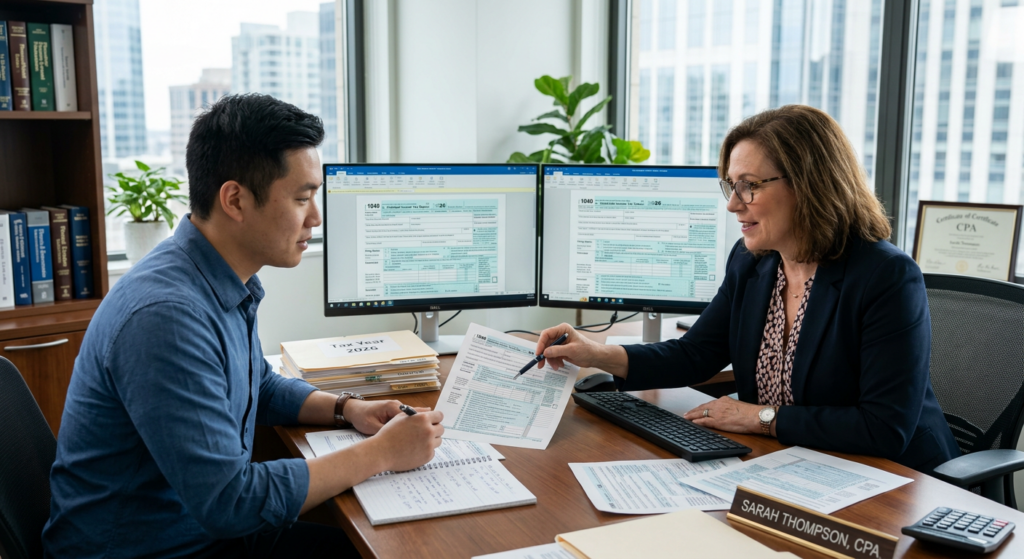
Best Tax Preparer in Concord, NH for 2026: Complete Guide to Finding Expert Help
Finding the best tax preparer in Concord starts with understanding what credentials matter and how to identify professionals who deliver genuine tax savings for the 2026 tax year. With major tax law changes from the One Big Beautiful Bill Act affecting your 2026 filing season, working with the right tax expert isn’t just convenient—it’s strategically essential for business owners, self-employed professionals, and real estate investors in New Hampshire.
Table of Contents
- Key Takeaways
- What Credentials Matter for Tax Preparers?
- Why Should You Hire a Professional Tax Preparer?
- How to Vet and Interview Tax Preparer Candidates
- What Red Flags Indicate a Bad Tax Preparer?
- What Questions Should You Ask a Tax Preparer?
- How to Find a Specialist for Your Tax Situation
- How 2026 Tax Law Changes Affect Preparer Selection
- Uncle Kam in Action
- Next Steps
- Frequently Asked Questions
Key Takeaways
- Verify credentials: CPAs, Enrolled Agents, and tax attorneys are the only legally qualified tax preparers to practice before the IRS
- Avoid ghost preparers who refuse to sign returns or provide a Preparer Tax Identification Number
- 2026 tax changes create opportunities and require specialized expertise in new deductions for tips, overtime, and senior benefits
- Ask about year-round planning, not just seasonal filing—the best preparers provide strategic guidance
- Interview multiple candidates and compare fees, specializations, and client testimonials before committing
What Credentials Matter for Tax Preparers?
Quick Answer: Only three credentials legally qualify someone to represent clients before the IRS: Certified Public Accountant (CPA), Enrolled Agent (EA), and Attorney. Anyone else cannot provide tax advice or representation with the IRS.
When selecting the best tax preparer in Concord, credentials are the foundation of legitimacy. The Internal Revenue Service recognizes three categories of tax professionals qualified to practice before the agency. Understanding each credential helps you evaluate whether a tax preparer meets professional standards for your specific situation.
Certified Public Accountant (CPA)
A CPA holds the most comprehensive credential in accounting and taxation. To become a CPA, professionals must complete 150 semester hours of college education, pass the Uniform CPA Examination, and fulfill state-specific experience requirements. In New Hampshire, this means at least two years of accounting-related experience under the recorded professional standards. CPAs maintain continuing education requirements annually to keep their licenses current, ensuring they stay informed of tax law changes like the 2026 updates in the One Big Beautiful Bill Act provisions affecting tips, overtime, and senior deductions.
CPAs can perform extensive services beyond tax preparation—they provide audit services, financial consulting, strategic business planning, and representation before the IRS at all administrative levels. For complex situations involving significant income, multiple business entities, real estate investments, or estate planning, a CPA brings specialized expertise that justifies their fees through comprehensive tax strategy development.
Enrolled Agent (EA)
An Enrolled Agent has earned the right to practice before the IRS by passing a comprehensive three-part examination covering individual income taxes, business income taxes, and representation and ethics. The EA credential represents deep technical tax knowledge specifically focused on tax compliance and IRS representation. Enrolled Agents can represent taxpayers in audits, appeals, and collections matters—essentially anywhere the IRS has jurisdiction. For many small business owners, self-employed professionals, and individuals with moderately complex tax situations, an EA provides expert, qualified representation at often lower costs than CPAs. Importantly, EAs must satisfy continuing education requirements to maintain their credentials, so you can be confident they understand current 2026 tax law changes.
Tax Attorney
A tax attorney holds a Juris Doctor (JD) degree and is licensed to practice law in their state. Tax attorneys specialize in tax law and can provide legal advice, representation, and litigation services. They are particularly valuable when dealing with IRS disputes that may result in litigation, complex estate tax issues, business restructuring with significant tax implications, or situations involving potential tax fraud considerations. Tax attorneys can also be found with CPA credentials (a tax attorney/CPA can provide both legal and accounting expertise).
Why Should You Hire a Professional Tax Preparer?
Quick Answer: Professional tax preparers maximize deductions, ensure compliance with 2026 tax law changes, and provide peace of mind by protecting you from audit risk and penalties—often saving far more than their fees cost.
The average federal income tax refund for the 2026 filing season has reached $3,676, representing a 10.6% increase compared to the same time last year. This increase largely reflects new tax benefits introduced in the One Big Beautiful Bill Act—benefits that many taxpayers are missing or incorrectly claiming. More than 27.5 million filers have claimed at least one new tax provision in 2026, yet confusion about eligibility, documentation, and calculation methods remains high.
A qualified tax preparer in Concord delivers value through several mechanisms. First, they understand the intricate rules around new 2026 deductions for overtime, tips, and senior benefits—rules that changed materially from how these provisions were initially promoted. Second, they identify legitimate deductions and credits you might overlook, particularly important for self-employed professionals who operate on Schedule C, real estate investors claiming depreciation benefits, and business owners using the new enhanced deductions available in 2026. Third, they maintain careful documentation practices that protect you if the IRS initiates an audit. Fourth, they provide year-round strategic guidance, not just seasonal filing—helping you make proactive decisions about quarterly estimated payments, entity structure optimization, and retirement contribution strategies using the increased 2026 limits for 401(k)s ($24,500) and IRAs ($7,500).
Pro Tip: The best tax preparers in Concord treat tax season as one annual appointment in a relationship focused on year-round planning. They ask about changes in your business, income sources, and personal situation, allowing them to proactively identify opportunities you might miss waiting until March or April.
How to Vet and Interview Tax Preparer Candidates
Quick Answer: Interview at least three candidates, verify credentials through official licensing boards, check client references, and compare their approach to 2026 tax law changes before making a commitment.
The vetting process for finding the best tax preparer requires more than asking a friend for a referral. While referrals can start your search, you should conduct a structured evaluation to ensure the professional matches your needs and operates with proper credentials and ethical standards. Begin by developing a shortlist of three to five candidates through referrals, online research, and professional directories. For each candidate, complete these verification steps before scheduling an interview.
Credential Verification Process
- For CPAs: Verify with the New Hampshire Board of Accountancy or through the American Institute of CPAs (AICPA) directory to confirm current licensure status
- For Enrolled Agents: Check IRS.gov and search the NAEA (National Association of Enrolled Agents) directory to verify EA status and current enrollment
- For Tax Attorneys: Verify bar admission with the New Hampshire Bar Association and confirm active status
- Check for disciplinary history through professional regulatory boards—a clean disciplinary record is essential
- Verify Preparer Tax Identification Number (PTIN) registration—this is a mandatory requirement for all tax preparers
Reference and Reputation Evaluation
Request at least three client references from tax preparers before committing. When contacting references, ask about their experience working with the preparer, whether the preparer delivered promised tax savings, how the preparer handled questions or issues, and whether they felt the fees were reasonable relative to services delivered. Ask if the preparer provides year-round communication or only during tax season. Ask specifically about how the preparer handled 2026 tax law changes and whether they proactively explained new deductions. Also review online ratings and testimonials on Google, the Better Business Bureau, and professional websites—look for patterns in feedback rather than isolated comments.
What Red Flags Indicate a Bad Tax Preparer?
Quick Answer: Walk away immediately from preparers who charge refund-based fees, refuse to sign returns, lack credentials, resist documenting positions, or promote questionable deductions not aligned with IRS guidance.
The IRS recognizes a category of tax preparers called “ghost preparers”—individuals who prepare tax returns but refuse to sign them or include a valid Preparer Tax Identification Number. These preparers create tremendous risk for clients. When a return is filed without a valid preparer signature and PTIN, the IRS considers the taxpayer solely responsible for all positions taken. If the return is selected for audit, the taxpayer cannot rely on the preparer’s professional judgment or authorization. Additionally, ghost preparers often engage in aggressive practices, including inflating deductions, fabricating income, or altering withholding amounts to generate inflated refunds. The IRS has increased enforcement against ghost preparers, warning taxpayers that following guidance from ghost preparers can result in not just penalties and interest, but in some cases criminal prosecution.
Beyond ghost preparers, watch for these warning signs in any tax professional you interview:
- Refund-based fees: A legitimate preparer charges based on return complexity or hourly rates, never by taking a percentage of your refund. This creates perverse incentives to inflate deductions
- No documentation requirements: Professional preparers require supporting documentation for all deductions claimed. Preparers who don’t ask for receipts, invoices, or documentation are likely engaging in aggressive practices
- Promises of unrealistic tax savings: If a preparer promises unusual deductions or significantly larger refunds than you expect without explaining the basis, be skeptical
- Resistance to written communication: Legitimate preparers document positions in writing and explain rationale. Preparers who resist written explanations or discourage email communication create risk
- Pushing questionable 2026 deductions: New preparers exploit confusion around 2026 tax law changes. Anyone promoting improper claims about tips deductions for gig workers or misinterpreting senior deduction requirements is problematic
- Lack of credentials: If a preparer cannot produce a credential (CPA, EA, or attorney) and professional license documentation, they are not legally qualified
What Questions Should You Ask a Tax Preparer in Concord?
 Free Tax Write-Off Finder
Quick Answer: Ask about credentials, specializations, fee structures, 2026 tax changes they recommend, year-round availability, and their process for handling IRS inquiries or audits.
Structure your interview with tax preparer candidates around these key questions. First, ask about their credentials and professional memberships: “What is your primary credential—CPA, EA, or attorney? How many years have you practiced tax preparation? Are you a member of professional organizations like the AICPA or NAEA?” Verify their answers against official databases. Second, ask about their Concord experience and specializations: “How many clients in Concord do you serve? What is your primary experience—individual returns, small business, real estate investors, or something else? Do you specialize in any particular industries or situations?” Third, ask specifically about 2026 tax law knowledge: “How have you prepared for the 2026 tax changes from the One Big Beautiful Bill Act? What new deductions or credits should I consider? Have you updated your practice to handle the new documentation requirements for tips and overtime deductions?” Use our Self-Employment Tax Calculator to understand your own situation before the interview—this gives you informed questions about estimated payments and quarterly obligations.
Fourth, ask about their fee structure and service scope: “How do you charge—hourly rate, fixed fee per return, or something else? What does your fee include? How much are you available for questions beyond tax season? Do you provide year-round planning advice?” Fifth, ask about audit handling: “If my return is selected for audit, how involved are you in my representation? Do you represent me before the IRS, or do I need to hire additional counsel? What is your experience with audit defense?” Sixth, ask about technology and documentation: “What software do you use for return preparation? How do you securely handle my financial documents? Can I access my return electronically before filing? Do you maintain organized documentation for each position you recommend?”
Pro Tip: The way a tax preparer answers questions reveals their approach. Those who provide detailed explanations, reference specific tax code sections, mention 2026 changes proactively, and offer written documentation are operating at a higher professional level than those giving vague answers or pushing you toward quick decisions.
How to Find a Specialist for Your Tax Situation
Quick Answer: Match your tax situation to a preparer’s specialization: business owners benefit from CPA firms, self-employed professionals work well with EAs, and investors need specialists in depreciation, cost segregation, or real estate tax matters.
Tax situations vary dramatically. A simple W-2 filer’s needs differ entirely from a self-employed 1099 contractor, a business owner with employees, or a real estate investor managing multiple properties. For the best tax preparation experience in Concord, match your situation to a preparer with relevant expertise.
Self-Employed and 1099 Contractors
If you earn 1099 income as a freelancer, consultant, or gig worker, seek a preparer with Schedule C specialization. These professionals understand deduction opportunities for home office expenses, equipment purchases, professional development, health insurance premiums paid by self-employed professionals, and quarterly estimated tax payment requirements. They should also understand 2026 changes affecting self-employed filers claiming the tips deduction, particularly new qualifying elements for what constitutes legitimate tip income. For 1099 contractors, ask specifically about self-employment tax planning—strategies that reduce 15.3% self-employment tax are worth thousands annually.
Small Business Owners with Employees
Business owners need preparers experienced with business entity selection (sole proprietorship, partnership, S Corp, C Corp, or LLC) and payroll tax obligations. The entity structure decision directly impacts 2026 taxes through different treatment of income, self-employment tax, and available deductions. A qualified preparer helps you evaluate whether S Corp election makes sense given 2026 changes, provides guidance on reasonable salary determinations for S Corp owners, and ensures compliance with state and federal payroll requirements. They should also understand new provisions affecting business owners under the One Big Beautiful Bill Act.
Real Estate Investors
Real estate investment taxation involves specialized knowledge around depreciation calculations, cost segregation analysis, passive activity losses, capital gains treatment, 1031 like-kind exchange strategies, and short-term rental versus long-term rental classification. Seek CPAs or EAs with specific real estate investment experience. They should understand how 2026 standard deduction changes (now $32,200 for married couples) affect real estate investor planning and positioning. They should also address passive loss limitations and how to structure investments to maximize available deductions within IRS guidelines.
How 2026 Tax Law Changes Affect Preparer Selection
Quick Answer: The One Big Beautiful Bill Act introduced significant 2026 changes—new deductions for tips and overtime, enhanced senior deductions, and revised withholding requirements. Your tax preparer should proactively explain these changes and their impact on your situation.
The One Big Beautiful Bill Act, signed into law on July 4, 2025, introduced substantial changes affecting your 2026 tax situation. These changes should heavily influence your choice of tax preparer. More than 15.5 million taxpayers have claimed the “No Tax on Overtime” provision, with 3.5 million claiming “No Tax on Tips” benefits, and 9.2 million claiming enhanced deductions for seniors. Yet confusion remains widespread about eligibility, documentation, and calculation methods. The best tax preparers in Concord are actively educating clients about these changes rather than waiting for questions.
The overtime deduction applies to qualified overtime compensation and reduces your tax bill by a percentage based on your tax bracket—not dollar-for-dollar as some taxpayers mistakenly believe. The tips deduction similarly reduces tax by a percentage, and recent IRS guidance clarified that self-employed filers have more restrictive requirements than W-2 employees. The enhanced deduction for seniors provides up to $6,000 for individuals over 65 (or $12,000 for joint filers), subject to income limitations. Someone preparing returns without deep knowledge of these 2026 provisions will either miss opportunities or misapply the rules.
Ask any tax preparer candidate: “Walk me through how 2026 changes affect my specific situation. Which new deductions or credits might apply? What documentation do I need to provide? How do you stay current on changes to these provisions throughout the year?” Their answer reveals their commitment to staying current with tax law evolution.
Did You Know: The average federal refund for 2026 reached $3,676 as of March 6—a 10.6% increase from the same period last year. However, tax experts note that much of this increase reflects overwithholding rather than new tax law benefits. The best preparers help you optimize withholding so you’re not giving the IRS an interest-free loan throughout the year.

Uncle Kam in Action: Sarah’s Concord Business Tax Strategy
Sarah, a 38-year-old consulting business owner operating in Concord, faced a common problem in 2026: confusion over new tax provisions combined with uncertainty about her business structure. Operating as an LLC taxed as a sole proprietorship, Sarah had been paying 15.3% self-employment tax on all business income while running a six-figure operation with three employees. She’d heard about 2026 changes but wasn’t sure whether they applied to her situation.
Sarah engaged a CPA with specific business owner experience rather than a general tax preparer. Through an initial consultation, the CPA identified that Sarah had never evaluated S Corporation election. Given her income level and employee payroll, an S Corp structure could reduce her self-employment tax by strategically splitting income between W-2 wages and distributions. The CPA calculated that by electing S Corp status and establishing a reasonable salary of $80,000, then distributing remaining profits of approximately $120,000 as distributions not subject to 15.3% self-employment tax, Sarah could save approximately $18,000 annually in taxes.
Beyond entity structure, the CPA reviewed Sarah’s 2026 deduction opportunities under new law provisions. While the tips deduction didn’t apply to her situation, she identified that Sarah qualified for the enhanced senior deduction in future years, allowing planning to position income strategically. The CPA also reviewed Sarah’s quarterly estimated payment obligations under the new 2026 withholding rules and recommended using the updated IRS Tax Withholding Estimator to ensure proper payment.
The Results: S Corp election generated $18,000 in annual self-employment tax savings, more than covering the CPA’s annual retainer for the year. Beyond the immediate tax savings, Sarah received quarterly strategy calls to address changing business circumstances, year-end planning to manage estimated payments, and proactive guidance on 2026 law changes as they were clarified. The upfront investment in finding a specialist preparer delivered substantial ROI and ongoing strategic value—exactly what Sarah needed beyond simple tax form preparation.
Next Steps: Taking Action to Find Your Best Tax Preparer
Finding the best tax preparer in Concord requires intentional effort, but the value delivered justifies the investment. Begin by identifying your specific tax situation and needs. Document your income sources, deductions, and any special circumstances. Then execute this three-step action plan:
- Request referrals from business contacts, fellow business owners, and trusted advisors. Ask specifically about preparer expertise in your situation
- Verify credentials for every candidate using AICPA, NAEA, and New Hampshire Board of Accountancy directories
- Schedule 15-minute phone consultations with at least three candidates—assess their knowledge of 2026 tax changes and whether they ask questions about your situation
- Request client references and contact them before making your decision
- Schedule a comprehensive planning meeting to discuss your financial goals and tax strategy—not just seasonal filing
Visit our Concord tax preparation services page to explore expert guidance tailored to your specific business situation and 2026 tax planning needs.
Frequently Asked Questions
What is the difference between a CPA and an Enrolled Agent?
CPAs have broader accounting credentials that require 150 semester hours of education and state licensing. Enrolled Agents specialize specifically in tax matters and IRS representation. Both can prepare returns and represent clients before the IRS. For complex business situations or financial consulting, CPAs offer broader expertise. For focused tax compliance and representation, Enrolled Agents often provide comparable expertise at lower cost.
How much should I expect to pay for tax preparation in Concord?
Tax preparation fees vary widely based on return complexity, preparer credentials, and location. Simple returns might cost $200-$500 with an Enrolled Agent, while complex business returns could exceed $2,000-$5,000 with a CPA. Expect to pay more for specialists (real estate, business owners) than for simple individual returns. Always verify fees in writing before engagement and understand what services are included. Legitimate preparers charge based on complexity or hourly rates—never by refund percentage.
Should I use a local Concord preparer or could I use someone online?
Both local and online preparers can provide quality service if they have proper credentials. Local preparers offer face-to-face meetings and may better understand local Concord tax issues and business context. Online preparers often provide convenience and potentially lower fees. The key isn’t location—it’s credentials, specialization in your situation, and demonstrated competence. Many clients benefit from a hybrid: a qualified online preparer supplemented with quarterly strategy calls.
What should I do if my current preparer doesn’t understand 2026 tax changes?
If your current preparer cannot explain how 2026 changes affect your situation, this is a significant red flag. Qualified professionals continue education to stay current with law changes. If your preparer hasn’t addressed 2026 provisions proactively, consider finding someone who prioritizes staying current. You can reference specific IRS guidance on the updated Tax Withholding Estimator and Form Schedule 1-A to educate yourself while considering alternatives.
How often should I meet with my tax preparer?
The best tax relationship includes at least quarterly touchpoints for self-employed professionals and business owners. These meetings address quarterly estimated tax payments, discuss business changes, plan for year-end deduction opportunities, and allow proactive strategy adjustments. For W-2 employees with simple returns, annual meeting may suffice. The more complex your situation, the more valuable regular communication becomes.
What happens if I disagree with my preparer’s tax position?
Good preparers welcome questions and provide written explanations for positions they recommend. If you disagree with a recommended deduction or tax treatment, ask for documentation of the basis—the specific tax code section, regulation, or IRS guidance supporting the position. If you remain uncomfortable, request a conservative alternative or seek a second opinion from another qualified preparer. Never sign a return you don’t understand—it’s your responsibility regardless of who prepared it.
Are there red flags I should watch for in initial consultations?
Avoid preparers who immediately recommend aggressive deductions without understanding your situation, refuse to provide written documentation of their reasoning, pressure you to make quick decisions, avoid discussing 2026 tax changes, or charge refund-based fees. Also be wary of preparers who seem disorganized, avoid phone calls, or can’t clearly explain their credentials and qualifications.
How do I know if my preparer is illegally aggressive?
Signs of illegally aggressive practices include refund-based fees, documentation that doesn’t support deductions claimed, recommendations that contradict IRS guidance, positions without clear basis in tax law, and preparers who avoid discussing audit risk. Remember: your preparer is responsible for positions taken, but you remain ultimately liable for your return. If something feels wrong, get a second opinion from another qualified professional before filing.
Related Resources
- Concord, NH Tax Preparation Services
- Self-Employed Tax Strategy Guide
- Business Owner Tax Solutions
- Real Estate Investor Tax Planning
- Complete Tax Preparation and Filing Services
Last updated: March, 2026
This information is current as of 3/16/2026. Tax laws change frequently. Verify updates with the IRS or qualified tax professionals if reading this later.

