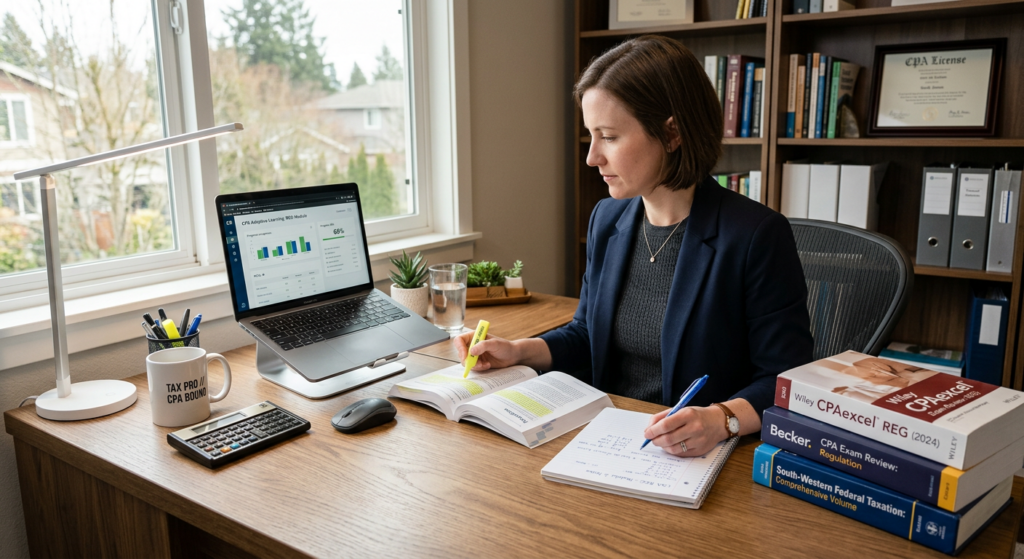
Best CPA Review Course: 2026 Guide for Tax Professionals
For 2026, choosing the best CPA review course is more critical than ever as the accounting profession undergoes significant transformation. With approximately 30 states implementing alternative CPA licensure pathways and AI reshaping traditional practice areas, tax professionals need comprehensive preparation that extends beyond memorization. This guide examines the most effective CPA review courses for 2026, helping you select a program that aligns with current exam requirements and emerging AICPA standards.
Table of Contents
- Key Takeaways
- What Makes the Best CPA Review Course in 2026?
- How Have 2026 Licensure Changes Affected CPA Exam Preparation?
- What Are the Essential Features to Compare?
- Which Study Methods Produce the Highest Pass Rates?
- How Do You Choose Between Self-Study and Live Instruction?
- What Technology and AI Tools Should Your Course Include?
- Uncle Kam in Action: Tax Professional Passes CPA Exam
- Next Steps
- Frequently Asked Questions
- Related Resources
Key Takeaways
- As of 2026, approximately 30 states offer alternative CPA licensure pathways requiring fewer education hours.
- The best CPA review course combines adaptive learning technology with comprehensive practice questions.
- Tax professionals benefit from courses emphasizing AI-driven practice areas and emerging attestation standards.
- Self-paced programs work best for working professionals managing client responsibilities alongside exam preparation.
- Investment in quality review materials typically ranges from $1,500 to $3,500 for comprehensive programs.
What Makes the Best CPA Review Course in 2026?
Quick Answer: The best CPA review course for 2026 offers adaptive learning technology, current exam content aligned with AICPA exam changes, comprehensive practice questions, and flexible study schedules for working professionals.
The accounting profession has transformed dramatically heading into 2026. With the AICPA Auditing Standards Board publishing its 2026-2027 work plan and states implementing new licensure pathways, CPA candidates face evolving exam content and professional expectations. The best CPA review course must address these changes while providing proven study methodologies.
Modern CPA review courses leverage technology to personalize learning experiences. Adaptive platforms identify your weak areas and adjust content accordingly. This approach maximizes study efficiency for tax professionals balancing client work with exam preparation. The most effective programs provide thousands of practice questions that mirror actual exam formats and difficulty levels.
Critical Components of Top-Tier Review Programs
Superior CPA review courses share several distinguishing characteristics that separate them from basic study materials. First, they maintain current content reflecting the latest AICPA exam blueprints and recent regulatory changes. In 2026, this includes updated attestation standards for sustainability assurance and enhanced fraud detection responsibilities.
Second, the best programs offer multiple learning modalities. Video lectures, written materials, audio reviews, and interactive simulations cater to different learning preferences. Tax professionals often benefit from being able to review audio content during commutes or between client meetings.
Third, robust performance tracking helps candidates identify knowledge gaps. Detailed analytics show which topics require additional focus and predict readiness for exam sections. This data-driven approach prevents wasted study time on already-mastered material.
Updated Content for 2026 Exam Standards
The National Association of State Boards of Accountancy continues refining exam content to reflect current professional practice. For 2026, emphasis has shifted toward technology integration, data analytics, and emerging areas like sustainability reporting. Your chosen review course must incorporate these evolving standards.
Tax professionals should prioritize courses that address AI’s growing role in accounting. Understanding how technology transforms traditional compliance and audit functions is increasingly tested on exam sections. Similarly, updated attestation standards addressing sustainability information have become prominent topics.
Pro Tip: Select a CPA review course that offers free content updates. Exam blueprints change annually, and courses providing automatic updates ensure your study materials remain current through your testing window.
How Have 2026 Licensure Changes Affected CPA Exam Preparation?
Quick Answer: In 2026, approximately 30 states implemented alternative licensure pathways requiring fewer education credits but maintaining the CPA exam requirement. This expands access while keeping professional standards rigorous.
Significant regulatory shifts occurred in early 2026 regarding CPA licensure requirements. Nevada implemented changes effective February 27, 2026, creating an additional pathway requiring a bachelor’s degree, two years of experience, and passing the CPA exam. West Virginia and Nebraska followed with similar legislation, with West Virginia’s changes taking effect May 24, 2026.
These changes address the ongoing accounting profession talent shortage while maintaining exam rigor. All alternative pathways still require passing the four-section CPA exam, meaning comprehensive review preparation remains essential. However, candidates can now pursue licensure through experience-heavy routes rather than exclusively through additional academic credits.
State-by-State Pathway Variations
The 2026 licensure landscape varies significantly by jurisdiction. Understanding your state’s specific requirements helps you plan both exam preparation and career trajectory. Here’s a breakdown of the new pathways:
| State | Effective Date | Education Requirement | Experience Required |
|---|---|---|---|
| Nevada | Feb 27, 2026 | Bachelor’s degree | 2 years |
| West Virginia | May 24, 2026 | Bachelor’s + accounting concentration | 2 years |
| West Virginia (Alt) | May 24, 2026 | Bachelor’s + 30 credits | 1 year |
| Nebraska | Feb 26, 2026 | Bachelor’s degree | 2 years |
These pathways recognize that practical experience develops competencies equally valuable to additional classroom hours. For tax professionals already working in firms, these changes create opportunities to pursue CPA credentials while continuing client service. This makes selecting a flexible, self-paced review course even more critical.
Impact on Exam Preparation Strategy
Working professionals pursuing alternative pathways face unique preparation challenges. Balancing full-time employment, client responsibilities, and intensive exam study requires strategic time management. The best CPA review course for this audience offers maximum flexibility without sacrificing content quality.
Consider courses with extended access periods of 18-24 months. This accommodates the reality that working professionals may need longer preparation windows than full-time students. Additionally, mobile app access enables study during otherwise unproductive time like commutes or waiting between appointments.
What Are the Essential Features to Compare?
Quick Answer: Compare question banks (minimum 5,000+ practice questions), video lecture hours, access duration, mobile capabilities, performance analytics, and instructor support when evaluating the best CPA review course options.
Selecting among competing CPA review courses requires systematic comparison of key features. Not all programs offer equal value despite similar pricing. Understanding which components drive exam success helps you make informed investment decisions about your professional future.
Practice Question Volume and Quality
The quantity and quality of practice questions directly correlates with exam performance. Premium courses provide 5,000 to 10,000+ practice questions across all exam sections. However, volume alone is insufficient. Questions must accurately reflect actual exam difficulty and format, including task-based simulations that mirror real testing experiences.
Evaluate whether questions include detailed explanations for both correct and incorrect answers. Learning why an answer is wrong proves as valuable as knowing the right answer. The best programs also track which question types you struggle with and serve additional similar problems for reinforcement.
Video Content and Instructional Quality
Comprehensive video lectures explain complex accounting, auditing, and taxation concepts more effectively than text alone. Quality courses offer 80-100+ hours of video instruction per exam section. Instructors should be CPAs with practical experience who can contextualize theoretical concepts with real-world applications.
Additionally, video production quality matters for long-term engagement. Professional production with clear audio, organized slides, and engaging presentation maintains focus during extended study sessions. Some programs offer bite-sized video modules of 10-15 minutes, ideal for professionals studying in short increments.
Technology Platform and User Experience
Modern review courses function as comprehensive learning management systems. The technology platform should offer intuitive navigation, progress tracking, customizable study plans, and seamless synchronization across devices. Tax professionals benefit particularly from mobile apps that enable study anywhere, anytime.
Adaptive learning algorithms represent cutting-edge course technology. These systems analyze your performance patterns and automatically adjust content delivery. If you consistently struggle with certain topics, the platform serves additional practice in those areas. This personalization accelerates learning compared to static, one-size-fits-all approaches.
| Feature Category | Minimum Standard | Premium Offering |
|---|---|---|
| Practice Questions | 3,000+ questions | 8,000-10,000+ questions |
| Video Lectures | 60-80 hours total | 100+ hours per section |
| Access Duration | 12 months | 18-24 months |
| Mobile Platform | Basic app access | Full offline capability |
| Instructor Support | Email support | Live chat, office hours |
Pro Tip: Take advantage of free trial periods offered by most major review courses. Test the platform’s interface, sample video lectures, and attempt practice questions before committing to purchase. This hands-on evaluation reveals whether the course aligns with your learning style.
 Free Tax Write-Off Finder
Which Study Methods Produce the Highest Pass Rates?
Quick Answer: Active learning methods including spaced repetition, practice question drilling, and teaching concepts to others consistently produce higher pass rates than passive reading or video watching alone.
Research into learning science reveals that active engagement with material drives retention far more effectively than passive consumption. The best CPA review course incorporates proven methodologies that promote active learning throughout your preparation journey.
Spaced Repetition and Interval Review
Spaced repetition involves reviewing material at increasing intervals over time. Instead of cramming topics in single marathon sessions, you revisit concepts periodically. This approach leverages how memory consolidation works, transferring knowledge from short-term to long-term retention.
Top-tier CPA review courses build spaced repetition into their study plans. After completing a module, the system schedules review sessions days or weeks later. This ensures topics learned early in your preparation remain fresh through exam day. For tax professionals with irregular schedules, automated reminders and flexible scheduling accommodate real-world constraints.
Question-Centric Learning Approach
Many successful CPA candidates advocate for question-heavy study methods. Rather than reading all materials first and then practicing, this approach involves attempting questions immediately after each topic. Wrong answers become learning opportunities, directing focused review of underlying concepts.
This method aligns with how the CPA exam tests knowledge. You won’t simply recall definitions but must apply concepts to novel scenarios. Early exposure to application-level questions prepares you for exam-day thinking patterns. The best review courses support this approach by organizing content around testable concepts rather than theoretical frameworks.
Multi-Modal Learning Integration
Engaging multiple senses improves information encoding. Effective study sessions combine reading, listening, writing, and doing. Watch video lectures while taking handwritten notes. Read explanations aloud. Create visual diagrams of complex processes. Teach challenging concepts to a study partner or even an imaginary audience.
Premium CPA review courses facilitate multi-modal learning through diverse content formats. Access to video, audio, text, flashcards, and interactive simulations enables you to vary your approach. This variety also prevents study fatigue during long preparation periods.
How Do You Choose Between Self-Study and Live Instruction?
Quick Answer: Self-study courses offer flexibility ideal for working professionals, while live instruction provides structure and accountability. Your choice depends on learning style, schedule constraints, and self-discipline levels.
The debate between self-paced and instructor-led CPA review courses continues among candidates. Both formats can lead to success when aligned with individual learning preferences and life circumstances. Understanding the tradeoffs helps you select the format maximizing your pass probability.
Self-Study Advantages for Tax Professionals
Tax professionals often work irregular hours, especially during busy season. Self-study programs accommodate unpredictable schedules by allowing study whenever time permits. You control the pace, spending extra time on challenging topics while moving quickly through familiar material.
Additionally, self-study typically costs less than live courses. Savings of $500-$1,000 are common. For professionals already confident in their learning abilities, this represents better value. The best self-study courses still provide instructor support through email, chat, or discussion forums when questions arise.
When Live Instruction Adds Value
Live instruction creates external accountability that some candidates require. Scheduled class times force consistent study habits. Real-time interaction with instructors allows immediate clarification of confusing concepts. Peer interaction in live settings also provides networking opportunities and mutual support.
Candidates who struggled with self-directed learning in the past may benefit from structured environments. If you need external motivation or perform better with fixed deadlines, live instruction’s higher cost may prove worthwhile. Many programs now offer hybrid models combining self-paced content with periodic live review sessions, providing balanced benefits.
For additional guidance on professional development and tax strategy planning, consider how exam preparation fits within your broader career advancement goals.
What Technology and AI Tools Should Your Course Include?
Quick Answer: In 2026, the best CPA review course includes adaptive learning algorithms, AI-powered question recommendations, performance prediction analytics, and mobile apps with offline access for studying anywhere.
Technology has revolutionized CPA exam preparation. Modern review courses leverage artificial intelligence and machine learning to create personalized study experiences that were impossible just a few years ago. Understanding these technological capabilities helps you select a program positioned for future success.
Adaptive Learning Algorithms
Advanced CPA review platforms use AI to analyze your performance across thousands of practice questions. These algorithms identify patterns in your strengths and weaknesses, then automatically adjust content delivery. If you consistently miss depreciation calculation questions, the system serves additional similar problems and targeted instructional content.
This personalization dramatically improves study efficiency. Instead of following generic study plans, you focus on areas requiring improvement. The technology also prevents false confidence by ensuring you truly master topics rather than simply memorizing specific question formats.
Performance Analytics and Exam Readiness Prediction
Sophisticated analytics dashboards track your progress across multiple dimensions. Beyond simple percentage scores, premium platforms show trends over time, compare your performance to successful candidates, and predict exam readiness. These insights answer the critical question every candidate asks: “Am I ready to schedule my exam?”
Predictive models analyzing thousands of prior candidate outcomes can estimate your pass probability based on current performance. While not guarantees, these predictions provide data-driven confidence for scheduling decisions. For working professionals with limited leave time, scheduling at optimal readiness maximizes first-attempt pass rates.
Mobile Technology and Cloud Synchronization
Modern candidates study across multiple devices throughout their day. The best review courses offer native mobile apps for iOS and Android with full feature parity to desktop versions. Offline mode allows downloading content for study during flights, commutes, or anywhere internet access is unavailable.
Cloud synchronization ensures seamless transitions between devices. Start studying on your desktop at home, continue on your tablet during lunch, and review flashcards on your phone while waiting for clients. Your progress, bookmarks, and notes follow you everywhere. This flexibility proves essential for busy tax professionals.
Did You Know? In 2026, accounting firms increasingly value AI fluency among staff. Choosing a CPA review course that incorporates modern technology not only aids exam success but also builds skills directly applicable to emerging practice areas.

Uncle Kam in Action: Tax Professional Passes CPA Exam While Serving Clients
Client Snapshot: Marcus T., a 32-year-old senior tax associate at a regional firm, had been preparing individual and business returns for seven years without his CPA credential. Working in business tax advisory, he frequently encountered situations where clients specifically requested CPA expertise for complex planning scenarios.
Financial Profile: Marcus earned approximately $85,000 annually in his current role. However, he recognized that CPA licensure would unlock opportunities for promotion to manager level with potential compensation exceeding $110,000. His firm offered modest tuition reimbursement of $1,500 toward review course costs.
The Challenge: Marcus had attempted the CPA exam twice previously, failing the FAR section both times. He attributed these failures to inadequate preparation time during busy season and choosing review materials that didn’t match his learning style. With his state implementing alternative licensure pathways in 2026, he saw renewed urgency to complete the credential.
The Uncle Kam Solution: Uncle Kam’s team worked with Marcus to develop a realistic 15-month study plan that accommodated his client service responsibilities. We recommended he invest in a premium self-study CPA review course priced at $2,800, utilizing adaptive learning technology that maximized limited study time. The course offered 24-month access, addressing his previous time constraint issues.
Marcus scheduled FAR for June 2026, after busy season but before vacation season demands increased. We advised him to study 12-15 hours weekly using the course’s mobile app during commutes and lunch breaks. The adaptive platform identified conceptual gaps from his previous attempts, focusing study on specific weak areas rather than reviewing all material equally.
The Results: Marcus passed FAR in June 2026 with a score of 82. He subsequently passed the remaining three sections over the next nine months, completing all requirements by March 2027. Upon licensure, his firm promoted him to tax manager with base compensation of $115,000 plus performance bonuses.
Tax Savings & ROI: Marcus invested $2,800 in his review course ($1,500 reimbursed by employer = $1,300 net cost). His salary increase of $30,000 annually created a first-year ROI exceeding 2,300%. Additionally, CPA licensure positioned him to serve high-net-worth clients requiring credentialed professionals, expanding his practice areas and future earning potential.
Marcus’s success illustrates how selecting the right review course—aligned with learning style, schedule constraints, and career goals—transforms exam preparation from obstacle to opportunity. See more success stories at our client results page.
Next Steps
Ready to begin your CPA journey or reignite stalled exam preparation? Take these concrete actions today:
- Research your state’s specific 2026 licensure requirements and alternative pathways at NASBA.org
- Trial three different CPA review courses using free demo periods to compare platforms
- Create a realistic study schedule accounting for busy season and client commitments
- Explore whether your firm offers tuition reimbursement or study leave benefits
- Schedule a consultation with Uncle Kam’s tax advisory team to discuss how CPA licensure fits your career and tax planning goals
Frequently Asked Questions
How much should I expect to invest in the best CPA review course?
Premium comprehensive CPA review courses typically range from $1,500 to $3,500 for all four exam sections. Basic programs start around $1,000 but may lack advanced features like adaptive learning or extensive practice questions. Section-specific courses average $400-$800 each. Consider value beyond price—higher-quality courses with better pass rates justify increased investment through reduced retake costs and faster licensure.
Can I claim tax deductions for CPA review course expenses?
For 2026, tax treatment depends on your employment status. Self-employed tax professionals can deduct CPA review costs as ordinary business expenses on Schedule C. Employees may deduct costs only if employer-required for current position and not reimbursed. The Tax Cuts and Jobs Act suspended miscellaneous itemized deductions through 2025, with current law extending this through 2026. Consult IRS Publication 970 for education expense guidance.
How long does it typically take to complete CPA exam preparation?
Most candidates require 300-400 total study hours across all four exam sections. At 15 hours weekly, this translates to approximately 6-7 months of preparation. However, working professionals often extend this to 12-18 months due to competing responsibilities. The 18-month testing window from passing your first section adds urgency to maintain steady progress. Select review courses offering 18-24 month access to accommodate realistic timelines.
What is the current CPA exam pass rate?
According to AICPA data, average pass rates by section range from approximately 45-55%. FAR (Financial Accounting and Reporting) historically shows the lowest pass rates around 45-48%. BEC (Business Environment and Concepts) typically has the highest rates at 55-60%. These statistics underscore the importance of comprehensive preparation using quality review materials. First-time pass rates improve significantly when candidates invest in premium study resources.
Are there CPA review courses specifically designed for tax professionals?
While most major review courses serve all candidates, some programs offer specialized content emphasizing taxation and business concepts relevant to practicing tax professionals. These courses may provide deeper coverage of REG (Regulation) section topics and practical applications. However, comprehensive preparation across all exam sections remains essential regardless of specialization. Review courses highlighting real-world tax scenarios may resonate more strongly with experienced practitioners.
How have 2026 alternative licensure pathways changed CPA exam preparation?
The 2026 licensure changes implemented by approximately 30 states expanded access to the profession but maintained rigorous exam requirements. Candidates now pursuing experience-heavy pathways often study while working full-time, increasing demand for flexible, self-paced review courses. Mobile-accessible platforms with strong analytics help working professionals maximize limited study time. The exam content and difficulty remain unchanged, so comprehensive preparation is still essential.
Should I wait for annual course updates before purchasing?
Most premium review courses provide free content updates throughout your access period. Purchase when ready to begin studying rather than waiting for annual refreshes. The AICPA updates exam blueprints periodically, but fundamental accounting principles remain consistent. Reputable providers continuously update content to reflect regulatory changes and exam evolution. Delaying preparation costs you more in career advancement opportunities than any potential content improvements are worth.
Can I use multiple review courses simultaneously?
Some candidates benefit from combining review courses, using one as primary instruction and another for supplemental practice questions. However, this approach requires careful planning to avoid conflicting methodologies and information overload. If pursuing this strategy, budget additional time and cost. Most successful candidates thoroughly utilize a single comprehensive program rather than fragmenting attention across multiple resources.
What role does AI play in modern CPA review courses?
Artificial intelligence powers adaptive learning algorithms that personalize study experiences based on individual performance patterns. AI analyzes thousands of data points to recommend specific content, predict exam readiness, and optimize study efficiency. As accounting practices increasingly integrate AI for compliance and advisory work, familiarity with these technologies during exam preparation provides dual benefits—improved pass rates and relevant professional skill development.
Related Resources
- Comprehensive Tax Strategy Services for CPAs
- Tax Advisory and Planning for Accounting Professionals
- Business Tax Solutions for Small Firm Owners
- Tax Strategy Blog and Industry Insights
Last updated: March, 2026
This information is current as of 3/10/2026. CPA exam requirements and review course offerings change frequently. Verify current details with AICPA and NASBA if reading this later.

