
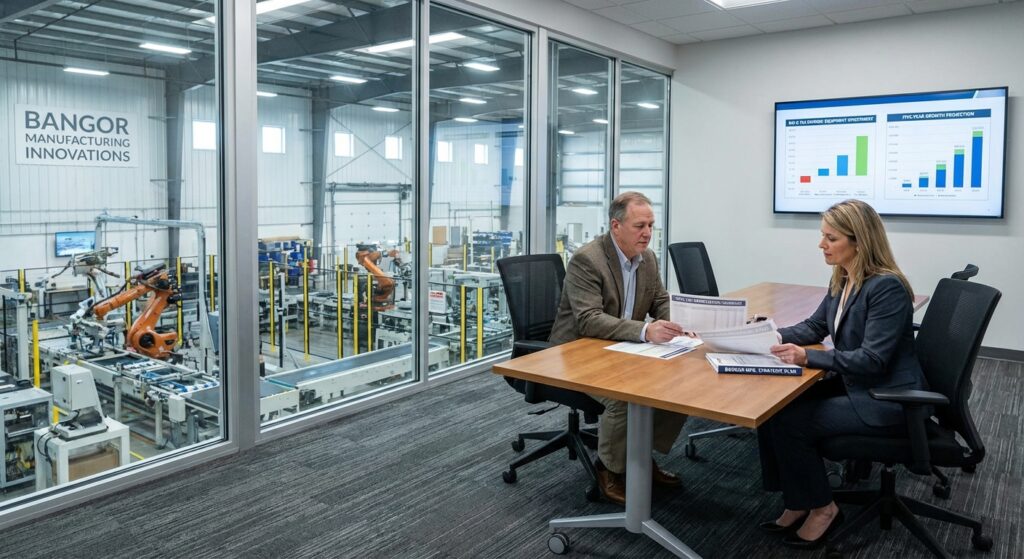
2026 Bangor Depreciation Strategies: Maximize Your Tax Deductions with Bonus Depreciation
For the 2026 tax year, business owners and real estate investors in Bangor can leverage permanent 100% bonus depreciation to write off qualifying property in the year it’s acquired. This game-changing depreciation strategy, made permanent under the One, Big, Beautiful Bill, allows you to accelerate deductions and reduce taxable income significantly. Whether you’re acquiring equipment, vehicles, or real property improvements, understanding bangor depreciation strategies will help you minimize taxes and maximize cash flow.
Table of Contents
- Key Takeaways
- What Is Bonus Depreciation and How Does It Work in 2026?
- How the Permanent 100% Additional First-Year Deduction Works
- What Is Cost Segregation and Why Does It Matter for Your Business?
- Understanding Section 1245 Property in Bonus Depreciation
- How Can You Maximize Depreciation Through Strategic Timing?
- Uncle Kam in Action: Real Tax Savings
- Next Steps
- Frequently Asked Questions
Key Takeaways
- The 100% bonus depreciation deduction is now permanent, allowing full write-offs of qualifying property acquired after January 19, 2025.
- Cost segregation breaks buildings into depreciable components, accelerating deductions on items like HVAC systems and parking lots.
- Strategic timing of equipment purchases in Q4 2026 can unlock substantial tax savings for Bangor-area business owners.
- Section 163(j) changes in 2026 allow depreciation add-backs when calculating Adjusted Taxable Income, enhancing deduction benefits.
- Professional tax planning is essential to ensure you’re claiming maximum allowed deductions and avoiding audit triggers.
What Is Bonus Depreciation and How Does It Work in 2026?
Quick Answer: Bonus depreciation lets you deduct the full cost of qualifying property in year one instead of spreading deductions over multiple years, effectively reducing taxable income immediately.
Bangor depreciation strategies center on understanding how businesses acquire assets. Normally, when you buy equipment or property for business use, the IRS requires you to depreciate it over several years. A five-year asset depreciates 20% annually. This spreads tax benefits across decades.
Bonus depreciation changes this entirely. For 2026, the IRS issued Notice 2026-11 providing guidance on the permanent 100% additional first-year depreciation deduction for qualifying depreciable property acquired after January 19, 2025. This means you can write off the entire cost of that asset in the year you purchase and place it in service.
The benefit is substantial. A Bangor manufacturer buying $500,000 in new machinery in 2026 can deduct the full $500,000 against 2026 income. Compare this to traditional depreciation where only $100,000 might be deductible annually.
Qualifying Property for 2026 Bonus Depreciation
Not all business property qualifies for bonus depreciation. The asset must be depreciable property used in your business. This includes machinery, equipment, vehicles placed in service after January 19, 2025, and most tangible property with a recovery period of twenty years or less.
Real property improvements also qualify, including roofs, HVAC systems, and qualified leasehold improvements. However, land itself never qualifies for any depreciation deduction.
- Qualified Property: Manufacturing equipment, computers, vehicles, furniture, machinery acquired after Jan. 19, 2025.
- Real Property: Qualified improvement property (roof replacements, HVAC upgrades, parking lot resurfacing).
- NOT Qualified: Land, used property purchased before Jan. 19, 2025, or property with recovery periods exceeding 20 years.
The Permanence Factor: Why 2026 Matters
For decades, bonus depreciation was temporary and threatened to phase down. Beginning in 2020, it was set to decline by 20% annually. Under the One, Big, Beautiful Bill, bonus depreciation is now permanent at 100%. This transforms your long-term tax planning for any acquisition strategy.
Pro Tip: Because bonus depreciation is permanent, you can confidently plan multi-year equipment acquisitions without worrying the benefit will disappear after 2026.
How the Permanent 100% Additional First-Year Deduction Works
Quick Answer: Under 2026 rules, 100% of qualifying property cost is deductible in year one. You can elect a lower percentage (40% or 60%) if strategic for your situation.
The mechanics are straightforward. When you place qualifying property in service during 2026, claim the full acquisition cost as a deduction on your tax return. This creates a dollar-for-dollar reduction in taxable income.
The IRS Notice 2026-11 allows elections for bangor depreciation strategies. You can choose to deduct 100% of the property cost, or you can elect to deduct only 40% (or 60% for certain property with longer production periods or qualified aircraft). This flexibility is valuable when you want to preserve deductions for future years.
For many Maine business owners, the choice is simple: claim the full 100% to maximize immediate tax relief. However, if you anticipate larger deductions in 2027 or want to manage your marginal tax bracket position, the election to claim less allows strategic tax planning.
Real-World Calculation Example for Bangor Businesses
Consider Sarah’s Bangor Manufacturing LLC. In March 2026, she purchases $250,000 in new CNC machinery to expand production. The equipment qualifies as Section 1245 property with a normal 5-year recovery period.
Under traditional depreciation, Sarah would deduct $50,000 annually ($250,000 ÷ 5 years). Over five years, total deductions = $250,000.
Under bonus depreciation (100%), Sarah deducts the full $250,000 in 2026. If her business has $400,000 in taxable income before the deduction, bonus depreciation reduces that to $150,000. This creates immediate tax savings while preserving regular depreciation for future MACRS calculations.
Assuming a 25% marginal tax rate for the LLC: $250,000 × 25% = $62,500 in immediate federal tax savings.
Elections and Documentation Requirements
To claim bonus depreciation, you must elect it on your 2026 tax return using Form 4562 (Depreciation and Amortization). The election is made at the time you file your return. Missing the election deadline means you cannot claim bonus depreciation for that asset in future years.
Documentation is critical. Keep detailed records of acquisition dates, cost basis, placed-in-service dates, and how the property is used in your business. The IRS audits bonus depreciation claims, so evidence matters.
What Is Cost Segregation and Why Does It Matter for Your Business?
Quick Answer: Cost segregation breaks a building into depreciable components (HVAC, roof, parking lot) and non-depreciable land. This accelerates depreciation on 5-15 year assets instead of waiting 27.5-39 years for full building depreciation.
Bangor depreciation strategies become more powerful when combined with cost segregation analysis. A cost segregation study is a professional engineering assessment that separates a building acquisition into its individual components and assigns recovery periods to each.
Normally, a commercial building depreciates over 39 years (27.5 years for residential). This means only about 2.6% of acquisition cost is deductible annually. Cost segregation changes this by identifying components that qualify for shorter depreciation periods.
Components Typically Identified in Cost Segregation
- 5-Year Property: Equipment, machinery, computers, production fixtures, specialty electrical systems.
- 7-Year Property: Certain building fixtures, tenant improvements, land improvements like landscaping and fencing.
- 15-Year Property: Qualified improvement property (roof, HVAC, parking lot, dock equipment).
- 39-Year Property: Remaining building structure (walls, foundation, floors).
For a Bangor real estate investor who purchased a $2 million office building in 2025, cost segregation might identify $600,000 in 5-year components. Under traditional depreciation, annual deductions = $51,282. With cost segregation AND bonus depreciation, the 5-year components could be deducted in 2026 entirely, creating massive first-year tax savings.
Did You Know? Cost segregation studies typically cost $2,000-$5,000 but can generate six-figure tax deductions. The ROI is exceptional, particularly when combined with bonus depreciation.
Understanding Section 1245 Property in Bonus Depreciation
Quick Answer: Section 1245 property is personal property (equipment, machinery, vehicles) that depreciates faster and triggers depreciation recapture upon sale, but qualifies fully for bonus depreciation.
Bangor depreciation strategies depend on understanding IRC Section 1245. Property classified as Section 1245 includes tangible depreciable property other than buildings and land.
This includes: manufacturing equipment, trucks, computers, furniture, machinery, and certain building components. The key advantage is that Section 1245 property qualifies for bonus depreciation and MACRS accelerated depreciation.
A critical consideration is recapture. When you sell Section 1245 property at a gain, you must recapture depreciation as ordinary income rather than capital gain. This affects your tax planning. If you buy equipment for $100,000 and claim $100,000 bonus depreciation, reducing cost basis to zero, and later sell it for $80,000, you have an $80,000 recapture gain taxed as ordinary income.
Despite recapture concerns, the benefit of immediate deductions typically outweighs future recapture liability due to time value of money and favorable 2026 tax rates.
Section 1245 vs Section 1250 Property
| Property Type | Examples | Recovery Period | Bonus Depreciation |
|---|---|---|---|
| Section 1245 (Personal Property) | Machinery, vehicles, equipment, computers | 5-7 years | 100% in 2026 |
| Section 1250 (Real Property) | Buildings, qualified improvement property | 15-39 years | 100% (if qualifies) |
How Can You Maximize Depreciation Through Strategic Timing?
Quick Answer: Property must be placed in service during the tax year to claim depreciation. A Q4 2026 purchase placed in service by December 31, 2026, allows full deduction in 2026.
Timing is crucial for maximizing bangor depreciation strategies. Bonus depreciation only applies to property placed in service during the tax year. Property purchased but not placed in service before year-end does not qualify for that year’s deduction.
For 2026, business owners should plan equipment acquisitions strategically. A Bangor company expecting strong 2026 income should acquire and place machinery in service by late November or December to capture immediate deductions while income is highest.
Conversely, if projected 2026 income is lower, accelerating acquisitions to 2025 (if applicable) or deferring to 2027 allows better tax planning. The flexibility of bonus depreciation elections means you can adapt to changing business circumstances.
Planning Bonus Depreciation for Different Business Scenarios
Scenario 1: High 2026 Income – If you anticipate $500,000+ in taxable income, maximum bonus depreciation claims reduce tax burden immediately. Acquire equipment in Q4 2026 to claim full deductions.
Scenario 2: Net Operating Loss – If your business has losses, large deductions may not provide benefit in 2026. Consider electing reduced bonus depreciation (40% or 60%) to preserve deductions for carryforward periods when income is positive.
Scenario 3: Multi-Year Growth Plan – If you’re planning equipment acquisitions over 2026-2028, spread them strategically across years to optimize deductions and coordinate with estimated tax liability.
Pro Tip: Work with a tax advisor to model scenarios. Should you buy in 2026 or 2027? Should you claim 100% bonus depreciation or reduce it? The difference can easily exceed $10,000 in tax savings.
Uncle Kam in Action: How a Maine Manufacturing Company Saved $87,500 with Bonus Depreciation
Client Snapshot: Marcus owns a mid-sized manufacturing company in Bangor with $1.2M in annual revenue. He manufactures specialty metal components for regional industries.
Financial Profile: Marcus typically generates $280,000 in taxable business income annually. In 2025, his tax liability was approximately $70,000 (federal, 25% rate). He was paying standard federal income taxes without optimizing depreciation.
The Challenge: Marcus had aging CNC machinery causing production delays and quality issues. He needed to invest in new equipment but was concerned about the tax impact. He also wasn’t aware that permanent bonus depreciation made the investment immediately deductible rather than spread over five years.
The Uncle Kam Solution: Our tax strategists reviewed Marcus’s 2026 projections and identified that he was expected to have $320,000 in taxable income. We recommended a $350,000 equipment acquisition in Q4 2026 and filed an election to claim 100% bonus depreciation under the One, Big, Beautiful Bill.
We also conducted a basic asset analysis (not a full cost segregation) on the equipment components, identifying $80,000 in specialized machinery that qualified for Section 1245 5-year depreciation with enhanced deduction availability.
The Results:
- Tax Savings: $87,500 in federal tax reduction (from $350,000 × 25% marginal rate)
- Investment: $3,500 for tax strategy consultation and return preparation
- Return on Investment: 25:1 ROI in year one alone
Marcus’s 2026 taxable income dropped from projected $320,000 to negative $(30,000) due to the bonus depreciation election. He received a refund and eliminated his estimated tax liability for Q1 2027. The equipment investment, which seemed like a tax burden, became a powerful tax shield thanks to understanding bangor depreciation strategies and the permanent 100% bonus deduction now available under current law.
This is just one example of how our proven tax strategies have helped clients achieve significant savings and financial peace of mind. When you align business decisions with tax planning, the results speak for themselves.
Next Steps to Maximize Your Depreciation Strategy in 2026
Ready to optimize your bangor depreciation strategies? Follow these actionable steps:
- Step 1 – Inventory Your Assets: List all business property you own or plan to acquire in 2026. Identify acquisition dates, costs, and how each asset is used.
- Step 2 – Qualify Property: Determine which assets qualify for bonus depreciation (acquired after Jan. 19, 2025, depreciable, used in business).
- Step 3 – Model Scenarios: Work with a tax professional to project 2026 income and model the tax impact of different deduction strategies. Visit our Bangor tax preparation services for expert guidance.
- Step 4 – Document Acquisitions: Keep meticulous records of purchase dates, invoices, placed-in-service documentation, and cost basis calculations.
- Step 5 – File Elections: When filing your 2026 return, ensure Form 4562 elections for bonus depreciation are properly completed and signed.
The permanent 100% bonus depreciation available in 2026 represents a unique opportunity for Bangor businesses. Strategic timing and planning can unlock substantial tax savings that improve cash flow and competitive position.
Frequently Asked Questions About 2026 Bangor Depreciation Strategies
Q1: Can I Claim Bonus Depreciation on Used Equipment Purchased in 2026?
No. Bonus depreciation only applies to property acquired AFTER January 19, 2025. This means both new and used property acquired after that date qualify, but property you purchased before January 20, 2025, does not qualify for 2026 bonus depreciation. The key is the acquisition date by your business, not the manufacture date of the equipment.
Q2: How Does Section 163(j) Impact My Depreciation Deductions in 2026?
The One, Big, Beautiful Bill modified Section 163(j) business interest deduction limitations. For 2026 tax years, you can now add back depreciation, amortization, or depletion deductions when calculating Adjusted Taxable Income (ATI). This means your depreciation deductions don’t reduce the income available for interest deduction limitations, making them more valuable for highly leveraged businesses.
Q3: Should I Claim Full 100% Bonus Depreciation or Use the Election to Claim Less?
This depends on your specific situation. If your 2026 income is strong and you’re in a 25%+ marginal tax bracket, claiming 100% immediately provides the highest benefit. However, if you expect higher income in 2027 or have loss carryforwards available, electing 40% or 60% bonus depreciation preserves deductions for more valuable years. A tax advisor can model both scenarios for your circumstances.
Q4: What Documentation Do I Need to Support Bonus Depreciation Claims?
The IRS requires: purchase invoices showing acquisition date and cost, receipts proving payment, evidence of placed-in-service date (photos, work orders, production records), depreciation schedules on Form 4562, and business use documentation. For real property, keep copies of contracts, appraisals, and architectural plans. For manufacturing equipment, maintenance records and usage logs help substantiate business use. Store these documents for at least 7 years to support potential IRS inquiries.
Q5: Does Cost Segregation Apply to All Commercial Buildings?
Cost segregation studies are most beneficial for buildings acquired or substantially improved after 2025 where significant capital was invested. Very small structures, buildings purchased years ago, or simple warehouses may not justify the cost of a professional study. However, basic asset categorization can still identify deductible components. Speak with a tax professional about whether a formal study makes sense for your specific property.
Q6: What Happens When I Sell Property I Claimed Bonus Depreciation On?
When you sell Section 1245 property (equipment, machinery), you must recapture depreciation as ordinary income. If you claimed $100,000 bonus depreciation on equipment and later sell it for $80,000, the $80,000 gain is taxed as ordinary income, not capital gains. This doesn’t eliminate the benefit of bonus depreciation (because of time value of money), but it’s a planning consideration for long-term strategies. Discuss recapture implications with your tax advisor when planning acquisitions.
Q7: Can a Partnership or S Corporation Claim Bonus Depreciation?
Yes. Partnerships, S Corporations, LLCs taxed as partnerships, and corporations all claim bonus depreciation at the entity level. The deduction flows through to partners/shareholders on their K-1 schedules. This makes entity structure an important consideration in depreciation planning. Some entities provide better tax optimization when combined with bonus depreciation strategies.
Q8: When Is the Deadline to Claim Bonus Depreciation on My 2026 Return?
Bonus depreciation elections must be made on your tax return filed by the extended deadline (October 15, 2027, for calendar-year businesses). You cannot make the election on an amended return filed after the extended deadline, so it’s critical to claim it on your original filing. If you miss the original return deadline and file late, consult a tax professional about petition procedures to recover the missed election.
Related Resources
- Entity Structuring Strategies for Tax Optimization
- 2026 Tax Strategy Planning for Business Owners
- Real Estate Investor Tax Deductions and Cost Segregation
- Year-Round Tax Advisory Services
- Professional Tax Preparation in Bangor, Maine
Last updated: January, 2026
This information is current as of 1/15/2026. Tax laws change frequently. Verify updates with the IRS or a qualified tax professional if reading this after January 2026.

