
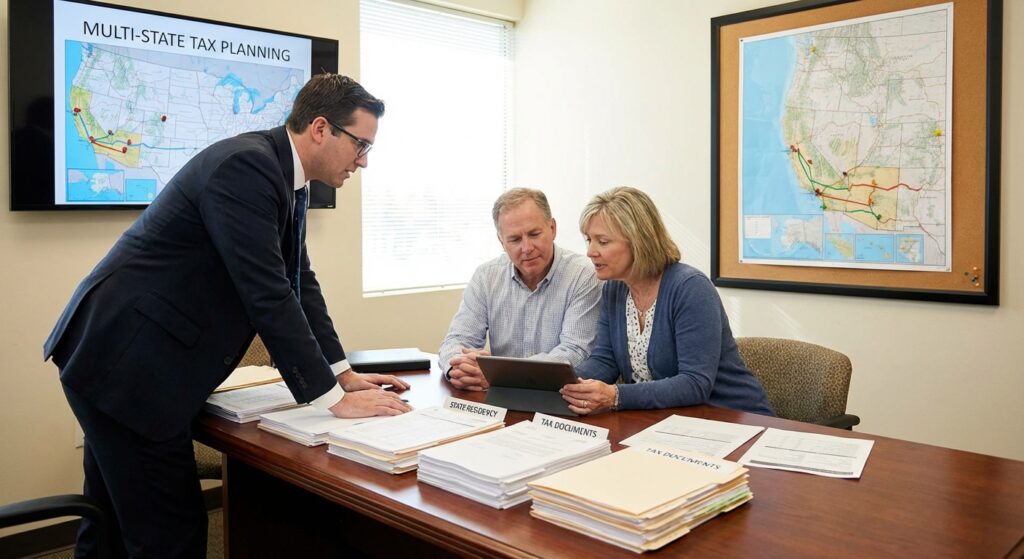
Arizona vs California Residency Tax Issues: Your 2026 Guide to State Tax Obligations
Arizona california residency tax issues represent one of the most complex tax planning challenges for high-income earners, business owners, and real estate investors relocating between these two states. With California’s top state income tax rate reaching 13.3% and Arizona offering a significantly lower tax burden, understanding your residency status and tax obligations for the 2026 tax year is critical. This comprehensive guide walks you through residency determination rules, state-specific tax implications, and actionable strategies to minimize your tax liability while remaining compliant with both state tax authorities.
Table of Contents
- Key Takeaways
- What Makes Residency Determination Complicated?
- How Do California and Arizona Define Residency?
- What Are the Tax Rate Differences Between These States?
- How Does the 183-Day Rule Affect Your Residency Status?
- What About Your Home, Real Estate, and Other Property?
- What Tax Deductions Can You Claim Across State Lines?
- Uncle Kam in Action: Multi-State Tax Planning Case Study
- Next Steps
- Frequently Asked Questions
- Related Resources
Key Takeaways
- Arizona california residency tax issues hinge on where you spend time and maintain your primary home—California’s aggressive residency rules can claim you even with part-time residence.
- California’s state income tax reaches 13.3% for high earners, while Arizona’s top rate is 4.5%—a massive differential for relocation planning.
- The 183-day rule is not an automatic threshold in either state; California uses a “primary home” test that can claim you as resident even below 183 days.
- Business owners relocating must address California Franchise Tax Board (FTB) residency rules carefully to avoid double taxation on business income.
- Real estate holdings in both states complicate your tax picture; you may owe state taxes in each state where you own property.
What Makes Residency Determination Complicated?
Quick Answer: Residency determination is complicated because California and Arizona use different tests, California applies aggressive multi-factor analysis, and your personal circumstances (business location, family, property ownership) trigger residency claims in multiple states.
Arizona california residency tax issues arise primarily because the two states use fundamentally different approaches to determine who must pay state income tax. California is known for its aggressive stance on residency, while Arizona takes a more straightforward approach based on primary domicile. When you have ties in both states, the IRS may view you as a resident in both, creating dual tax obligations and the potential for expensive audit exposure.
The core issue is that neither state recognizes the other’s residency determinations automatically. If California claims you as a resident, Arizona doesn’t automatically defer. This creates a scenario where you could theoretically owe state income tax on the same income to both states, though tax credits and careful planning can mitigate this.
Why Multi-State Tax Planning Matters
For business owners generating six or seven figures, the difference between California and Arizona residency can mean hundreds of thousands of dollars in annual tax liability. A $500,000 annual income subject to California’s 13.3% state tax costs $66,500 in state taxes alone. The same income taxed in Arizona at 4.5% costs $22,500—a potential $44,000 annual savings.
However, this isn’t as simple as moving to Arizona and claiming residency. California has specific rules designed to keep high-income earners classified as residents, even if they spend significant time outside the state. Understanding these rules is essential.
The Personal vs. Business Income Distinction
Arizona california residency tax issues differ based on whether you’re dealing with W-2 employment income, self-employment income, or business profits. An employee working remotely from Arizona faces different residency exposure than a business owner with substantial California-source income. Residency determinations for business income can trigger additional complications involving California corporate franchise taxes if you maintain any business operations in the state.
Pro Tip: For the 2026 tax year, maintain detailed documentation of your time spent in each state, where your primary home is located, and where your business operations occur. This documentation becomes critical if either state audits your residency claim.
How Do California and Arizona Define Residency?
Quick Answer: California defines a resident as anyone maintaining a primary home in the state or spending more than nine months there; Arizona defines residents as those domiciled in the state and meeting specific presence requirements.
California’s Aggressive Residency Test
California’s approach to arizona california residency tax issues is notoriously aggressive. Under California law, you’re considered a resident if either: (1) you maintain your principal place of residence in California, or (2) you spend more than nine months in the state during the tax year. But there’s a significant catch: “principal place of residence” isn’t just about where you sleep most nights.
The California Franchise Tax Board looks at a multi-factor test including where your family lives, where you maintain property, where you’re registered to vote, where you have your driver’s license, and where your business operates. You can have a smaller home in Arizona while maintaining your principal residence in California if those factors point to California. This is why high-net-worth individuals relocating from California face such complex challenges.
- Principal place of residence (where most personal and family life occurs)
- Location of immediate family members
- Where you conduct business or professional practice
- Location of real property ownership and investments
- Voter registration and driver’s license location
- Membership in social, civic, or religious organizations
Arizona’s Simpler Domicile-Based Approach
Arizona uses a simpler domicile-based test. You’re an Arizona resident for tax purposes if Arizona is your domicile—the place where you intend to establish a permanent home. Arizona generally doesn’t aggressively pursue residents who maintain secondary homes in the state while claiming residency elsewhere, as long as your primary domicile is clear.
Arizona’s approach for arizona california residency tax issues means that if you establish Arizona as your domicile with clear intent to make it your permanent home, you have a better chance of defending against California residency claims. However, you must actively establish Arizona domicile through concrete actions: obtaining an Arizona driver’s license, registering to vote, establishing Arizona banking, and most importantly, making Arizona your principal home.
Did You Know? Arizona doesn’t have a “safe harbor” that automatically shields you from California’s residency claims. Even if Arizona accepts you as a resident, California may still claim you owe taxes if FTB auditors determine you maintained California residency. The burden falls on you to prove Arizona domicile in any dispute.
What Are the Tax Rate Differences Between These States?
Quick Answer: For the 2026 tax year, California’s state income tax reaches 13.3% for high earners, while Arizona’s top rate is 4.5%—creating an 8.8 percentage point advantage for Arizona residents.
Understanding the tax rate differential is foundational to resolving arizona california residency tax issues. The difference between these two states’ tax systems is substantial and creates compelling financial motivation for relocation planning, particularly for business owners and high-net-worth individuals.
| Income Range (2026) | California Rate | Arizona Rate | Difference |
|---|---|---|---|
| $0 – $50,000 | 1% – 2% | 1.55% – 2.55% | -0.55% |
| $50,000 – $300,000 | 2% – 9.3% | 2.55% – 4.5% | -4.8% |
| $300,000+ | 9.3% – 13.3% | 4.5% | -8.8% |
For a business owner earning $500,000 annually, Arizona residency saves approximately $44,000 in state income taxes compared to California—before accounting for other tax differences. This differential compounds over years and creates substantial incentive for strategic relocation planning.
Beyond Income Tax: Other State Tax Considerations
The arizona california residency tax issues extend beyond income tax rates. California also imposes a “net investment income tax” of 1% on investment income above threshold amounts, while Arizona does not. Additionally, California has a corporate franchise tax on business entities, while Arizona’s corporate taxation is less aggressive. Real estate investors need to understand that California also taxes real property transferred to relatives within certain timeframes, adding another complexity layer.
How Does the 183-Day Rule Affect Your Residency Status?
Quick Answer: The 183-day rule is not an automatic residency threshold in California or Arizona; both states use other factors, and California will claim you as a resident even below 183 days if you maintain a principal residence there.
Many high-net-worth individuals mistakenly believe the 183-day rule provides protection from California residency claims. This is one of the most dangerous misunderstandings when addressing arizona california residency tax issues. California’s primary residence test can make you a resident even if you spend fewer than 183 days in the state.
The 183-day threshold does matter in Arizona—if you spend more than 183 days in Arizona, you’re conclusively presumed to be an Arizona resident. However, Arizona residency below 183 days is possible if Arizona is your domicile. Conversely, spending fewer than 183 days in California does not protect you from California residency claims if FTB auditors find your principal residence is still in California.
Tracking Physical Presence for Audit Defense
For the 2026 tax year, if you’re managing arizona california residency tax issues, maintain a contemporaneous log of your time spent in each state. This includes travel dates, where you slept, and business activities. Don’t rely on credit card statements or airline records alone—FTB auditors will conduct detailed investigations into your time allocation.
- Document arrival and departure dates for each state
- Record where you spent each night (maintain a travel log)
- Note business activities and client meetings by location
- Keep copies of hotel bills, airline tickets, and relevant expenses
- Maintain records of family location and activities
Pro Tip: Use phone location data and cloud backup location metadata as corroborating evidence of where you actually spent time. Many people discover that their actual travel patterns differ from their memory when FTB auditors present location data during residency disputes.
What About Your Home, Real Estate, and Other Property?
Quick Answer: Real estate ownership in either state creates complications with arizona california residency tax issues; owning rental properties in California while claiming Arizona residency typically results in dual state tax filing.
Property ownership significantly complicates arizona california residency tax issues. If you own a home in California while maintaining an Arizona residence, California will likely claim you as a resident based on the principal residence test, regardless of where you actually live most of the year.
For real estate investors, the situation becomes even more complex. If you own rental properties in California, you must file California tax returns reporting the rental income, even if you’re an Arizona resident. This doesn’t mean you avoid California tax entirely—you’ll owe California state income tax on California-source real estate income.
Principal Residence Determination and Tax Implications
To resolve arizona california residency tax issues involving real estate, you must establish which home is your principal residence. This is where FTB applies its multi-factor test. If you own a $3 million home in Malibu and a $800,000 home in Scottsdale, Arizona, California will argue the Malibu home is your principal residence based on value, history of ownership, and location of personal property.
Some high-net-worth individuals have successfully rebutted California’s presumption by selling their California homes, maintaining only a rental property or investment real estate in the state. However, this requires strong documentation that your primary residence and daily life center in Arizona, not California.
Rental Properties and Multi-State Tax Filing
Real estate investors managing arizona california residency tax issues must understand that owning rental properties in California creates California tax filing requirements. You’ll need to file California Form 540 (California Resident Income Tax Return) reporting your California-source rental income, regardless of your residency status. Additionally, if your business entity managing the properties is structured in California, you may owe California’s annual franchise tax on that entity.
| Scenario | Arizona Residency Impact | California Tax Filing |
|---|---|---|
| Arizona resident, CA rental property | Arizona claims you as nonresident | Must file Form 540-NR (nonresident) |
| Arizona resident, CA principal home | California claims you as resident | Must file Form 540 (resident) |
| Arizona resident, sold CA home | Stronger argument for nonresident | No filing requirement if no CA income |
What Tax Deductions Can You Claim Across State Lines?
Quick Answer: Deduction availability for arizona california residency tax issues depends on your residency status in each state; residents get more favorable treatment, while nonresidents claim only state-source income deductions.
Multi-state deductions are a critical component of planning for arizona california residency tax issues. Your residency status determines which deductions you can claim, and the state-source income rules may limit deductions for nonresidents.
As an Arizona resident with California-source income (such as rental properties), you can only deduct expenses directly related to that California-source income. You cannot claim home office deductions, office supplies, or general business expenses unless they’re specifically allocable to the California income. This creates complexity for business owners with multi-state operations.
Business Expense Allocation Across States
For the 2026 tax year, managing arizona california residency tax issues requires careful allocation of business expenses. If you operate a business with clients in both states, you’ll need to allocate expenses proportionally based on where income is generated.
- Allocate rent/office space based on percentage of time serving CA vs AZ clients
- Divide employee salaries proportionally if staff serves both states
- Track travel expenses by destination state and income source
- Use a Small Business Tax Calculator to estimate multistate tax exposure
- Maintain detailed records supporting allocation methodology
Consider using our Small Business Tax Calculator for Everett to model different allocation strategies and estimate your potential California tax exposure before filing.
Did You Know? California allows “apportionment” of business income based on sales, payroll, and assets. If you’re an Arizona resident operating a business with significant California-source income, you’ll pay California tax on the apportioned portion of your business income—even if you don’t maintain a California office or employees.
State Tax Credits and Avoiding Double Taxation
If you file tax returns in both California and Arizona for the same income (which can happen during residency disputes), you may be entitled to state tax credits to prevent double taxation. Both states allow credits for taxes paid to other states, though the mechanics differ. Arizona typically provides more generous credits, while California’s credit is limited to California’s tax on that income.
Filing in both states and claiming tax credits is permissible, but it’s not an ideal resolution to arizona california residency tax issues. The better approach is establishing clear residency status so you file in only one state for personal income.

Uncle Kam in Action: Multi-State Tax Planning Case Study
The Client: Michael, a 52-year-old real estate developer, earned $650,000 annually through his development business. He maintained a primary home in Newport Beach, California worth $4.5 million, plus a second home in Scottsdale, Arizona worth $1.2 million. He spent about 40% of his time in Arizona managing a new development project and wanted to claim Arizona residency.
The Challenge: California’s Franchise Tax Board had already flagged his prior-year return, questioning his residency status. Michael worried he’d face a significant audit and tax bill. His CPA had advised him to “just pick a state,” but Michael wanted a defensible strategy supported by proper documentation and planning.
The Uncle Kam Solution: We conducted a comprehensive arizona california residency tax issues analysis. Rather than attempting to claim Arizona residency (which would be difficult to defend given his substantial California ties), we implemented a strategic repositioning plan. Michael sold his Newport Beach home and relocated his family to Arizona. We established Arizona as his domicile through multiple concrete steps: new driver’s license, voter registration, bank account transfers, and updated business registration.
We also restructured his development business to establish two entities: one Arizona LLC for Arizona-source income and one California LLC for California-source income. This allowed him to file as an Arizona resident while reporting California-source income appropriately.
The Results: For the 2026 tax year, Michael achieved Arizona residency status with defensible documentation. His state tax liability dropped from approximately $86,450 (13.3% on $650,000 in California) to approximately $29,250 (4.5% on $650,000 in Arizona)—an annual savings of $57,200. His investment in implementing this strategy: $15,000 in professional fees for entity restructuring and documentation. First-year return on investment: 381%.
More importantly, Michael’s residency position was now defensible if FTB audited. He had concrete evidence of Arizona domicile, and his business structure reflected genuine Arizona operations, not a tax shelter.
Next Steps
Take control of your arizona california residency tax issues with these immediate action steps:
- Document Your Current Status: Create a written record of where you spent each day of 2025 and plan for 2026. Include where you maintained your primary residence, business locations, and family residence.
- Audit Your Ties to Each State: List all factors pointing to California residency and all pointing to Arizona residency. Include property ownership, business operations, voter registration, and driver’s licenses.
- Consult a Multi-State Tax Specialist: Visit our tax strategy service page to explore how Uncle Kam approaches multi-state residency planning for your specific situation.
- Model Your Tax Impact: Calculate your potential tax liability under both California and Arizona residency scenarios for 2026.
- Develop Your Residency Plan: If Arizona residency is advantageous, begin implementing concrete steps to establish Arizona domicile and reduce California ties before filing your 2026 return.
Frequently Asked Questions
If I spend less than 183 days in California, am I protected from California residency claims?
No. California’s primary residence test can make you a resident even if you spend fewer than 183 days in the state. The 183-day rule is a convenient guideline, but not a safe harbor. If your primary residence is in California (even if you spend only 100 days there), California will claim you as a resident for tax purposes.
Can I claim Arizona residency if I own rental property in California?
Yes, you can claim Arizona residency while owning California rental property. However, you must file a California nonresident income tax return reporting the rental income, and you’ll owe California state tax on that California-source income. Simply owning property in California doesn’t make you a resident if your principal residence and family are in Arizona.
What happens if California claims I as a resident and I claim Arizona residency?
This creates a residency dispute. If both states claim you, you may owe taxes in both states unless you successfully defend your position. You can file in both states and claim tax credits for taxes paid to one state against your liability in the other, but this isn’t ideal. The better approach is establishing clear residency status before filing.
How aggressively will California pursue residency disputes?
Very aggressively. California consistently ranks among the most aggressive states in pursuing residency disputes, particularly for high-income earners. The FTB audits residency claims regularly and has extensive resources for these investigations. If your reported income suggests you might have California connections, expect heightened audit scrutiny.
If I move to Arizona, when can I file as an Arizona resident?
You can file as an Arizona resident starting the tax year in which you establish Arizona domicile. However, California may challenge your residency for the year of your move. The best practice is to establish Arizona domicile well before the end of the tax year, with concrete actions (new driver’s license, voter registration, home purchase) occurring several months before year-end.
What if my business is incorporated in California but I’m managing it from Arizona?
You’ll face significant complications with arizona california residency tax issues. A California corporation is subject to California’s annual franchise tax regardless of where you manage it, and where you physically manage the business may determine the apportionment of your business income. You may want to restructure your business entity to establish your operational headquarters in Arizona.
Related Resources
- Entity Structuring Services for Multi-State Businesses
- Tax Strategy for High-Net-Worth Individuals
- Tax Planning for Real Estate Investors
- Tax Strategy Blog and Current Updates
- California Franchise Tax Board Official Website
This information is current as of 2/16/2026. Tax laws change frequently. Verify updates with the IRS (IRS.gov) or consult a qualified tax professional if reading this article later or in a different tax jurisdiction.
Last updated: February, 2026

