
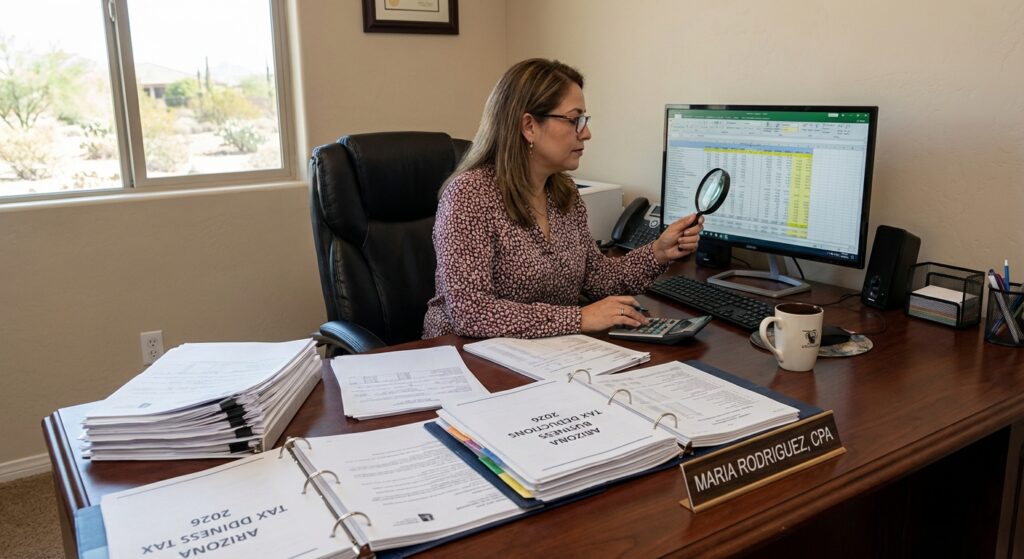
For the 2026 tax year, Arizona business owners and self-employed professionals face new opportunities to maximize their tax savings through an expanded arizona tax deduction list. The One Big Beautiful Bill Act (OBBBA) introduced significant federal deduction changes, and understanding which deductions apply to Arizona residents is critical for strategic tax planning. Whether you’re a small business owner, real estate investor, or independent contractor, this comprehensive guide covers federal deductions, Arizona-specific tax benefits, and strategies to reduce your 2026 tax liability.
Table of Contents
- Key Takeaways
- What’s the Standard Deduction for 2026?
- What Are the Key Self-Employment and Business Deductions Available?
- Which Deductions Are Unique to Arizona Residents?
- How Did the OBBBA Change the Arizona Tax Deduction List?
- How Can You Strategically Maximize Your Deductions?
- Uncle Kam in Action
- Next Steps
- Frequently Asked Questions
- Related Resources
Key Takeaways
- The 2026 standard deduction increased to $13,850 for single filers, $27,700 for married filing jointly, and $20,800 for head of household.
- New OBBBA deductions for 2026 include $6,000 for seniors (single) and $12,000 (married), tips, overtime pay, and auto loan interest deductions with income limits.
- Arizona allows pass-through entity deductions (APTED) allowing up to 4.95% deduction on S Corp and partnership income.
- Business owners can deduct ordinary and necessary business expenses including home office, vehicle costs, equipment, and professional services.
- Strategic deduction planning now requires understanding both federal and Arizona conformity rules for maximum 2026 tax savings.
What’s the Standard Deduction for 2026?
Quick Answer: For the 2026 tax year, the standard deduction is $13,850 (single), $27,700 (married filing jointly), and $20,800 (head of household), representing increases from 2025 figures.
The standard deduction is the baseline amount every taxpayer can deduct from their gross income without itemizing specific expenses. For 2026, the IRS has adjusted these amounts to account for inflation. Arizona residents use the same federal standard deduction amounts on their federal return, though Arizona may apply different rules for state-level filing.
Understanding the standard deduction is the first step in building your arizona tax deduction list. If your itemized deductions (mortgage interest, charitable donations, property taxes) exceed the standard deduction, you’ll itemize instead. For most taxpayers, the standard deduction provides the greater benefit.
2026 Standard Deduction by Filing Status
| Filing Status | 2026 Standard Deduction | Increase from 2025 |
|---|---|---|
| Single | $13,850 | +$350 |
| Married Filing Jointly | $27,700 | +$700 |
| Head of Household | $20,800 | +$500 |
| Married Filing Separately | $13,850 | +$350 |
Taxpayers age 65 or older qualify for an additional standard deduction for 2026. Single filers age 65+ receive an additional $1,800 deduction, while married couples age 65+ each receive an additional $1,450 deduction. These amounts are indexed annually for inflation.
Pro Tip: If you’re age 65 or older in 2026, verify eligibility for the additional deduction when filing. This applies to both federal and Arizona returns for residents.
Standard Deduction vs. Itemized Deductions
When building your arizona tax deduction list, you must choose between the standard deduction and itemizing. Itemized deductions include mortgage interest, charitable contributions, state and local taxes (SALT), and medical expenses. For most middle-income Arizona residents, the standard deduction provides greater tax savings.
- Standard deduction: Simpler, automatic, no documentation required
- Itemized deductions: Requires detailed records, benefits high-tax-state residents
- Choose whichever produces the larger total deduction on your 2026 return
What Are the Key Self-Employment and Business Deductions Available?
Quick Answer: Self-employed professionals and business owners can deduct ordinary and necessary business expenses including home office deductions, vehicle costs, equipment, supplies, professional services, and insurance premiums on Schedule C or Schedule F.
Self-employment deductions form the backbone of the arizona tax deduction list for independent contractors, freelancers, and small business owners. These deductions directly reduce your taxable business income, lowering both income tax and self-employment tax obligations. Understanding what qualifies as deductible is essential for 2026 tax planning.
The IRS allows deductions for any ordinary and necessary expense required to run your business. This broad definition covers expenses directly tied to generating business income. Keep detailed records and receipts for all deductions claimed on your Schedule C or Schedule F.
Major Business Expense Deduction Categories
- Home office deduction: Simplified method ($5 per square foot, max 300 sq ft = $1,500) or actual expense method
- Vehicle expenses: Standard mileage rate ($0.67 per mile for 2026) or actual expenses including depreciation
- Office supplies, software, subscriptions, and equipment under $2,500 (Section 179 expensing available)
- Professional services: Accounting, legal, consulting, and advisory fees
- Insurance: Business liability, professional indemnity, and health insurance premiums
- Utilities, internet, phone, and office rent for business purposes
- Meals and entertainment: 50% deductible for business meals (100% for employee meals under temporary rules)
- Travel and conference expenses directly related to your business
Pro Tip: Everett-area self-employed professionals should use our Self-Employment Tax Calculator to estimate quarterly tax obligations and deduction savings for 2026.
Depreciation and Section 179 Expensing
For 2026, Section 179 expensing allows business owners to immediately deduct up to $1.16 million in qualified asset purchases rather than depreciating them over several years. This accelerates deductions and improves cash flow for growing businesses. Real estate investors and business owners should evaluate whether Section 179 expensing or bonus depreciation provides greater 2026 benefits.
Which Deductions Are Unique to Arizona Residents?
Quick Answer: Arizona offers the Arizona Pass-Through Entity Deduction (APTED), allowing eligible business owners to deduct up to 4.95% of qualified business income, and specific retirement and investment deductions not available at the federal level.
Arizona residents enjoy several state-specific deductions that enhance the overall arizona tax deduction list. These deductions apply exclusively to Arizona state income tax and provide significant planning opportunities for business owners, real estate investors, and self-employed professionals operating in Arizona.
Arizona Pass-Through Entity Deduction (APTED)
The Arizona Pass-Through Entity Deduction is among the most valuable deductions on the arizona tax deduction list for business owners. This deduction allows S Corporation owners, partnership owners, and LLC members to deduct up to 4.95% of their qualified business income from their Arizona taxable income. For example, a business with $500,000 in qualifying income could claim approximately $24,750 in APTED deductions.
The APTED is available to pass-through entities including S Corporations, partnerships, and single-member LLCs. C Corporations do not qualify, but owners can structure their business as a pass-through to access this significant tax benefit. This deduction applies only to Arizona state income tax, not federal returns.
- Maximum APTED deduction: 4.95% of qualified business income
- Available to S Corps, partnerships, and LLCs filing Arizona Form 140
- Requires Arizona Department of Revenue reporting and compliance
- Can significantly reduce Arizona state income tax liability
Pro Tip: Arizona business owners should evaluate entity structure based on APTED eligibility. An S Corporation structure often provides greater 2026 savings than an LLC when combined with APTED benefits and self-employment tax reduction.
Other Arizona-Specific Tax Deductions
Beyond APTED, Arizona offers additional deductions that should be included in your comprehensive arizona tax deduction list. These include deductions for contributions to individual retirement accounts, spousal IRAs, and small business retirement plans. Arizona also provides deductions for certain education expenses and investment-related costs.
Arizona residents may also benefit from unique charitable deduction opportunities and deductions for losses on sale of qualified business assets. Review Arizona Department of Revenue guidance to ensure you’re capturing all available state-level deductions on your Form 140.
How Did the OBBBA Change the Arizona Tax Deduction List?
Quick Answer: The One Big Beautiful Bill Act (OBBBA) introduced new federal deductions for seniors ($6,000 single/$12,000 married), qualified tips, overtime pay, and auto loan interest effective for the 2026 tax year, expanding deduction opportunities for many Arizona taxpayers.
The OBBBA significantly expanded the arizona tax deduction list by introducing four new major deductions for 2026. These additions represent the most substantial changes to federal deductions in recent years and provide meaningful tax relief for multiple taxpayer groups. Understanding OBBBA provisions is critical for 2026 tax planning and filing.
Senior Citizen Deduction
Effective for 2026, the OBBBA creates a new Senior Citizen Deduction that replaces the standard deduction increase for qualified seniors. This deduction provides $6,000 for single filers (age 62+) and $12,000 for married couples (both age 62+). This provides greater deductions than the traditional additional standard deduction for seniors.
Arizona residents age 62 and older should evaluate whether claiming the Senior Citizen Deduction provides greater benefits than the standard deduction plus additional deduction for age. The Senior Citizen Deduction is available in addition to any other deductions claimed on your federal return for 2026.
OBBBA Deduction for Tips, Overtime, and Auto Interest
The OBBBA expanded the arizona tax deduction list with three new deductions targeting specific income categories. First, workers can now deduct up to $12,500 (single) or $25,000 (married) in qualified tips received during the year. Second, employees can deduct overtime pay up to $12,500 (single) or $25,000 (married). Third, individuals can deduct interest paid on auto loans used for personal transportation, creating new planning opportunities.
These deductions have income phase-out limits and specific eligibility requirements. Auto loan interest deductions phase out for taxpayers earning over $150,000 (single) or $300,000 (married filing jointly). The tips and overtime deductions are subject to their own income limitations and must be reported on Schedule 1 of the federal return.
- Qualified tips deduction: $12,500 (single) / $25,000 (married) with income phase-outs
- Overtime deduction: $12,500 (single) / $25,000 (married) with income phase-outs
- Auto loan interest deduction: Limited to vehicles weighing under 6,000 lbs; phases out over $150k/$300k income
- Documentation required: Keep records of tips, overtime hours, and auto loan interest paid
Did You Know? OBBBA deductions may not be automatically adopted by Arizona for state income tax purposes. Arizona taxpayers should verify current state conformity status before claiming these deductions on their Arizona return to avoid compliance issues.
How Can You Strategically Maximize Your Deductions?
Quick Answer: Maximize 2026 deductions by categorizing all expenses on your arizona tax deduction list, tracking business vs. personal expenses, timing major purchases strategically, and documenting everything thoroughly for comprehensive tax strategy implementation.
Building an effective arizona tax deduction list requires proactive planning throughout 2026. Rather than scrambling to find deductions in April, successful business owners and self-employed professionals implement systematic tracking and year-round planning. Strategic deduction management can reduce your taxable income by 20-40% depending on business type and structure.
Systematic Deduction Tracking Strategy
The foundation of maximizing deductions is implementing systematic tracking throughout the year. Use accounting software like QuickBooks, FreshBooks, or Wave to categorize expenses as they occur. This approach provides accurate records for your arizona tax deduction list and simplifies tax preparation.
Create expense categories aligned with IRS Schedule C categories to ensure comprehensive deduction capture. Common categories include office supplies, vehicle expenses, utilities, insurance, professional services, equipment, and travel. Many accounting platforms automatically suggest deduction categories based on expense descriptions.
- Use accounting software to track all business expenses throughout 2026
- Create separate business credit cards or bank accounts for business transactions
- Reconcile accounts monthly to catch missed deductions early
- Keep digital receipts for all expenses over $25
- Document business purpose for mixed-use expenses (vehicle, phone, utilities)
Timing and Planning Strategies
Strategic timing of major purchases can significantly impact 2026 deductions. Consider implementing Section 179 expensing for equipment purchases before year-end to accelerate deductions. If projected income runs high, timing certain expenses into 2026 versus deferring to 2027 can optimize your overall tax position.
Professional tax advisory services can help identify optimal timing for business investments, entity elections, and deduction strategies. Quarterly reviews ensure you’re capturing all available deductions on your arizona tax deduction list and maintaining compliance throughout the year.
Pro Tip: Schedule a mid-year tax review in July 2026 to assess deduction categories and identify missed opportunities. This allows time to implement additional strategies like retirement plan contributions or business investment before year-end.

Uncle Kam in Action: Arizona Business Owner Deduction Strategy
Client Profile: Sarah is a 48-year-old business owner in Phoenix running a consulting firm structured as an S Corporation. Her 2026 business revenue is projected at $380,000 with $120,000 in operating expenses. She pays herself a reasonable salary of $140,000 and takes distributions of $120,000.
The Challenge: Sarah was unsure which deductions to claim on her arizona tax deduction list and whether Arizona’s APTED would apply to her situation. She wanted to maximize 2026 tax savings while maintaining IRS compliance for reasonable compensation and self-employment tax obligations.
The Solution: We implemented a comprehensive deduction strategy including business expense categorization, home office deduction, vehicle mileage tracking, and identified APTED eligibility. Her S Corporation structure qualified for the Arizona Pass-Through Entity Deduction. We calculated her qualified business income at $240,000 (after reasonable salary), generating approximately $11,880 in Arizona state deductions through APTED.
Business Expenses Captured: Home office ($5,500), vehicle mileage ($8,200), professional software ($3,400), accounting services ($5,000), business insurance ($4,200), and professional development ($2,100). Total deductible business expenses: $28,400 against federal taxable income.
Results: Sarah’s 2026 federal income tax decreased by $6,840, and her Arizona state income tax decreased by approximately $4,100 through APTED benefits. Total 2026 tax savings: $10,940. Return on investment: Her $1,500 tax strategy investment generated 729% ROI in first-year savings alone. Beyond 2026, these structures provide recurring annual benefits.
Sarah’s case demonstrates how comprehensive deduction planning on the arizona tax deduction list, combined with proper entity structure and understanding APTED, creates significant 2026 tax advantages for Arizona business owners.
Next Steps
To maximize your 2026 arizona tax deduction list and minimize tax liability, implement these immediate action steps:
- Download and organize your 2026 expense records into deduction categories by March 2026.
- Evaluate your business structure (LLC, S Corp, sole proprietorship) for APTED eligibility and tax optimization.
- Schedule a tax strategy review to identify missed deductions and optimal 2026 planning opportunities.
- Implement systematic expense tracking using accounting software to capture all deductions throughout 2026.
- Consult with a CPA about timing major equipment purchases to maximize Section 179 expensing and depreciation deductions.
Frequently Asked Questions
Can I claim the OBBBA senior deduction in addition to the standard deduction?
The OBBBA senior deduction replaces the additional standard deduction for seniors age 62 and older. You choose whichever provides greater benefit. The senior deduction of $6,000 (single) or $12,000 (married) typically exceeds the traditional additional standard deduction, providing greater 2026 savings for most retirees.
How does Arizona APTED deduction work for real estate investors?
Real estate investors using pass-through entities (partnerships, S Corps, or LLC taxed as partnership) qualify for APTED deductions on rental income. The deduction applies to 4.95% of qualified business income from rental properties. Real estate professionals should structure their entities strategically to maximize APTED benefits alongside cost segregation and depreciation deductions.
What documentation is required for home office deductions?
For the simplified method, simply measure your dedicated home office square footage (maximum 300 sq ft) and multiply by $5 per square foot ($1,500 maximum). The actual expense method requires tracking mortgage interest, rent, utilities, insurance, repairs, and depreciation allocated to office space. Keep receipts for all utilities and home-related expenses to support actual expense method deductions on your arizona tax deduction list.
Does Arizona conform to OBBBA deductions for state tax purposes?
Arizona’s conformity with OBBBA deductions may vary by deduction type. Federal senior, tips, overtime, and auto loan interest deductions may or may not apply to Arizona state tax returns. Verify current Arizona Department of Revenue guidance before claiming OBBBA deductions on your Arizona Form 140 to avoid compliance issues.
How do I calculate the mileage deduction for 2026?
For 2026, the standard mileage rate for business use is $0.67 per mile. Track business miles separately from personal miles throughout the year using a mileage log or app. Multiply total business miles by $0.67 to calculate your deduction. This is typically more generous than tracking actual vehicle expenses, making it the preferred method for many business owners on their arizona tax deduction list.
Are meal and entertainment expenses still 50% deductible for 2026?
Generally, meal and entertainment expenses are 50% deductible for 2026. However, temporary provisions may allow 100% deduction for certain employee meals. Keep detailed records with dates, attendees, business purpose, and amounts. This deduction applies on Schedule C for self-employed professionals and on business tax returns for business owners.
Related Resources
- Tax Strategies for Arizona Business Owners
- Self-Employment Tax Planning for 1099 Contractors
- Real Estate Investor Tax Deductions and Strategies
- LLC vs S Corp Tax Planning for Arizona Residents
- Client Success Stories and Tax Savings Results
This information is current as of 2/16/2026. Tax laws change frequently. Verify updates with the IRS (IRS.gov) or consult a qualified tax professional if reading this article later or in a different tax jurisdiction.
Last updated: February, 2026

