
2026 Arizona 1031 Exchange Guidance: Complete Tax Strategy Guide for Real Estate Investors
For the 2026 tax year, Arizona real estate investors need current Arizona 1031 exchange guidance to make informed property investment decisions. The IRS maintains strict timelines and requirements for like-kind exchanges, with a 45-day identification period and 180-day closing deadline. This comprehensive guide covers everything Arizona property investors need to know about 1031 exchanges in 2026, including federal rules, state compliance, and advanced tax deferral strategies.
Table of Contents
- Key Takeaways
- What Is a 1031 Exchange and Why Does It Matter for Arizona Investors?
- What Are the Critical Deadlines for Your Arizona 1031 Exchange?
- What Qualifies as Like-Kind Property Under 2026 Rules?
- How Do Qualified Intermediaries Ensure Your Exchange Complies?
- How Can You Maximize Tax Deferral Through Strategic 1031 Planning?
- What Are the Most Common 1031 Exchange Mistakes in Arizona?
- Uncle Kam in Action
- Next Steps
- Frequently Asked Questions
Key Takeaways
- The 45-day identification deadline and 180-day closing deadline are absolute requirements for IRC Section 1031 exchanges.
- Arizona real estate investors can defer unlimited capital gains taxes through compliant 1031 exchanges.
- A qualified intermediary is legally required to hold exchange proceeds and facilitate the transaction.
- Arizona follows federal 1031 rules with no additional state-specific restrictions for like-kind exchanges.
- Missing deadlines by even one day disqualifies the entire exchange and triggers immediate tax liability.
What Is a 1031 Exchange and Why Does It Matter for Arizona Investors?
Quick Answer: A 1031 exchange under IRC Section 1031 allows Arizona real estate investors to sell investment property and reinvest the proceeds into like-kind property without paying capital gains taxes, deferring the tax obligation indefinitely.
A 1031 exchange is one of the most powerful tax deferral strategies available to real estate investors in Arizona. When you sell investment property for a profit, normally you would owe capital gains tax on the appreciation. However, IRC Section 1031 provides a mechanism to defer this tax entirely by reinvesting the sale proceeds into another property of like-kind within strict timeframes.
The beauty of a 1031 exchange is that the tax deferral can continue indefinitely. You can perform a 1031 exchange today, and then perform another 1031 exchange several years later with the replacement property. This creates a compounding effect where your investment capital continues growing without being reduced by capital gains taxes.
The Economics of 1031 Exchanges for Arizona Investors
Consider a practical example: You purchase a rental property in Phoenix for $500,000 and sell it five years later for $750,000. That’s a $250,000 gain. At a 20% long-term capital gains rate (standard for 2026), you would normally owe $50,000 in federal taxes alone, not counting Arizona state income tax.
With a compliant 1031 exchange, you can take that full $750,000 and invest it into replacement properties without paying a dime in capital gains tax. That extra $50,000 stays in your investment account, acquiring more rental properties and generating additional income.
Pro Tip: Many Arizona investors combine 1031 exchanges with strategic entity structuring. While planning your exchange for 2026, consult a tax advisor about whether LLC or S-Corp status could provide additional tax benefits alongside your 1031 strategy.
What Are the Critical Deadlines for Your Arizona 1031 Exchange?
Quick Answer: You have exactly 45 days from closing your property sale to identify replacement properties in writing, and 180 days total to close on the replacement property for a compliant 2026 1031 exchange.
The IRS enforces two non-negotiable deadlines for 1031 exchanges. These are strict deadlines, and missing them by even one day disqualifies your entire exchange. Understanding these timelines is critical for Arizona investors planning their 2026 transactions.
The 45-Day Identification Period
Starting the day after you close on the sale of your relinquished property, you have exactly 45 days to identify replacement property. This identification must be in writing and submitted to your qualified intermediary. The written notice must clearly identify the replacement properties by legal description or address.
During this 45-day window, you can identify multiple properties. The IRS allows what’s called the “three-property rule”—you can identify up to three replacement properties without any limitation. If you identify more than three properties, you must ensure that the fair market value of those additional properties does not exceed 200% of the value of the relinquished property.
The 180-Day Exchange Period
You have 180 days from the closing date of your relinquished property to actually close on and take title to the replacement property. This 180-day window includes the 45-day identification period, so you effectively have only 135 days remaining after the identification deadline to locate and purchase your replacement property.
Both deadlines are calendar deadlines, not business days. Weekends and holidays count toward the deadlines. If the 45th day or 180th day falls on a weekend or holiday, the deadline moves to the next business day.
| Timeline Event | Days to Complete | Requirements |
|---|---|---|
| Sale of Relinquished Property | Day 0 | Close on original property; funds go to qualified intermediary |
| Identification Period | Days 1-45 | Submit written identification of replacement properties |
| Exchange Period | Days 1-180 | Close on replacement property and receive title |
What Qualifies as Like-Kind Property Under 2026 Rules?
Quick Answer: For 2026, like-kind property means virtually any real property can be exchanged for any other real property—residential for commercial, vacant land for apartments, or office buildings for retail centers.
One of the significant benefits of 1031 exchanges for Arizona real estate investors is the broad definition of like-kind property under current law. Many investors misunderstand what qualifies, so let’s clarify the 2026 rules.
Real Property Requirements for Arizona Investors
The fundamental rule is simple: the property must be real property, and you must exchange real property for real property. Personal property does not qualify for 1031 treatment. This means you can exchange Arizona rental properties, vacant land, commercial office buildings, industrial warehouses, and multi-family apartment complexes.
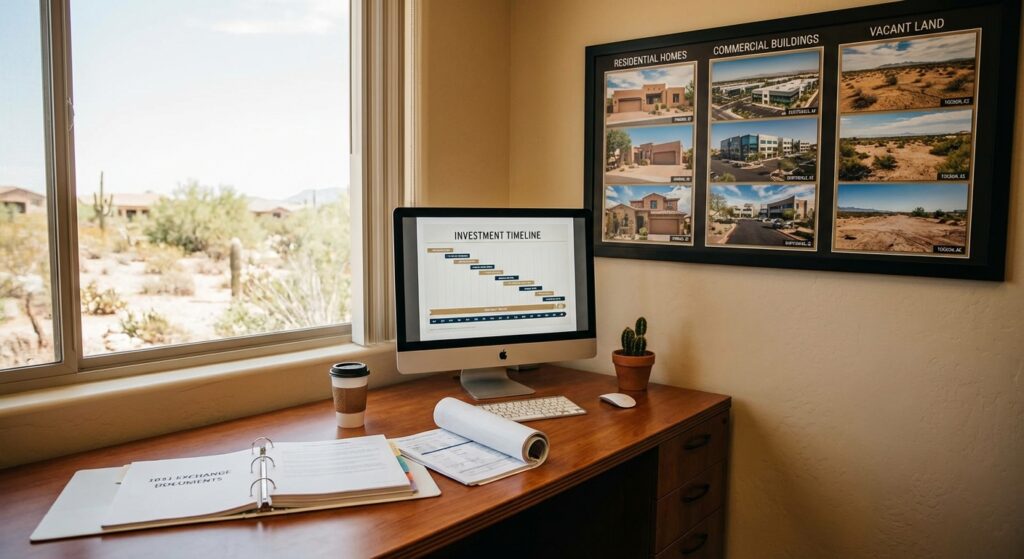
The beauty of the current rules is that there are virtually no type restrictions. You can exchange a residential rental property in Phoenix for a commercial office building in Tucson. You can exchange vacant land for an operating hotel. You can exchange a retail shopping center for industrial warehouse space.
- Residential rental properties (single-family homes, apartments)
- Commercial real estate (office buildings, retail centers)
- Industrial properties (warehouses, manufacturing facilities)
- Land (raw, agricultural, or development-ready)
- Special-use properties (hotels, golf courses, marinas)
What Does NOT Qualify for 1031 Treatment
Equally important is understanding what doesn’t qualify. Personal property exchanges do not qualify, which means you cannot exchange stocks, bonds, collectibles, or equipment. Primary residences also cannot be exchanged under Section 1031, only investment or business-use property.
Pro Tip: Arizona investors should document that their property is held for investment or business purposes, not personal use. Even a principal residence that you later convert to rental property may have issues qualifying for 1031 treatment if the purpose isn’t clearly documented.
How Do Qualified Intermediaries Ensure Your Exchange Complies?
Quick Answer: A qualified intermediary is a third party who holds your sale proceeds and ensures compliance with all 1031 requirements, and hiring one is legally mandatory for a valid exchange.
One of the most critical components of any 1031 exchange is the qualified intermediary. This is not optional—the IRS requires that you use a qualified intermediary for your transaction to be valid. Many Arizona real estate investors don’t fully understand the role and importance of the qualified intermediary.
What Is a Qualified Intermediary?
A qualified intermediary is a person or entity that stands between you and the replacement property seller. They receive the sale proceeds from your relinquished property, hold those funds, and then disburse them to purchase the replacement property on your behalf.
The key requirement is that you must never touch the funds. If you receive the sale proceeds directly and then buy replacement property with those funds, the IRS will disqualify the exchange entirely. The qualified intermediary must maintain control of the funds throughout the transaction.
Qualified Intermediary Responsibilities
- Receive and hold sale proceeds from your relinquished property closing
- Maintain written records and documentation of the exchange
- Provide you with written confirmation of deadlines and requirements
- Ensure proper identification of replacement property within 45 days
- Disburse funds to purchase replacement property within 180 days
Finding a reputable qualified intermediary in Arizona is essential. You should work with someone who specializes in 1031 exchanges and can provide proper documentation for IRS Form 8824, which reports your exchange on your tax return.
How Can You Maximize Tax Deferral Through Strategic 1031 Planning?
Quick Answer: Advanced planning strategies include the 1031 exchange boot rules, consolidation transactions, and multi-property exchanges that allow Arizona investors to strategically defer taxes while optimizing their real estate portfolios.
Beyond the basics, sophisticated Arizona investors use strategic planning techniques to maximize tax deferral benefits in their 2026 exchanges. Understanding these advanced concepts can save you thousands in unnecessary taxes.
Managing Boot and Partial Exchanges
In 1031 terminology, “boot” refers to any cash or other property that you receive in addition to the like-kind replacement property. If you structure your exchange with boot, you may owe tax on the boot received, but you can still defer tax on the remaining proceeds.
For maximum tax deferral in 2026, the standard rule is to invest 100% of your sale proceeds into replacement property. However, if you need cash, you can structure a partial exchange. For example, if you sell a property for $750,000 and want to take $100,000 in cash, you invest $650,000 in replacement property. You’ll owe tax on the $100,000 boot received, but defer tax on the $650,000 portion.
Our LLC vs S-Corp Tax Calculator can help you model how different entity structures might work alongside your 1031 strategy for optimal tax efficiency in 2026.
Multi-Property Exchanges
Advanced Arizona investors use multi-property exchanges to consolidate or diversify their portfolios. You could sell one large apartment complex and purchase three smaller single-family rentals as replacement property. Or you could sell multiple properties and consolidate into a single large commercial building.
As long as you meet the like-kind requirements and deadlines, the number of properties doesn’t matter. This flexibility allows Arizona investors to restructure their portfolios while deferring capital gains taxes in 2026.
What Are the Most Common 1031 Exchange Mistakes in Arizona?
Quick Answer: Common mistakes include missing deadlines, touching exchanged funds directly, failing to identify proper like-kind property, or not using a qualified intermediary.
After years of working with Arizona real estate investors, certain mistakes appear repeatedly. Learning from others’ errors can protect your 2026 exchange and save you significant tax liability.
Missing the 45-Day Identification Deadline
The most common mistake is failing to submit written identification of replacement properties within 45 days. Many Arizona investors think they have more time or fail to properly document their identification. If you miss this deadline by even one day, your entire exchange fails and you become liable for capital gains taxes immediately.
Touching the Funds Directly
Some Arizona investors receive the sale proceeds in their personal account temporarily. Even if you intend to invest those funds in replacement property immediately, if you have access to or control of the funds, the IRS may disqualify your exchange. The qualified intermediary must maintain control at all times.
Neglecting Arizona State Tax Compliance
While Arizona follows federal 1031 rules, you must ensure that your replacement property and exchange structure comply with any Arizona-specific reporting requirements for real estate transactions. Arizona’s Department of Revenue expects proper documentation of your exchange.

Uncle Kam in Action: From Single Rental to Diversified Portfolio Through Strategic 1031 Planning
Client Profile: Marcus, a Phoenix-based real estate investor with a successful career as a commercial contractor, owned a single rental property in Ahwatukee that he had held for eight years.
Financial Situation: Marcus purchased the property for $400,000 and sold it in early 2026 for $750,000, creating a $350,000 gain. At 20% federal long-term capital gains tax plus Arizona state income tax (approximately 4.5%), he faced roughly $85,750 in total tax liability. He had worked hard for this profit and wanted to preserve his investment capital.
The Challenge: Marcus wanted to diversify his real estate portfolio by moving from a single rental in one neighborhood to multiple properties across the greater Phoenix area. He also wanted to ensure his exchange complied with all 2026 regulations while maximizing his available capital.
Uncle Kam’s Strategy: We structured a multi-property 1031 exchange where Marcus’s $750,000 proceeds were used to purchase three replacement properties: a single-family rental in Chandler ($350,000), a duplex in Mesa ($250,000), and raw land in Apache Junction ($150,000). We engaged a specialized qualified intermediary on day one of the close to hold all proceeds and manage the strict deadlines.
The Results: Marcus successfully executed his 2026 exchange, avoiding all $85,750 in capital gains taxes. His investment capital of $750,000 remained fully intact and was now deployed across three diversified properties in different markets. By deferring the taxes, Marcus kept that money invested, compounding his wealth. Within the first year of his diversified portfolio, he was generating approximately $18,000 in additional annual rental income compared to his single property. The tax strategy advantage he gained through proper 1031 planning paid for itself multiple times over.
First-Year ROI: Tax savings of $85,750 achieved with a $1,500 qualified intermediary fee equals an immediate 5,717% return on investment, plus additional income benefits from diversification.
Next Steps
- Review your current real estate portfolio and identify properties that may benefit from a 1031 exchange.
- Contact a qualified intermediary specializing in Arizona 1031 exchanges to understand costs and requirements.
- Schedule a consultation with real estate investment tax specialists to evaluate your specific situation.
- Document your investment intent for all properties being held for exchange purposes.
- Begin analyzing potential replacement properties in the Arizona market for your 2026 transaction.
Frequently Asked Questions
Can I sell multiple properties and use a 1031 exchange?
Yes. You can sell multiple relinquished properties and use the combined proceeds to purchase replacement properties. However, all deadlines still apply—you must identify replacement properties within 45 days and complete the exchange within 180 days from the first property closing.
What happens if I accidentally touch the exchange funds?
If you have control over or access to the exchange funds, the IRS may disqualify your entire exchange, resulting in immediate capital gains tax liability. Always ensure your qualified intermediary maintains sole control of proceeds.
Can I do a 1031 exchange on my primary residence?
No. The 1031 exchange applies only to investment or business-use real property. Your primary residence does not qualify, though there may be other tax benefits available for primary residence sales.
Does Arizona have any specific state-level 1031 requirements beyond federal rules?
Arizona generally follows federal 1031 rules without additional state-specific restrictions. However, you should ensure proper documentation of your exchange for Arizona state income tax purposes and compliance with any local real estate transfer reporting requirements.
How much does a qualified intermediary cost for an Arizona 1031 exchange?
Qualified intermediary fees for Arizona exchanges typically range from $1,500 to $2,500 depending on transaction complexity. Given that you’re potentially saving tens of thousands in capital gains taxes, the fee is a valuable investment.
Can I exchange real property across state lines using a 1031 exchange?
Yes. You can sell Arizona property and purchase replacement property in any other state, or vice versa. The 1031 exchange applies to any qualified real property regardless of state location.
What documentation do I need to file with my 2026 tax return?
You must file IRS Form 8824 with your 2026 tax return to report your 1031 exchange. Your qualified intermediary should provide all necessary documentation to complete this form accurately.
Related Resources
- Real Estate Investor Tax Strategies
- Entity Structuring for Real Estate Investors
- Advanced Tax Strategy Planning
- Ongoing Tax Advisory Services
Last updated: February, 2026
Compliance Disclosure: This information is current as of 2/9/2026. Tax laws and IRS guidance change frequently. For 2026 transactions, always verify current rules with the IRS.gov website or consult with a qualified tax professional before executing any 1031 exchange strategy.

