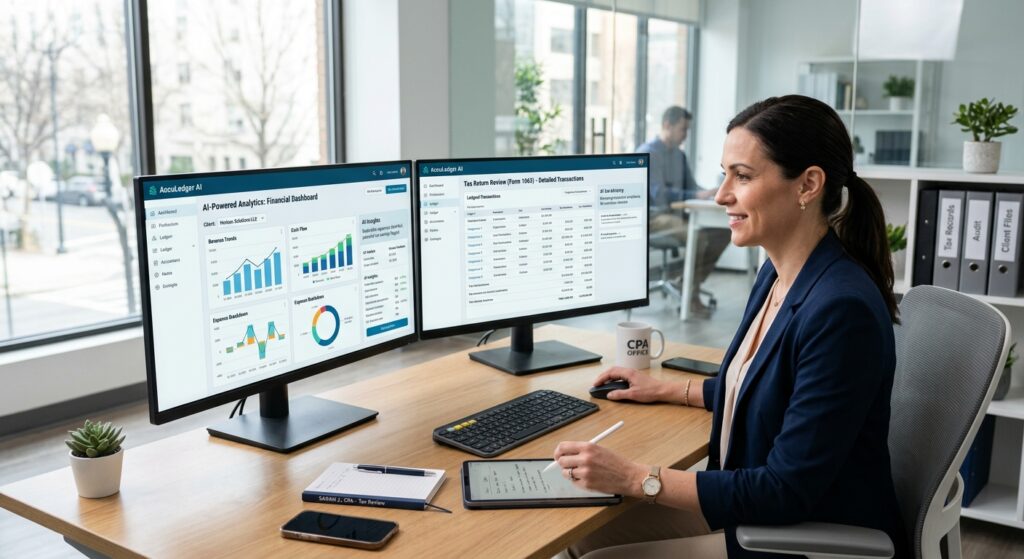
AI Bookkeeper: 2026 Guide for Tax Professionals
The AI bookkeeper revolution is transforming how tax professionals serve clients in 2026. With generalist AI models achieving only 77.3% accuracy in accounting workflows, domain-specific solutions are becoming essential for CPAs, enrolled agents, and tax firm owners navigating this technological shift.
Table of Contents
- Key Takeaways
- What Is an AI Bookkeeper and How Does It Work?
- What Are the Accuracy Limitations of AI Bookkeeping Tools?
- How Should Tax Professionals Adopt AI Bookkeeper Technology?
- Why Do Domain-Specific AI Solutions Outperform Generalist Models?
- What Implementation Challenges Do Tax Firms Face?
- When Does Human Expertise Remain Essential?
- Uncle Kam in Action: CPA Firm Saves 420 Hours With Strategic AI Integration
- Next Steps
- Frequently Asked Questions
- Related Resources
Key Takeaways
- Generalist AI models achieve only 77.3% accuracy in structured accounting tasks for 2026
- 67% of tax professionals report technology investment enabled more proactive strategic work
- Domain-specific AI bookkeeper tools require validation mechanisms to prevent cascading errors
- Human expertise remains critical for context, compliance, and strategic tax planning decisions
- Privacy concerns prevent 40% of Americans from entering financial data into AI systems
What Is an AI Bookkeeper and How Does It Work?
Quick Answer: An AI bookkeeper is specialized software that automates financial record-keeping tasks. It uses machine learning to classify transactions, reconcile accounts, and prepare tax documentation. For 2026, these tools range from generalist chatbots to purpose-built accounting platforms.
The AI bookkeeper landscape has evolved significantly for the 2026 tax season. According to the Thomson Reuters Institute’s 2026 Corporate Tax Department Technology Report, automation of routine tax functions is enabling a fundamental shift toward more strategic work. However, this transformation comes with critical limitations that tax professionals must understand.
Core Functions of AI Bookkeeping Systems
Modern AI bookkeeper tools perform several critical functions for tax practices. These systems automatically categorize transactions by reading W-2s, 1099s, receipts, and bank statements. They map this financial data into relevant tax forms, reducing the time-intensive manual work that has traditionally consumed tax season.
Advanced platforms like Xero are moving from AI as a feature to AI as the core engine. As reported in Accounting Today, these systems now provide auto bank reconciliation and real-time financial insights as seamless workflow components rather than add-on features.
How AI Bookkeepers Process Tax Data
The technology relies on what industry leaders call “decisioned data”—a series of high-stakes decisions that build on each other. For instance, reconciling a transaction leads to closing books, which then enables accurate tax filing. This interconnected decision chain requires context graphs that understand financial ledgers line by line.
For the 2026 tax year, practitioners must understand that AI systems operate differently than human accountants. They excel at pattern recognition and repetitive tasks. However, they struggle with nuanced situations requiring judgment calls about deductibility, classification, or strategic timing.
Pro Tip: When evaluating AI bookkeeper solutions for your practice, prioritize platforms with built-in audit trails and validation mechanisms. These controls prevent errors from cascading through financial reporting and tax returns.
What Are the Accuracy Limitations of AI Bookkeeping Tools?
Quick Answer: DualEntry’s 2026 benchmark testing found generalist AI models achieve maximum 77.3% accuracy in accounting workflows. Domain-specific solutions perform better due to specialized training on financial datasets and integration with accounting standards.
The accuracy gap presents the most significant challenge for tax professionals considering AI bookkeeper adoption. According to comprehensive testing by DualEntry, even the most advanced generalist AI models plateau at 77.3% accuracy for structured accounting tasks.
The 2026 Benchmark Study Results
DualEntry tested 19 different generalist AI models across 101 accounting workflows. These workflows represent core functions including transaction classification, journal entry creation, accounts payable and receivable, bank reconciliation, financial reporting, and month-end close processes.
The results reveal critical performance gaps. While models scored well on knowledge recall (discussing GAAP principles), they failed dramatically when creating structured records. This distinction matters enormously for tax professionals because bookkeeping requires precise journal entries, not theoretical discussions.
| AI Model Category | Accuracy Rate | Primary Limitation |
|---|---|---|
| Generalist AI (ChatGPT 5.4) | 77.3% | Lack of domain context, limited external data access |
| Generalist AI (Gemini 3.1 Pro) | 66.0% | Trained on broad internet data vs accounting standards |
| Domain-Specific Systems | 85%+ | Requires system-level controls and validation |
Why Accuracy Matters for Tax Compliance
The stakes for accuracy in tax work far exceed those in many other fields. A 77% accuracy rate means roughly one in four accounting transactions contains an error. For tax professionals serving business owners who depend on precise financial records, this error rate creates unacceptable compliance risk.
Santiago Nestares, co-founder of DualEntry, explained the fundamental issue: “Finance doesn’t run on drafts; it runs on validated records.” Without system-level controls and validation, AI-generated errors cascade through financial reporting, potentially triggering IRS audits or penalties.
For the 2026 tax year, practitioners must implement validation checkpoints. Every AI-generated entry should undergo review before posting to the general ledger. This human-in-the-loop approach combines AI efficiency with professional judgment.
Understanding Context Limitations
Generalist AI models struggle with accounting accuracy for three fundamental reasons. First, they lack domain context because they’re trained on broad internet data rather than deep exposure to accounting standards and workflows. Second, they have limited access to external tools like specialized databases and calculators that accounting professionals routinely use. Third, they cannot apply the nuanced judgment required for edge cases and unusual transactions.
Domain-specific AI bookkeeper systems address these gaps through fine-tuning on financial datasets and real accounting scenarios. However, even these specialized tools require professional oversight to ensure compliance with evolving IRS regulations and the complexities introduced by legislation like the One Big Beautiful Bill Act.
How Should Tax Professionals Adopt AI Bookkeeper Technology?
Quick Answer: Start with low-risk data sorting and error detection tasks. Gradually expand to transaction categorization while maintaining human review of all financial records. Prioritize platforms with audit trails and integration capabilities with your existing tax software.
The 2026 Corporate Tax Department Technology Report reveals that 67% of tax professionals who received technology investment successfully shifted toward more proactive work. However, the report also documents a growing “frustration gap” between what professionals want to achieve and what their current tools allow.
Phase 1: Data Sorting and Transaction Categorization
Begin AI bookkeeper adoption with straightforward categorization tasks. Train AI systems to read standard documents like W-2s, 1099s, and bank statements. These documents follow consistent formats, making them ideal for AI processing.
For example, a solo practitioner can implement AI to sort client receipts by category (meals, travel, office supplies). The AI classifies each receipt, but the practitioner reviews classifications before finalizing entries. This approach captures time savings while maintaining accuracy.
Phase 2: Error Detection and Anomaly Identification
Once comfortable with basic categorization, expand AI use to error detection. Modern AI bookkeeper platforms excel at identifying anomalies in financial data. They flag duplicate entries, unusual amounts, and transactions that deviate from historical patterns.
This capability proves particularly valuable for tax professionals serving clients who prepare their own preliminary returns. The AI reviews client-prepared returns, identifies discrepancies, and surfaces them for professional review before filing.
Phase 3: Automated Reconciliation With Oversight
The most advanced application involves automated bank reconciliation. Systems like those offered by Xero now provide automatic reconciliation as a core workflow tool. However, professionals must establish confidence thresholds determining when AI can act autonomously versus when it must flag items for review.
Campfire’s Ember Agents exemplify this approach. Their AI workers handle recurring tasks like transaction matching and AP/AR processing. Users control exactly how much autonomy the AI has by setting confidence thresholds. Below the threshold, the AI surfaces findings for human review before posting.
Pro Tip: For the 2026 tax season, establish written policies documenting which tasks AI handles autonomously versus which require professional review. This documentation protects you in potential IRS inquiries and malpractice situations.
Training and Change Management
Successful AI bookkeeper adoption requires more than software installation. According to industry research, organizations that invest in proper training and change management achieve significantly better outcomes. Staff must understand both the capabilities and limitations of AI tools.
Create a training program covering three areas. First, technical operation of the AI platform. Second, understanding of accuracy limitations and when to escalate to human review. Third, ethical considerations around client data privacy and professional responsibility.
Why Do Domain-Specific AI Solutions Outperform Generalist Models?
Quick Answer: Domain-specific AI bookkeeper tools are fine-tuned on accounting datasets and integrate with financial databases. They understand accounting standards and tax regulations that generalist models lack. This specialized training improves accuracy from 77% to 85%+.
The distinction between generalist and domain-specific AI matters enormously for tax professionals. While tools like ChatGPT can discuss tax concepts, they cannot reliably create the structured financial records that underpin tax returns and compliance.
Context Graphs and Decisioned Data
Xero’s chief product officer Diya Jolly explained their approach in a March 2026 interview: “Small business accounting isn’t a place where you can ‘hallucinate’ or guess. It’s built on decisioned data—a series of high-stakes decisions that build on each other.”
Domain-specific platforms build context graphs that understand how each transaction relates to others. For instance, when processing a business meal expense, the system knows to check whether it exceeds 50% deductibility limits for the 2026 tax year, whether it requires additional documentation under IRS Publication 463, and how it impacts quarterly estimated payments.
Integration With Tax Compliance Systems
Purpose-built AI bookkeeper platforms integrate directly with tax preparation software and compliance databases. This integration enables real-time validation against current tax law. For 2026, this means automatic incorporation of One Big Beautiful Bill Act provisions including the expanded SALT deduction cap of $40,000 and the new tips deduction of up to $25,000.
Generalist AI models cannot access these specialized databases. They rely solely on training data, which may be outdated or incomplete regarding recent legislative changes. This gap creates significant compliance risk for tax professionals relying on generalist tools.
Validation Mechanisms and Audit Trails
Domain-specific solutions incorporate built-in validation mechanisms. They cross-reference entries against accounting standards, flag inconsistencies, and maintain detailed audit trails showing how AI reached each decision. These features prove essential for both error prevention and professional liability protection.
When an AI bookkeeper categorizes a transaction, domain-specific systems document the reasoning. This transparency allows professionals to verify the logic, correct misclassifications, and demonstrate due diligence if questions arise during IRS examinations.
| Feature | Generalist AI | Domain-Specific AI Bookkeeper |
|---|---|---|
| Training Data | Broad internet content | Financial datasets, accounting standards, tax regulations |
| Tax Law Updates | Delayed or absent | Real-time integration with IRS databases |
| Validation | Limited or none | Multi-layer validation against GAAP and tax standards |
| Audit Trail | Not designed for compliance | Comprehensive documentation for IRS defense |
| Accuracy Rate | 77.3% (2026 benchmark) | 85%+ with proper configuration |
What Implementation Challenges Do Tax Firms Face?
 Free Tax Write-Off Finder
Quick Answer: Tax firms encounter four main challenges: organizational resistance to change, integration with legacy systems, staff training requirements, and client data privacy concerns. The 2026 report shows upgrading tax technology remains low priority despite demonstrated benefits.
The path to AI bookkeeper adoption is rarely smooth. The 2026 Thomson Reuters study documented a growing frustration gap between what tax professionals want to achieve technologically and what their organizations actually support.
Organizational Resistance and Budget Constraints
Despite 67% of surveyed professionals reporting positive results from technology investment, most organizations still treat tax tech upgrades as low priority. This disconnect creates what researchers call the “frustration gap”—professionals see the potential but cannot secure necessary resources.
Budget constraints particularly affect smaller firms. While large corporations invest generously in tax technology, solo practitioners and regional firms struggle to justify the upfront costs. They face the classic innovator’s dilemma: invest now in uncertain returns or continue with proven manual methods.
Legacy System Integration Issues
Most tax practices operate with multiple disconnected systems. Client data lives in one platform, time tracking in another, documents in a third. Adding AI bookkeeper functionality often requires replacing these systems entirely or building complex integration layers.
As consultancy experts warned in 2026, “If you automate a mess, you just get a faster mess.” Firms cannot simply overlay AI onto broken processes. They must first standardize workflows, clean data, and establish governance structures before AI can deliver value.
Client Privacy and Data Security Concerns
Survey data from 2026 reveals that 40% of Americans refuse to enter personal or financial information into AI systems due to privacy fears. This client resistance complicates AI adoption for tax professionals serving self-employed individuals and small businesses.
Practitioners must address these concerns proactively. Develop clear privacy policies explaining how AI processes client data, where information is stored, and what safeguards prevent unauthorized access. Transparency builds trust and enables adoption.
Staff Training and Workflow Disruption
Implementing AI bookkeeper tools temporarily reduces productivity as staff learn new systems. The IRS’s own experience implementing technology for the 2026 filing season illustrates this challenge. According to the Government Accountability Office, understaffed and undertrained functions led to processing errors and poor customer service.
Plan for a 3-6 month learning curve. During this period, maintain parallel processes using both old and new systems. This redundancy prevents client service disruptions while staff build competency with AI tools.
When Does Human Expertise Remain Essential?
Quick Answer: Human expertise is essential for strategic tax planning, compliance judgment calls, client advisory relationships, and situations requiring professional skepticism. AI bookkeeper tools excel at data processing but cannot replace the contextual understanding tax professionals provide.
The question isn’t whether AI will replace tax professionals. The answer is clearly no. Instead, the question is how the role evolves as AI handles routine bookkeeping tasks.
Strategic Tax Planning and Advisory Work
AI bookkeeper systems are reactive, not proactive. They process transactions after they occur but cannot develop strategies minimizing long-term tax liability. This limitation preserves the core advisory function of tax professionals.
For instance, advising a client on optimal entity structure requires understanding their business goals, risk tolerance, and growth projections. Should they remain a sole proprietorship? Elect S Corp status? These decisions involve trade-offs between compliance burden and tax savings that AI cannot evaluate without human context.
Complex Compliance Situations
Tax law complexity continues growing. The One Big Beautiful Bill Act alone introduced numerous provisions requiring professional judgment. Consider the new senior deduction of $6,000 for taxpayers 65 and older. The deduction phases out starting at $75,000 modified adjusted gross income for singles and $150,000 for joint filers.
An AI bookkeeper might correctly calculate the phase-out. However, it cannot advise clients on timing strategies to stay below thresholds or coordinate with other planning opportunities. These multi-dimensional decisions require human expertise synthesizing multiple tax code sections.
Client Relationship and Trust Building
Tax work is fundamentally a relationship business. Clients hire professionals not just for technical knowledge but for trusted guidance during financial stress. AI cannot provide the empathy, reassurance, and personalized attention that cements long-term client relationships.
As Xero’s strategy emphasizes, the most effective model pairs AI handling routine heavy lifting with advisors providing essential human context. This “accountable intelligence” approach leverages technology while preserving the irreplaceable human elements of professional service.
Professional Skepticism and Error Detection
Tax professionals develop intuition through years of practice. They recognize red flags: unusual deductions, inconsistent income reporting, transactions lacking business purpose. This professional skepticism catches errors and prevents fraud that AI systems miss.
For the 2026 tax year, this human oversight proves especially valuable. With IRS staffing reduced by approximately 26,100 employees in 2025, enforcement activities have shifted toward data analytics. Professionals must ensure client returns withstand algorithmic scrutiny while remaining defensible under examination.
Pro Tip: Position AI adoption to clients as enhancing service quality rather than reducing costs. Explain that AI handles data entry while you focus on strategic planning that saves them more money than your fee.

Uncle Kam in Action: CPA Firm Saves 420 Hours With Strategic AI Integration
Harrison Tax Partners, a mid-sized CPA firm in Arizona serving 180 small business clients, faced the classic tax season crunch. Their team of five preparers worked 70-hour weeks during peak season, struggling to handle routine bookkeeping while providing strategic advice clients valued.
The Challenge: Managing partner Jennifer Harrison estimated her team spent 60% of billable time on data entry and transaction categorization—tasks offering minimal value to clients. Meanwhile, strategic planning opportunities went unexplored because staff lacked bandwidth.
The Uncle Kam Solution: We implemented a phased AI bookkeeper adoption strategy integrated with comprehensive tax planning. Phase 1 deployed domain-specific AI for transaction categorization and bank reconciliation. We established validation protocols ensuring 100% human review before posting. Phase 2 introduced automated error detection scanning client-provided data before professional review. Phase 3 developed strategic planning workflows leveraging time savings from automation.
The Results:
- Time Savings: 420 hours reclaimed during the 2026 tax season through automated data processing
- Client Tax Savings: Strategic planning identified $186,000 in additional deductions across the client base
- Investment: $18,500 in AI platform costs plus $12,000 Uncle Kam consulting fee
- Return on Investment: 510% first-year ROI based on billable hours recaptured and client retention from improved service
Harrison reflected on the transformation: “AI didn’t replace our expertise—it amplified it. We now spend time on work that actually requires our professional judgment. Client satisfaction scores increased because we’re proactive advisors instead of reactive data processors.”
The firm also avoided hiring an additional preparer they had budgeted for, saving approximately $65,000 in annual salary and benefits. More importantly, they repositioned themselves as strategic advisors rather than compliance providers, enabling premium pricing on advisory services.
Discover how Uncle Kam helps tax professionals leverage technology without compromising service quality. Visit our client results page to see more transformation stories.
Next Steps
Ready to evaluate AI bookkeeper solutions for your tax practice? Take these concrete actions:
- Audit your current workflow to identify high-volume, low-complexity tasks suitable for AI automation
- Request demos from domain-specific platforms emphasizing validation mechanisms and audit trail capabilities
- Develop written policies defining which tasks AI handles versus which require professional oversight
- Create client communication materials explaining privacy protections and how AI enhances service quality
- Schedule a strategic planning consultation to explore how AI integration fits your practice growth goals
Frequently Asked Questions
Can AI bookkeeper tools file complete tax returns without human review?
No, not for 2026. While AI can prepare draft returns, professional review remains essential. Accuracy rates top out at 77.3% for generalist models and 85%+ for specialized tools. Tax law complexity requires human judgment on classification, timing, and compliance issues. The IRS holds practitioners responsible for return accuracy regardless of technology used.
How do privacy concerns affect AI adoption in tax practices?
Privacy concerns create significant adoption barriers. 2026 surveys show 40% of Americans refuse to enter financial data into AI systems. Tax professionals must implement robust data protection policies, use encrypted platforms, and maintain transparency about AI processing. Client education proving AI enhances security rather than compromising it helps overcome resistance.
What is the realistic timeline for AI bookkeeper implementation?
Plan for 3-6 months from selection to full deployment. Month 1-2 involves vendor evaluation and platform selection. Month 3-4 covers staff training and parallel processing. Month 5-6 transitions to full AI operation with human oversight. Rushing implementation creates errors and staff resistance. Gradual adoption ensures quality maintenance throughout the transition.
Will the IRS accept AI-prepared returns?
Yes, with proper professional oversight. The IRS does not distinguish between AI-assisted and manually prepared returns. However, the practitioner of record bears full responsibility for accuracy and compliance. Maintain documentation showing validation procedures, human review checkpoints, and professional judgment applied. This documentation protects you during examinations.
How do domain-specific AI bookkeepers handle 2026 tax law changes?
Quality platforms integrate with IRS databases for real-time updates. For 2026, this includes automatic incorporation of OBBBA provisions like the $40,000 SALT cap, senior deduction phase-outs, and tips deduction limits. Generalist AI relies on training data often lacking recent changes. Always verify AI incorporates current law before relying on its output.
What cost savings can tax firms expect from AI automation?
Savings vary based on current efficiency and implementation quality. Successful adopters report 20-40% reduction in data processing time. For a 5-person firm, this translates to 300-500 hours recaptured during tax season. However, savings come from redeploying staff to higher-value work rather than reducing headcount. Firms using AI for strategic advisory expansion see strongest financial returns.
Should small solo practitioners invest in AI bookkeeper technology?
Yes, if they handle sufficient transaction volume. Solo practitioners processing 50+ business returns annually benefit from transaction categorization automation. Start with affordable platforms offering monthly subscriptions rather than enterprise solutions. Focus on tools with strong support and intuitive interfaces minimizing training time. The competitive advantage from increased capacity often justifies the investment.
How does AI impact professional liability and E&O insurance?
Professional liability remains unchanged—you’re responsible for all work product regardless of technology used. Inform your E&O carrier about AI adoption as some policies require disclosure. Document your validation procedures thoroughly. This documentation demonstrates reasonable care if errors occur. Some carriers offer premium discounts for practices with robust quality control including AI oversight protocols.
Related Resources
- Tax Preparation and Filing Services for Modern Practices
- Business Solutions: Automation and Financial Systems Integration
- The MERNA Method: Strategic Tax Planning Framework
- Tax Strategy Blog: Latest Technology and Planning Insights
Last updated: March, 2026
This information is current as of 3/19/2026. Tax laws and technology capabilities change frequently. Verify updates with the IRS or technology vendors if reading this later.

