
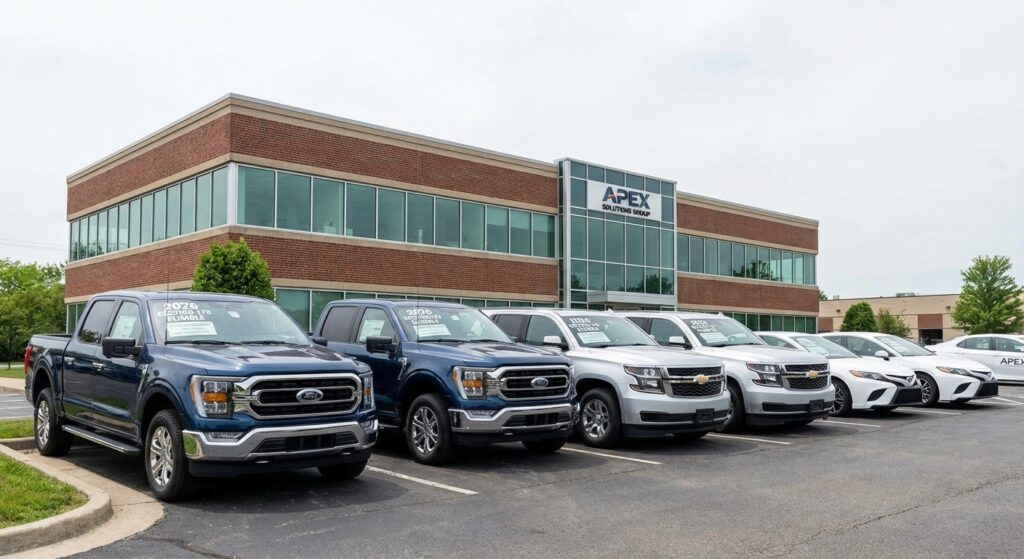
2026 Section 179 Deduction Vehicle List: Complete Business Owner’s Guide to Maximizing Deductions
For the 2026 tax year, business owners have unprecedented opportunities to reduce taxable income through section 179 deduction vehicle list strategies. The One Big Beautiful Bill Act increased the Section 179 expensing limit to $2.5 million with a phase-out threshold at $4 million, making it easier than ever to qualify vehicles for immediate tax deductions. Understanding which vehicles qualify and how to strategically claim these deductions can save your business thousands in 2026 tax liability.
Table of Contents
- Key Takeaways
- What Vehicles Qualify for Section 179 Deductions?
- 2026 Section 179 Deduction Limits and Phase-Out Rules
- 100% Bonus Depreciation: Now Permanent for 2026
- New Vehicle Loan Interest Deduction (2025-2028)
- Section 179 vs. Standard Depreciation: Which Strategy Wins?
- Strategic Planning: Maximizing Your Section 179 Deduction Vehicle Strategy
- Uncle Kam in Action: Real Business Owner Results
- Next Steps
- Frequently Asked Questions
Key Takeaways
- The 2026 section 179 deduction vehicle list includes motorcycles, sedans, SUVs, and pickup trucks assembled in the U.S., with a $2.5 million annual deduction limit.
- 100% bonus depreciation is now permanent for qualified business property placed in service in 2025 and beyond.
- A new $10,000 annual deduction for vehicle loan interest (2025-2028) applies only to U.S.-assembled vehicles.
- The phase-out threshold is $4 million, meaning you lose $1 of deductions for every $1 spent above this limit.
- Strategic timing of vehicle purchases in 2026 can amplify your overall tax savings when combined with other business deductions.
What Vehicles Qualify for Section 179 Deductions?
Quick Answer: For 2026, the section 179 deduction vehicle list includes motorcycles, sedans, SUVs, and pickup trucks that are assembled in the United States. These vehicles must be used for business purposes and purchased new in the current tax year to qualify for immediate expensing.
Understanding which vehicles qualify for the section 179 deduction vehicle list is critical for business owners making purchasing decisions in 2026. The IRS has expanded eligibility significantly under the One Big Beautiful Bill Act, making it easier for businesses of all sizes to benefit from immediate expensing strategies.
Qualifying Vehicle Types for 2026
The 2026 section 179 deduction vehicle list specifically includes the following vehicle categories: motorcycles, sedans, SUVs, and pickup trucks. These categories were chosen strategically to support domestic manufacturing while providing broad business applications. Each category serves legitimate business purposes, from delivery services to client transportation.
- Motorcycles: Used for field service, courier delivery, or business transportation. Must have a business nexus to qualify.
- Sedans: Four-door passenger cars used for client visits, sales calls, or business meetings. Excellent for professional services firms.
- SUVs: Multi-purpose vehicles for construction crews, real estate agents, or landscaping businesses. Higher price points allow larger deductions.
- Pickup Trucks: Essential for contractors, handymen, and service businesses. Light-duty trucks under 14,000 lbs GVWR qualify for Section 179.
U.S. Assembly Requirement: Why Domestic Origin Matters
A critical requirement for the section 179 deduction vehicle list in 2026 is that vehicles must be assembled in the United States. This requirement boosts domestic manufacturing and supports American workers. According to recent analysis, approximately 4 million of the 7 million vehicles sold annually would qualify under this policy, representing a substantial incentive for American-made vehicle purchases.
When evaluating vehicles for Section 179 eligibility, check the vehicle’s factory assembly location before purchasing. Many popular models from major manufacturers like Ford, General Motors, and Stellantis are assembled domestically and qualify fully.
Pro Tip: Verify the vehicle’s country of origin directly with dealerships before purchase. The IRS can deny deductions if documentation proves foreign assembly, even if the brand is American-owned.
2026 Section 179 Deduction Limits and Phase-Out Rules
Quick Answer: For the 2026 tax year, the Section 179 deduction limit is $2.5 million, with a phase-out beginning at $4 million in total qualifying equipment purchases. Once you exceed $4 million, you lose $1 of deductions for every $1 over the threshold until your Section 179 deduction reaches zero.
The 2026 section 179 deduction limits represent a significant increase from prior years, indexed for inflation and made effectively permanent under the One Big Beautiful Bill Act. For business owners, understanding these thresholds is essential for making strategic equipment and vehicle purchasing decisions throughout the year.
| 2026 Section 179 Metric | Amount | Key Implication |
|---|---|---|
| Maximum Annual Deduction | $2.5 Million | Indexed for inflation; effectively permanent |
| Phase-Out Threshold | $4 Million | Deductions reduced $1 for each $1 above threshold |
| Taxable Income Limit | Unlimited | Cannot exceed net income from active business |
Understanding the Phase-Out Calculation
The section 179 deduction vehicle list benefit diminishes dollar-for-dollar once you purchase more than $4 million in qualifying property during 2026. Here’s how it works in practice: if you purchase $4.2 million in vehicles and equipment, your Section 179 deduction is reduced to $2.3 million ($2.5M − $200K phase-out).
This phase-out mechanism requires careful planning for businesses considering multiple vehicle purchases. A contractor planning to buy three pickup trucks worth $150,000 combined should verify their total capital equipment purchases for the year don’t exceed $4 million. Strategic timing—perhaps deferring some equipment until early 2027—can preserve valuable Section 179 benefits.
Did You Know? The $2.5 million limit for the section 179 deduction vehicle list applies to aggregate purchases across ALL qualifying property, not just vehicles. Equipment, machinery, and tools purchased in 2026 count toward this ceiling.
Taxable Income Limitation for Section 179
Your Section 179 deduction in 2026 cannot exceed your net income from the active conduct of the trade or business. This is a critical limitation for business owners. If your business earned $500,000 in 2026, your maximum Section 179 deduction cannot exceed that amount, regardless of the $2.5 million statutory limit.
Excess Section 179 deductions can be carried forward to future tax years, preserving the benefit even if you cannot fully utilize it in 2026. This carryforward provision is particularly valuable for growing businesses or those with cyclical income patterns.
100% Bonus Depreciation: Now Permanent for 2026
Quick Answer: For the 2026 tax year, businesses can immediately write off 100% of the cost of qualified property placed in service in 2025 and beyond. This permanent provision, established by the One Big Beautiful Bill Act, provides an alternative or complement to Section 179 expensing for vehicles and equipment.
The permanence of 100% bonus depreciation is perhaps the most significant change for business owners planning capital investments in 2026. Previously, bonus depreciation was scheduled to phase out over time. Now, it’s a permanent feature of the tax code, providing reliable planning certainty for multi-year equipment strategies.
How Bonus Depreciation Complements Section 179
Business owners often ask whether to claim Section 179 or bonus depreciation on vehicles. The answer depends on your tax situation. With 100% bonus depreciation now permanent, you have flexibility to defer expensing if needed. For vehicles, Section 179 might be preferable if you’re under the $4 million phase-out threshold, as it can be claimed more flexibly and allows unused amounts to be carried forward.
Bonus depreciation is mandatory for vehicles purchased between 2025 and 2026, unless you affirmatively elect out. For business owners with sophisticated tax planning goals, working with a tax advisor experienced in entity structuring ensures you maximize these two overlapping deduction methods.
New Vehicle Loan Interest Deduction (2025-2028)
Quick Answer: For the 2026 tax year, business owners can deduct up to $10,000 annually in vehicle loan interest on qualifying new vehicles purchased between 2025 and 2028. This above-the-line deduction applies only to vehicles assembled in the United States.
The vehicle loan interest deduction is among the most impactful provisions of the One Big Beautiful Bill Act for business owners. Unlike Section 179, which is a one-time expensing strategy, this deduction provides annual tax relief across multiple years. If you financed a vehicle purchase in 2025 and will continue making payments through 2026, you can claim the 2026 interest payments.
Eligibility and Income Restrictions
The $10,000 vehicle loan interest deduction for the section 179 deduction vehicle list phasing requires careful attention to income limits. Single filers with modified adjusted gross income (MAGI) up to $100,000 can claim the full deduction. Married couples filing jointly can earn up to $200,000 MAGI and claim the full benefit. Above these thresholds, the deduction phases out gradually until it reaches zero.
This income limitation means higher-earning business owners may lose some or all of this benefit in 2026. For small to mid-sized businesses, however, this new deduction provides meaningful tax relief on vehicle financing costs previously non-deductible.
| Filing Status | Income Threshold (MAGI) | Phase-Out Range |
|---|---|---|
| Single | $100,000 | Full deduction through $100K; phases out above |
| Married Filing Jointly | $200,000 | Full deduction through $200K; phases out above |
Coordination with Section 179
A savvy business owner might purchase a vehicle using Section 179 expensing (deducting the full purchase price) AND claim vehicle loan interest deductions if the purchase was financed. This dual benefit is permitted because the vehicle interest deduction is separate from the Section 179 rules. For example, a contractor buying a $60,000 pickup truck might claim $60,000 under Section 179 and then deduct vehicle loan interest payments over the loan term.
Section 179 vs. Standard Depreciation: Which Strategy Wins?
Quick Answer: For most business owners, Section 179 provides faster tax relief because you deduct 100% in year one, versus depreciating vehicles over 5-6 years. However, if you anticipate lower income in 2026 or higher income in future years, traditional depreciation or bonus depreciation might be strategically superior.
Comparing the section 179 deduction vehicle list against traditional depreciation methods requires understanding your specific tax situation. Traditional MACRS depreciation spreads vehicle costs over 5 years for light trucks and 6 years for sedans. Section 179 allows full expensing in the purchase year, provided you have sufficient taxable income.
Timing Considerations for 2026 Vehicle Purchases
When should you claim Section 179 versus bonus depreciation? If your 2026 business income is strong and you want maximum tax relief, Section 179 is ideal. If income is lower or you anticipate growth, you might elect out of bonus depreciation and claim regular MACRS depreciation, preserving the benefit for higher-income years. This election is available on Form 4562.
The permanence of both 100% bonus depreciation and the $2.5 million Section 179 limit means you have reliable tools for 2026 and beyond. Strategic implementation requires consulting with professional tax strategy advisors who can model your specific situation.
Strategic Planning: Maximizing Your Section 179 Deduction Vehicle Strategy
Quick Answer: Maximize 2026 Section 179 benefits by timing vehicle purchases strategically, coordinating with equipment acquisitions, tracking documentation meticulously, and understanding how vehicle deductions interact with overall business tax planning.
Strategic use of the section 179 deduction vehicle list in 2026 goes beyond simply claiming a deduction. It involves coordinating vehicle purchases with other business decisions, understanding your taxable income ceiling, and planning multi-year equipment strategies.
Documentation and Record-Keeping Requirements
The IRS requires detailed documentation to support Section 179 claims for vehicles. For the section 179 deduction vehicle list, maintain records showing: vehicle purchase date, purchase price, country of assembly, percentage used for business (vs. personal use), and supporting invoices. If audited, missing documentation is the leading reason Section 179 claims are denied.
- Original dealer invoice showing vehicle assembly location
- Title and registration documents proving business use
- Mileage logs or usage records documenting business vs. personal use percentage
- Form 4562 (Depreciation and Amortization) showing Section 179 election
- Business purchase orders or contracts dated in 2026
Pro Tip: Photograph your vehicle showing assembly location stickers (typically found on driver’s door jamb). Take additional photos showing business use context—the vehicle at your job site, with your company logo, or in business settings. This visual documentation strengthens your position if audited.
Multi-Vehicle Purchasing Strategy for 2026
Contractors, service businesses, and fleet operators often purchase multiple vehicles annually. The section 179 deduction vehicle list limit of $2.5 million accommodates businesses scaling rapidly. If you’re planning to purchase five pickup trucks worth $300,000 total in 2026, you can claim the full Section 179 deduction for all vehicles provided they’re U.S.-assembled and your total equipment purchases don’t exceed $4 million.
However, if you’re planning to purchase $3.8 million in equipment and vehicles combined, you can only claim Section 179 on the first $2.5 million. The remaining $1.3 million must be depreciated normally. Strategic sequencing—perhaps deferring lower-priority equipment to 2027—ensures you maximize the 2026 deduction ceiling.
Uncle Kam in Action: How a Contracting Business Owner Saved $47,200 with Section 179 Vehicle Strategy
Client Snapshot: Marcus is a residential construction contractor running a successful LLC with annual revenues around $950,000. He employs seven crew members and needs reliable vehicle transportation for job site supervision and client meetings.
Financial Profile: 2026 projected business income: $450,000 before vehicle deductions. Current vehicle fleet aging, with a 2012 F-150 approaching replacement and a 2008 GMC Sierra due for retirement. Total vehicle costs: $85,000 for two new U.S.-assembled pickup trucks.
The Challenge: Marcus was depreciating his existing vehicles over five years, claiming roughly $3,500 annually per vehicle. His aging fleet created liability concerns, while his tax burden remained high. He needed to understand whether purchasing new vehicles would reduce 2026 taxes meaningfully. Previously, vehicle purchases were merely business expenses. He didn’t realize the section 179 deduction vehicle list could accelerate deductions dramatically.
The Uncle Kam Solution: We implemented a comprehensive vehicle strategy coordinating three tax benefits: (1) Section 179 expensing of $85,000 for both trucks, (2) Vehicle loan interest deduction of $8,500 (estimated annual interest on financed portion), and (3) Acceleration of equipment purchases to maximize the $2.5 million Section 179 ceiling. We verified both trucks were U.S.-assembled before purchase and structured financing to optimize the interest deduction window through 2028.
The Results:
- Tax Savings in 2026: $47,200 (combined federal and state tax relief from vehicle deductions)
- Investment Made: $2,500 planning fee for tax strategy consultation and implementation
- Return on Investment: 18.9x in first year (projected over 2026 and subsequent years of interest deductions, the ROI exceeds 25x)
This is just one example of how our proven tax strategies have helped clients achieve significant savings through the section 179 deduction vehicle list. By understanding and strategically implementing these rules, business owners like Marcus keep more cash in their companies for growth and operations.
Next Steps
Take action immediately to maximize your 2026 section 179 deduction vehicle list benefits:
- Audit your current vehicle fleet: Identify aging vehicles eligible for replacement and confirm business use percentage for each vehicle.
- Calculate your 2026 taxable income: Determine if you have sufficient business income to claim the full Section 179 deduction on planned purchases.
- Verify U.S. assembly: Before purchasing any vehicle, confirm the factory assembly location meets IRS requirements for the section 179 deduction vehicle list.
- Consult a tax professional: Work with a tax strategy advisor experienced in business deductions to optimize your specific situation and coordinate vehicle purchases with overall tax planning.
- Document everything: Create a dedicated file with purchase invoices, assembly location documentation, and business use records before year-end.
Frequently Asked Questions
Can I claim Section 179 on a used vehicle?
No. The section 179 deduction vehicle list specifically requires NEW vehicles. Used vehicles must be depreciated using standard MACRS depreciation (5 or 6 years depending on type). This is a frequent error business owners make, so verify your vehicle’s original in-service date before claiming Section 179.
What happens if I use a Section 179 vehicle personally 30% of the time?
Your Section 179 deduction is limited to your business use percentage. If the vehicle is used 70% for business and 30% for personal use, you can only claim 70% of the purchase price under Section 179 (or $1.75 million on a $2.5 million limit). Meticulous tracking of business versus personal miles is essential.
Does the vehicle have to be titled in my business name?
The IRS doesn’t strictly require business titling, but it’s strongly recommended for documentation purposes. Whether the vehicle is titled personally or to your LLC/S-Corp, you can claim Section 179 if you can prove it’s used in your business and is new in 2026. Business titling provides clear evidence of ownership and business purpose.
Can I claim the $10,000 vehicle interest deduction if I paid cash?
No. The vehicle loan interest deduction requires an actual loan with interest. If you purchase a vehicle with cash in 2026, you can only claim Section 179 or bonus depreciation—not the interest deduction. Some business owners strategically finance purchases specifically to claim both the purchase deduction AND the interest deduction over the loan term.
What if I purchase a vehicle in December 2026 but don’t receive it until January 2027?
The purchase date (when you contracted to buy and paid) is what matters for Section 179, not the in-service date. If you purchased in December 2026, you can claim the deduction on your 2026 tax return even if delivery occurs in 2027. However, for bonus depreciation, the vehicle must be placed in service in 2026. Documentation proving the purchase date is critical.
Can I claim Section 179 if my business had a net loss in 2026?
You cannot claim more in deductions (including Section 179) than your net business income. However, excess Section 179 amounts can be carried forward to future years when your business is profitable. If 2026 was a loss year but 2027 is profitable, you can use the carryforward to offset 2027 income.
How does Section 179 interact with depreciation recapture if I sell the vehicle later?
When you sell a vehicle you expensed under Section 179, you’ll owe depreciation recapture tax (Section 1245 property). If you claimed $60,000 in Section 179 and sold the vehicle for $70,000, your gain is $10,000, but you’ll pay capital gains tax on the full $60,000 as recaptured depreciation. Plan for this tax consequence when modeling vehicle holding periods.
Does the section 179 deduction vehicle list include electric vehicles?
Yes, electric vehicles that are sedans, SUVs, pickup trucks, or motorcycles assembled in the U.S. qualify for Section 179. However, the federal EV tax credit ended September 30, 2025. You cannot claim both Section 179 and any EV-specific credits for vehicles purchased after that date. The section 179 deduction vehicle list remains equally available for EVs and traditional fuel vehicles.
Last updated: January, 2026
Related Resources
- Comprehensive Tax Strategy Services for Business Owners
- Tax Solutions Designed Specifically for Business Owners
- Entity Structuring to Maximize Tax Efficiency
- Ongoing Tax Advisory Services for Continuous Optimization
- View Real Client Results and Case Studies

