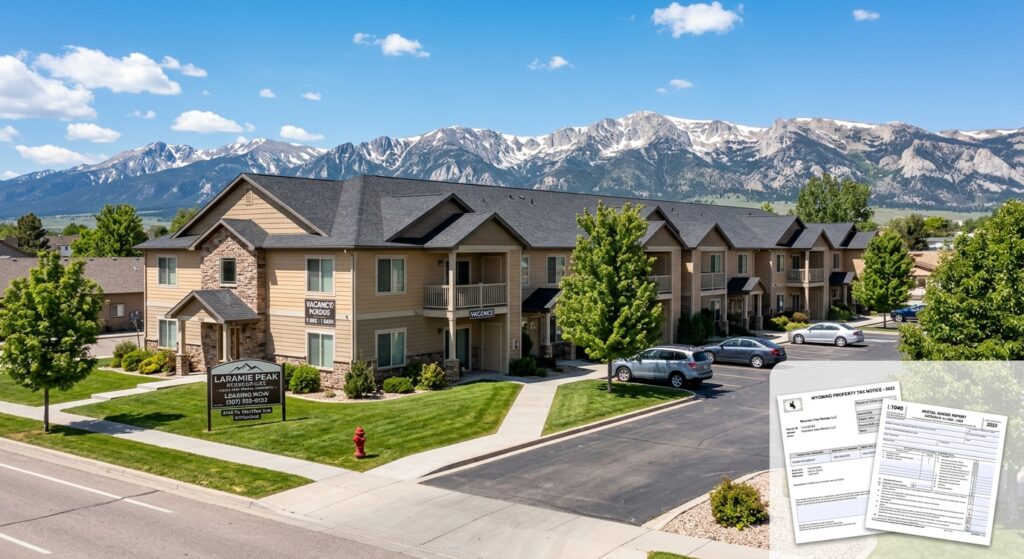
2026 Rental Income Taxes in Laramie: Complete Deduction & Tax Planning Guide for Real Estate Investors
For the 2026 tax year, understanding rental income taxes in Laramie is critical for maximizing your real estate investment returns. Wyoming offers a unique advantage: zero state income tax. This means your rental income is subject only to federal taxation, making Laramie an exceptionally tax-efficient location for property owners. Unlike high-tax states like California or New York where rental income faces both federal and state levies, Wyoming landlords keep more of their hard-earned rental revenue. This guide covers the essential deductions, depreciation strategies, and 2026 tax changes every Laramie rental property owner must know.
Table of Contents
- Key Takeaways
- Wyoming’s No State Income Tax Advantage
- What Are the Key Deductions for Rental Properties in Laramie?
- How Does Depreciation Work for Rental Income?
- What Expenses Can You Deduct From Rental Income?
- How Is Your Rental Income Taxed Federally?
- Uncle Kam in Action: A Laramie Property Owner’s Success Story
- Next Steps
- Frequently Asked Questions
- Related Resources
Key Takeaways
- Wyoming has zero state income tax, making Laramie rental properties more profitable after taxes than properties in most other states.
- Rental property owners can deduct mortgage interest (unlimited for rentals), property taxes, depreciation, repairs, utilities, and property management fees.
- In 2026, the SALT deduction cap increased to $40,000, allowing more homeowners to itemize and increase refunds.
- Federal tax brackets and standard deductions increased for 2026, affecting your overall tax liability on rental income.
- Depreciation is one of the largest deductions available to rental property owners, typically recovered over 27.5 years using MACRS method.
Why Wyoming’s No State Income Tax Is Your Biggest Rental Income Tax Advantage in Laramie
Quick Answer: Wyoming imposes zero state income tax on any type of income, including rental property revenue. This is the single most significant tax advantage for Laramie real estate investors compared to owners in other states.
For the 2026 tax year, one of the greatest benefits of owning rental properties in Laramie is the state’s tax structure. Wyoming has no state income tax whatsoever. This means every dollar of rental income you earn avoids state-level taxation entirely. Compare this to high-tax states like California, which imposes up to 13.3% state income tax, or New York with top rates near 10%. A Laramie landlord earning $100,000 in annual rental income saves approximately $10,000-$13,300 compared to similar property owners in those states, even before considering federal deductions.
How This Translates to Real Tax Savings for Laramie Investors
Let’s examine a concrete scenario. Suppose you own a residential property in Laramie that generates $150,000 in gross rental income annually. After accounting for legitimate business expenses like mortgage interest, property taxes, maintenance, and depreciation, your net taxable rental income might be reduced to $60,000. In 2026, this $60,000 would be taxed at your federal marginal rate (potentially 22% to 24% depending on your total income). However, because you’re in Wyoming, zero of that $60,000 faces state income taxation. In a high-tax state, you might face an additional 10% to 13.3% state tax, costing $6,000 to $7,980 more annually. Over a 10-year rental property ownership period, that’s $60,000 to $79,800 in additional state taxes you’ll never pay by operating in Laramie.
Wyoming’s Tax Advantage Combined With Federal Deductions
The real power emerges when you combine Wyoming’s zero state income tax with aggressive federal deductions. Federal law allows you to deduct virtually all legitimate business expenses. This means that while your property might generate $150,000 in gross rent, your taxable income could legitimately drop to $40,000 to $60,000 after accounting for depreciation, mortgage interest, property taxes, repairs, insurance, and utilities. At the 2026 federal rates, that’s significantly less federal tax than the gross income suggests. Then add the state tax savings, and your effective tax burden becomes remarkably low compared to property owners elsewhere.
What Are the Key Deductions for Rental Properties in Laramie?
Quick Answer: The primary deductions include mortgage interest (unlimited for rentals), property taxes, depreciation, repairs, maintenance, utilities, insurance, property management fees, and advertising costs. For 2026, the SALT cap increased to $40,000, allowing more itemization opportunities.
The 2026 tax year brings important changes to deductions available to rental property owners. The State and Local Tax (SALT) deduction cap, which had been fixed at $10,000, has now increased to $40,000. This is a significant change for Laramie property owners. If you own multiple rental properties with substantial property tax bills, you can now deduct more of those taxes, further reducing your taxable rental income. This increased SALT cap applies through 2030, making this an ideal time to review your deduction strategy.
Mortgage Interest and Property Tax Deductions
For rental properties specifically, mortgage interest is fully deductible with no upper limits. This is distinct from personal residences, where mortgage interest is limited to $750,000 of debt. For your Laramie rental properties, if you have a $500,000 mortgage at 6.5%, you can deduct every dollar of interest paid that year—potentially $32,500 in year one. Property taxes on the rental property are similarly deductible, and with Wyoming’s property tax rates averaging around 0.61% of assessed value, this creates a meaningful deduction. A $300,000 property might generate approximately $1,830 annually in property tax deductions.
Our Small Business Tax Calculator helps real estate investors estimate how these deductions reduce your taxable income for 2026.
Operating Expenses and Maintenance Deductions
Beyond mortgage and property taxes, you can deduct all reasonable operating expenses. This includes property management fees (typically 7-12% of rent collected), utilities you pay if you cover them, property insurance, maintenance and repairs, advertising to find tenants, landscaping, pest control, and snow removal. Laramie winters create legitimate and substantial snow removal expenses—an average single-story home requires approximately $500-$1,500 in annual snow removal costs, all fully deductible. These operating expenses typically reduce a Laramie investor’s taxable rental income by 20-40%.
How Does Depreciation Work for Rental Income Properties in Laramie?
Quick Answer: Depreciation allows you to deduct the cost of your rental building (but not the land) over 27.5 years using the Modified Accelerated Cost Recovery System (MACRS). This is often the largest deduction available, sometimes exceeding your actual cash expenses.
Depreciation is often the most valuable deduction available to rental property owners, yet many Laramie investors underutilize it. The IRS allows you to deduct the cost of your building (not the land) as if it’s declining in value over 27.5 years for residential properties. Here’s how this works: If you purchased a Laramie duplex for $400,000, with the building representing approximately $300,000 of value and land $100,000, you can deduct $300,000 ÷ 27.5 years = approximately $10,909 per year in depreciation. This deduction requires no actual cash outlay and significantly reduces your taxable income.
The Concept of Depreciation and Tax Deductions
For 2026 tax year calculations, the IRS uses the Modified Accelerated Cost Recovery System (MACRS). This system provides standard depreciation rates that apply regardless of actual condition changes in your property. Even if your Laramie rental property appreciates $50,000 in value during the year, you still claim the depreciation deduction. This creates a powerful tax deferral mechanism: your property generates current-year tax deductions while building equity and appreciating in value simultaneously.
Recapture Rules: Planning Ahead for Future Sales
One critical consideration: when you eventually sell your Laramie rental property, the IRS recaptures all depreciation deductions taken. If you’ve claimed $150,000 in cumulative depreciation, you’ll owe tax on $150,000 of gain at the 25% depreciation recapture rate when you sell. This isn’t a reason to avoid the deduction—it’s a reason to plan strategically. For 2026, understanding that depreciation will eventually be recaptured helps you decide whether a 1031 exchange (deferring sale indefinitely) might benefit your overall strategy.
What Specific Expenses Can You Deduct From Rental Income in Laramie?
 Free Tax Write-Off Finder
Quick Answer: Deductible rental expenses include any legitimate business cost: mortgage interest, property taxes, insurance, utilities, repairs, maintenance, management fees, advertising, and more. HOA fees are fully deductible for rental properties in 2026.
The IRS allows deduction of any ordinary and necessary business expenses incurred in operating your rental property. For 2026, this includes a comprehensive list of deductible items. The key distinction is between repairs (deductible immediately) and capital improvements (depreciated over time). A $500 roof repair in response to storm damage is deductible in the year incurred. A $15,000 roof replacement is capitalized and depreciated over the building’s remaining useful life. Laramie’s climate creates legitimate repair expenses—hail storms, freeze-thaw damage, and extreme weather are common deductible expenses.
Here’s a comprehensive table of deductible 2026 rental expenses:
| Expense Category | 2026 Deductible Status | Laramie Example |
|---|---|---|
| Mortgage Interest | Fully deductible (no limit for rentals) | $32,500 on $500k mortgage at 6.5% |
| Property Taxes | Fully deductible (under $40,000 SALT cap for 2026) | $1,830 on $300k property at 0.61% rate |
| Property Insurance | Fully deductible | $1,200-$1,800 annual |
| Repairs & Maintenance | Fully deductible (if not capital improvements) | Roof repairs, plumbing fixes, painting |
| Utilities (if landlord pays) | Fully deductible | Electric, gas, water ($100-$200/month) |
| Property Management Fees | Fully deductible | 7-12% of rent collected |
| HOA Fees | Fully deductible (2026 rule) | $200-$400 monthly |
| Landscaping & Snow Removal | Fully deductible | $500-$1,500 annually (Laramie winters) |
| Advertising for Tenants | Fully deductible | Online listings, signs, Zillow/Apartments.com |
| Depreciation | Fully deductible over 27.5 years (MACRS) | Approximately $10,909 on $300k building |
Expenses You Cannot Deduct
The IRS disallows certain expenses. You cannot deduct mortgage principal (that builds equity, not an expense). You cannot deduct personal use of the property. You cannot deduct depreciation on land (only buildings). For Laramie property owners, understanding this distinction prevents audit risks. If you use a guest house as a personal vacation property any days during the year, you must reduce depreciation and deductions proportionally.
Pro Tip: Keep meticulous records of all rental expenses for 2026. The IRS requires documentation supporting every deduction claimed. Maintain receipts, bank statements, and contractor invoices for a minimum of three years, seven years for depreciation schedules. Audit risk decreases dramatically when you have organized documentation.
How Is Your Rental Income Taxed Federally for the 2026 Tax Year?
Quick Answer: Rental income is taxed as ordinary income at your marginal federal tax rate (2026 rates: 10%, 12%, 22%, 24%, 32%, 35%, or 37%). Your deductions reduce taxable income, and you file Schedule E (Form 1040) to report it.
Rental income is classified as ordinary income by the IRS and taxed at your marginal tax rate. For 2026, federal tax brackets remain structured progressively. A single filer with $100,000 in total taxable income (including rental income) falls into the 22% bracket. For married filing jointly, the 22% bracket covers taxable income up to $211,400 in 2026. The standard deduction for married couples in 2026 is $32,200, up from $30,750 in 2025. This $1,450 increase directly reduces your tax liability.
Here’s a practical example: If you own a Laramie rental property generating $80,000 in gross rent annually, and you legitimately deduct $35,000 in expenses and depreciation, your net taxable rental income is $45,000. For a married couple with no other income, your total taxable income is $45,000. In 2026, after applying the $32,200 standard deduction, your federal taxable income is approximately $12,800. At the 10% tax bracket rate, you’d owe approximately $1,280 in federal income tax on the entire $80,000 rental property, before any credits or other considerations. Compare this to a similar property in California, where the same rental income would face both federal and state taxation, potentially doubling your tax liability.
Rental income is reported on Schedule E of your Form 1040 individual income tax return. You cannot claim the standard deduction for Schedule E income (it’s already accounted for on your 1040), but all legitimate business expenses reduce gross rental income dollar-for-dollar.
How Passive Loss Rules Affect Your Rental Income Deductions
The passive activity loss (PAL) rules can limit how much of your rental property losses you can deduct if you’re not a professional real estate dealer. For 2026, the passive loss limitation creates important planning considerations. If you’re active in real estate (meaning you meaningfully participate in property management decisions), you may be able to deduct up to $25,000 of passive losses against your ordinary income if your modified adjusted gross income is below $150,000. Real estate professionals who meet material participation standards face no passive loss limitations. Laramie property owners should understand which category applies to their situation to optimize their 2026 deductions.

Uncle Kam in Action: How a Laramie Property Owner Saved $28,000 in Taxes With Strategic Planning
Michael, a business owner in Laramie, purchased three rental properties totaling $1.2 million in building value and $300,000 in land value. His portfolio generated $180,000 in annual gross rental income. Previously, Michael had assumed his rental income would be taxed heavily, similar to what he’d experienced with properties in California before moving to Wyoming. He was only deducting mortgage principal and property taxes—approximately $85,000 annually—resulting in taxable rental income of $95,000. At his marginal federal rate of 24%, this meant an $22,800 annual federal tax liability on the rental properties, plus approximately 10% California-equivalent state taxes if he’d remained there (another $9,500).
Michael consulted with Uncle Kam’s Laramie tax specialists who conducted a comprehensive rental property tax audit. The analysis revealed Michael was missing significant deductions. First, depreciation: the three properties’ building value of $1.2 million ÷ 27.5 years = approximately $43,636 in annual depreciation he wasn’t claiming. Second, operating expenses: Michael was paying a property management company $14,000 annually but not deducting it. Third, maintenance and repairs: years of deferred maintenance totaling $8,500 were immediately deductible repairs, not capital improvements. Fourth, utilities for vacant periods and common areas: approximately $3,200 annually. Fifth, marketing and tenant acquisition costs: approximately $2,100.
The revised calculation looked dramatically different: Gross rental income of $180,000 minus proper deductions (mortgage interest $68,000 + property taxes $7,300 + insurance $5,400 + utilities $3,200 + property management $14,000 + repairs $8,500 + marketing $2,100 + depreciation $43,636) = Net taxable income of only $27,864. At his 24% marginal rate, his federal tax on the rental income dropped from $22,800 to just $6,687—a savings of $16,113 annually. Multiply by his projection of owning these properties for 10 years: Uncle Kam’s strategy saved Michael approximately $161,130 in federal taxes. Add Wyoming’s zero state income tax (which saved him $18,000 annually versus California’s 10%), and Michael’s 10-year total tax savings exceeded $341,000 compared to owning these same properties in his previous state.
The fee for Uncle Kam’s comprehensive tax planning engagement was $2,500. Over 10 years, Michael’s return on investment exceeded 13,600%—making professional tax strategy one of the highest-ROI investments real estate owners can make. Check out Uncle Kam’s client results page to see additional case studies demonstrating similar outcomes.
Next Steps: Optimize Your 2026 Laramie Rental Income Taxes
- Compile a comprehensive list of all rental property expenses incurred in 2026, organizing them by category (mortgage interest, repairs, utilities, management fees, depreciation).
- Calculate your building’s depreciation basis by dividing building value by 27.5 years using the MACRS method.
- Review whether the 2026 increased SALT cap of $40,000 allows you to itemize deductions more beneficially than claiming the standard deduction.
- Schedule a consultation with Uncle Kam’s Laramie tax professionals to review your portfolio for missed deductions and strategic planning opportunities.
- Establish a system for tracking rental property expenses throughout 2027, ensuring you capture every legitimate deduction before year-end filing.
Frequently Asked Questions About Rental Income Taxes in Laramie
Do I need to file a separate business tax return for my Laramie rental properties?
No. Rental income from residential properties is reported on Schedule E of your Form 1040 individual income tax return, not a separate business return. You file one personal return reporting all sources of income, including rental properties. However, if you operate rental properties as a business partnership, S-Corporation, or other entity, separate entity returns may be required. For most individual landlords in Laramie, the Schedule E approach on Form 1040 is sufficient.
What happens if my rental property generates a loss rather than income?
If your rental property expenses (including depreciation) exceed rental income, you generate a passive activity loss (PAL). For 2026, you can deduct up to $25,000 of passive losses against your ordinary income if you’re active in property management and your modified adjusted gross income is below $150,000. Losses above $25,000 or those incurred by high-income earners are suspended and carried forward to offset future rental income or gains from sales. If you’re a real estate professional, different rules apply, and losses may be fully deductible. Consult a tax professional to understand which rules apply to your specific situation.
Does Wyoming really have no state income tax on rental property?
Correct. Wyoming imposes zero state income tax on any type of income, including wages, rental income, capital gains, or investment income. This has been Wyoming’s tax policy for decades. It’s one of only nine states with no state income tax. For Laramie rental property owners, this means your rental income is subject only to federal taxation, making Wyoming one of the most tax-efficient locations for real estate investing in the nation.
Can I deduct a loss on a Laramie rental property if I never used it as primary residence?
Yes. Property held solely for rental purposes qualifies as investment property under IRS rules. All legitimate business expenses and depreciation reduce taxable rental income. You can deduct losses subject to passive activity loss limitations (up to $25,000 annually for active managers with income below $150,000). The key requirement is that the property is held for income production, not personal use. If you personally occupy the property or use it for vacation purposes, depreciation and deduction rules change significantly.
What is the Augusta Rule and does it affect my Laramie property?
The Augusta Rule, named after homeowners who rent their houses during the Masters golf tournament, allows you to rent your primary residence for up to 14 days per year without reporting any of that income. If you own a Laramie home you occasionally rent for a major event (like a nearby competition or festival), you can pocket that rental income entirely tax-free if rental days don’t exceed 14. However, once you exceed 14 days, all rental income becomes taxable. This is a valuable loophole for property owners who want occasional short-term rental income without complexity.
How does the increased 2026 SALT deduction cap of $40,000 affect my deductions?
The State and Local Tax (SALT) deduction cap increased from $10,000 to $40,000 for 2026 through 2030. For Laramie property owners with multiple rental properties generating substantial property tax bills, this change is significant. If you own properties with combined property taxes of $35,000, you can now deduct the full amount (previously limited to $10,000). This increased deduction capacity may make itemizing more advantageous than claiming the standard deduction ($32,200 for married couples in 2026), further reducing your taxable income.
Should I hire a property management company from a tax perspective?
From a pure tax standpoint, yes. Property management fees are fully deductible in 2026. A company charging 8% of collected rent (typical for Laramie) generates a deduction that reduces your taxable income dollar-for-dollar. If the company collects $120,000 in annual rent, the $9,600 management fee creates a $9,600 deduction worth approximately $2,304 in federal tax savings at the 24% marginal rate. If the company increases your rent collection by even $600 or reduces vacancy periods, the financial benefit exceeds the deduction advantage. Beyond taxes, professional management often reduces tenant issues and property damage. For most Laramie property owners, the combination of tax deductions and operational benefits justifies hiring professional management.
Related Resources
- Real Estate Investor Tax Planning Services
- Comprehensive 2026 Tax Strategy for High-Income Earners
- Business Owner Tax Deduction Guide
- IRS Publication 527: Residential Rental Property
- Schedule E Instructions: Rental Income and Loss
Last updated: April, 2026

