
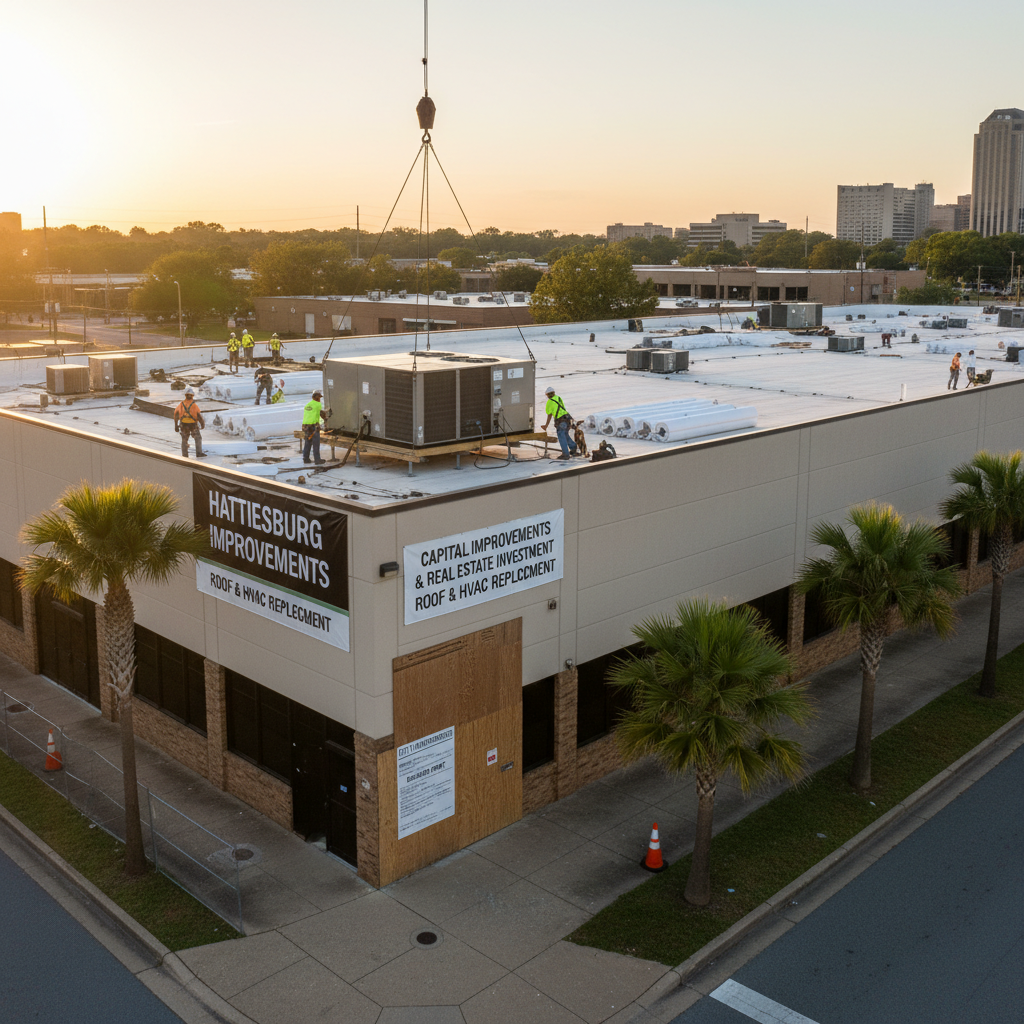
2026 Hattiesburg Section 179 Deduction Guide: Double Your Property Improvement Deductions
For the 2026 tax year, Hattiesburg real estate investors face a transformative opportunity. The Section 179 deduction has doubled to $2.5 million, up from just $1.25 million in 2025. This means that property improvements like roofs, HVAC systems, fire protection systems, and security systems can now be fully deducted in the year they’re placed in service—instead of being spread across decades of depreciation. If you own rental properties or commercial real estate in Hattiesburg, understanding this 2026 Hattiesburg Section 179 deduction strategy could save you tens of thousands in federal taxes. This guide breaks down eligibility, qualifying improvements, and the exact steps to claim this powerful deduction.
Table of Contents
- Key Takeaways
- What Is the Section 179 Deduction?
- What Changed in 2026?
- What Property Improvements Qualify?
- Do You Qualify as a Real Estate Professional?
- How Much Can You Save With Section 179 Deductions?
- How to Claim the Section 179 Deduction
- Common Mistakes to Avoid
- Uncle Kam in Action: Section 179 Success Story
- Next Steps
- Frequently Asked Questions
Key Takeaways
- The Section 179 deduction limit doubled to $2.5 million for 2026 tax year.
- Qualifying property improvements include roofs, HVAC, fire systems, and security systems.
- Only real estate professionals meeting IRS criteria qualify for Hattiesburg Section 179 deductions on rental property.
- The phase-out threshold increased to $4 million for 2026 tax year.
- Documentation and timing are critical to claiming this deduction successfully.
What Is the Section 179 Deduction?
Quick Answer: Section 179 allows immediate expensing of qualifying property instead of depreciating it over years, creating massive first-year tax deductions for Hattiesburg real estate investors.
The Section 179 deduction is one of the most powerful tax tools available to real estate investors. Unlike standard depreciation that spreads property improvements across decades, Section 179 allows you to deduct the full cost of certain business property in the year it’s placed in service. This is an “above-the-line” deduction, meaning it reduces your adjusted gross income and is available whether you itemize deductions or claim the standard deduction.
For Hattiesburg property owners, this means a $50,000 roof replacement, a $30,000 HVAC system upgrade, or a $20,000 security system can all be fully deducted in 2026 rather than spread across 5, 15, or 39 years of depreciation. This acceleration of deductions significantly reduces your taxable income and federal tax liability in the year improvements are completed.
How Section 179 Differs From Standard Depreciation
Standard depreciation requires spreading the cost of property improvements across their useful life. A roof might depreciate over 15-20 years, while an HVAC system depreciates over 15 years. Section 179 eliminates this waiting period entirely. You write off the entire cost immediately, creating an immediate tax benefit without waiting decades.
This difference is crucial for cash flow management. An investor who upgrades an HVAC system for $35,000 would normally claim roughly $2,300 in annual depreciation deductions over 15 years. With Section 179 in 2026, that same investor claims the full $35,000 in year one, potentially reducing taxable income by $35,000 and federal taxes by $8,750 (at a 25% tax bracket).
What Changed in 2026 for the Hattiesburg Section 179 Deduction?
Quick Answer: The One Big Beautiful Bill Act doubled the Section 179 limit to $2.5 million and increased the phase-out threshold to $4 million for 2026, creating unprecedented opportunities for Hattiesburg real estate investors.
The One Big Beautiful Bill Act, signed into law on July 4, 2025, made three critical changes to Section 179 for the 2026 tax year. First, it doubled the deduction limit from $1.25 million to $2.5 million. Second, it increased the phase-out threshold from $2 million to $4 million. Third, it permanently restored 100% bonus depreciation for qualified property acquired after January 19, 2025.
For Hattiesburg investors, this means you can now deduct up to $2.5 million in qualifying property improvements in 2026 without waiting for depreciation schedules. The phase-out threshold increase is equally important—it means more investors stay within the deduction cap, even if they make substantial property improvements.
Understanding the $4 Million Phase-Out Threshold
The phase-out threshold works like this: If you place more than $4 million in qualifying property into service during 2026, your Section 179 deduction begins to decrease dollar-for-dollar. For example, if you place $4.1 million in qualifying improvements into service, your Section 179 deduction is reduced from $2.5 million to $2.4 million.
This threshold protects most Hattiesburg property investors. Even those making substantial improvements—$100,000, $250,000, or even $500,000—will not hit the phase-out limit. The phase-out primarily affects large commercial developers making multiple property acquisitions in a single year.
What Property Improvements Qualify for the Hattiesburg Section 179 Deduction?
Quick Answer: Roofs, HVAC systems, fire protection systems, and security systems qualify for Section 179 deductions on nonresidential rental property in Hattiesburg if you meet real estate professional requirements.
Not all property improvements qualify for Section 179. The IRS specifically allows Section 179 deductions for qualified property improvements to nonresidential real property. This category includes specific building components that have a recovery period of 20 years or less. Hattiesburg investors should focus on the four primary categories the IRS explicitly approves.
Qualifying Improvements for 2026
- Roofs: Complete roof replacements or major roof repairs on nonresidential rental properties (residential roofs do not qualify)
- HVAC Systems: Heating, ventilation, and air conditioning system replacements or upgrades that serve the entire building
- Fire Protection Systems: Sprinkler systems, fire alarms, and automated fire suppression equipment
- Security Systems: Video surveillance systems, access control systems, and integrated security infrastructure
Additionally, tangible assets with a recovery period of 20 years or less generally qualify. This includes appliances, flooring, doors, windows, and fixtures specifically installed in nonresidential rental properties. However, the structure itself—the building’s bones—does not qualify for Section 179 deductions. Land also never qualifies.
Pro Tip: Hattiesburg commercial properties qualify more broadly than residential properties. Residential property Section 179 deductions are limited to specific improvements, while commercial nonresidential property offers more flexibility. If you own commercial office buildings, warehouses, or retail spaces, you have significantly more deduction opportunities than residential landlords.
What Does NOT Qualify for Section 179
- The building structure itself or the land
- Improvements to residential rental properties (with very limited exceptions)
- Repairs and maintenance—only capital improvements qualify
- Improvements placed into service before January 19, 2025
- Property acquired from related parties
Understanding the line between maintenance repairs and capital improvements is critical. Repainting an HVAC unit is maintenance (not deductible). Replacing the entire HVAC system is a capital improvement (fully deductible). When in doubt, consult with a qualified tax professional before claiming a deduction.
Do You Qualify as a Real Estate Professional for Hattiesburg Section 179 Benefits?
Quick Answer: You must meet three IRS requirements: maintain separate books for each property, perform at least 250 hours of rental services annually, and keep detailed contemporaneous records documenting those hours.
Here’s the critical limitation for Hattiesburg Section 179 deductions: Section 179 deductions for rental property improvements only apply if you qualify as a “real estate professional” under IRS rules. This is not automatic for all landlords. You must affirmatively meet three specific conditions outlined in Revenue Procedure 2019-38 to establish this status.
The Real Estate Professional Safe Harbor Test
The IRS provides a safe harbor that treats your rental enterprise as a “trade or business” if you meet all three conditions:
- Separate Books and Records: You maintain separate books and records for each rental property enterprise (not just one general file for all properties)
- 250 Hours Annually: You personally perform at least 250 hours of rental services per year across your rental enterprise
- Contemporaneous Documentation: You keep detailed records documenting hours, dates, services performed, and who performed the work
Qualifying rental services include maintenance and repairs, collecting rent, screening tenants, advertising vacancies, managing the property, and traveling to and from the property. Time spent arranging financing or shopping for new properties does not count toward the 250-hour requirement.
Calculating Your 250 Hours
For a Hattiesburg investor managing two properties, 250 hours annually breaks down to roughly 5 hours per week of documented rental services. This includes time spent meeting contractors, approving repairs, reviewing tenant applications, and visiting the property. Most active landlords easily exceed this threshold, but you must document it contemporaneously—not reconstruct time logs months later during tax season.
Pro Tip: Keep a detailed property management log documenting every hour spent on rental activities. Include the date, specific tasks performed, time spent, and the property involved. This becomes invaluable if the IRS ever questions your real estate professional status. Digital calendars with time blocking are an excellent alternative to paper logs.
How Much Can You Save With Section 179 Deductions?
Quick Answer: A $50,000 roof replacement could save $12,500 in federal taxes at a 25% tax bracket—all in the year the improvement is placed in service.
The tax savings from Hattiesburg Section 179 deductions depend on your federal tax bracket, state taxes, and the amount of qualifying improvements. Let’s walk through realistic examples to show how this deduction works in practice.
Scenario 1: Small Rental Property Portfolio
Sarah owns two rental properties in Hattiesburg with annual rental income of $65,000. In 2026, she replaces the HVAC system in her office building for $32,000. She qualifies as a real estate professional (she manages both properties and logs 300+ hours annually). With Section 179, she can deduct the full $32,000 in 2026.
Assuming Sarah is in the 24% federal tax bracket and pays 5% Mississippi state income tax, her total tax savings equals: $32,000 × 29% = $9,280 in 2026. Compare this to standard depreciation: She would have claimed roughly $2,100 annually over 15 years, never fully deducting the improvement.
Scenario 2: Commercial Property with Multiple Improvements
James owns a commercial retail building in Hattiesburg with $180,000 in annual rental income. In 2026, he makes qualifying improvements: a new roof ($65,000), HVAC system ($35,000), security system ($18,000), and fire suppression upgrades ($12,000). Total qualifying improvements: $130,000.
James qualifies as a real estate professional. He can deduct all $130,000 using Section 179 in 2026. At a 32% combined federal and state tax rate, his tax savings equals: $130,000 × 32% = $41,600. Without Section 179, these improvements would be depreciated over 5-20 years, with combined annual deductions of roughly $6,500-$10,000.
To estimate your own potential savings, use our Self-Employment Tax Calculator for Brattleboro, Vermont to input your estimated deductions and see projected tax impacts.
Comparing Section 179 vs. Standard Depreciation
| Improvement | Cost | Section 179 (2026) | Standard Depreciation (Annual) |
|---|---|---|---|
| Roof Replacement | $50,000 | $50,000 deduction in Year 1 | ~$3,125/year for 16 years |
| HVAC System | $35,000 | $35,000 deduction in Year 1 | ~$2,333/year for 15 years |
| Security System | $18,000 | $18,000 deduction in Year 1 | ~$2,250/year for 8 years |
| TOTAL | $103,000 | $103,000 in Year 1 | ~$7,700/year (avg) |
As the table shows, Section 179 accelerates deductions dramatically. Instead of claiming $7,700 annually over multiple years, you claim $103,000 in year one. At a 30% tax rate, this equals $30,900 in immediate tax savings.
How to Claim the Section 179 Deduction on Your 2026 Tax Return
Quick Answer: File Form 4562 with your tax return, reporting each qualifying improvement’s cost and the amount deducted under Section 179.
Claiming the Hattiesburg Section 179 deduction requires proper form filing and detailed documentation. The IRS requires Form 4562 (Depreciation and Amortization) submitted with your tax return. This form lists each qualifying improvement, its date of placement into service, the cost basis, and the Section 179 amount claimed.
Step-by-Step Claiming Process
- Step 1: Document all qualifying improvements with receipts, invoices, and proof of payment showing the date placed into service
- Step 2: Calculate total qualifying property placed into service during 2026 (must not exceed $4 million for phase-out to apply)
- Step 3: Determine your Section 179 election amount (cannot exceed $2.5 million for 2026)
- Step 4: Complete Form 4562 Part II, listing each improvement with its cost, date placed into service, and Section 179 amount claimed
- Step 5: File Form 4562 with your complete tax return (Form 1040 for individual landlords, Form 1120-S for S Corp, Form 1065 for partnerships)
Documentation Requirements
The IRS requires contemporaneous documentation supporting every Section 179 deduction. This means you must have proof ready before filing your return, not reconstructed after the fact. Required documentation includes:
- Original contractor invoices showing itemized improvement costs
- Payment receipts or bank statements proving payment was made
- Proof the improvement was actually placed into service (photos, inspection reports, permits)
- Real estate professional documentation (property management logs, hour tracking)
Common Mistakes Hattiesburg Investors Make With Section 179
Quick Answer: The most common mistakes are claiming residential property improvements, failing to document real estate professional status, and not tracking the placement-into-service date accurately.
After years of helping Hattiesburg real estate investors maximize tax deductions, we’ve identified patterns in how claims go wrong. Understanding these mistakes helps you avoid costly audit risks and missed deduction opportunities.
Mistake #1: Claiming Residential Property Improvements
Many Hattiesburg landlords own residential rental properties (apartments, single-family homes, duplexes). Here’s the problem: Section 179 deductions for residential improvements are severely restricted. You can only claim Section 179 for specific improvements like certain qualified roof replacements or HVAC systems, and only if your property qualifies under strict definitions.
Commercial nonresidential property (office buildings, retail spaces, warehouses) has far broader Section 179 eligibility. If you own residential property, consult a tax professional before claiming any Section 179 deductions—the risk of audit is significant.
Mistake #2: Failing to Document Real Estate Professional Status
Without real estate professional status, you cannot claim Section 179 on rental property improvements. Yet many investors claim Section 179 without maintaining the required documentation. If the IRS audits you and asks for proof of your 250 hours worked annually, you have nothing to show.
Start tracking your property management hours immediately in 2026. Use a detailed time log (digital or paper) documenting every hour spent on rental activities. This becomes invaluable if questions arise during an audit.
Mistake #3: Getting the Placement Date Wrong
“Placed into service” means the improvement is ready for its intended use, not necessarily when you paid the contractor. An improvement ordered in 2025 but completed in 2026 gets claimed on your 2026 return. An improvement ordered in 2024 and completed in January 2025 gets claimed on your 2025 return (already filed).
For improvements placed into service before January 19, 2025, you cannot claim Section 179 deductions. For improvements placed into service after January 19, 2025, you have Section 179 eligibility for 2026 and beyond.

Uncle Kam in Action: How One Hattiesburg Landlord Saved $28,000 With Section 179
Client Profile: Michael is a real estate investor in Hattiesburg, Mississippi, who owns three commercial properties generating approximately $220,000 in annual rental income. He actively manages all properties, spending 15+ hours per week on maintenance, tenant relations, repairs, and administrative tasks.
The Challenge: In early 2026, Michael faced aging building systems across his portfolio. Two properties needed roof replacements ($45,000 combined), one needed a complete HVAC overhaul ($28,000), and all three required security system upgrades ($22,000 total). Total improvements: $95,000. Without strategic tax planning, Michael would face a $95,000 capital expenditure hitting his cash flow immediately while spreading the tax benefits across years of depreciation.
The Uncle Kam Solution: We identified that Michael qualified as a real estate professional (he maintained separate books for each property and documented 350+ annual hours managing his rental enterprise). This qualification unlocked Section 179 deductions for his improvements. We had all improvements completed and placed into service by March 31, 2026—well within the tax year and before any April deadlines.
We then filed Form 4562 with his 2026 tax return claiming the full $95,000 Section 179 deduction on his Schedule C (rental income). Michael filed electronically with all supporting documentation (invoices, payment receipts, completion photos, real estate professional hour documentation).
The Results: Michael’s 2026 taxable rental income dropped from $220,000 to $125,000 due to the $95,000 Section 179 deduction. At his effective federal and state tax rate of 30%, this $95,000 deduction saved him $28,500 in 2026 taxes. Instead of spreading $95,000 in deductions across 15-20 years (totaling roughly $4,750 in annual deductions), he captured the full tax benefit in a single year when he made the capital improvements.
Return on Investment: Michael invested $95,000 in property improvements and recovered $28,500 in tax savings through Section 179 planning. His net property investment cost dropped to $66,500 after tax savings. Compare this to depreciation: Standard depreciation would have generated only $4,750 annually (averaged across property types), requiring 20 years to recoup the tax benefits.
Michael’s case illustrates the dramatic impact Section 179 planning can have on real estate investor cash flow and tax liability. By understanding 2026 requirements and documenting his real estate professional status, he accelerated tax benefits by 20 years.
Next Steps for Hattiesburg Section 179 Planning
If you own rental or commercial property in Hattiesburg and are considering property improvements for 2026, now is the time to act. The Section 179 deduction doubles to $2.5 million, creating unprecedented tax planning opportunities. Here’s your action plan:
- Audit Your Properties: Walk each rental property and identify aging systems (roofs, HVAC, security, fire suppression). Get contractor quotes for replacements or upgrades.
- Document Real Estate Professional Status: If you manage your properties, start a detailed time log immediately. Track hours spent on property management, maintenance coordination, tenant relations, and administrative work.
- Time Your Improvements: Schedule property improvements for completion by December 31, 2026, to claim Section 179 deductions on your 2026 return. Improvements completed in 2027 get deducted in 2027.
- Gather Documentation: Collect invoices, payment receipts, and proof of placement into service before filing your 2026 tax return.
- Consult a Tax Professional: We recommend discussing your specific situation with a qualified tax advisor at Uncle Kam’s tax strategy team to maximize deductions while ensuring IRS compliance.
Frequently Asked Questions About Hattiesburg Section 179 Deductions
Can I claim Section 179 on my primary residence?
No. Section 179 deductions only apply to business or investment property. Your primary residence is personal property and does not qualify, even if you make significant improvements.
What if my property is financed? Do I have to pay off the loan before claiming Section 179?
No. Financing status is irrelevant to Section 179 deductions. Whether your property is paid off or financed with a mortgage, you can still claim Section 179 deductions for qualifying improvements. The deduction applies to the full improvement cost regardless of how you financed it.
Do I have to deduct the entire improvement amount under Section 179?
No. You can elect to claim Section 179 on some improvements and use standard depreciation on others. This flexibility lets you manage your deduction timing to optimize your tax situation in different years.
What happens if I exceed the $2.5 million Section 179 limit?
If you place more than $2.5 million in qualifying improvements into service during 2026, you must allocate your $2.5 million limit among qualifying improvements (you choose which ones to prioritize). Excess improvements over the $2.5 million limit are depreciated normally over their useful lives rather than expensed immediately.
Does Section 179 apply to equipment, or just real property?
Section 179 applies broadly to both equipment and certain real property improvements. Beyond roofs, HVAC, and security systems, you can claim Section 179 for appliances, flooring, doors, windows, fixtures, and other tangible property with a recovery period of 20 years or less used in your rental business.
What if I sell the property—do I lose the Section 179 deduction?
No. Section 179 deductions are permanent tax benefits. If you claim a $50,000 Section 179 deduction in 2026 and sell the property in 2027, you keep the $50,000 deduction claimed in 2026. The sale simply triggers gain or loss calculations on the remaining property value.
Can I amend my 2025 return to claim Section 179 for improvements made in 2025?
Possibly. If you made qualifying improvements in 2025 but did not claim Section 179, you can file an amended 2025 return (Form 1040-X) to add the deduction. The deadline for amending is typically three years from the original filing date or two years from when you paid the taxes, whichever is later.
How does Section 179 interact with bonus depreciation?
For 2026, 100% bonus depreciation is available and permanent for qualified property placed into service after January 19, 2025. You can combine Section 179 and bonus depreciation strategies to maximize immediate deductions. Generally, Section 179 deductions are taken first, then bonus depreciation applies to the remaining basis.
Is the $2.5 million Section 179 limit per property or per person?
The $2.5 million limit is per taxpayer (individual, S Corp, or partnership) per tax year, regardless of how many properties you own. If you own three properties and make improvements totaling $4 million, you can only claim $2.5 million in Section 179 deductions total (distributed among the properties as you choose).
What if I don’t have enough taxable income to use the full Section 179 deduction?
Section 179 deductions cannot exceed your taxable income. If you claim a $100,000 Section 179 deduction but only have $60,000 in taxable income, the remaining $40,000 carries forward to future years. This carryforward gives you flexibility in high-income and lower-income years.
This information is current as of 2/23/2026. Tax laws change frequently. Verify updates with the IRS or our tax advisory team if reading this later.
Related Resources
- Real Estate Investors Tax Strategy Guide
- Entity Structuring for Real Estate Professionals
- 2026 Tax Preparation and Filing Services
- Cost Segregation Studies for Rental Properties
- 2026 Tax Calendar and Important Deadlines
Last updated: February, 2026

