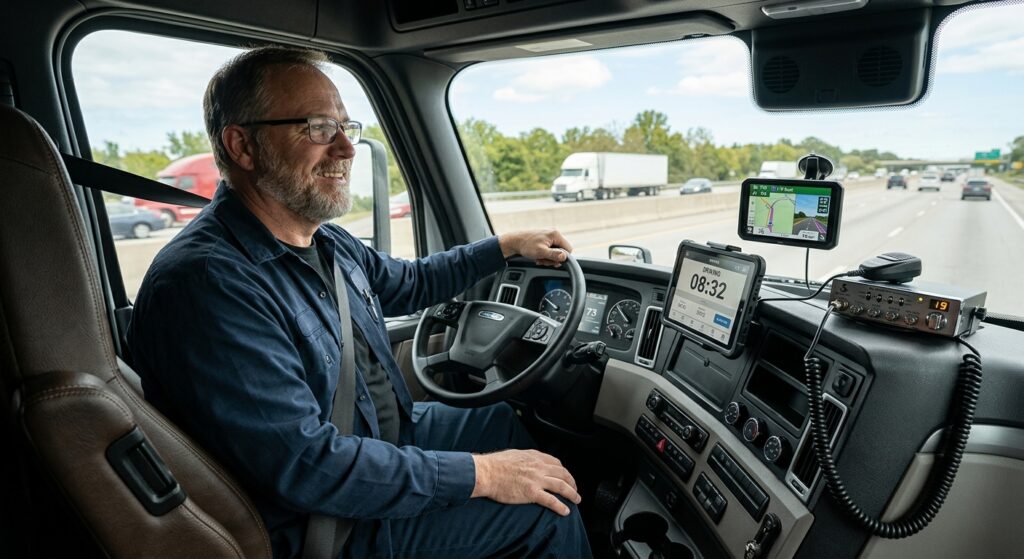
2026 ELD, GPS, CB Radio & Truck Technology Deductions: How Much Can You Deduct?
For the 2026 tax year, owner-operators, fleet drivers, and self-employed 1099 truckers face critical decisions about maximizing deductions for ELD, GPS, CB radio, and truck technology equipment. The good news is that most truck equipment—from electronic logging devices to advanced telematics systems—qualifies as ordinary and necessary business expenses, making them 100% tax deductible on your Schedule C return. Understanding which expenses you can deduct, how much you can claim, and the proper documentation required will directly impact your bottom line. This complete guide walks through 2026 truck technology deductions for owner-operators earning 1099 income and shows exactly how to maximize your tax savings while staying compliant with IRS rules.
Table of Contents
- Key Takeaways
- What Truck Technology Deductions Qualify in 2026?
- ELD and GPS Deduction Limits and Rules
- CB Radio and Communication Equipment Deductions
- New 2026 Vehicle Loan Interest Deduction for Truckers
- How Do You Claim Truck Technology Deductions on Your 2026 Tax Return?
- Documentation and Audit Protection for Truck Deductions
- Uncle Kam in Action: Owner-Operator Tax Success Story
- Next Steps
- Frequently Asked Questions
Key Takeaways
- ELDs and GPS equipment are 100% deductible as ordinary and necessary business expenses on your 2026 Schedule C return with no deduction cap.
- CB radios and communication devices qualify as full deductions when used exclusively for business purposes, including safety and fleet communication.
- New 2026 vehicle loan interest deduction allows up to $10,000 annual deduction for qualifying personal-use vehicles (requires less than 14,000 lb weight limit).
- Proper documentation is critical for all equipment purchases and improvements to survive IRS audit scrutiny.
- Owner-operators can save thousands by tracking installation, maintenance, and upgrade costs for all truck technology systems.
What Truck Technology Deductions Qualify in 2026?
Quick Answer: Truck technology equipment qualifies as a deductible business expense if it’s ordinary and necessary for operating your trucking business. ELDs, GPS units, CB radios, dashcams, and telematics systems are all deductible when used for business purposes. There are no specific deduction caps for equipment—you deduct the full cost under the right conditions.
The IRS defines ordinary and necessary business expenses as costs incurred while operating your trade or business. For owner-operators and 1099 truckers, this means any technology directly used to run your trucking operation is fully deductible. This includes the purchase price, installation costs, and ongoing maintenance and repairs.
Categories of Deductible Truck Technology Equipment
- Mandatory compliance equipment: ELDs (required by FMCSA since 2018), GPS tracking units, and onboard diagnostics systems
- Safety and visibility systems: Backup cameras, blind-spot monitoring, collision avoidance systems, and advanced driver assistance
- Communication equipment: CB radios, satellite communication systems, two-way radios, and emergency communication devices
- Telematics and optimization: Fleet management software, load optimization platforms, fuel tracking systems, and route planning tools
- Maintenance and diagnostic tools: Digital inspection systems, predictive maintenance sensors, and specialized truck diagnostic equipment
The key question for the IRS is whether the equipment is exclusively or primarily used for business. If your CB radio is used only for business communication and coordinating loads, the entire cost is deductible. If you use it personally 40% of the time, you can deduct only 60% of the cost.
Important: Asset vs. Expense Treatment
There’s a critical distinction between small expenses and capital assets. If you purchase a $200 dashcam, you deduct it immediately as a business expense. If you install a $5,000 integrated telematics system with multiple sensors and software, the IRS may classify this as a capital asset requiring depreciation over several years. The FMCSA required ELDs typically cost $500-$1,500 installed, which most owner-operators deduct as an immediate expense rather than capitalizing and depreciating.
Pro Tip: For the 2026 tax year, talk with your tax professional about whether your truck equipment purchases qualify for Section 179 expensing, which allows you to deduct the full purchase price immediately rather than depreciating over years. This can produce significant first-year tax savings.
ELD and GPS Deduction Limits and Rules
Quick Answer: There are NO deduction limits for ELDs and GPS units used in your trucking business. You can deduct 100% of the purchase price, installation, and monthly subscription fees as ordinary and necessary business expenses on Schedule C. The only limit is that these devices must be used for business purposes.
Electronic logging devices (ELDs) became mandatory for most commercial truckers in December 2017 under FMCSA regulations. For the 2026 tax year, the cost of complying with ELD requirements is fully deductible. This includes the device purchase, professional installation, and recurring subscription costs.
What ELD and GPS Costs Are Deductible?
- Initial device purchase: The cost of the FMCSA-compliant ELD hardware (typically $500-$1,500)
- Professional installation: Labor costs for integrating the device with truck systems
- Monthly/annual subscriptions: Recurring fees for ELD software and cloud storage (fully deductible each year)
- Hardware replacement and upgrades: When you replace an ELD or upgrade to a newer model
- GPS tracking systems: Standalone GPS units, fleet tracking software, and integration costs
- Training and setup: Reasonable costs for training drivers and staff on the system
The FMCSA continues to strengthen its vetting process for approved ELDs in 2026, so you’ll want to use only FMCSA-listed approved devices. The good news is that whether you purchase a basic $500 device or a more advanced $1,500 system, the entire cost remains deductible.
GPS-Only Systems vs. Integrated ELDs
Some truckers use GPS tracking systems separate from their ELD. Both are deductible. A standalone GPS unit for route optimization, fuel tracking, or fleet monitoring is fully deductible as a business technology expense. If your ELD includes integrated GPS (which most modern ELDs do), you don’t depreciate or split the cost—it’s one 100% deductible equipment expense.
Pro Tip: Keep all ELD subscription receipts, device purchase receipts, and installation invoices in a dedicated folder for your tax professional. In 2026, the IRS pays close attention to trucking deductions, so clear documentation of these recurring subscription costs (often $30-$100/month) prevents audit questions.
CB Radio and Communication Equipment Deductions
Quick Answer: CB radios and communication equipment are 100% deductible for owner-operators when used exclusively for business communication. This includes the radio unit, installation, repairs, and maintenance. If the equipment is used for personal communication, you can deduct only the business-use percentage.
For truckers, CB radios have been essential for road safety and fleet coordination for decades. In 2026, CB radios remain fully deductible business expenses when you can demonstrate they’re used for business purposes. This includes communication with dispatch, coordination with other drivers, and receiving traffic/weather information.
Deductible CB Radio and Communication Costs
- CB radio unit: The hardware cost ($150-$500 for quality truck models)
- Professional installation: Labor cost for mounting, wiring, and antenna installation
- Antenna and related equipment: Antennas, magnetic mounts, coax cable, and wiring supplies
- Repairs and maintenance: Fixing a damaged CB unit or replacing worn components
- Satellite phones and SPOT devices: Emergency communication systems used for business and safety
- Two-way radio systems: Company communication devices for fleet coordination
- Mobile phone mounts and hands-free kits: Safety equipment for business communication while driving
The critical distinction is business-exclusive use. If you use the CB radio only to receive traffic reports for business driving, that’s 100% deductible. If you also use it for personal recreational communication or non-business chat, you need to estimate the business percentage and deduct only that portion.
Modern Truck Communication Systems in 2026
Today’s owner-operators often use integrated communication systems that combine multiple technologies. A modern truck might have a CB radio, a satellite phone (like Iridium), a cellular data system for dispatch apps, and Bluetooth hands-free connectivity—all in one system. If all components serve business purposes, the entire system is deductible.
Pro Tip: Document which communication systems are business-exclusive. Create a simple spreadsheet noting what you use each device for (dispatch calls, safety communication, weather information, personal chat percentage). This documentation is invaluable if the IRS questions your deductions.
New 2026 Vehicle Loan Interest Deduction for Truckers
Quick Answer: A new 2026 tax law allows up to $10,000 annual deduction for vehicle loan interest (available through 2028). However, this applies only to new vehicles under 14,000 pounds used personally 50%+ of the time. Most commercial trucks exceed this weight limit, so this deduction has limited applicability for truckers using trucks for business.
Under the One Big Beautiful Bill Act (OBBBA) passed in 2025, the IRS introduced a new personal vehicle loan interest deduction for the first time in nearly 40 years. For the 2026 tax year, you can deduct up to $10,000 annually in interest paid on qualifying vehicle loans. This provision represents a significant change in tax law that directly impacts some owner-operators.
Qualification Requirements for the 2026 Vehicle Loan Interest Deduction
| Requirement | Details |
|---|---|
| Vehicle must be brand new | Cannot be used or previously owned; must be sold as new from a dealership |
| Vehicle weight limit | Must weigh less than 14,000 pounds (commercial trucks typically exceed this) |
| Final assembly in the U.S. | Vehicle final assembly must occur in the United States (check VIN decoder) |
| Personal use requirement | Vehicle must be used for personal reasons more than 50% of the time |
| Loan origination date | Loan must have been originated after December 31, 2024 |
| Availability window | Available for 2026-2028 tax years only (currently expires after 2028) |
For most owner-operators, this new deduction won’t apply to their primary commercial trucks. Here’s why: A commercial truck used 100% for business doesn’t qualify because it’s not used for personal reasons 50%+ of the time. Additionally, most commercial Class 8 trucks weigh 30,000-80,000 pounds, far exceeding the 14,000-pound threshold.
When This Deduction MIGHT Apply to Truckers
There are rare scenarios where this applies to owner-operators:
- Pickup truck for mixed use: If you purchase a new Ford F-150 (under 14,000 lbs) and use it 60% for business and 40% for personal use, you can deduct up to $10,000 in annual loan interest
- Lightweight delivery vehicle: A cargo van or box truck under 14,000 lbs used partially for business might qualify
- Secondary vehicle strategy: Some owner-operators could purchase a secondary personal-use vehicle to capture this deduction
If your situation qualifies, the benefit is significant. On a $50,000 vehicle loan at 6% interest, you’d pay about $3,000 in interest the first year—all deductible, subject to the $10,000 annual cap. This could translate to $600-$900 in federal income tax savings in your first year (depending on your tax bracket).
Pro Tip: If you’re considering purchasing a secondary vehicle in 2026 for mixed personal and business use, verify its weight and assembly location before buying. You can check the NHTSA VIN decoder to confirm final assembly location and gross vehicle weight rating (GVWR).
How Do You Claim Truck Technology Deductions on Your 2026 Tax Return?
 Free Tax Write-Off Finder
Quick Answer: You claim truck equipment and technology deductions on Schedule C (Profit or Loss from Business). Smaller expenses under $2,500 typically go in the “Supplies” or “Other Expenses” category. Larger equipment purchases may require depreciation or Section 179 treatment. Your tax professional can help determine the right approach for your situation.
For 1099 owner-operators and self-employed truckers, the process is straightforward. You report your business income on Schedule C and reduce it by all ordinary and necessary business expenses. This includes every ELD subscription, CB radio purchase, GPS system, and maintenance cost directly attributable to your trucking operation.
Step-by-Step: Claiming Equipment Deductions on Schedule C
Step 1: Categorize Your Equipment Expense
- Small annual subscriptions (ELD monthly fees): Schedule C “Supplies” or “Other Expenses”
- Single equipment purchase under $2,500: Schedule C “Supplies” or “Equipment”
- Capital equipment over $2,500: Consider Section 179 expensing or depreciation (Form 4562)
Step 2: Calculate Business-Use Percentage
If the equipment serves dual purposes (business and personal), calculate the business-use percentage. For example, if your satellite phone is used 80% for dispatch and 20% for personal calls, you deduct only 80% of the cost.
Step 3: Gather Documentation
- Receipt or invoice for the purchase
- Installation invoice (if applicable)
- Subscription or service invoices (monthly/annual)
- Repair and maintenance records
Step 4: Enter the Deduction on Schedule C
Find the appropriate line item on Schedule C Part II (Deductions). Most truck technology will fall under “Supplies,” “Equipment,” or “Other Expenses.” Cumulative recurring expenses (like monthly ELD subscriptions) should be totaled and entered as one line item.
For 2026, you can also use our LLC vs S-Corp Tax Calculator to explore whether electing S-Corp status could provide additional tax savings by reducing self-employment tax liability—something many successful owner-operators overlook.
Pro Tip: Keep receipts organized by category (ELD, GPS, CB Radio, Safety Equipment, Repair/Maintenance) in a dedicated folder. When tax time arrives in April 2027, you’ll have everything ready. Better organization means less stress and fewer missed deductions.
Documentation and Audit Protection for Truck Deductions
Quick Answer: The IRS scrutinizes trucking business deductions heavily. Maintain detailed records for all equipment purchases, installation costs, subscriptions, and maintenance. Keep receipts for a minimum of 3-7 years. Document the business purpose of each item and the business-use percentage for dual-use equipment.
Owner-operators are statistically more likely to face IRS audits than many other business types. The reason: self-employment income and Schedule C business deductions are high-risk audit areas. But here’s the good news—if you have solid documentation, you’ll pass any audit with flying colors. The IRS can’t disallow a deduction you can substantiate with credible records.
Essential Documentation for Truck Technology Deductions
| Document Type | What to Keep | Retention Period |
|---|---|---|
| Purchase Receipts | Original invoice with vendor name, date, description, and cost | 7 years |
| Installation Records | Labor invoice, parts list, and completion photos | 7 years |
| Subscription Receipts | Monthly/annual invoice emails from service providers | 7 years |
| Maintenance Records | Service tickets, repair invoices, and parts receipts | 7 years |
| Business Purpose Notes | Written explanation of how equipment is used for business | With tax return |
How to Organize and Store Documentation
Create a simple system that works for you. Many successful owner-operators use:
- Digital folder method: Create year-specific folders (2026) with subfolders for ELD, GPS, CB Radio, Maintenance, and Subscriptions. Scan receipts and store PDFs.
- Spreadsheet tracking: Maintain a simple Excel file listing each expense with date, vendor, amount, and category. Total by category monthly.
- Accounting software: Use QuickBooks Self-Employed or Wave Accounting to categorize and track expenses automatically.
- Cloud storage: Upload organized documents to Google Drive or Dropbox to protect against loss and ensure easy access during tax preparation.
The key principle: if you can’t show the IRS how you calculated a deduction and why it’s a legitimate business expense, the IRS won’t allow it. Clear documentation eliminates audit risk and gives you confidence in your deductions.
Pro Tip: At the end of 2026, before year-end, review all your truck equipment documentation and ensure it’s complete. If you’re missing an installation invoice or service record, contact the vendor now while details are fresh. This proactive approach prevents problems when tax time arrives in April 2027.

Uncle Kam in Action: Owner-Operator Tax Success Story
Client Profile: Marcus D., 42, owner-operator based in Ohio. Solo owner of a Class 8 Freightliner tractor, primarily long-haul interstate trucking. 2026 gross income: approximately $185,000.
The Challenge: Marcus was filing as a sole proprietor and claiming basic deductions (fuel, tolls, insurance). However, he was missing significant truck technology expenses. Over the previous three years, he’d invested in an FMCSA-approved ELD ($800 installed), GPS tracking system ($300), CB radio upgrade ($450 installed), and annual ELD subscription costs ($480/year). Additionally, he’d overlooked subscription services and hadn’t properly tracked maintenance.
The Uncle Kam Solution: We conducted a comprehensive tax audit of Marcus’s 2026 business operations. After gathering documentation of all truck technology equipment and subscriptions, we identified $4,200 in previously unclaimed deductions across three years (including $1,440 in ELD subscriptions alone). Additionally, we reviewed his business structure and discovered that S-Corp election could save him approximately $8,400 annually in self-employment taxes going forward.
The Results:
- Immediate 2026 Tax Savings: $1,210 (from properly claimed truck equipment deductions)
- S-Corp Election Benefit (2027 forward): $8,400 annual self-employment tax savings
- Prior-Year Adjustment: $3,860 refund from amended returns for 2023-2025
- First-Year Investment: Uncle Kam service fee of $1,400
- Return on Investment: 277% first year ($3,860 refund + $1,210 savings = $5,070 benefit vs. $1,400 cost)
The Lesson: Marcus’s situation is typical for owner-operators. Many successful truckers fail to document and claim legitimate equipment deductions simply because they don’t know they’re deductible. By systematically reviewing all truck technology expenses and implementing S-Corp structure, Marcus will save over $8,400 annually going forward—money that stays in his pocket and compounds over time.
Read more about owner-operator success stories and tax planning case studies from Uncle Kam’s trucking clients.
Next Steps
You now understand how to maximize your 2026 truck technology deductions. Here’s what to do next:
- Audit your equipment: List all truck technology you own (ELD, GPS, CB radio, dashcams, communication systems, telematics). Note purchase dates and costs.
- Gather documentation: Collect all receipts, invoices, and subscription statements for 2026 equipment and subscriptions. Organize by category.
- Calculate business-use percentage: For any dual-use equipment, estimate what percentage is used for business vs. personal purposes.
- Explore business structure optimization: Meet with a tax professional about LLC vs. S-Corp election to determine if restructuring could provide additional tax savings beyond equipment deductions.
- Schedule a tax review: Before filing your 2026 return, have a tax professional review your complete situation to identify all available deductions and credits.
Frequently Asked Questions
Can I deduct the cost of an ELD if my carrier requires me to use one?
Yes, absolutely. If you’re an owner-operator or contractor who must provide your own ELD, the cost is 100% deductible as a business expense. This includes the device, installation, and monthly subscription fees. The fact that your carrier requires it doesn’t change the tax treatment—it’s still your business equipment.
What’s the difference between deducting equipment vs. depreciating it?
Smaller items (under $2,500) are typically deducted immediately in the year purchased. Larger items (over $2,500) may require depreciation over several years, or you can use Section 179 expensing to deduct them immediately. A tax professional can help determine the best approach for your equipment. Generally, Section 179 is more favorable because it provides immediate tax deductions.
Can I deduct my personal cell phone as a business expense?
Yes, but only the business-use percentage. If you use your phone 70% for business calls and dispatch, 30% for personal use, you can deduct 70% of the monthly service cost and the device cost. Document the business vs. personal use breakdown to substantiate this calculation if audited.
Are telematics and fleet management software subscriptions deductible?
Yes, 100% deductible. Telematics systems, load optimization software, fuel tracking platforms, and any fleet management subscription used exclusively for business are fully deductible as ordinary and necessary business expenses. Keep subscription receipts and billing statements organized by year.
What if I use the same equipment for both business and personal purposes?
Deduct only the business-use percentage. For example, if you use a GPS device 60% for business routes and 40% for personal navigation, you can deduct 60% of the device cost and subscription. The IRS allows this pro-rata deduction as long as you can document or reasonably estimate the business vs. personal usage.
How long should I keep receipts for equipment deductions?
Keep all receipts and supporting documentation for at least 7 years. The IRS can audit a return up to 3 years after filing, but for substantial underreporting (over 25%), they have 6 years. To be safe, maintain complete records for 7 years. Store both physical and digital copies in a secure location.
Do I need to file Form 4562 for equipment deductions?
If you’re depreciating equipment over multiple years or claiming Section 179 expensing, yes. You’ll file Form 4562 (Depreciation and Amortization) with your tax return. For simple deductions (immediate expensing of supplies and small items), you don’t need Form 4562—you just claim the deduction on Schedule C. Your tax professional will handle this.
Can I deduct equipment purchased used or refurbished?
Yes. Used or refurbished equipment is still deductible as a business expense. The new vehicle loan interest deduction has strict “brand new” requirements, but for standard business equipment deductions, used equipment is fully deductible. Just maintain documentation proving you paid for it and it’s used for business purposes.
This information is current as of 4/5/2026. Tax laws change frequently. Verify updates with the IRS or a tax professional if reading this later.
Related Resources
- Tax Strategy Services for Self-Employed Truckers
- 2026 Self-Employed Tax Planning Guide
- LLC vs. S-Corp Entity Structuring for Owner-Operators
- Bookkeeping and Tax Prep for Trucking Businesses
- IRS Publication 587: Business Use of Home
Last updated: April, 2026

