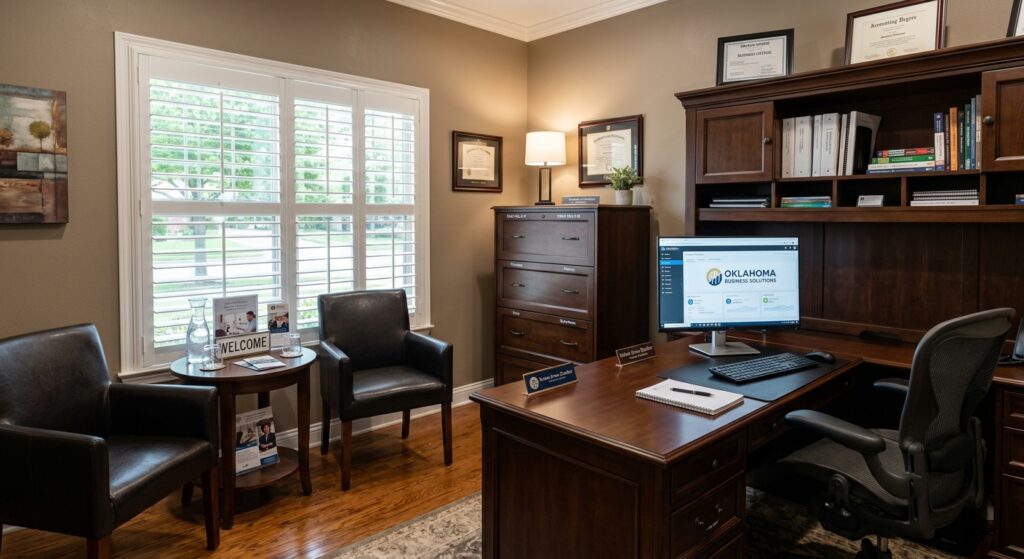
2026 Broken Arrow Home Office Audit Defense: Your Complete Protection Guide
In 2026, Broken Arrow business owners claiming home office deductions need a comprehensive broken arrow home office audit defense strategy. The IRS workforce has shrunk by 25-27%, yet automated audit filters are more aggressive than ever. This guide reveals exactly what you need to know to defend your home office claim and avoid costly penalties this tax year.
Table of Contents
- Key Takeaways
- Why 2026 Is High-Risk for Home Office Audits
- How the IRS Targets Home Office Deductions in 2026
- Critical Documentation Requirements for Broken Arrow Taxpayers
- Calculating Your Home Office Deduction: Simplified vs. Regular Method
- How Does Home Office Deduction Interact With Entity Structure?
- Step-by-Step: What to Do If You’re Audited in Broken Arrow
- Uncle Kam in Action: Real Audit Defense Success Story
- Next Steps
- Frequently Asked Questions
Key Takeaways
- IRS audit risk for home office claims is elevated in 2026 due to staffing cuts and aggressive automated systems.
- Maintain meticulous documentation: square footage, utility receipts, photos, and exclusive-use proof.
- The simplified method ($5 per square foot) offers audit protection; regular method requires detailed expense tracking.
- Broken Arrow business owners should respond promptly to any IRS notice and involve a professional immediately.
- Entity structure (LLC vs. S Corp) can affect how your home office deduction is claimed and audited.
Why 2026 Is High-Risk for Home Office Audits
Quick Answer: The IRS workforce has shrunk by 25-27% in 2026, yet automated audit systems are more aggressive. This creates a perfect storm: fewer human reviewers but more computer-flagged returns, meaning your home office claim faces higher scrutiny with less opportunity for reasonable explanation.
The 2026 tax year presents unprecedented challenges for Broken Arrow home office deduction filers. The Internal Revenue Service has reduced its workforce from approximately 100,000 employees down to roughly 75,000 staffers as of April 2026. This 25-27% reduction fundamentally changes how audits are conducted and which returns get flagged.
What this means in practice: fewer IRS agents are available to manually review cases, so the agency has increasingly relied on automated computer algorithms to identify suspicious returns. Home office deductions are among the most commonly flagged deductions in these systems, particularly when they appear inconsistent with the business type, income level, or regional norms.
Additionally, the One Big Beautiful Bill Act introduced new tax breaks for tips and overtime income in 2025-2026. Taxpayers who combine these new deductions with home office claims create a “multi-deduction profile” that triggers even more aggressive automated filtering. The IRS received over 99.8 million tax returns by early April 2026, and processing this surge with minimal staff has created system strain.
IRS Resource Constraints Create Opportunity and Risk
The paradox of 2026 is this: while IRS staff levels are historically low, enforcement is highly automated and statistical. The agency released final guidance on April 11, 2026, naming 70+ occupations eligible for the new tips deduction. This clarification created confusion and last-minute filing changes, straining IRS computer systems and increasing the likelihood of correspondence audits for home office claims combined with these new deductions.
How the IRS Targets Home Office Deductions in 2026
Quick Answer: The IRS uses computer filters to identify returns with home office deductions that are statistically unusual. Returns with large home office deductions relative to income, or those claiming multiple deductions (home office + tips + overtime), face the highest audit likelihood in 2026.
Understanding the IRS audit selection process is critical to defending your home office claim. In 2026, most home office audits begin with a computer-generated correspondence letter, not a field visit. The IRS sends these automated notices to taxpayers whose deduction patterns appear statistically unusual within their income bracket and industry.
The Red Flags That Trigger Home Office Audits
- Home office deduction exceeds 25% of gross business income (statistical outlier).
- Claimed square footage inconsistent with property records or home size.
- Home office deduction combined with tips, overtime, or other new 2026 deductions.
- Irregular or significantly increased deduction from prior years without documented business change.
- Claiming exclusive-use home office while also using the space for personal activities.
- Missing or incomplete Form 8829 (home office deduction worksheet).
Pro Tip: Many Broken Arrow taxpayers don’t realize that inconsistent home office deductions year-to-year are especially dangerous. If you claimed a $3,000 deduction in 2025 and suddenly jumped to $7,500 in 2026 without clear documentation of business expansion, you’ve flagged yourself for automated review.
Critical Documentation Requirements for Broken Arrow Taxpayers
Quick Answer: Document the exclusive and regular business use of your home office space. Maintain receipts for utilities, property tax allocation, depreciation records, and photos/floor plans proving your home office layout and exclusive-use status.
The foundation of any successful home office audit defense is documentation. In 2026, with IRS audits increasingly driven by automated systems and correspondence letters, your ability to provide complete, organized documentation determines whether you win or lose the dispute.
The Documentation Checklist: What You Must Keep
- Square Footage Documentation: Current floor plan, detailed measurements of home office space, and total home square footage. This is non-negotiable proof for the exclusive-use test.
- Utility Receipts: 12 months of electric, water, gas, and internet bills. These prove ongoing business use and support allocation methodology.
- Property Tax Records: Current property tax bill showing total home value and property square footage.
- Mortgage Interest/Rent Allocation: If using regular method, document how you allocated mortgage or rent to home office percentage.
- Depreciation Basis Schedule: Original home cost, acquisition date, and annual depreciation calculations (Form 4562).
- Exclusive-Use Proof: Photos of home office showing dedicated business furniture, computer setup, no personal items. Video walkthrough acceptable.
- Business Use Documentation: Business calendar, client meeting logs, emails showing home office as primary business location, or lease/contract with clients showing home office address.
- Repair and Maintenance Receipts: Itemized expenses for home office repairs, office supplies, equipment purchases, and maintenance work.
- Insurance and Property Tax Allocation: Documentation showing how you calculated the percentage allocated to home office.
In 2026, the average refund has reached $3,462 for all filers due to expanded deductions. If your home office claim is contributing significantly to a large refund, that amplifies audit risk. Your documentation must be so thorough and clear that an IRS agent cannot reasonably challenge the deduction without appearing to dispute objective facts.
Organizing Your Defense File: Best Practices
Create a dedicated folder (physical or digital) labeled “2026 Home Office Documentation.” Include: a cover memo explaining your business, floor plan with measurements, photos with dates, and all receipts organized by category. If audited, you should be able to email this entire file to the IRS within 24 hours. This level of preparedness changes the auditor’s perception of your credibility.
Calculating Your Home Office Deduction: Simplified vs. Regular Method
Quick Answer: For 2026, the simplified method allows $5 per square foot (up to 300 sq ft = max $1,500/year) with minimal audit risk. The regular method permits larger deductions but requires extensive documentation and carries higher audit probability.
The IRS offers two methods for calculating home office deductions: the simplified method and the regular method. In 2026, choosing the right approach can significantly impact both your deduction size and audit risk.
| Method | 2026 Calculation | Audit Risk | Documentation Required |
|---|---|---|---|
| Simplified Method | $5/sq ft × home office square feet (max 300 sq ft) | Low — Minimal IRS scrutiny | Square footage only; no depreciation recapture |
| Regular Method | Home office % × (mortgage interest + utilities + insurance + depreciation + repairs) | High — Requires detailed substantiation | All expenses, allocation calculations, depreciation schedules, receipts |
Example Calculation: A Broken Arrow business owner with a 200-square-foot home office would claim $1,000/year using the simplified method ($5 × 200 sq ft). Using the regular method with allocated utilities, insurance, and depreciation might yield $2,500 annually. However, that larger deduction comes with significantly higher audit probability in 2026.
Pro Tip: If your business income exceeds $100,000 annually and you have strong documentation, the regular method makes sense. If you’re under $100,000 or documentation is incomplete, the simplified method provides maximum audit protection while still yielding meaningful deductions.
How Does Home Office Deduction Interact With Entity Structure?
 Free Tax Write-Off Finder
Quick Answer: Sole proprietors claim home office on Schedule C; S Corp/LLC owners claim it on their entity tax return. The entity structure affects whether the deduction reduces self-employment tax and influences IRS audit patterns.
Your business entity structure affects both how home office deductions are reported and how the IRS audits them. Sole proprietors report home office deductions on Schedule C (Form 1040). S Corporation and LLC owners report them on the entity return (Form 1120-S or 1065).
The critical difference: sole proprietor home office deductions reduce self-employment tax; S Corp home office deductions do not (if you take a reasonable W-2 salary). This distinction becomes important in 2026 because the IRS views S Corp home office deductions with heightened skepticism—they wonder if you’re using it as a tax avoidance strategy.
Broken Arrow business owners operating as LLCs taxed as S Corps should be especially careful. If your home office deduction combined with a low W-2 salary creates a pattern suggesting you’re inflating business expenses to reduce self-employment tax, expect an audit.
Our LLC vs S-Corp Tax Calculator for Broken Arrow helps business owners determine which entity structure minimizes audit risk while optimizing tax savings for 2026. The home office deduction treatment differs significantly between structures, so this analysis is critical before year-end planning.
Step-by-Step: What to Do If You’re Audited in Broken Arrow
Quick Answer: Upon receiving an IRS notice, respond within 30 days, gather all documentation, and consider hiring a tax professional immediately. Do not contact the IRS without professional guidance.
Receiving an IRS audit notice triggers a precise timeline and set of required actions. In 2026, most home office audits begin with a correspondence letter requesting specific documentation by a deadline (typically 30-60 days). Here’s your step-by-step response framework:
The Audit Response Timeline: Step-by-Step
- Step 1 (Day 1): Read the notice carefully. Note the specific items the IRS is questioning and the response deadline. Contact a tax professional or attorney immediately.
- Step 2 (Day 2-3): Gather all requested documentation. Use the checklist provided earlier in this guide. Organize chronologically and by category.
- Step 3 (Day 4-7): Prepare a cover letter explaining your business, home office use, and how the deduction was calculated. Include a narrative describing exclusive business use.
- Step 4 (Day 8-14): Submit all documentation to the IRS via certified mail or online upload (if directed). Keep copies for your records.
- Step 5 (Day 15-30): Follow up with the IRS if you don’t receive acknowledgment. Request written confirmation of receipt.
- Step 6 (Post-Response): Do not contact the IRS again unless they request additional information. Let your professional representative handle all communication.
Pro Tip: The first 10 days are critical. Hiring a professional immediately signals you’re serious and knowledgeable. It also prevents you from making statements to the IRS that could later be used against you. In 2026, with staff shortages, correspondence audits can take 60-90 days to resolve. Don’t rush your response—provide complete documentation the first time.

Uncle Kam in Action: Real Audit Defense Success Story
Client Profile: Sarah, a Broken Arrow-based digital marketing consultant operating as an LLC taxed as an S Corp, claimed a $4,200 home office deduction for her 2025 tax return using the regular method. Her business generated $185,000 in annual revenue, and her home office was her primary client meeting location.
The Challenge: In April 2026, Sarah received an IRS correspondence audit notice questioning whether the deduction was legitimate. The automated system flagged her return because: (1) her home office deduction exceeded 2% of gross income, which seemed statistically high, and (2) her return also included new tips-related deductions from client entertainment expenses, triggering the multi-deduction flag.
Uncle Kam’s Solution: We immediately compiled Sarah’s documentation: floor plans showing 380 square feet of dedicated office space, 12 months of utility bills, exclusive-use photos showing professional setup, a business calendar proving 85% of her work occurred in that office, and detailed allocation calculations. We also prepared a narrative explaining how her client entertainment tips (which created the multi-deduction flag) were distinct from her home office business expense.
The Results: The IRS received our documentation package and, within 60 days, sent Sarah a letter accepting her home office deduction in full. The audit was closed with zero adjustments. Sarah’s initial investment in professional representation was $2,100, but it saved her from a potential $1,260 in additional taxes plus penalties and interest (roughly 4-5x ROI). More importantly, the professional handling of her audit response prevented future examination risk—the IRS’s records now show she maintained complete documentation and responded promptly and thoroughly.
This case illustrates why proactive broken arrow home office audit defense preparation is essential in 2026. The IRS is resource-constrained but statistically aggressive. When you respond with comprehensive, organized documentation, you signal you’ve done your homework, and the agency closes the case.
Next Steps
Your 2026 home office audit defense begins now, not when you receive an IRS notice. Take these immediate actions:
- Create Your Documentation File: Use the checklist provided in this guide. Gather floor plans, photos, receipts, and utility records. Organize digitally for easy IRS submission.
- Review Your Entity Structure: Evaluate whether your current business entity optimizes your home office deduction treatment. Consult our Broken Arrow tax preparation specialists if considering an entity change before year-end.
- Calculate Your Deduction: Determine whether simplified ($5/sq ft) or regular method yields the larger defensible deduction for your situation.
- Schedule a 2026 Tax Review: Meet with a tax professional to ensure your home office claim is documented, defensible, and optimized for your income level and business structure.
Frequently Asked Questions
Q: Does claiming a home office deduction automatically trigger an IRS audit in Broken Arrow in 2026?
A: Not automatically, but audit risk is elevated in 2026 due to IRS staffing cuts and automated filtering. The risk depends on your deduction size relative to income, business type, and whether you combine the home office deduction with other high-risk deductions (tips, overtime). Conservative claims with solid documentation face minimal audit risk.
Q: What’s the maximum home office deduction I can claim in 2026 without raising red flags?
A: There’s no absolute limit, but deductions exceeding 8-10% of your gross business income invite scrutiny. If you earn $150,000 annually, a $15,000 home office deduction is reasonable; a $50,000 deduction is not. The simpler method limits you to $1,500/year (300 sq ft × $5), which is universally defensible.
Q: If I’m audited, should I respond directly to the IRS or hire a professional?
A: Hire a professional immediately. In 2026, with IRS staffing shortages, correspondence audits are increasingly impersonal and procedurally rigid. A tax professional or attorney ensures your response meets all technical requirements, includes complete documentation, and prevents you from making statements that could extend the audit. The professional fee typically pays for itself through reduced audit adjustment risk.
Q: How far back can the IRS audit my home office deduction?
A: Typically 3 years (the standard statute of limitations). However, if the IRS believes you negligently or intentionally disregarded tax law, the statute can extend to 6 years or longer. This is why accurate documentation and conservative deduction calculations matter for multiple years, not just the current year.
Q: Can I deduct my entire home if I use it exclusively for business?
A: No. The “exclusive use” test means you can only deduct the portion of the home actually used for business. If you have a 3,000 sq ft home with a 250 sq ft dedicated office, you deduct only the office portion. The exclusive-use test is strictly enforced and frequently disputed in audits.
Q: Are home office supplies and equipment deductible in addition to the home office deduction?
A: Yes, absolutely. Office supplies, computers, software, furniture, and equipment are separate from the home office deduction. These are deductible as business expenses on Schedule C or the entity return. However, keep receipts and document the business-use percentage for items used partially outside the office.
Q: What happens if I can’t find all my utility receipts for an audit?
A: Missing receipts significantly weaken your audit defense. Request duplicate statements from utility providers (most keep 7 years of records). If unavailable, provide bank statements showing utility payments. In worst-case scenarios, reasonable approximations can work if supported by affidavits, but this creates audit risk. Always maintain complete records going forward.
Q: If the IRS denies my home office deduction, can I appeal?
A: Yes, absolutely. You have appeal rights at multiple levels: IRS Appeals, the Tax Court, the District Court, or the Court of Claims. Most home office disputes settle at the Appeals level. An experienced tax professional dramatically increases your success rate in appeals, particularly for substantive documentation issues.
Q: Are there specific risks for S Corp or LLC owners claiming home office deductions?
A: Yes. The IRS views S Corp and LLC home office deductions with heightened scrutiny, especially if they’re combined with aggressive salary strategies or business loss positions. If your entity shows a loss but you claim a substantial home office deduction, expect examination. Ensure your W-2 salary is reasonable relative to business revenue.
This information is current as of April 20, 2026. Tax laws change frequently. Verify updates with the IRS or a professional if reading this later.
Related Resources
- Broken Arrow Tax Preparation Services
- Business Owner Tax Strategy
- Self-Employed Tax Planning
- Entity Structuring Strategies
- Comprehensive Tax Strategy Planning
Last updated: April, 2026

