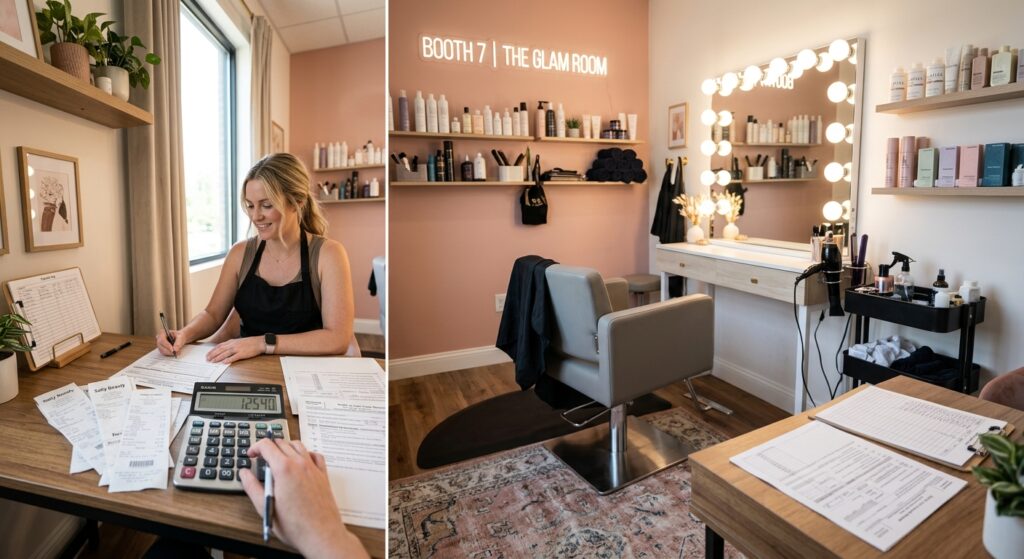
2026 Booth Rent, Chair Rental & Salon Suite Fees: What Can You Deduct as a Self-Employed Stylist?
For self-employed salon stylists and beauty professionals, understanding how to deduct booth rent, chair rental, and salon suite fees is critical for maximizing tax savings in 2026. Whether you work as an independent contractor in a salon booth, rent a chair in a shared salon space, or lease a private salon suite, these rental expenses represent one of your largest deductible business costs. The good news: the IRS allows you to deduct 100% of these legitimate business expenses on Schedule C before calculating your standard deduction, potentially saving thousands of dollars in federal income and self-employment taxes. This comprehensive guide reveals everything you need to know about 2026 salon rental deductions, documentation requirements, and strategies to keep more of your income.
Table of Contents
- Key Takeaways
- What Counts as a Deductible Salon Expense?
- How Much Can You Actually Deduct in Booth Rental Fees?
- Booth Rental vs. Chair Rental vs. Salon Suite: Which Is Best?
- How to Document and Track Your Deductions
- Booth Rental Deductions and Self-Employment Tax
- Common Mistakes Salon Stylists Make
- Uncle Kam in Action
- Next Steps
- Frequently Asked Questions
Key Takeaways
- Booth rent, chair rental, and salon suite fees are 100% deductible business expenses on Schedule C for self-employed stylists in 2026.
- You can deduct these rental fees even if you take the standard deduction ($16,100 for single filers in 2026).
- Self-employment tax rate in 2026 is 15.3%, but deducting booth rent reduces your income subject to SE tax.
- Documentation is critical—keep written rental agreements, monthly receipts, and payment records for audit protection.
- Related business expenses (supplies, utilities, insurance) may also be fully deductible alongside booth rental.
What Counts as a Deductible Salon Expense?
Quick Answer: The IRS considers booth rent, chair rental fees, and salon suite leases fully deductible “ordinary and necessary” business expenses. These direct rental costs reduce your taxable income dollar-for-dollar before self-employment and federal income taxes are calculated.
Under IRS guidelines, booth rental, chair rental, and salon suite fees qualify as ordinary and necessary business expenses. The key requirement is that the expense must be directly related to your salon business and must actually be paid. For self-employed stylists, this means your rental agreement establishes a clear business relationship where you pay a fixed monthly fee or per-client commission to a salon owner or suite operator in exchange for work space and access to salon amenities.
Types of Salon Rental Arrangements That Are Deductible
- Fixed Monthly Booth Rent: A set amount you pay each month regardless of client volume (e.g., $400/month for dedicated booth space).
- Commission-Based Arrangements: A percentage of your daily/weekly salon revenue paid to the salon (e.g., 35% commission on all services rendered).
- Chair Rental by Day/Hour: Per-chair rental fees for stylists who don’t maintain a permanent booth (e.g., $50/day for chair access).
- Private Salon Suite Lease: Monthly rent for exclusive use of a fully-equipped salon suite (e.g., $800-$1,500/month depending on location and amenities).
- Shared Salon Space: Co-rental of salon space with other stylists where you split monthly lease (e.g., $600/month for shared 4-person salon).
Related Expenses You Can Bundle with Booth Rental
Beyond basic booth rent, the IRS allows deductions for related salon business expenses paid alongside your rental arrangement. These include liability insurance required by the salon owner, salon utilities (if included in your rental fee), cleaning and maintenance supplies, booth setup supplies, and product storage costs. If your salon suite lease includes Wi-Fi, reception services, or appointment scheduling software, these embedded service costs are also deductible as part of your space rental. The critical distinction is that these expenses must be directly connected to your rented salon space and not personal in nature.
How Much Can You Actually Deduct in Booth Rental Fees?
Quick Answer: You can deduct 100% of all booth rent, chair rental, and salon suite fees you actually pay, with no dollar limit. There is no IRS cap on salon space rental deductions for 2026. Charlotte-based stylists should use our Small Business Tax Calculator for Charlotte to estimate exact tax savings from your specific rental expenses.
The IRS allows self-employed stylists to deduct 100% of documented booth rental, chair rental, and salon suite fees with no statutory limit. Unlike retirement contributions or health insurance premiums that have annual caps, salon space rental is fully deductible for any amount you legitimately pay. For example, if you pay $500/month in booth rent ($6,000 annually) or $800/month in salon suite fees ($9,600 annually), the entire amount reduces your taxable income on Schedule C.
Why Booth Rental Deductions Are Powerful
Booth rental deductions are among the most valuable tax breaks for salon professionals because they reduce income on multiple tax fronts. First, booth rent lowers your Schedule C net profit, which directly reduces your federal income tax liability. Second, booth rental expenses reduce your self-employment tax base. In 2026, the SE tax rate is 15.3% (12.4% for Social Security plus 2.9% for Medicare). When you deduct $6,000 in booth rent, you save approximately $918 in self-employment tax alone ($6,000 × 15.3%), plus your marginal federal income tax rate (12%, 22%, or higher depending on total income). The combined savings from a single $6,000 booth deduction could total $1,200 to $2,000 or more depending on your tax bracket.
Pro Tip: In 2026, self-employed stylists can deduct one-half of their self-employment tax as an above-the-line deduction on Form 1040. Combined with booth rent deductions, this creates a powerful income reduction. For example: $6,000 booth rent × 15.3% SE tax = $918 in SE tax. Then deduct 50% of your total SE tax ($459 in this example) on the 1040. This layering of deductions maximizes your tax savings.
Commission-Based vs. Fixed Rent: Tax Implications
Some stylists work under commission arrangements (e.g., paying 30-40% of daily revenue to the salon owner) rather than fixed monthly rent. In this scenario, the IRS treats your commission payment as a fully deductible business expense. If you generate $2,000 in weekly salon revenue and pay 35% commission, you deduct $700/week ($36,400 annually). This is reported on Schedule C as “Salon Commission Paid” or “Space Rental.” Commission arrangements offer tax flexibility because your deduction automatically scales with your income—higher revenue weeks = higher deductions—which can provide better tax planning in variable income months.
Booth Rental vs. Chair Rental vs. Salon Suite: Which Is Best for Your 2026 Taxes?
Quick Answer: From a tax perspective, all three arrangements offer identical deduction benefits—100% of rental costs are deductible. However, salon suite fees offer additional tax advantages because you can also deduct utilities, insurance, and related business expenses that may not be available in shared booth rental scenarios.
All three salon arrangement types offer full deductibility of rental costs. The tax advantage differences lie in what additional business expenses you can claim alongside your primary rent or commission payment.
| Arrangement Type | Monthly Cost Example | Tax Deductibility | Additional Deductions Available |
|---|---|---|---|
| Shared Booth Rental | $300-$600/month | 100% deductible | Limited (salon owner handles utilities/insurance) |
| Chair Rental (Daily) | $40-$80/day ($800-$1,600/month) | 100% deductible | Limited (as with shared booth) |
| Private Salon Suite | $800-$1,500/month | 100% deductible | Extensive (utilities, insurance, supplies, signage) |
Private Salon Suite: Maximum Deduction Potential
If you operate a private salon suite, your deductions extend significantly beyond the base lease payment. You can deduct utilities (electric, water, internet), business liability insurance, salon equipment purchases, cleaning and sanitizing supplies, professional product inventory storage, appointment booking software, signage and branding materials, and business phone lines. A stylist paying $1,000/month for a salon suite might deduct an additional $200-400/month in utilities and supplies, totaling $14,400 to $16,800 in annual deductions—dramatically reducing taxable income compared to a shared booth arrangement.
How to Document and Track Your Deductions for 2026 Taxes
Quick Answer: The IRS requires written proof that you paid booth rental fees. Keep your signed rental agreement, monthly invoices, bank statements showing payments, and cancelled checks or credit card receipts. Maintain this documentation for at least seven years in case of audit.
Proper documentation of booth rental payments is critical because the IRS scrutinizes self-employed deductions more closely than W-2 employee deductions. If you cannot produce evidence that you paid booth rent, you cannot deduct it—even if the payments were legitimate. The audit risk for self-employed stylists is measurably higher than for salaried workers, making documentation your best defense against tax complications.
Required Documentation Checklist
- Written Rental Agreement: A signed contract between you and the salon owner or suite operator specifying the monthly fee, payment terms, services included, and term length. Even informal agreements should be documented in writing.
- Monthly Invoices or Receipts: The salon owner or property manager should provide monthly invoices or receipts showing the rental amount and payment due date. Keep copies of all 12 months of invoices for each year.
- Bank Records Showing Payments: Bank statements, cancelled checks, credit card statements, or payment app records (Venmo, PayPal, Square Cash) showing that you actually paid the rental amount. This is critical evidence of legitimate business expense.
- Email Confirmations: Save email confirmations of payments, payment reminders, or correspondence about booth rental arrangements. Emails can establish the business relationship and payment history.
- Mileage Log (If Applicable): If you drive to multiple salon locations, maintain mileage logs showing dates, locations, and business purposes. This supports your claim of active business operations.
Best Practices for Record Keeping
Create a dedicated folder (physical or digital) for all salon business documents. Organize by year and by month, with separate sub-folders for rental agreements, invoices, and payment records. Use accounting software like QuickBooks Self-Employed, FreshBooks, or Wave to automatically categorize booth rent expenses and generate reports. These tools create timestamped records that are particularly helpful if the IRS requests substantiation. Additionally, take screenshots or digital photos of important receipts and agreements, storing them in cloud-based backup (Google Drive, Dropbox, OneDrive) to prevent loss due to computer failure or physical damage. The IRS is more likely to accept deductions that are well-organized and contemporaneously documented.
Booth Rental Deductions and Self-Employment Tax: How These Work Together in 2026
 Free Tax Write-Off Finder
Quick Answer: In 2026, the self-employment tax rate is 15.3% on net self-employed income. Booth rental deductions reduce the income subject to this 15.3% tax, creating significant savings alongside federal income tax reductions.
Self-employed stylists must understand how booth rental deductions interact with self-employment tax. When you file Schedule C and Schedule SE (Self-Employment Tax), your booth rent deduction reduces net self-employment income, which is the income subject to the 15.3% SE tax. This creates a cascading tax benefit: booth rent reduces federal income tax AND self-employment tax.
Self-Employment Tax Savings Calculation Example
Imagine a Charlotte salon stylist earning $50,000 in gross client revenue for 2026. Without deductions, Schedule SE would calculate SE tax as: $50,000 × 92.35% (net self-employment income %) × 15.3% SE tax rate = $7,070 in self-employment tax.
Now subtract $6,000 in booth rent: ($50,000 – $6,000) × 92.35% × 15.3% = $5,868 in self-employment tax. The booth rent deduction saves $1,202 in SE tax alone. Additionally, the stylist deducts 50% of SE tax ($2,934) on Form 1040, further reducing federal income tax. In the 22% federal tax bracket, this additional deduction saves $646 in federal income tax. Total savings: $1,848 from a $6,000 deduction.
Pro Tip: Commission-based arrangements offer more tax flexibility than fixed booth rent because your SE tax deduction scales automatically with income. Higher-revenue months = higher SE tax savings. If you have variable monthly income, consider negotiating a commission-based arrangement (e.g., 35% of daily revenue) rather than fixed monthly rent to maximize tax benefits during high-income periods.
Common Mistakes Salon Stylists Make with Booth Rental Deductions
Quick Answer: The most common mistakes are failing to claim deductions (leaving money on the table), commingling personal and business expenses, and lacking written documentation. Avoid these to protect your deductions and reduce audit risk.
Mistake #1: Not Claiming Any Booth Rental Deduction
Many stylists pay booth rent without deducting it on Schedule C, either because they don’t realize it’s deductible or they fear IRS scrutiny. This is a costly error. If you pay $6,000 annually in booth rent and file without claiming the deduction, you overpay federal and SE tax by $1,848 or more (depending on tax bracket). Over a five-year career, this represents nearly $10,000 in unnecessarily paid taxes. The IRS expects self-employed individuals to claim legitimate business deductions. Not claiming booth rent raises audit flags because your Schedule C income looks artificially high.
Mistake #2: Deducting Personal or Non-Business Expenses
The IRS strictly prohibits deductions for personal expenses disguised as business costs. Stylists sometimes attempt to deduct personal items (clothing worn while working, personal grooming products, home internet used partially for personal use) as booth rental-related expenses. This is incorrect and invites audit penalties. The rule is straightforward: an expense is only deductible if it is ordinary, necessary, and exclusively business-related. Your booth rental is fully deductible, but your personal outfit is not. Your salon supplies and professional products are deductible, but your personal beauty products are not.
Mistake #3: Lacking Written Documentation
Many stylists pay booth rent informally—handing cash or payment apps to a salon manager—without obtaining written receipts or formal agreements. When audited, they cannot produce evidence of payment, forcing the IRS to disallow the deduction. Always request a written rental agreement at the start of your arrangement, even if the salon operates informally. Get monthly invoices or receipts. Save bank statements showing payments. Without documentation, even legitimate $6,000 booth rent deductions can be completely disallowed by the IRS.
Mistake #4: Mixing Commission and Tips
Some stylists confuse commission paid to the salon (a business deduction) with tips received from clients (business income). Under the One Big Beautiful Bill Act, tips are reportable income that can be deducted up to $25,000 annually under a new tax provision. Commission payments are always fully deductible. Never net these against each other. Report all salon revenue (before commission) as income, then deduct the full commission amount separately. This distinction becomes critical if you’re audited, as the IRS scrutinizes tip deductions closely and expects clear income/expense separation.

Uncle Kam in Action: How One Charlotte Salon Stylist Saved $2,340 in Taxes
Meet Jasmine, a 28-year-old salon stylist operating out of a private salon suite in Charlotte, North Carolina. She generates approximately $55,000 in annual salon revenue through hair coloring, styling, and treatment services. When Jasmine filed her 2025 taxes (for tax year 2025), she worked with an accountant to organize her business finances. However, her filing that year was incomplete—she claimed only $2,000 in deductions (for supplies) and completely overlooked her salon suite rental expenses.
Recognizing the error, Uncle Kam’s team reviewed Jasmine’s 2026 tax situation and helped her implement a comprehensive deduction strategy. Her annual salon suite lease was $10,800 ($900/month). Additionally, she paid $1,800 annually for utilities, $1,200 for liability insurance, and $800 for salon supplies and cleaning products. Total deductible salon expenses: $14,600.
By properly deducting these business expenses on Schedule C, Jasmine’s net Schedule C income dropped from $55,000 to $40,400. This $14,600 reduction generated tax savings across multiple categories:
- Self-employment tax savings (15.3% rate): $2,236
- Federal income tax savings (22% bracket): $1,815
- One-half SE tax deduction on Form 1040 (22% bracket): $247
- Total First-Year Tax Savings: $2,340
Jasmine invested $500 in working with Uncle Kam to organize her deductions and file amended returns for prior years, receiving refunds totaling $3,100. Her ongoing annual tax savings of $2,340 represent a 4.7x return on that initial investment in her first year alone. More importantly, Jasmine now maintains proper records and documentation, reducing audit risk and ensuring she claims every deduction she’s entitled to claim.
Jasmine’s success highlights a critical point: many salon stylists leave thousands of dollars in tax deductions unclaimed each year. Booth rental, chair rental, and salon suite expenses are often the largest deductible costs for salon professionals. Proper documentation and professional guidance can transform your tax filing from leaving money on the table to maximizing every eligible deduction.
Next Steps
Now that you understand booth rental, chair rental, and salon suite fee deductions for 2026, take these action steps to maximize your tax savings:
- Gather Documentation: Collect your signed rental agreement, 12 months of monthly invoices, bank statements showing payments, and any email confirmations of your booth rental arrangement. Organize these chronologically.
- Calculate Total Deductible Expenses: Add up all booth rent, chair rental, salon suite fees, utilities, insurance, and related salon business expenses for 2026. Use spreadsheet or accounting software to track by month.
- Identify Related Deductions: Don’t just claim booth rent. Also deduct supplies, professional products, equipment, mileage to salon, and other salon-related business expenses that maximize your Schedule C net business loss or lower income.
- File Schedule C Correctly: Report all salon business revenue on Line 1 of Schedule C. Report booth rent on Line 27 (“Rent or Lease”) and related expenses on appropriate lines. Use Schedule SE to calculate self-employment tax on your net profit.
- Consult a Tax Professional: Given the complexity of self-employment tax and the audit risk for 1099 contractors, work with a CPA or enrolled agent experienced in salon and beauty industry taxes to ensure your return is filed correctly and defensibly.
Frequently Asked Questions
Can I Deduct Booth Rent If I Take the Standard Deduction?
Yes, absolutely. This is one of the biggest misconceptions among self-employed stylists. You can deduct 100% of booth rent on Schedule C even if you take the standard deduction on Form 1040. The standard deduction ($16,100 for single filers in 2026) replaces itemized deductions, not business deductions. Booth rent is a business deduction that reduces your Schedule C net profit before you ever calculate standard vs. itemized deductions. The IRS treats self-employment business expenses as above-the-line adjustments that reduce income before the standard deduction is applied. This means stylists benefit from both the standard deduction AND full booth rent deductions.
What If the Salon Doesn’t Give Me a Written Receipt?
Request one immediately, in writing. Send an email to the salon owner or manager stating: “For my tax records, I need a monthly invoice or receipt for my booth rental agreement showing my name, the rental amount ($XXX), and the month paid.” Save this email. If the salon refuses to provide receipts, this is a major red flag—you may be dealing with unreported income or an informal arrangement that lacks legal protection. Additionally, without receipts, you cannot substantiate deductions to the IRS. Bank statements and credit card records showing payments can partially substitute for receipts, but a written rental agreement and monthly invoices are still critical. If the salon refuses both, consider whether the arrangement is legitimate and properly structured.
Is There a Maximum Amount of Booth Rent I Can Deduct?
No. Unlike retirement contributions (capped at $23,500 for 401(k) in 2026) or health insurance premiums (limited for some high earners), booth rent has no dollar limit. Deduct 100% of what you actually pay. Whether you rent a booth for $300/month or lease an exclusive salon suite for $2,000/month, the entire amount is deductible with no IRS cap. The only requirement is that the amount must be reasonable for your geographic market and salon type. An extremely high salon suite rent in a rural area (e.g., $3,000/month when market rates are $800) might trigger audit scrutiny as unreasonable, but salon rents in major metropolitan areas (Charlotte, which has higher market rates than rural North Carolina) are generally accepted without question if documented.
Should I Report Booth Rent on Line 27 (Rent or Lease) or Elsewhere on Schedule C?
Booth rent should be reported on Schedule C Line 27 “Rent or Lease (see instructions).” This is the standard IRS line for space rental expenses. If you pay commission to the salon instead of fixed rent, you may report this on Line 27 as well, or on Line 24 “Commissions and Fees Paid” if that’s more descriptive. Most tax software has dropdown menus allowing you to select the category that best matches your expense. Check the Schedule C instructions to ensure proper line-item placement, but Line 27 is the default for booth and salon space rental for self-employed stylists.
What If I Work Part-Time in a Salon and Part-Time as a W-2 Employee?
You file both a W-2 (from your salon employee job) and a Schedule C (for your self-employed salon booth rental). Report W-2 income on Form 1040 Line 1, then attach Schedule C for your self-employed booth rental income and deductions. This is common for stylists transitioning from W-2 employment to self-employment or building an independent client base while working part-time. Self-employment tax (15.3%) applies only to your Schedule C net profit, not your W-2 wages. Your W-2 employer withholds FICA taxes already. You may also be eligible for the Earned Income Tax Credit (EITC) or other credits based on total household income, so work with a tax professional to optimize your overall return.
Can I Deduct Booth Rent for a Home Salon Studio?
If you operate a salon in your home (e.g., you rent a chair or room from a homeowner for your salon business), booth rent is still deductible. However, you cannot deduct the homeowner’s home office deduction as well—only one tax benefit applies. Additionally, home-based salons face zoning and licensing restrictions in many jurisdictions. Verify local zoning laws and business licensing requirements before deducting salon expenses for a home-based operation. If zoning violations exist, the IRS may disallow deductions as expenses for an illegal business. Ensure your home salon operates with proper licensing and permits before claiming booth rent deductions.
What Records Should I Keep for Audit Protection?
The IRS recommends keeping all business tax records for at least seven years (three years for routine audits, six years if income is understated by 25% or more, and indefinitely for fraud). For booth rental deductions specifically, maintain your signed rental agreement, all 12 months of monthly invoices or receipts, bank statements or credit card statements showing payments, email confirmations, and any correspondence about the rental arrangement. Store duplicates in cloud-based backup (Google Drive, Dropbox). If audited, produce these documents in organized chronological order. Well-documented records dramatically increase the likelihood that the IRS will accept your booth rent deduction without challenge. Disorganized or missing records often result in complete disallowance of the deduction.
Related Resources
- Self-Employed Tax Strategies for 1099 Contractors
- Comprehensive Tax Planning for Salon Owners and Stylists
- Business Entity Selection: Should You Form an LLC or S Corp?
- 2026 Tax Return Preparation and Filing Services
- Real Client Results: How We Help Beauty Industry Professionals Save Taxes
Last updated: April, 2026

