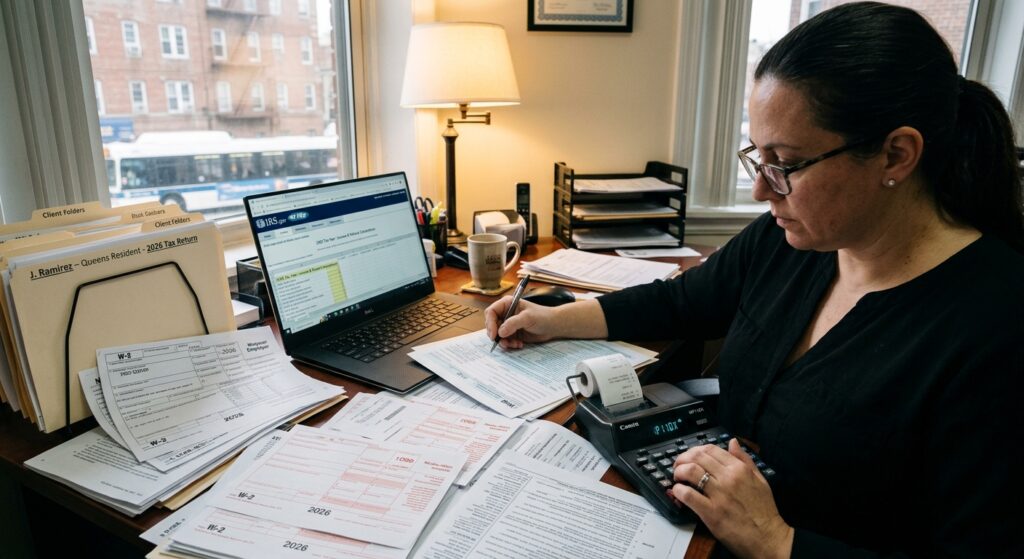
Queens Tax Preparation 2026: Complete Guide to New Tax Laws, Deadlines & Local Strategies

Queens Tax Preparation 2026: Complete Guide to New Tax Laws, Deadlines & Local Strategies
For the 2026 tax year, queens tax preparation requires understanding major changes from the One Big Beautiful Bill Act. Getting expert queens tax preparation guidance is critical when over 53 million Americans are now using new tax breaks that could increase your refund to an average of $3,462. Whether you’re a W-2 employee, 1099 contractor, small business owner, or real estate investor in Queens, New York, this comprehensive guide explains exactly what changed, who benefits most, and how to file strategically before April 15, 2026.
Key Takeaways
- Average 2026 refunds jumped 11% to $3,462 due to new Trump tax breaks under the One Big Beautiful Bill Act.
- April 15, 2026 is the critical filing deadline; extensions available until October 15 but taxes owed are still due April 15.
- New deductions for tips (up to $25,000), overtime pay, and enhanced senior deductions offer significant tax savings.
- IRS staffing cuts of 25-27% mean longer wait times; file early or use digital tools to avoid delays.
- Queens taxpayers should use digital filing, gather documents early, and work with credentialed tax professionals to maximize 2026 refunds.
Table of Contents
- What Changed in 2026 Tax Law for Queens Residents?
- How Much Can You Save? 2026 Refund Estimates for Queens Filers
- Who Qualifies for the New Deductions and Tax Breaks?
- How Can Small Business Owners in Queens Maximize 2026 Tax Savings?
- Step-by-Step: How to Prepare Your 2026 Taxes in Queens
- How Will IRS Staffing Cuts Impact Your 2026 Refund Timeline?
- How to Choose a Safe, Credentialed Tax Preparer in Queens
- Frequently Asked Questions About 2026 Queens Tax Preparation
What Changed in 2026 Tax Law for Queens Residents?
Quick Answer: The One Big Beautiful Bill Act introduced multiple new deductions in 2026. These include no federal tax on tips (up to $25,000), overtime pay deductions, enhanced senior deductions, expanded child tax credits, and new deductions for interest on American-made vehicle loans. Over 53 million Americans are now using these breaks.
For the 2026 tax year, the biggest change affecting queens tax preparation comes from the One Big Beautiful Bill Act, passed in July 2025. This sweeping tax legislation created opportunities that weren’t available in 2025, fundamentally reshaping how millions of Americans file and calculate their refunds.
The most significant change is the elimination of federal income tax on qualified tips. Queens residents who work in hospitality, food service, rideshare, personal care, or any tipped occupation can now deduct up to $25,000 in qualified tips from their federal taxable income. This deduction phases out for single filers earning above $150,000 and married couples earning above $300,000. For Queens workers, this typically means hundreds or even thousands in additional tax savings depending on your annual tip income.
New Overtime and Compensation Deductions
Approximately 25 million filers claimed overtime pay deductions for 2026, making this one of the most popular new provisions. If you earned overtime in 2026, a portion of that overtime compensation may now be deductible. This is particularly relevant for Queens workers in manufacturing, healthcare, public safety, and other industries where overtime is common. The deduction applies to W-2 employees who can document overtime hours and compensation on their W-2 forms.
Additionally, nearly 30 million seniors took advantage of an enhanced deduction that allows qualified individuals age 65+ to deduct up to $6,000 of income. This provision recognizes that many retired or semi-retired workers have continued employment income and need tax relief. Couples with dual income can benefit substantially from this deduction structure.
Child Tax Credits and Vehicle Interest Deductions
The expanded child tax credit benefited approximately 34 million families in 2026. If you have dependent children, this expanded credit likely increases your refund significantly. The credit applies per qualifying child and can result in refunds of hundreds of dollars per dependent. Queens families with multiple children should ensure they claim all eligible dependents.
A newer provision allows about 1 million filers to deduct interest paid on loans for new American-made vehicles. This encourages purchasing domestic vehicles while providing tax relief. If you financed a new American-made vehicle in 2026 or 2025, document the loan amount and interest paid for potential deduction eligibility.
How Much Can You Save? 2026 Refund Estimates for Queens Filers
Quick Answer: The average 2026 refund is $3,462, up 11% from 2025’s $3,116. Filers using at least one new tax provision saw average tax cuts of $800. Your actual refund depends on filing status, income, dependents, and which new deductions you qualify for.
Understanding potential refund amounts helps Queens residents prioritize tax preparation and make strategic decisions. According to 2026 IRS data, the average federal income tax refund reached $3,462, representing an 11% increase over the previous year’s $3,116. This $346 average increase reflects widespread adoption of the new tax provisions introduced by the One Big Beautiful Bill Act.
For Queens residents specifically, refund amounts vary significantly based on several factors. Filers who used at least one new tax provision saw average tax cuts of approximately $800. This means that compared to 2025 tax calculations, simply claiming one new deduction could add an average of $800 to your refund. Many Queens residents qualify for multiple new deductions, potentially increasing their total savings.
Pro Tip: Over 105 million filers claimed the expanded standard deduction in 2026. For 2026, the standard deduction is $29,100 for married filing jointly, $15,750 for single filers, and $22,800 for heads of household. Using the higher standard deduction alone reduces your taxable income compared to 2025, increasing your refund potential.
Sample 2026 Refund Scenarios for Queens Residents
| Filer Profile | 2025 Estimated Refund | 2026 Estimated Refund | Increase |
| Single W-2 Employee, $55K income, no dependents | $1,200 | $2,000 | +$800 |
| Married Filing Jointly, $85K income, 2 children | $2,500 | $4,100 | +$1,600 |
| Rideshare Driver (1099), $42K income, tipped work | $800 | $2,100 | +$1,300 |
| Senior Couple (MFJ), $65K income, age 67+ | $1,400 | $2,900 | +$1,500 |
These scenarios illustrate how different Queens residents benefit from 2026 changes. Note that actual refunds depend on withholding accuracy, deduction qualification, and specific income circumstances. The key insight is that nearly every filing status benefits from 2026 law changes, with tipped workers and families with dependents seeing the largest increases.
Who Qualifies for the New Deductions and Tax Breaks?
Quick Answer: Qualification depends on your occupation, income level, and filing status. Tipped workers earning under $150,000 (single) or $300,000 (married) can claim tip deductions. Overtime workers with W-2 documentation qualify. Senior filers age 65+ can claim enhanced deductions. Families with children qualify for expanded credits.
Determining who qualifies for each new 2026 tax break is essential to maximize queens tax preparation effectiveness. The qualification rules vary significantly by deduction type, income level, and filing circumstances. Understanding your eligibility prevents missed opportunities and ensures compliance.
Tip Deduction Eligibility in Queens
To claim the tip deduction, you must work in a qualified occupation as defined by IRS guidance for qualified tip deductions. Over 70 occupations qualify, including bartenders, restaurant servers, housekeeping staff, personal appearance specialists (hairstylists, makeup artists), personal trainers, tour guides, and transportation workers (taxi/rideshare drivers). If your job involves receiving customer tips, you likely qualify. The key requirement is that you actually received qualified tips documented on your W-2 form (Box 5 for tips). You can deduct up to $25,000 in annual qualified tips. The deduction begins phasing out at $150,000 for single filers and $300,000 for married filing jointly couples.
Overtime Pay Deduction Eligibility
W-2 employees who earned overtime in 2026 can qualify for overtime deductions. Your employer should have reported this on your W-2 form. Unlike tips, overtime deductions aren’t subject to income phase-out limits, making them valuable for higher-earning workers. You need documentation showing the hours worked and overtime rate. Many manufacturing, healthcare, public service, and hospitality workers in Queens qualify.
Senior Deduction Eligibility
If you were age 65 or older on December 31, 2026, you qualify for an enhanced deduction allowing you to deduct up to $6,000 of earned income. This applies to both W-2 employees and self-employed individuals with earned income. If you’re married filing jointly and both spouses are 65+, you can each claim up to $6,000. Approximately 30 million seniors claimed this deduction in 2026, recognizing that many retirees continue earning income.
How Can Small Business Owners in Queens Maximize 2026 Tax Savings?
Quick Answer: Small business owners should review 2026 deductions for business expenses, home office deductions, vehicle expenses, and retirement contributions. Using our Small Business Tax Calculator for Chelsea helps estimate 2026 tax savings before filing. Structure your business entity (sole proprietor, LLC, S-Corp) strategically.
Queens small business owners face unique tax planning opportunities in 2026. Whether you operate as a sole proprietor, LLC, partnership, or S-Corporation, strategic structuring combined with proper deduction documentation can dramatically reduce your tax burden.
For 2026, self-employed Queens business owners should prioritize claiming all qualified business deductions including home office expenses (square footage method or actual expense method), vehicle mileage deductions (actual miles driven for business purposes), equipment and supplies, professional services, and insurance premiums. Additionally, contributions to SEP-IRAs or Solo 401(k)s reduce both self-employment taxes and income taxes. The 2026 Solo 401(k) contribution limit is $24,500 for employees under 50, with higher limits for those 50 and older ($32,500).
Step-by-Step: How to Prepare Your 2026 Taxes in Queens
 Free Tax Write-Off Finder
Quick Answer: Gather documents by early March. Identify which new 2026 deductions you qualify for. Calculate your estimated refund. File electronically before April 15 to avoid IRS delays. Consider professional help given 2026 complexity.
For successful queens tax preparation in 2026, follow this step-by-step approach designed specifically for New York taxpayers navigating the new tax law changes and IRS processing challenges.
Step 1: Gather All 2026 Income Documents (January-February)
- W-2 forms from all employers showing wages, withholding, and tips (Box 5)
- 1099 forms for contractor income, freelance work, and gig economy earnings
- K-1 forms if you have partnership or S-Corp interests
- 1099-INT and 1099-DIV for interest and dividend income
- Mortgage interest statements (1098) and property tax records
- Business expense records and mileage logs
- Documentation of charitable contributions and medical expenses
- Child and dependent information for expanded tax credits
Step 2: Identify Your Qualification for New 2026 Deductions (February-March)
Review your documents to determine which new tax provisions apply to you. Do you have tips reported on a W-2? Did you earn overtime? Are you 65 or older? Do you have qualifying children or dependents? Each positive answer means additional tax savings. Write down the amounts for each deduction you qualify for before meeting with your tax professional or completing your return.
Step 3: Calculate Your Estimated 2026 Refund (Early March)
Using your documents and identified deductions, estimate your refund. Many tax software providers offer free estimates. This helps you understand the expected benefit and ensures you claim everything. Remember that the average 2026 refund is $3,462, so compare your estimate to ensure you’re not leaving money on the table.
Step 4: File Your Return Electronically by April 15 (Early-Mid April)
The IRS filing deadline for 2026 is April 15, 2026. File electronically, not by paper, to avoid delays. The IRS is processing returns from digital filing much faster than paper returns. Expect your refund to arrive within 21 days of successful electronic filing in most cases. If you’re not ready by April 15, file for a free tax extension using IRS Form 4868, but pay any estimated taxes owed by April 15 to avoid penalties.
How Will IRS Staffing Cuts Impact Your 2026 Refund Timeline?
Quick Answer: IRS workforce reduced 25-27%, but the agency claims filing season 2026 succeeded despite cuts. Average processing time under 231 days. File electronically early to avoid April bottlenecks. Expect longer phone wait times when calling the IRS.
The IRS experienced significant staffing reductions entering 2026, with the agency losing 25-27% of its workforce. More than 26,000 IRS employees departed, mostly through voluntary retirement incentives. This reduction raises legitimate questions about queens tax preparation timeline and service quality. However, the IRS claims that 2026 filing season proceeded smoothly, processing 134 million returns and issuing 80 million refunds.
The agency reduced planned technology modernization and shelved artificial intelligence projects to maintain core filing functions. For Queens residents, this means: expect longer wait times for phone support, but digital services like the IRS Where’s My Refund tool remain functional. Filing electronically is critical—paper returns face much longer processing times given reduced staff. Early filers avoid the April 15 bottleneck when millions of procrastinating taxpayers suddenly file simultaneously.
Pro Tip: Use the IRS Where’s My Refund tool at IRS.gov to check your refund status online without calling. This tool is 100% digital and doesn’t require speaking with a staffed IRS representative. You can check status 24/7, which is much faster than phone support given current staffing constraints.
How to Choose a Safe, Credentialed Tax Preparer in Queens
Quick Answer: Verify credentials: CPA, EA, or attorney. Check PTIN (Preparer Tax Identification Number) at IRS.gov. Avoid preparers promising specific refund amounts. Never sign blank returns. Ensure fee is transparent and reasonable.
Given the complexity of 2026 queens tax preparation with new deductions and IRS staffing challenges, working with a credentialed professional is prudent. However, choose carefully—fraudulent tax preparers cause millions in problems for unsuspecting clients annually.
Credentials to Verify
- CPA (Certified Public Accountant): Most credentialed option. Requires passing comprehensive exam and continuing education. Highly regulated.
- EA (Enrolled Agent): IRS-credentialed tax specialist. Requires passing IRS exam. Strong alternative to CPA for tax preparation.
- Attorney (JD): Tax attorneys specialize in complex situations. More expensive but appropriate for complex business tax planning.
- PTIN: All paid tax preparers must have a Preparer Tax Identification Number. Verify the number is current and valid at IRS.gov.
Red Flags to Avoid
| Red Flag Warning | Why It’s Dangerous |
| Preparer promises specific refund amount before reviewing documents | Impossible to estimate without full financial picture; indicates guessing or fraud |
| Preparer asks you to sign blank return pages | Preparer could alter information without your knowledge; you’re legally liable |
| Fee is percentage of refund or contingent on refund size | Creates incentive to inflate deductions illegally; violates IRS regulations |
| Preparer discourages you from reviewing completed return | Likely hiding errors or fraudulent entries; you remain legally responsible |
| Preparer lacks PTIN or won’t provide it | May not be registered; hard to hold accountable for errors or fraud |
Always insist on reviewing your completed return before signing. Ask questions about deductions claimed. A professional preparer welcomes your engagement and questions—they should be transparent about every line item on your return.

Uncle Kam in Action: How Sophia, a Queens Rideshare Driver, Saved $2,400 on Her 2026 Taxes
Client Snapshot: Sophia, 34, drives for a rideshare company in Queens three days a week while working a part-time hospitality job. Combined annual income from both jobs: $48,000. She has two dependent children ages 7 and 10.
The Challenge: When Sophia started working with Uncle Kam in early 2026, she’d been filing her taxes herself using generic tax software. For 2025, she received a $1,100 refund. She had no idea that new 2026 tax laws could increase her refund substantially. Additionally, she wasn’t properly documenting rideshare expenses or understanding which new deductions applied to her situation.
The Uncle Kam Solution: Our team conducted a comprehensive 2026 tax situation analysis for Sophia. We identified that she qualified for: (1) the new tip deduction for her hospitality job (approximately $3,500 in annual tips), (2) the expanded child tax credit for her two dependents, (3) proper documentation of vehicle mileage for her rideshare driving (tracked 12,000 business miles in 2026), and (4) home office deduction for her small space dedicated to business administration. We structured her filing using the new One Big Beautiful Bill Act provisions while ensuring every deduction was properly documented and defensible.
The Results:
- 2025 Refund: $1,100
- 2026 Refund (without professional help): Estimated $1,200 (minimal increase)
- 2026 Refund (with Uncle Kam strategy): $3,500
- Tax Savings vs. Generic Software: $2,300
- Uncle Kam Fee: $400 (All-in tax preparation service)
- First-Year ROI: 475% return on investment ($2,300 extra refund ÷ $400 fee)
Sophia’s case demonstrates how strategic queens tax preparation, paired with knowledge of 2026 changes, transforms a modest refund into substantial tax relief. She now works with Uncle Kam annually to optimize her tax position, ensuring she never misses available deductions or tax credits.
Next Steps to Maximize Your 2026 Queens Tax Preparation
- Gather documents immediately: Collect all W-2s, 1099s, and supporting documentation by early March to meet April 15 deadline.
- Identify your new 2026 deductions: Review which new tax breaks apply to your situation (tips, overtime, senior deduction, child credit).
- Estimate your refund: Use free tax software or consult with a professional to understand your expected refund before filing.
- Choose your filing method: Determine whether DIY software, free file options, or professional help best fits your situation complexity.
- File electronically before April 15: Electronic filing is faster and more reliable than paper, especially given IRS staffing constraints.
- Visit our Queens tax preparation services page to consult with credentialed professionals for personalized guidance on your specific situation.
Frequently Asked Questions About 2026 Queens Tax Preparation
What happens if I miss the April 15, 2026 filing deadline?
You can file a free extension using IRS Form 4868 by April 15, which gives you until October 15, 2026 to file your return. However, any taxes owed are still due April 15—the extension only applies to filing your return, not paying what you owe. If you owe money and don’t pay by April 15, you’ll owe interest and penalties. Filing an extension is free and simple using tax software or the IRS website.
How long will it take to receive my 2026 tax refund?
The IRS processes most electronically filed returns and issues refunds within 21 days. For 2026, the average processing time was under 231 days overall, but most refunds arrived much faster than that average. Use the IRS Where’s My Refund tool to check your specific status. Direct deposit to your bank account is fastest. Paper checks take longer, especially given IRS staffing constraints.
Can I claim tips on my 2026 taxes even if my employer didn’t report them on my W-2?
You should report all tips, whether or not they appear on your W-2. If tips are missing from your W-2, contact your employer’s payroll department immediately to request a corrected W-2. For 2026, tips must be reported by your employer in Box 5 of your W-2 to be deductible. You cannot simply claim tips without documentation. This is why proper tip tracking and employee-employer communication is critical for queens tax preparation.
Should I claim the standard deduction or itemize deductions on my 2026 return?
For most Queens residents, claiming the standard deduction is better. The 2026 standard deduction is significantly higher: $29,100 for married filing jointly, $15,750 for single filers, and $22,800 for heads of household. Unless your itemized deductions (mortgage interest, charitable contributions, property taxes, medical expenses) exceed these amounts, take the standard deduction. The 2026 increase in standard deduction amounts makes itemization beneficial only for higher-income filers with substantial deductible expenses.
What documents should I keep if I use new 2026 tax deductions like the tip or overtime deduction?
Keep your W-2 form (which documents both regular wages and tips/overtime reported by your employer). Additionally, maintain personal records including: tip logs or summaries showing daily tips received, overtime documentation showing hours worked and rates paid, business expense receipts for deductible items, vehicle mileage logs for business driving, and charitable contribution receipts. The IRS typically audits tax returns for three years after filing, so maintain records for at least three to four years. For significant deductions, keep records indefinitely.
As a small business owner in Queens, what’s the best way to structure my business for 2026 tax benefits?
Business structure optimization depends on your specific situation. Sole proprietors file Schedule C. LLCs can elect to be taxed as corporations (S-Corp or C-Corp) for potential self-employment tax savings. S-Corporations require paying yourself a reasonable W-2 wage, then taking remaining profit as distributions (potentially subject to lower tax rates). This is complex and requires professional guidance. The right structure depends on your income level, business profitability, number of owners, and long-term plans. Working with a tax professional or tax strategist ensures you choose the structure delivering maximum 2026 tax benefits.
How do the IRS staffing cuts affect my ability to get help if I have questions while preparing my 2026 taxes?
IRS phone lines are experiencing longer wait times due to staffing cuts (25-27% reduction). Rather than calling, use these digital resources: the IRS website (IRS.gov) has comprehensive guidance on 2026 tax law changes. The IRS Interactive Tax Assistant tool answers specific questions. The Where’s My Refund tool checks refund status without calling. Many tax preparation software providers offer live chat support. For complex questions, consulting with a tax professional is often faster and more reliable than trying to reach the IRS by phone during peak filing season.
What are the biggest mistakes Queens residents make when filing their 2026 taxes?
Common 2026 errors include: (1) Not claiming new deductions they qualify for (tips, overtime, senior deduction), leaving money on the table. (2) Providing incorrect Social Security numbers or names, causing processing delays. (3) Inconsistently reporting income across returns (claiming one income source on 1040 but a different amount on Schedule C). (4) Filing paper returns instead of electronically when given staffing constraints. (5) Miscalculating home office or vehicle deductions without proper documentation. (6) Using outdated software that doesn’t include 2026 tax law provisions. (7) Not separating business and personal expenses, resulting in missed deductions. Work with a tax professional to avoid these costly errors.
Related Resources
- Queens Tax Preparation Services
- 2026 Tax Strategy Planning for Maximum Refunds
- Self-Employed and 1099 Contractor Tax Solutions
- See How Our Clients Save on Taxes
- IRS Where’s My Refund Tool
This information is current as of April 20, 2026. Tax laws and IRS procedures change frequently. Verify all information with the IRS or a tax professional if reading this later in the tax year, as additional guidance or rule changes may have been issued.
Last updated: April, 2026

