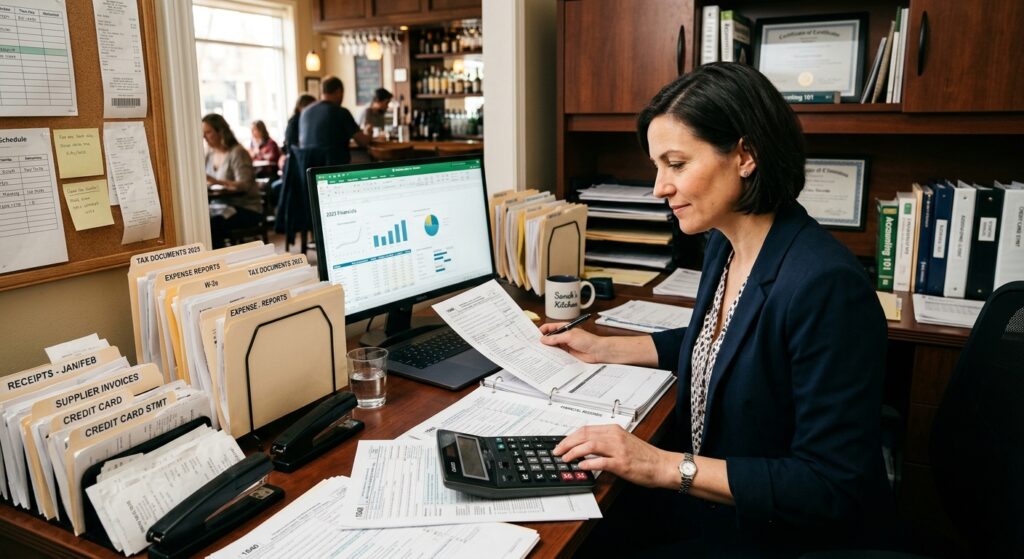
What Can a Restaurant Deduct on Taxes? 2026 Complete Guide for Business Owners
Understanding what can restaurant deduct on taxes is essential for maximizing your 2026 tax savings and staying compliant with the IRS. Restaurant owners can now take advantage of the groundbreaking $25,000 qualified tips deduction through 2028, available through restaurant owner tax write-offs and strategic deductions, plus hundreds of other eligible business expenses. This comprehensive 2026 guide reveals every deduction available to restaurant operators, from payroll costs to equipment purchases, and shows you how to properly document and claim these deductions to reduce your tax burden.
Table of Contents
- Key Takeaways
- What Is the New $25,000 Qualified Tips Deduction?
- How Do You Claim the $25,000 Qualified Tips Deduction?
- What Are the Standard Restaurant Business Deductions?
- Can You Deduct Equipment, Supplies, and Inventory?
- What Documentation Is Required for Tax Deductions?
- What Are Common Tax Deduction Mistakes Restaurants Make?
- Uncle Kam in Action
- Next Steps
- Frequently Asked Questions
Key Takeaways
- Restaurant employees can now deduct up to $25,000 in qualified tips for 2026, phasing out above $150,000 MAGI (single) or $300,000 (married)
- Tips must be voluntary customer payments reported on Form W-2, 1099, or Form 4137 to qualify
- Automatic service charges do not qualify as deductible tips
- Restaurant owners can deduct standard business expenses including labor, food costs, rent, and utilities
- The tips deduction is available for tax years 2025-2028 only under the One Big Beautiful Bill Act
What Is the New $25,000 Qualified Tips Deduction?
Quick Answer: For the 2026 tax year, eligible restaurant workers can deduct up to $25,000 in qualified tips from their taxable income through 2028 under the One Big Beautiful Bill Act (OBBBA), signed into law on July 4, 2025.
The groundbreaking qualified tips deduction represents one of the most significant tax changes for restaurant workers in recent years. For the 2026 tax year and through 2028, eligible workers in occupations that customarily receive tips can deduct up to $25,000 of qualified tips from their taxable income. This deduction applies whether you itemize or claim the standard deduction, making it accessible to virtually all qualifying workers.
To understand which tips qualify, the IRS finalized comprehensive regulations on April 10, 2026, clarifying that only voluntary tips paid directly by customers qualify for this deduction. The IRS groups eligible occupations into eight categories through the Treasury Tipped Occupation Code (TTOC) system, with the “Beverage and Food Service” category (100s) encompassing waiters, bartenders, busers, and kitchen staff.
Understanding Qualified Tips vs. Non-Qualifying Tips
Not all tip income qualifies for this deduction. Qualified tips must meet strict criteria. They must be paid voluntarily by customers in cash, check, credit card, debit card, or electronic payment. Customers must have complete discretion to add, modify, or disregard the tip amount. Importantly, automatic service charges do not qualify, even if they’re labeled as tips and distributed to staff.
For example, if a restaurant automatically adds an 18% service charge to large party bills with no customer option to remove or adjust it, those amounts distributed to servers do not qualify as deductible tips. However, if a customer voluntarily adds an additional gratuity beyond the automatic charge, that additional amount qualifies.
Income Phase-Out Thresholds for 2026
The qualified tips deduction begins to phase out at specific Modified Adjusted Gross Income (MAGI) thresholds in 2026. For single filers, the phase-out begins at $150,000 MAGI. For married couples filing jointly, the phase-out begins at $300,000 MAGI. Married individuals filing separately cannot claim this deduction at all.
Phase-out means that as your income rises above these thresholds, the maximum deduction amount you can claim decreases gradually. If your income significantly exceeds these thresholds, the deduction may be entirely eliminated. This structure targets the deduction benefit toward moderate-income service workers rather than high earners.
How Do You Claim the $25,000 Qualified Tips Deduction?
Quick Answer: Report your tip income on your tax return as normal (Form W-2 line 1 or Schedule C), then claim the deduction using the new IRS Schedule 1-A form for 2026 tax year filings.
Claiming the qualified tips deduction in 2026 involves a straightforward three-step process. First, ensure your tip income is properly reported on the correct forms. Second, calculate your deduction eligibility based on your MAGI and filing status. Third, use the new Schedule 1-A form to claim your deduction on your 2026 tax return.
Step 1: Verify Proper Tip Reporting
For employees, tips must be reported on your Form W-2 (wage statement) by your employer. The tips should appear in Box 5 (Medicare wages and tips) and Box 7 (Social Security tips). If you’re self-employed or work as a gig worker, you’ll report tips on your Schedule C (business income). Some workers may also need to use Form 4137 to report tips that weren’t reported to employers.
The critical requirement is that tips must be formally reported on one of the following IRS forms: Form W-2, Form 1099-NEC, Form 1099-MISC, Form 1099-K, or Form 4137. If your tips aren’t reported on any of these forms, they don’t qualify for the deduction under the 2026 rules.
Step 2: Calculate Your Eligibility
Calculate your MAGI to determine if you qualify for the full $25,000 deduction or if it phases out. Your MAGI starts with your adjusted gross income and includes specific add-backs. For most workers, MAGI equals your AGI, but some income adjustments may apply.
If your MAGI is below $150,000 (single) or $300,000 (joint), you can claim the full $25,000 deduction (up to the amount of tips you actually reported). If your MAGI exceeds these thresholds, the deduction phases out gradually, reducing your benefit. The IRS provides worksheets on Schedule 1-A to calculate your exact deductible amount.
Pro Tip: Self-employed restaurant workers face an additional limitation: the tips deduction cannot exceed your business’s net income (gross income minus deductible business expenses). If your business operates at a loss, you cannot claim the tips deduction that year.
Step 3: File Using Schedule 1-A
For the 2026 tax year, claim your qualified tips deduction on the new IRS Schedule 1-A form. This form specifically guides you through calculating your deduction based on your tip income, filing status, and MAGI. You’ll use our Small Business Tax Calculator for Rochester to estimate your potential tax savings from this deduction and plan accordingly.
Once you complete Schedule 1-A, you file it with your Form 1040. The deduction flows through to your income tax calculation, reducing your taxable income and your federal tax liability. Because this deduction is available whether you itemize or take the standard deduction, it provides substantial savings for eligible workers.
What Are the Standard Restaurant Business Deductions?
Quick Answer: Restaurant owners can deduct ordinary and necessary business expenses including labor costs, food and beverage purchases, rent, utilities, insurance, equipment maintenance, marketing, and licensed professional fees.
Beyond the employee tips deduction, restaurant owners can deduct a comprehensive range of standard business expenses. The IRS allows deductions for any ordinary and necessary expense you incur to operate your restaurant business. Understanding these categories helps you maximize your 2026 tax deductions and reduce your overall business tax liability.
Employee Compensation and Payroll Expenses
Labor costs represent the largest deductible expense for most restaurants. You can deduct wages, salaries, and bonuses paid to employees. Additionally, payroll taxes (Social Security, Medicare, unemployment insurance), workers’ compensation insurance premiums, and employee benefits are all deductible.
Training programs, uniforms, employee meals, and retirement plan contributions are also deductible. For owner-operators, reasonable compensation you pay yourself is deductible, though it must meet IRS reasonableness standards. Fringe benefits like health insurance contributions, 401(k) matches, and paid time off are deductible business expenses that reduce your taxable income.
Cost of Food, Beverages, and Supplies
The cost of all food and beverages you purchase for sale is deductible through your cost of goods sold (COGS) calculation. This includes all ingredients, prepared foods, beverages, condiments, and garnishes. Supplies for food preparation such as cooking oils, seasonings, and packaging materials are deductible.
Additionally, restaurant supplies like napkins, paper products, dishware, glassware, utensils, and linens are deductible. Cleaning supplies, cleaning services, and pest control are ordinary business expenses. These supply deductions significantly reduce your cost of operations and your final tax liability.
Facility Operating Costs
Rent or mortgage payments for your restaurant space are fully deductible. Utilities including electricity, water, gas, sewer, trash collection, and internet service are deductible operating expenses. Property taxes, liability insurance, property insurance, and health permits are all deductible.
Maintenance and repairs to your facility, equipment servicing, HVAC maintenance, and security systems are deductible. If you own your building, depreciation deductions on the building structure (though not the land) provide additional tax benefits. These facility costs form a substantial portion of your annual deductions.
Can You Deduct Equipment, Supplies, and Inventory?
Quick Answer: Equipment under $2,500 can be expensed immediately, while larger purchases are typically depreciated over several years, though Section 179 expensing may allow immediate deduction of larger purchases up to annual limits.
Restaurant equipment purchases receive favorable tax treatment. Items under $2,500 can be expensed immediately as a deduction in the year purchased. This includes small kitchen equipment, point-of-sale systems, furniture, and technology items. Larger equipment purchases like commercial ovens, refrigeration systems, cooking ranges, and dishwashing equipment are typically depreciated over time.
Section 179 expensing allows you to deduct larger equipment purchases immediately rather than depreciating them over years, provided the total doesn’t exceed annual limits. Bonus depreciation on qualified property provides additional deduction acceleration. These provisions make equipment investments more tax-advantaged in the year you purchase them.
Inventory Valuation and Deductions
Your ending food and beverage inventory is not deducted as an expense. Instead, you calculate your cost of goods sold (COGS) by adding beginning inventory plus purchases, then subtracting ending inventory. This method ensures you deduct only the food and beverages you actually used or sold during the year.
Proper inventory tracking is essential for accurate tax deductions. You should conduct physical inventory counts at year-end and maintain detailed records of all purchases. Items that spoil, expire, or become unusable should be properly documented, and some may qualify for additional deductions if they become worthless during the year.
What Documentation Is Required for Tax Deductions?
 Free Tax Write-Off Finder
Quick Answer: Keep receipts, invoices, bank statements, payroll records, and expense logs for all deductible items; the IRS can request documentation to substantiate any deduction claimed on your tax return.
Documentation is the foundation of defensible tax deductions. The IRS requires that you maintain records substantiating every deduction claimed on your tax return. For restaurant businesses, comprehensive documentation is particularly important because the IRS scrutinizes cash-intensive businesses more closely.
Essential Records to Maintain
Maintain receipts and invoices for all business purchases. Credit card statements, bank statements, and check registers document payment. Payroll records including pay stubs, W-2s issued, and payroll tax deposits substantiate employee compensation deductions. Lease agreements, mortgage statements, and property tax bills document facility costs.
Insurance policies and premium payment records document insurance deductions. Utility bills establish monthly facility operating costs. Equipment purchase receipts document capital items. Miles logs for business vehicle use and receipts for vehicle expenses substantiate transportation deductions. Meals and entertainment expense logs document these often-questioned deductions.
Pro Tip: Store digital copies of all receipts and invoices using cloud-based accounting software. The IRS generally accepts digital records if they’re retained in an accessible format. This reduces storage space and makes documentation retrieval easy during an audit.
Record Retention Period
The IRS generally requires that you maintain records for at least three years from the date you file your return. However, if you underreport income by more than 25%, the IRS can look back six years. If fraud is involved, there’s no time limit. For permanent assets, maintain records for the entire holding period plus three years after you sell or dispose of the asset.
For restaurant businesses, it’s prudent to maintain records for at least seven years given the cash-intensive nature and higher audit risk. Digital storage makes this practical without excessive physical space requirements. Organized record-keeping is your best defense against audit complications.
What Are Common Tax Deduction Mistakes Restaurants Make?
Quick Answer: Common mistakes include claiming automatic service charges as tips, failing to document meal and entertainment expenses, mixing personal and business expenses, overlooking depreciation deductions, and not properly calculating cost of goods sold.
Restaurant tax deductions offer substantial savings, but mistakes can trigger IRS audits and penalties. Understanding common pitfalls helps you avoid them. The most frequent errors involve misunderstanding what qualifies as deductible, poor documentation, and mixing personal with business expenses.
Confusing Automatic Charges with Tips
The most common 2026 mistake is claiming automatic service charges as deductible tips. Many restaurants add mandatory 18-20% service charges to large parties, assuming these are deductible tips. Under 2026 IRS rules, automatic charges do not qualify because customers have no discretion to modify or disregard them.
Only voluntary tips genuinely given by customers at their discretion qualify. If your restaurant policy adds automatic gratuities, train staff and management to separate these charges from actual customer tips. Documentation becomes critical—maintain records showing which tips are voluntary versus automatic to substantiate your deduction claims.
Inadequate Meal and Entertainment Documentation
Restaurant owners often claim meals with clients or business entertainment without proper documentation. The IRS requires contemporaneous written records for meal and entertainment deductions. You must document the date, location, purpose, attendees, and amount of each expense.
Simply having a receipt isn’t sufficient—you need a log or narrative explaining the business purpose. Without this documentation, the IRS will disallow these deductions. Meals provided to employees as a fringe benefit may have different rules, so consult a tax professional about your specific situation.
Overlooking Depreciation Benefits
Many restaurant owners purchase substantial equipment but fail to claim depreciation deductions or Section 179 expensing. This represents significant tax savings being left on the table. When you purchase ovens, refrigeration, kitchen equipment, POS systems, or furniture, these items qualify for deduction acceleration strategies.
Modern tax rules allow immediate expensing of many items through Section 179 or bonus depreciation provisions. Working with a tax professional ensures you properly classify and deduct all equipment purchases to minimize your 2026 tax liability.

Uncle Kam in Action: How One Restaurant Owner Recovered $18,500 in Tax Savings
Consider Sarah, who owns a successful farm-to-table restaurant in Rochester generating $950,000 in annual revenue with 15 employees. When Sarah first calculated her 2025 taxes, she claimed basic deductions and owed approximately $62,000 in federal income tax. She had no systematic approach to capturing available deductions and didn’t understand the new 2026 tax rules for restaurant businesses.
Sarah engaged Uncle Kam’s tax strategy team to optimize her 2026 tax position. Our analysis identified significant missed deductions. Her waitstaff earned $31,000 combined in tips annually, but she hadn’t claimed the new $25,000 qualified tips deduction for employees. Additionally, she had purchased $22,000 in kitchen equipment the previous year without claiming Section 179 expensing or depreciation benefits.
Sarah’s restaurant wasn’t capturing employee benefits as deductions—health insurance contributions, 401(k) matches, and training costs weren’t documented properly. Facility costs including utilities and maintenance weren’t systematically tracked. She was also mixing some personal expenses with business expenses.
Working with Uncle Kam, we implemented several strategies: (1) Established proper systems to document and claim the $25,000 employee tips deduction, generating $7,000 in tax savings; (2) Applied Section 179 expensing to equipment, creating $4,400 in immediate deductions; (3) Organized and documented all employee benefits properly, capturing $3,100 in previously missed deductions; (4) Implemented systematic tracking of utilities and facility maintenance costs, identifying $2,800 in captured expenses; (5) Separated personal from business expenses, removing $1,200 in non-deductible items.
Sarah’s total tax liability for 2026 decreased from $62,000 to $43,500—an $18,500 reduction in federal income tax. Her annual Uncle Kam tax strategy fee of $3,600 represented a 514% return on investment in the first year alone. More importantly, these strategies created a sustainable system for capturing deductions year after year, ensuring she never leaves tax savings on the table again.
Visit Uncle Kam’s restaurant owner tax write-off resources to implement similar strategies for your business today.
Next Steps
Take control of your restaurant’s tax position by implementing a comprehensive deduction capture system. Document all business expenses starting today—food purchases, utilities, payroll, equipment, and supplies. Establish separate business and personal bank accounts to eliminate commingling.
Calculate your team’s tip income to ensure it’s properly reported and claimed on Schedule 1-A forms where applicable. Review your 2026 equipment purchases for Section 179 expensing eligibility. Finally, schedule a consultation with our tax strategy team for business owners to develop a customized deduction strategy that maximizes your specific situation’s tax savings potential.
Frequently Asked Questions
Is the $25,000 tips deduction available for restaurant owners?
The $25,000 qualified tips deduction primarily benefits employees and workers who receive tips. Restaurant owners themselves can claim it if they personally receive tips in their role as servers or bartenders. However, owners can deduct tips their employees receive if properly documented and claimed by the employees on their returns. The deduction belongs to the individual receiving the tips, not the business owner, unless the owner also works as a tipped employee.
Can I deduct my own meals at my restaurant?
Meals you provide to yourself as the owner are generally not deductible as a business expense. However, free meals provided to all employees as a fringe benefit may qualify for deduction if they meet IRS requirements. Additionally, meals you provide while entertaining clients or conducting business discussions may be partially deductible (50% of meal costs) if properly documented with business purpose and attendees.
How do I calculate cost of goods sold (COGS) for my restaurant?
Calculate COGS using this formula: Beginning Inventory + Purchases – Ending Inventory = COGS. Take a physical inventory count at the beginning and end of your tax year. Add all food and beverage purchases during the year. Subtract your ending inventory value. This amount is your deductible cost of goods sold. Accurate inventory tracking and valuation is essential for this calculation.
What happens if automatic service charges are included with tips?
Automatic service charges do not qualify as deductible tips under 2026 rules. These charges must be segregated from voluntary customer tips. If your Point of Sale (POS) system combines automatic charges with voluntary tips, reconfigure it to track these separately. Provide clear reporting to employees showing automatic charges separately from voluntary tips. Only the voluntary portion qualifies for the deduction.
Are there deductions specifically for food service businesses?
Food service businesses qualify for standard business deductions plus specialized deductions. Specialized deductions include: perishable food spoilage losses, grease disposal and trap cleaning, commercial kitchen equipment repairs, food safety certifications and training, health permits and inspections, food service-specific uniforms and protective equipment, and commercial dishwashing service contracts. Work with a tax professional familiar with restaurant operations to ensure you capture all industry-specific deductions.
Can I deduct the cost of replacing broken glassware and dishes?
Yes, the cost of replacing broken or worn glassware, plates, utensils, and dining ware is a deductible business expense. These are ordinary and necessary supplies for restaurant operations. However, items with salvage value should be depreciated if they have a useful life exceeding one year. Small replacement items purchased regularly are typically expensed immediately as routine supplies.
What records should I keep for the tips deduction?
Maintain detailed records showing tip amounts received, the form on which tips are reported (W-2, 1099, Form 4137), the date tips were received, and documentation that tips were voluntary customer payments. Point of sale receipts showing customer signatures and tip lines provide good documentation. Separate records showing automatic service charges distinct from voluntary tips are critical. If the IRS audits your return, these records substantiate your claimed deduction.
Is the tips deduction available for 2026?
Yes, the $25,000 qualified tips deduction is fully available for the 2026 tax year. It was enacted in July 2025 and is retroactively available for 2025 tax year filings. The deduction will be available through 2028, then expires. If you’re filing your 2025 tax return in 2026, you can claim this deduction. For 2026 income earned this year, claim it when filing your 2026 return in 2027.
Related Resources
- Comprehensive Tax Strategy Services
- Tax Solutions for Business Owners
- 2026 Tax Preparation and Filing Services
- Entity Structuring for Restaurants and Food Service
- Restaurant Owner Tax Write-Off Guide
Last updated: April, 2026
Important Disclaimer: This information is current as of 4/13/2026. Tax laws change frequently. For your specific situation, consult with a qualified tax professional or CPA before making tax decisions. Uncle Kam provides tax education and strategy guidance but does not provide tax advice for individual returns without a professional engagement.

