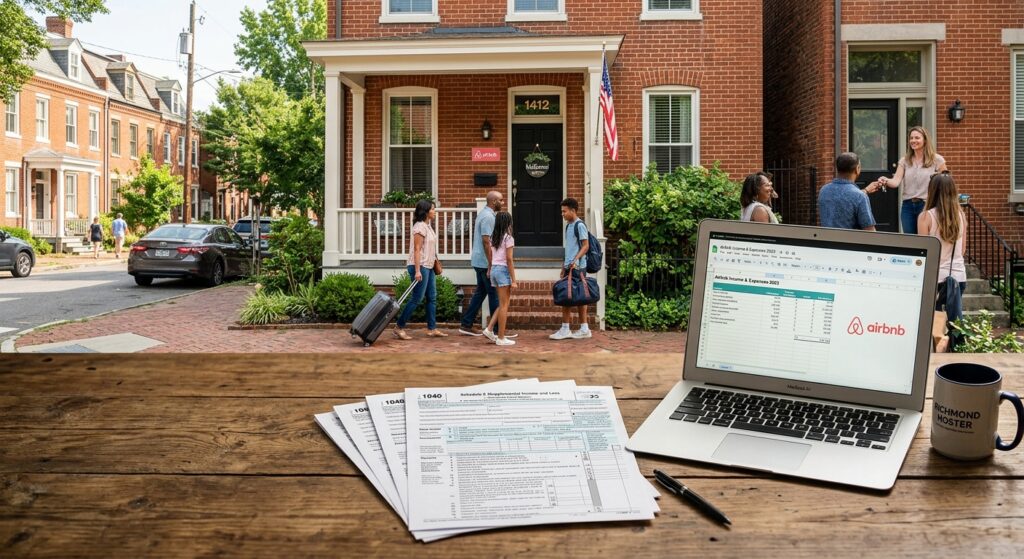
2026 Richmond Airbnb Taxes: Complete Guide for Hosts & Investors
Hosting on Airbnb in Richmond can be very profitable, but it also creates federal, Virginia, and local tax obligations you can’t ignore. This guide walks Richmond hosts and real estate investors through how Airbnb income is taxed in 2026, what forms you need, how Virginia and the City of Richmond treat short-term rentals, and how to legally reduce your tax bill.
Key Takeaways
- All Richmond Airbnb income is taxable and must be reported to the IRS, even if you don’t receive a 1099-K.
- Most active hosts use Schedule C, which makes net profit subject to self-employment tax (15.3% for 2026).
- Virginia taxes your Airbnb profit on your state return; there is no special exemption for short-term rentals.
- Richmond may require local registration and charges transient occupancy/lodging-type taxes on short stays.
- Careful expense tracking (utilities, cleaning, repairs, depreciation, etc.) can cut your federal and state tax bill dramatically.
How Federal Taxes Work for Richmond Airbnb Hosts
From the IRS’ perspective, it doesn’t matter that your property is in Richmond — your federal reporting follows the same rules as any other U.S. Airbnb. The key questions are: Is your rental a business or a passive investment? and how many days is it rented vs. personal use?
Schedule C vs. Schedule E
Most Richmond Airbnb hosts fall into one of two buckets:
- Schedule C (business income) – You actively manage the listing, communicate with guests, clean or coordinate cleaners, and provide hotel-like services (frequent stays under 30 days). Profits are subject to income tax and self-employment tax.
- Schedule E (rental income) – More “hands-off” rentals, often longer stays, sometimes managed by a third party. Profits are generally not subject to self-employment tax, but most true short-term Airbnbs don’t qualify.
If you’re providing substantial services (frequent cleaning, guest support, amenities similar to a hotel), the IRS usually treats this as a business reported on Schedule C (Form 1040). That’s the default for many Richmond hosts renting out a primary home, basement unit, or investment property on Airbnb.
The 14-Day Rule for Occasional Hosts
If you rent out your Richmond home or a room for fewer than 15 days in the year, and you also live there personally, federal law generally lets you treat that income as tax-free. You still may have Richmond zoning or permit rules to follow, but federally you don’t report that income. Once you hit 15 rental days or more, the income becomes taxable and must be reported.
Self-Employment Tax for Richmond Airbnb Hosts in 2026
Summary: If you’re on Schedule C and net at least $400 in profit, your Airbnb income is subject to self-employment tax (Social Security and Medicare) at a combined rate of roughly 15.3% for 2026, on top of regular income tax.
Self-employment tax is calculated on your net profit, not gross payout. Here’s the basic process:
- Start with your Schedule C net profit (Airbnb income minus expenses).
- Multiply that amount by 92.35% (the portion treated as self-employment earnings).
- Multiply by 15.3% to get your self-employment tax.
Example: A Richmond host nets $20,000 from an Airbnb near Scott’s Addition in 2026. Self-employment tax is about 20,000 × 0.9235 × 0.153 ≈ $2,825, plus regular federal and Virginia income tax on that same profit.
Planning tip: You can deduct half of your self-employment tax as an “above-the-line” deduction on your federal return, which slightly reduces your overall tax bill.
Airbnb Forms & 1099-K Thresholds
Payment platforms like Airbnb may issue a Form 1099-K or 1099 series form if you cross certain thresholds. Federal rules have shifted several times; always verify the current threshold on the IRS website when you file for 2026. Some key points:
- The 1099-K usually reports your gross payouts processed through the platform, not your net profit.
- Even if you do not receive any 1099 form, you are still required to report all Airbnb income.
- You should reconcile 1099 figures with your Airbnb transaction history and your own bookkeeping.
Gross vs. Net: Why Your 1099 Doesn’t Match Your Profit
| Item | Amount |
| Total payouts reported on 1099 (gross) | $30,000 |
| Less: Airbnb host fees, cleaning, utilities, repairs, etc. | $12,000 |
| Schedule C net profit you actually report | $18,000 |
The IRS expects to see at least the 1099 amount reflected somewhere on your return, but it also expects legitimate business expenses. Good documentation protects you in case of questions.
Virginia State Taxes on Richmond Airbnb Income
 Free Tax Write-Off Finder
Virginia taxes your taxable income after federal adjustments. Your Airbnb profit flows from your federal return onto your Virginia Form 760. There is no special state-level exemption for Airbnb or other short-term rentals:
- Net profit from Schedule C or Schedule E is included in your Virginia taxable income.
- Virginia uses a progressive rate schedule topping out at 5.75% for higher incomes.
- The same expenses you claim federally (utilities, supplies, depreciation, etc.) typically flow through and reduce Virginia taxable income as well.
If your Airbnb profits are significant, you may need to make quarterly estimated tax payments to Virginia to avoid underpayment penalties, especially if you don’t have enough withholding from a W‑2 job to cover them.
Richmond Local Rules: Registration & Lodging-Type Taxes
On top of federal and Virginia taxes, the City of Richmond may require:
- Short‑term rental registration or a business license for your Airbnb activity.
- Collection and remittance of transient occupancy, lodging, or similar taxes on guest stays under a certain number of days (often 30).
- Compliance with zoning rules (for example, primary-residence requirements or limits on whole‑home rentals in some neighborhoods).
Platforms like Airbnb sometimes collect and remit local occupancy taxes on your behalf, but they don’t always cover every locality or every type of tax. Richmond hosts should confirm current requirements directly with the city before assuming everything is handled at the platform level.
Common Tax Deductions for Richmond Airbnb Hosts
Every deductible expense reduces both your federal income tax and (if you’re on Schedule C) your self-employment tax. Typical deductible expenses include:
- Mortgage interest on the portion of the property used for Airbnb.
- Property taxes allocated to the rental use.
- Utilities (electric, gas, water, internet) for time/space used by guests.
- Cleaning and laundry (either your own cleaning supplies or professional cleaners).
- Repairs and maintenance to keep the space in good working order.
- Furniture, linens, and supplies used by guests.
- Depreciation on the building and major improvements, spread over time.
If you rent out only part of your Richmond home (for example, a spare bedroom in the Fan District), expenses must be allocated between personal and rental use. Allocation is typically based on square footage or number of rooms, and sometimes also by the number of days the space is rented.
Should Richmond Airbnb Hosts Use an LLC or S Corporation?
Many Richmond investors wonder if they should form an LLC for liability protection, and whether it makes sense to elect S corporation status for tax savings.
- LLC (legal protection): Helps separate business assets from personal assets if something goes wrong (for example, a guest injury claim). By itself, an LLC does not automatically reduce federal or Virginia income taxes.
- S corporation election (potential tax savings): For hosts with solid, consistent profits, electing S‑corp status and paying yourself a reasonable salary can reduce the portion of profit subject to self-employment tax.
Whether an S‑corp is right for you depends on your annual net profit, how many properties you own, and your comfort level with additional payroll and bookkeeping requirements. Many Richmond hosts find that S‑corp strategies begin to make sense when Airbnb net profits reach a healthy five‑figure level.

Frequently Asked Questions about Richmond Airbnb Taxes
1. Do I have to report my Richmond Airbnb income if I never got a 1099-K?
Yes. You must report all Airbnb income on your federal and Virginia returns, regardless of whether you receive any 1099 forms. The reporting threshold for 1099-Ks does not change your obligation to report income.
2. Is my Richmond Airbnb income subject to self-employment tax?
If you report activity on Schedule C and provide substantial services to guests, your net profit is generally subject to self-employment tax in addition to income tax. If you truly operate a passive, long-term rental, you may report on Schedule E instead, which usually isn’t subject to self-employment tax.
3. How do Richmond occupancy or lodging taxes affect my income taxes?
Local occupancy-type taxes are usually separate from income tax. You may collect them from guests and remit them to the city, or the platform may do it for you. They do not replace federal or Virginia income tax. Any city taxes you pay out of pocket can often be deducted as a business expense on your federal return.
4. Can I deduct a portion of my Richmond home if I only rent a room on Airbnb?
Yes. You’ll usually allocate expenses based on square footage (for example, guest room plus shared areas) and the number of days rented vs. personal use days. That portion of mortgage interest, property taxes, utilities, and other expenses becomes deductible against your Airbnb income.
5. Do I need an LLC to run an Airbnb in Richmond?
No, you’re not required to have an LLC; many hosts operate as sole proprietors. An LLC is mainly about legal and asset protection, not automatic tax savings. You should weigh setup and annual costs against the value of added protection and any financing or co‑owner considerations.
Tax rules can change and your facts matter. For personalized advice about Richmond Airbnb taxes in 2026, speak with a qualified tax professional who understands both federal and Virginia law.

