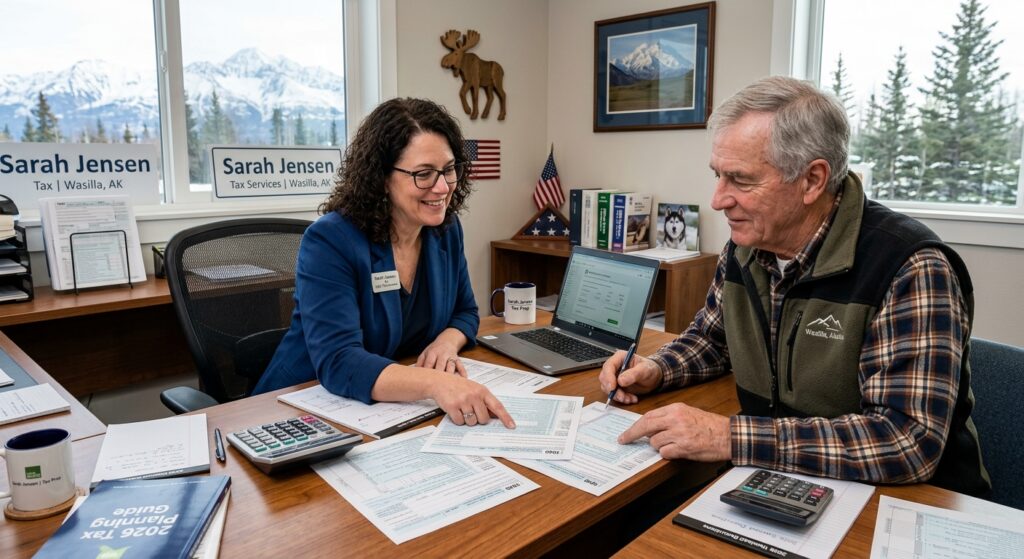
2026 Tax Preparer in Wasilla: Complete Guide to New Deductions, Credits & OBBBA Changes
For the 2026 tax year, working with a tax preparer in Wasilla has become more critical than ever. The One Big Beautiful Bill Act (OBBBA) introduced sweeping changes affecting how business owners, self-employed professionals, and employees file their returns. Wasilla residents benefit from Alaska’s lack of state income tax, but they must navigate new federal deductions for vehicle loan interest, overtime pay, qualified tips, and senior income—all with complex phase-out thresholds and reporting requirements.

Table of Contents
- Key Takeaways
- Why Hire a Tax Preparer in Wasilla for 2026?
- What Are the Major 2026 OBBBA Tax Changes?
- How Can You Claim Overtime Pay and Tip Deductions?
- What About the New Vehicle Loan Interest Deduction?
- How Much is the 2026 Senior Deduction?
- What Tax Strategies Should Wasilla Business Owners Use?
- Frequently Asked Questions
- Related Resources
Key Takeaways
- OBBBA introduces four new major deductions: overtime pay (up to $12,500 single/$25,000 joint), qualified tips (up to $25,000), vehicle loan interest (up to $10,000), and senior deduction ($6,000).
- A qualified tax preparer in Wasilla ensures proper Form W-2 reporting and avoids common mistakes that trigger IRS penalties.
- Alaska has no state income tax, but accurate federal filing and reporting remain critical for Wasilla residents.
- New vehicle loan interest deduction requires documentation: vehicle must be brand new, U.S.-assembled, and for personal use (50%+ of time).
- Nearly 20 million returns claimed the overtime deduction in 2026, but misreporting can result in substantial audit exposure.
Why Hire a Tax Preparer in Wasilla for 2026?
Quick Answer: The 2026 tax code is the most complex in years. OBBBA created four new deductions with strict eligibility rules, phase-outs, and reporting requirements. A qualified tax preparer in Wasilla navigates these rules, coordinates with employers on Form W-2 reporting, and identifies overlooked deductions that save you thousands.
The One Big Beautiful Bill Act fundamentally changed the 2026 tax filing landscape. Unlike previous years, you cannot simply replicate last year’s return strategy. Taxpayers who attempt to self-prepare risk costly errors, missed deductions, and audit triggers. A seasoned tax preparer in Wasilla brings four critical advantages to your 2026 filing.
Expert Navigation of 2026 OBBBA Rules
The OBBBA created unprecedented complexity. Between new deductions, modified phase-out thresholds, and separate Form W-2 reporting for tips and overtime, the margin for error is substantial. A tax preparer in Wasilla stays current on IRS guidance, understands the interaction of new provisions with existing tax law, and applies proven strategies to maximize your benefit while maintaining IRS compliance. For example, many Wasilla employees and contractors claimed overtime deductions in 2026 without understanding the “premium portion” rule or income phase-outs—exposing them to later audit adjustments. Professional preparation prevents this.
Coordination with Payroll and Employer Reporting
Beginning in 2026, employers must separately report qualified tips and overtime compensation on Form W-2. If your W-2 is incomplete or incorrectly prepared, your tax return cannot be properly filed. A tax preparer in Wasilla coordinates with your employer, reviews W-2 documentation for accuracy, and works with you to reconcile payroll records with your tax return. This coordination prevents delays, rejections, and penalty notices from the IRS.
Alaska Tax Advantage Planning
Wasilla residents enjoy a significant advantage: Alaska imposes no state income tax. This tax-free status creates unique planning opportunities unavailable to residents of other states. A local tax preparer in Wasilla understands how to structure entity elections, retirement contributions, and business deductions to maximize your federal savings within Alaska’s environment. Multi-state taxpayers (who earn income across states) require specialized expertise that a Wasilla-based preparer provides.
What Are the Major 2026 OBBBA Tax Changes?
Quick Answer: OBBBA introduced four primary changes: (1) no tax on qualified tips (deductible up to $25,000), (2) no tax on overtime pay (up to $12,500 single/$25,000 joint), (3) new vehicle loan interest deduction (up to $10,000 through 2028), and (4) senior deduction ($6,000 per eligible taxpayer ages 65+). All four require careful documentation and carry income phase-out limits.
The One Big Beautiful Bill Act represents the most significant federal tax legislation in years for wage earners, business owners, and seniors. Your tax preparer in Wasilla must understand how each provision interacts with your specific situation. Let’s break down each major change and its implications for 2026 filers.
| OBBBA Provision | 2026 Limit (Single) | 2026 Limit (Married Joint) | Expiration |
|---|---|---|---|
| Qualified Tips Deduction | Up to $25,000 | Up to $25,000 per spouse | 2028 |
| Overtime Pay Deduction | Up to $12,500 | Up to $25,000 | 2028 |
| Vehicle Loan Interest | Up to $10,000 | Up to $10,000 | 2028 |
| Senior Deduction (Age 65+) | Up to $6,000 | Up to $12,000 | 2028 |
No Tax on Tips: Reporting Requirements and Phase-Outs
For the first time in decades, the IRS allows wage earners—especially those in hospitality, food service, and personal services—to deduct qualified tip income. The maximum deduction for 2026 is $25,000 per person. However, three conditions must be met: (1) tips must be properly reported to your employer, (2) tips must appear on your Form W-2, and (3) your modified adjusted gross income cannot exceed certain thresholds. A tax preparer in Wasilla reconciles your reported tips with IRS records and ensures you claim only qualifying amounts. Many Wasilla hospitality workers in seasonal industries (particularly summer tourism) earned substantial tips in 2026 and missed large deductions because they didn’t understand reporting rules.
Overtime Pay Deductions: The “Premium Portion” Rule
Nearly 20 million tax filers claimed overtime deductions in 2026, making it one of the most popular new provisions. However, the IRS strictly defines what qualifies. The deduction applies only to the “premium portion” of overtime—that is, the additional 50% of your regular wage rate for time-and-a-half pay. You cannot deduct the full overtime amount. For example, if your regular rate is $20 per hour and you earned $30 per hour for overtime (time-and-a-half), you can deduct $10 per hour, not $30. Single filers are limited to $12,500; married couples filing jointly can deduct up to $25,000. Income phase-outs apply. A tax preparer in Wasilla performs the calculation based on your actual paystubs and W-2 form data, preventing overstated claims.
How Can You Claim Overtime Pay and Tip Deductions?
Quick Answer: Both deductions are claimed on Schedule 1-A (new for 2026). You must provide documentation: W-2 forms showing separately reported tips and overtime, paystubs, and employer records. A tax preparer in Wasilla uses your small business tax calculator to model your deductions and ensure compliance before filing.
The new Schedule 1-A form, introduced specifically for OBBBA deductions, fundamentally changes how overtime and tips are reported on your 1040. This section of your return is audited frequently because the IRS wants to prevent fraud and ensure only eligible taxpayers claim these deductions. Your tax preparer in Wasilla prepares Schedule 1-A correctly and supports all entries with documentation.
Step-by-Step Process for Tax Preparers in Wasilla
- Collect all W-2 forms showing separately reported tips and overtime wages for the 2026 tax year.
- Request copies of paystubs covering the full year to verify tip and overtime amounts on W-2 forms.
- Calculate the premium portion of overtime (50% of regular wage rate × overtime hours) separately from base hourly wages.
- Apply income phase-out thresholds to determine eligible deduction amounts.
- Report qualified tips and overtime deductions on Schedule 1-A, then transfer to Form 1040 Schedule 1.
- Maintain copies of all documentation (paystubs, W-2 forms, employer records) in client files for IRS substantiation.
Common Mistakes Your Wasilla Tax Preparer Should Prevent
Many Wasilla residents filed their 2026 returns without understanding these rules, resulting in overstated deductions and audit notices. The IRS has already begun issuing correspondence to taxpayers who claimed excessive overtime amounts without proper substantiation. The most common errors include: (1) claiming full overtime wages instead of the premium portion, (2) ignoring income phase-out limits, (3) claiming tips that were never reported to employers, and (4) combining multiple W-2 forms incorrectly. A tax preparer in Wasilla prevents these mistakes by validating every entry against source documents.
What About the New Vehicle Loan Interest Deduction?
Quick Answer: For the first time since 1986, personal vehicle loan interest is deductible—up to $10,000 annually through 2028. The vehicle must be brand new, assembled in the U.S., weigh under 14,000 pounds, and be for personal use (50%+ of the time). Leased and used vehicles do not qualify.
Wasilla residents who purchased new vehicles after December 31, 2024, may deduct vehicle loan interest on their 2026 returns. This is a substantial benefit—the average new car loan involves $3,000 to $5,000 in interest per year. Your tax preparer in Wasilla needs specific information about your vehicle to determine eligibility and calculate your deduction correctly.
Eligibility Requirements You Must Document
- Brand New Vehicle: Vehicle must be purchased after December 31, 2024. Previously owned vehicles do not qualify, even if new to you.
- U.S. Assembly: Final assembly must have occurred in the United States. Check the vehicle identification number (VIN) using the NHTSA VIN decoder.
- Weight Limit: Vehicle must weigh less than 14,000 pounds. Most cars, SUVs, and light trucks qualify; heavy-duty trucks do not.
- Personal Use: Vehicle must be used for personal reasons more than 50% of the time. Business use does not qualify for this deduction.
- Loan Documentation: You must provide the tax preparer with loan statements showing interest paid in 2026 and the vehicle’s purchase date.
Example: Calculating Vehicle Loan Interest Deduction
Sarah, a Wasilla resident, purchased a brand-new Honda CR-V on March 15, 2025, assembled in Ohio. The vehicle loan has a 5-year term at 5.5% annual interest. In 2026, she paid $3,200 in vehicle loan interest. Because the vehicle meets all requirements, Sarah can deduct the full $3,200. If the interest had been $12,000 (on a higher-priced vehicle with higher interest), she would be limited to $10,000 in 2026. A tax preparer in Wasilla verifies these details and documents the VIN to prove U.S. assembly.
How Much is the 2026 Senior Deduction?
 Free Tax Write-Off Finder
Quick Answer: Senior citizens age 65 or older can deduct up to $6,000 per person for 2026 (up to $12,000 for married couples filing jointly). The full deduction is available only if your modified adjusted gross income is $75,000 or less (single) or $150,000 or less (married joint). A tax preparer in Wasilla calculates your MAGI and applies phase-out limits correctly.
The OBBBA introduced a temporary senior deduction for taxpayers age 65 and older, effective for 2026 through 2028. Unlike the credits many seniors have claimed for years, this new deduction appears to be one of the largest tax benefits introduced by OBBBA for older Americans. However, it does not apply to Social Security benefits directly; it simply provides an additional deduction that reduces your taxable income on your return.
Senior Deduction Phase-Out Thresholds for 2026
Your modified adjusted gross income (MAGI) determines how much senior deduction you can claim. MAGI includes W-2 wages, business income, rental income, Social Security benefits (as included in AGI), and other income sources. If your MAGI exceeds the threshold, the deduction is reduced or eliminated. A tax preparer in Wasilla calculates your MAGI from your tax return information and applies the phase-out.
| Filing Status | MAGI Threshold | Full Deduction Eligibility |
|---|---|---|
| Single (age 65+) | $75,000 or less | $6,000 |
| Married Filing Jointly (both 65+) | $150,000 or less | $12,000 |
| Single above $75,000 | Reduced by $1 for each $2 over limit | Partial deduction |
| Above income limit entirely | No additional $6,000 threshold phase-out | $0 deduction |
Senior Deduction Example
Robert, a Wasilla retiree age 68, has MAGI of $82,000 from Social Security, pension income, and rental property. His MAGI exceeds the $75,000 single threshold by $7,000. The deduction phases out at $1 for every $2 over the limit. Therefore, Robert’s senior deduction is reduced by $3,500 (half of $7,000), leaving him with a $2,500 deduction. A tax preparer in Wasilla performs this calculation and ensures Robert receives the maximum benefit he qualifies for.
What Tax Strategies Should Wasilla Business Owners Use?
Quick Answer: Wasilla business owners benefit from three advantages: (1) no Alaska state income tax, (2) a permanent 20% qualified business income deduction under OBBBA, and (3) new solo 401(k) contribution limits ($72,000 combined for 2026). A tax preparer in Wasilla structures your business entity and retirement contributions to maximize federal tax savings while leveraging Alaska’s favorable environment.
Wasilla business owners face a unique situation. Unlike their counterparts in states with income taxes, Wasilla entrepreneurs can focus entirely on federal tax optimization. OBBBA made several provisions permanent, including the 20% qualified business income (QBI) deduction, which benefits LLC members, S Corp shareholders, and sole proprietors. A tax preparer in Wasilla aligns your entity structure (sole proprietorship, LLC, S Corp, or C Corp) with your income level and business goals.
Permanent 20% Qualified Business Income Deduction
For 2026, the qualified business income (QBI) deduction remains at 20% of your net business income, subject to W-2 wage and depreciable property limitations for higher earners. This means if your business generated $150,000 in net income, you could potentially deduct $30,000, reducing your taxable income significantly. A tax preparer in Wasilla ensures you calculate the QBI deduction correctly and considers whether your income level triggers the wage and property limitations. Wasilla business owners with combined business income exceeding $191,950 (single) or $383,900 (married joint) must pay special attention to these limitations.
Solo 401(k) Contribution Strategies
Self-employed Wasilla business owners can contribute significantly more to retirement accounts than W-2 employees. For 2026, the combined employee and employer limit for a solo 401(k) is $72,000. Individuals ages 60 to 63 can contribute even more through the super catch-up provision ($35,750 as the employee deferral portion plus employer profit-sharing up to $72,000 total). A tax preparer in Wasilla models your solo 401(k) contribution and ensures the account is established by December 31 to accept 2026 contributions. For many Wasilla entrepreneurs, this is the single most powerful tax-deferral strategy available.
Uncle Kam in Action: Wasilla Small Business Owner Saves $18,500
Mike owns a commercial contracting business in Wasilla with three employees. In 2025, he filed his own return, claiming a basic QBI deduction and missing several new OBBBA provisions. His tax liability was $47,000. When Mike hired a tax preparer in Wasilla for 2026, his preparer reviewed his business structure and identified multiple opportunities. First, the preparer calculated Mike’s QBI deduction correctly, accounting for his employee W-2 wages and construction equipment basis. Second, Mike’s business had three employees who earned overtime in 2026; the preparer ensured Mike properly documented and reported their overtime compensation on W-2 forms, then guided Mike to claim his own business overhead allocation. Third, Mike had purchased two new company vehicles in late 2025; the preparer verified their eligibility and deducted $8,500 in combined vehicle loan interest Mike had missed. Finally, the preparer increased Mike’s solo 401(k) contribution to $72,000, reducing his 2026 taxable income further.
Results: Mike’s 2026 federal tax liability dropped to $28,500—a savings of $18,500 in his first year working with a qualified tax preparer in Wasilla. Mike paid Uncle Kam’s firm $3,200 for the comprehensive return preparation and year-end tax planning consultation. His return on investment: 578% in the first year, with ongoing tax planning savings in subsequent years. Mike now consults with his Wasilla tax preparer quarterly to optimize payroll strategies, quarterly estimated taxes, and equipment depreciation elections.
Next Steps
Taking action now positions you to maximize your 2026 refund or minimize your tax liability. Here are the concrete steps to take: (1) Gather all W-2 forms, 1099 forms, and loan statements showing 2026 interest payments. (2) Schedule a consultation with a tax preparer in Wasilla to discuss your specific situation, new deductions, and entity structure options. (3) Bring documentation of overtime hours, tips received, and any vehicle purchases made after December 31, 2024. (4) If you own a business, provide your tax preparer with payroll records, business income statements, and depreciation schedules. (5) Ask your tax preparer about 2027 tax planning strategies and whether quarterly estimated tax payments will be required for your situation. Don’t leave thousands of dollars in tax savings on the table.
Frequently Asked Questions
Can I claim both the overtime deduction and the tip deduction on the same return?
Yes. If you earned both overtime wages (as an employee under the Fair Labor Standards Act) and received reportable tips, you can claim both deductions on your 2026 return. Both are claimed on Schedule 1-A and subject to separate income phase-outs. A tax preparer in Wasilla ensures neither deduction exceeds its limit and both are properly coordinated with your overall tax situation. For example, a Wasilla restaurant worker who also works occasional overtime shifts can claim both deductions if her W-2 shows both types of compensation separately.
What if my employer did not separately report tips on my W-2?
You should contact your employer immediately and request a corrected W-2 (Form W-2c). The IRS requires tips to be separately reported on Box 8 of your W-2 for you to claim the deduction. A tax preparer in Wasilla can file an amended return once you receive the corrected W-2. Do not claim tips on your 2026 return if they are not separately reported on your W-2; doing so will trigger an IRS notice and potential penalties. Correcting the W-2 first is the proper approach.
Does Alaska’s lack of state income tax save me money on these new deductions?
Not directly. The overtime, tips, vehicle loan interest, and senior deductions reduce your federal taxable income, resulting in federal tax savings. Since Alaska imposes no state income tax, you save on federal tax only—but that savings is substantial. Compared to residents of high-income-tax states like California or New York, Wasilla residents keep more of their income after claiming these deductions because they avoid state-level taxation entirely. A tax preparer in Wasilla can show you the federal tax savings, which typically range from 10% to 37% of your deductions depending on your tax bracket.
Is the vehicle loan interest deduction really available for used cars purchased in 2026?
No. The IRS definition of “new vehicle” is strict: the vehicle must have been brand new (model year 2025 or 2026 for 2026 filers) and purchased after December 31, 2024. Previously owned vehicles—even if new to you—do not qualify. Additionally, the vehicle must have undergone final assembly in the United States. A tax preparer in Wasilla verifies the vehicle’s eligibility by checking your purchase documents and VIN decoding. If you purchased a used vehicle in 2026, vehicle loan interest is not deductible regardless of the model year.
What happens if my income exceeds the phase-out limits for the senior deduction?
The deduction is reduced dollar-for-dollar based on how much your MAGI exceeds the threshold. For example, if you’re single with MAGI of $85,000, you exceed the $75,000 limit by $10,000. Your senior deduction would be reduced from $6,000 to $1,000 (you lose $1 of deduction for every $2 of income over the limit). If your MAGI is $87,000 or higher, you lose the entire $6,000 senior deduction. A tax preparer in Wasilla calculates your phase-out carefully using your actual tax return numbers.
Should I file my 2026 return immediately after receiving all documents, or should I wait?
File as soon as you have all required documents—typically by late February for most taxpayers. The only reason to delay is if you’re expecting additional documents (corrected W-2s, late 1099s) or if you anticipate a refund and want to maximize the timing of when you receive it (though the IRS processes refunds within 21 days of filing electronically). A tax preparer in Wasilla manages the filing timeline based on your specific situation. If you owe taxes, filing early gives you more time to arrange payment; if you’re expecting a refund, filing early speeds up your receipt of the funds.
Related Resources
- 2026 Tax Strategy Planning for Self-Employed Professionals
- Tax Strategies for Wasilla Business Owners and Contractors
- LLC vs. S Corp vs. C Corp: Which Entity Structure Maximizes Your Savings?
- Solo 401(k) Contribution Limits and Self-Employment Tax Strategies
- Advanced Tax Planning for High-Net-Worth Individuals
Last updated: April, 2026
This article contains current 2026 tax information as of April 6, 2026. Tax laws change frequently and may be updated by Congress or the IRS throughout the year. Always verify current rules with the IRS.gov website or consult a qualified tax professional before making tax planning decisions. The examples and calculations in this article are for illustrative purposes and do not constitute tax advice. Consult a tax preparer in Wasilla or your local tax professional for guidance specific to your situation.

