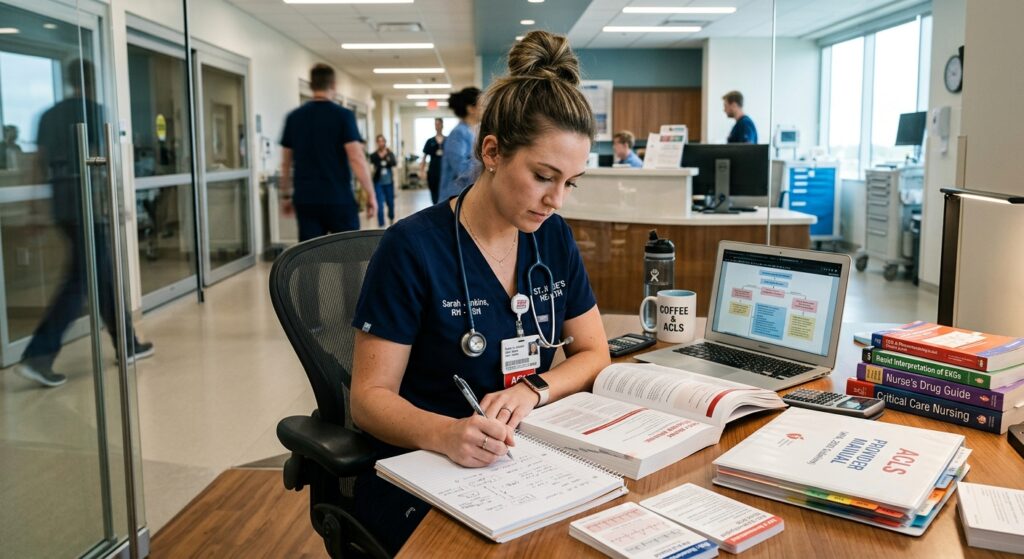
How to Deduct Nursing License, ACLS, BLS & Specialty Certifications: Complete 2026 Tax Guide for Nurses
For the 2026 tax year, nurses and medical professionals can significantly reduce their tax liability by learning how to deduct nursing license, ACLS, BLS & specialty certifications through legitimate IRS deduction methods. Whether you’re a W-2 employee, travel nurse, or 1099 independent contractor, your continuing education and professional licensing costs may be fully deductible—potentially saving you thousands of dollars annually.
Table of Contents
- Key Takeaways
- IRS Rules for Nursing Certifications
- What Qualifies as a Deductible Nursing Education Expense
- Deduction Strategies for W-2 Employees
- How 1099 Contractors & Self-Employed Nurses Deduct Certifications
- Documentation & Record-Keeping Requirements
- Common Mistakes Nurses Make When Claiming Deductions
- Uncle Kam in Action: Real Nurse Tax Savings
- Next Steps
- Frequently Asked Questions
Key Takeaways
- Nursing license renewal, ACLS, BLS, and specialty certifications are deductible if they maintain or improve job-related skills (IRS Publication 970 rules apply).
- For the 2026 tax year, W-2 employees must itemize to deduct these expenses; the 2% AGI floor limitation no longer applies under current law.
- 1099 contractors and self-employed nurses deduct certification costs on Schedule C as ordinary business expenses with no income limitations.
- Travel nurses and 1099 medical professionals often see the largest deductions due to higher education and relocation costs.
- Proper documentation is critical—maintain receipts, course syllabi, and proof of certification for IRS audit protection.
IRS Rules for Nursing License, ACLS, BLS & Specialty Certifications Explained
Quick Answer: The IRS allows nurses to deduct professional education and licensing costs if the education maintains or improves skills required in your current profession and doesn’t qualify you for a new profession. This applies to nursing licenses, ACLS, BLS, specialty certifications, and continuing education required for licensure.
The Internal Revenue Service treats nursing education expenses under two primary rules: they must be ordinary and necessary business expenses, and they cannot be education that qualifies you for a new trade or profession. This distinction is critical for the 2026 tax year.
According to IRS Publication 970 and related guidance, continuing education for nurses—including ACLS certification renewal, BLS renewal, specialty nursing certifications (Critical Care, Pediatric, Oncology, etc.), and licensing renewal fees—qualifies for deduction. The key is that these certifications maintain your existing nursing license and skills rather than qualifying you for an entirely new profession.
The Two-Tier IRS Qualification Test for 2026
The IRS applies two essential tests to determine if your nursing education is deductible in 2026:
- Test 1—Maintain or Improve Skills: The education must maintain, improve, or perfect skills already required in your nursing position. ACLS, BLS, and specialty nursing certifications clearly satisfy this test because they’re often required by employers and directly improve clinical competency.
- Test 2—Not a New Profession: The education cannot qualify you for a new or different profession. Going from RN to becoming an MD or NP (Nurse Practitioner)—which represents a new license and career—doesn’t qualify. However, advanced certifications within nursing (CCRN, CNOR, CEN) that enhance your RN license do qualify.
This distinction means your nursing license renewal fees, ACLS recertification, BLS recertification, and specialty nursing board certifications are all deductible because they directly maintain and improve your current nursing credentials.
2026 OBBBA Changes Impact on Nursing Education Deductions
The One Big Beautiful Bill Act (OBBBA) enacted in 2025 introduced significant changes affecting how nurses and medical professionals claim education deductions for the 2026 tax year. The American Opportunity Tax Credit, which can benefit nursing students pursuing new credentials, now requires a valid Social Security Number starting in 2026 (previously allowed ITINs). While this primarily affects student status, it’s important to understand if you’re funding education for family members.
What Qualifies as a Deductible Nursing Education Expense?
Quick Answer: Deductible nursing education expenses include license renewal fees, ACLS and BLS certification courses and renewal fees, specialty nursing board exams and certifications, required continuing education credits for license maintenance, exam preparation courses that directly support skill improvement, and professional books or reference materials directly related to your specialty.
Understanding what the IRS allows is essential for maximizing your 2026 deduction. Below is a comprehensive breakdown of deductible and non-deductible nursing education expenses for independent contractors and self-employed healthcare professionals, with an option to use our Small Business Tax Calculator for Columbus medical professionals to estimate your specific tax savings based on your professional expenses.
| Expense Category | 2026 Deductibility Status | IRS Guidance |
|---|---|---|
| RN License Renewal Fee | ✓ Deductible | Maintains current license; ordinary and necessary |
| ACLS Certification Course & Renewal | ✓ Deductible | Required for most nursing positions; improves clinical skills |
| BLS Certification Course & Renewal | ✓ Deductible | Core nursing competency; widely required by employers |
| Specialty Certifications (CCRN, CEN, ONC, etc.) | ✓ Deductible | Enhances nursing credentials within RN profession |
| Continuing Education Units (CEUs) for License Maintenance | ✓ Deductible | Required by state nursing boards; maintenance of credentials |
| Advanced Exam Prep (NCLEX, specialty boards) | ✓ Deductible (with limits) | Deductible if advancing within nursing; not if new profession |
| Professional Books (Clinical reference, specialty guides) | ✓ Deductible | Directly related to current practice; necessary for job |
| Travel to ACLS/BLS Course (mileage or airfare) | ✓ Deductible | Transportation to required education qualifies |
| RN to MSN Bridge Program (without job requirement) | ✗ NOT Deductible | New profession qualification; fails IRS Test 2 |
| RN to NP (Nurse Practitioner) Program | ✗ NOT Deductible | Creates new license and profession; IRS prohibits deduction |
Deduction Strategies for W-2 Employees: How Employed Nurses Claim Nursing License Deductions
Quick Answer: For 2026, W-2 nurses can deduct unreimbursed professional education expenses only if they itemize on Schedule A rather than claim the standard deduction. The 2026 standard deduction for single filers is $16,100 and $32,200 for married filing jointly—meaning itemized deductions must exceed these amounts to provide benefit.
W-2 employees face significant limitations when deducting nursing education expenses for 2026. Unlike self-employed nurses who can deduct these expenses directly as business costs, W-2 employees must itemize deductions on Schedule A and exceed the standard deduction threshold to realize any tax benefit.
Itemizing vs. Standard Deduction for 2026
For the 2026 tax year, the standard deduction increased to $16,100 for single nurses and $32,200 for married filing jointly. This means your itemized deductions—including unreimbursed professional expenses, medical expenses, state/local taxes (capped at $40,000 under OBBBA), mortgage interest, and charitable contributions—must collectively exceed these thresholds to provide value.
For example, a single RN with $4,000 in nursing certification costs, $2,500 in state/local taxes, and $1,200 in charitable contributions would have $7,700 in itemized deductions—below the $16,100 standard deduction. This nurse would use the standard deduction and receive zero tax benefit from the professional education expenses.
The Employer Reimbursement Strategy
Many hospitals and healthcare systems offer educational reimbursement programs. If your employer reimburses your nursing license renewal, ACLS, BLS, or specialty certification costs, those reimbursements are generally tax-free under Internal Revenue Code Section 127, provided they meet specific requirements. This is often the most efficient deduction strategy for W-2 employees because you avoid the itemization limitation entirely.
Pro Tip: If your employer offers education benefits but hasn’t provided reimbursement, ask about employer-sponsored professional development programs. Many healthcare organizations allocate $1,200-$5,000 annually per nurse for continuing education. Direct the reimbursement through your employer’s qualified education benefit plan for maximum tax efficiency in 2026.
How 1099 Contractors & Self-Employed Nurses Deduct Certifications
Quick Answer: Self-employed and 1099 nurses deduct professional education expenses directly on Schedule C as ordinary and necessary business expenses. There are no income limitations, no itemization requirements, and no standard deduction thresholds—you deduct 100% of qualifying nursing education costs dollar-for-dollar.
Travel nurses, independent contractors, and 1099 medical professionals receive superior tax treatment for nursing education deductions. These professionals report income on Schedule C (Form 1040) and deduct professional development costs as business expenses, subject to the simple rule: the expense must be ordinary and necessary to your business as a nurse.
Schedule C Deduction Method for Travel Nurses & Independent Contractors
When you’re self-employed or operate as a 1099 contractor, every dollar spent on nursing license maintenance, ACLS, BLS, specialty certifications, and related professional education directly reduces your business income. This means a travel nurse spending $3,500 annually on certifications and continuing education could reduce taxable income by the full $3,500, potentially providing $700-$1,050 in direct tax savings (depending on your 2026 tax bracket).
For 2026, the 12% federal tax bracket for married filing jointly covers income from $24,801 to $100,800. This means professional education deductions in this bracket save 12% of the deduction amount. At the 22% bracket (income $100,801-$211,400 for MFJ), each dollar of nursing education expense saves $0.22.
Related Business Deductions for Self-Employed Nurses
Beyond the certification costs themselves, self-employed and 1099 nurses can deduct related education expenses:
- Mileage to ACLS/BLS classes (using 2026 standard mileage rate; track actual miles)
- Airfare and lodging for required certifications in other states
- Meals while attending education events (50% deductible under current rules)
- Professional books and subscription services directly related to nursing practice
- Online course platforms and educational software
- Professional membership dues to nursing organizations (often required for specialty certifications)
Documentation & Record-Keeping Requirements for 2026 Tax Audit Protection
 Free Tax Write-Off Finder
Quick Answer: The IRS requires complete documentation for all nursing education deductions: original receipts showing course name and date, proof of certification (copy of credential), evidence the course maintains nursing skills (syllabus or course description), and records showing the expense was directly related to your current nursing position.
Proper documentation is essential for defending your nursing education deductions during an IRS audit. The IRS scrutinizes education deductions more carefully than many other business expenses because the line between deductible (maintaining skills) and non-deductible (new profession) education can be subjective.
Complete Documentation Checklist for Nursing Education Deductions
| Documentation Type | What to Keep | Retention Period |
|---|---|---|
| Course Receipt/Invoice | Original receipt showing course name, date, provider, and amount paid | At least 3 years (7 if significant income) |
| Certification Proof | Copy of ACLS/BLS card, certification letter, or credentials document | At least 3 years |
| Course Syllabus/Description | Syllabus, course outline, or description proving course maintains nursing skills | At least 3 years |
| Employment Verification | Job description or employer documentation showing certification required/beneficial | At least 3 years |
| License Requirements | Proof from state nursing board showing CEU/certification requirements | At least 3 years |
| Payment Records | Bank statements, credit card statements, or check copies proving payment | At least 3 years |
Best Organization System for Nursing Education Records
Create a dedicated folder (digital or physical) for each year containing all nursing education documentation. Organize by expense type (Licensing, ACLS/BLS, Specialty Certs, CEUs, Travel) with dates clearly marked. Digital storage is preferable—scan all receipts to PDF and maintain backup copies cloud storage. This approach ensures you can quickly produce evidence during an audit without scrambling.
Common Mistakes Nurses Make When Claiming Nursing Certification Deductions in 2026
Quick Answer: The most common deduction mistakes are: (1) claiming non-qualifying education as maintenance expense, (2) failing to itemize when necessary for W-2 employees, (3) mixing personal and professional education costs, (4) deducting education taken in anticipation of a new job, and (5) inadequate documentation of course content and employer requirements.
- Mistake #1—Deducting RN-to-NP Education: Many nurses mistakenly deduct Nurse Practitioner program tuition as a nursing education expense. The IRS explicitly prohibits this because NP programs represent a new profession with a separate license, failing the “not a new profession” test.
- Mistake #2—W-2 Employees Not Itemizing: W-2 nurses often claim education deductions without itemizing, which provides zero tax benefit. For 2026, your itemized deductions must exceed $16,100 (single) or $32,200 (MFJ) to benefit.
- Mistake #3—Inadequate Documentation: Claiming $5,000 in ACLS/BLS and specialty certification expenses without receipts invites IRS challenges. Maintain comprehensive documentation showing the course maintains your current nursing skills.
- Mistake #4—Claiming Future-Job Education: If you take nursing education in anticipation of a new position with a different employer before that position begins, the IRS may disallow the deduction. The education must be required or beneficial for your current job.
- Mistake #5—Personal vs. Professional Education: Travel nurses sometimes deduct general professional development that lacks direct connection to their nursing practice. The IRS requires the education to improve skills directly used in your current position.
Pro Tip: Document the business purpose for each education expense at the time of purchase. Write a brief note: “ACLS renewal—required by St. Mary’s Hospital employer policy” or “CCRN certification—maintains critical care specialty skills for ICU position.” This contemporaneous record is extremely valuable if the IRS questions the deduction.

Uncle Kam in Action: How a Travel Nurse Saved $3,200 on 2026 Taxes
Meet Sarah, a 35-year-old RN travel nurse working through a staffing agency on 1099 contracts. During 2025, Sarah earned $85,000 in nursing income and spent $4,200 on professional education and certifications. She renewed her RN license ($250), maintained ACLS and BLS certifications ($600), earned a critical care specialization (CCRN certification prep course and exam—$1,800), attended three continuing education conferences ($1,200 in registration and travel), and purchased professional nursing software subscriptions ($350).
As a self-employed nurse, Sarah reported her income on Schedule C and deducted all $4,200 in professional education expenses as ordinary business costs. This reduced her net profit from $85,000 to $80,800. At Sarah’s effective 2026 tax rate of 24% (including self-employment tax), the $4,200 deduction saved her approximately $1,008 in federal income tax plus an additional $594 in self-employment tax savings, totaling $1,602 in direct tax reduction on her deduction.
Beyond the first-year tax savings, Sarah’s CCRN certification qualified her for higher-paying specialty positions, increasing future annual income by $12,000. By working with Uncle Kam’s tax strategy service, Sarah optimized her business structure and implemented quarterly estimated tax payments, reducing her overall 2026 tax liability by an additional $1,600 through strategic income timing and deduction sequencing.
Total 2026 Tax Savings for Sarah: $3,202 (combining the nursing education deduction, self-employment tax reduction, and additional optimization strategies through professional tax planning). This demonstrates how travel nurses and 1099 medical professionals can leverage professional development deductions with proper planning and documentation.
Next Steps: Start Claiming Your Nursing Education Deductions for 2026
- Step 1—Gather Documentation: Collect all 2026 receipts for nursing license renewal, ACLS/BLS certifications, specialty certifications, continuing education, professional books, and related expenses. Maintain proof of certification and course syllabus/descriptions.
- Step 2—Determine Filing Status: If you’re a W-2 employee, calculate whether your itemized deductions exceed the $16,100 (single) or $32,200 (MFJ) standard deduction for 2026. If you’re 1099 or self-employed, proceed to Step 3.
- Step 3—Calculate Deductible Expenses: Add all qualifying nursing education expenses, being careful to exclude non-deductible items like RN-to-NP education or personal development unrelated to your current position.
- Step 4—Report on Your 2026 Tax Return: W-2 employees report on Schedule A (if itemizing). Self-employed and 1099 nurses report on Schedule C as business expenses. Include supporting documentation with your return.
- Step 5—Consult a Tax Professional: Connect with Uncle Kam’s tax advisory service to optimize your nursing education deductions, explore additional business deductions, and implement year-round tax strategies maximizing 2026 savings.
Frequently Asked Questions: Nursing License & Certification Deductions for 2026
Can I deduct my nursing license renewal fee for 2026?
Yes, your nursing license renewal fee is deductible if you meet the IRS qualification tests. Your RN license renewal maintains your current professional credential and doesn’t qualify you for a new profession. For self-employed nurses, this is a direct Schedule C deduction. For W-2 employees, you must itemize on Schedule A if claiming this expense.
Are ACLS and BLS certification costs deductible in 2026?
Yes, ACLS and BLS certification costs, including both initial certification and renewal courses, are fully deductible. These certifications are directly required or beneficial for nursing positions, maintain your clinical competency, and don’t qualify you for a new profession. This includes the certification course, exam fees, and renewal fees.
Can I deduct specialty nursing certifications like CCRN, CEN, or CNOR?
Yes, specialty nursing board certifications are deductible because they enhance your nursing credentials within the RN profession rather than qualifying you for a new profession. This includes the certification exam fee, exam prep courses, and renewal fees. These certifications maintain and improve your specialized nursing skills.
Can travel nurses deduct continuing education credits (CEUs) required for license maintenance?
Yes, continuing education units required by your state nursing board for license maintenance are fully deductible. These are ordinary and necessary expenses directly tied to maintaining your RN license. The deduction includes the course fee, any required textbooks, and travel costs to attend the course.
Is a Nurse Practitioner (NP) program deductible if I’m planning to transition from RN to NP?
No, NP program education is not deductible because it represents a new profession with a separate, independent license. The IRS specifically prohibits deductions for education that qualifies you for a new trade or profession. However, if your employer requires an RN to obtain NP credentials for a specific position you currently hold, consult a tax professional, as facts may differ.
Can I deduct professional books and reference materials for nursing practice?
Yes, professional books, reference guides, and subscriptions directly related to your nursing practice are deductible. This includes clinical reference books, specialty nursing journals, and online professional platforms supporting your current clinical work. The materials must directly relate to skills you use in your nursing position.
What documentation do I need to support my nursing education deductions during an IRS audit?
For 2026 tax audits, maintain complete documentation: original receipts showing course name and date, proof of certification obtained, syllabus or course description proving the course maintains nursing skills, employment documentation showing the certification is required or beneficial, and state nursing board requirements proving CEU compliance. Organize documents by year and expense type, and keep records for at least three years (seven for significant income).
Can I deduct travel costs (airfare, lodging) for attending an ACLS or specialty certification course in another state?
Yes, reasonable travel costs directly related to required nursing education are deductible. This includes airfare, lodging, and meal expenses (50% of meal costs) for traveling to attend required certifications or continuing education. For self-employed nurses, these are direct Schedule C deductions. For W-2 employees, they’re subject to itemization requirements.
If my employer reimburses me for nursing certifications, do I still get a tax deduction?
No, if your employer reimburses you for nursing education through a qualified educational assistance program (under IRC Section 127), those reimbursements are tax-free and you don’t claim an additional deduction. The tax benefit comes through the exclusion from income rather than an itemized deduction or business expense deduction.
Are professional nursing association dues deductible for 2026?
Yes, professional nursing organization dues are deductible if membership is directly related to your nursing practice and often required for maintaining specialty certifications. This includes memberships in the American Association of Critical-Care Nurses (AACN), Emergency Nurses Association (ENA), Oncology Nursing Society (ONS), and similar organizations. For self-employed nurses, these are Schedule C deductions.
Related Resources
- Tax Strategy Services for Healthcare Professionals
- Self-Employed & 1099 Contractor Tax Strategies
- 2026 Tax Preparation and Filing Services
- Business Entity Structuring for Medical Professionals
- Expert Tax Advisors for Healthcare Professionals
Last updated: April, 2026

