Burlington 1031 Exchange Guide for 2026: How Local Investors Can Defer Taxes Legally
Burlington 1031 Exchange Guide for 2026: How Local Investors Can Defer Taxes Legally
If you own investment property in Burlington and you’re considering selling, a Burlington 1031 exchange can help you defer capital gains taxes while you reinvest in new real estate. Local investors are using this powerful IRS strategy to reposition portfolios, upgrade rentals, and move between neighborhoods without an immediate tax hit.
What is a 1031 Exchange?
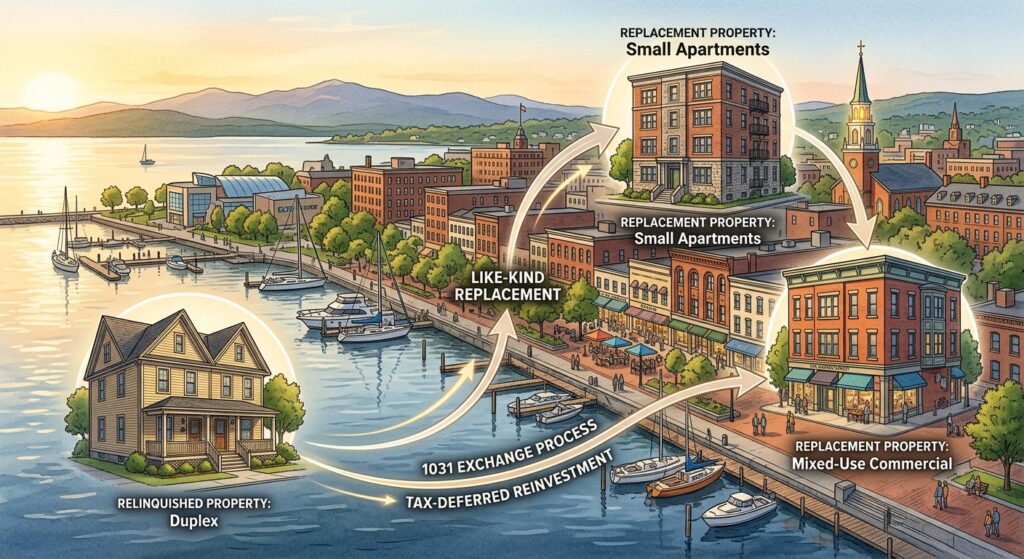
A 1031 exchange, named after Section 1031 of the Internal Revenue Code, allows you to sell qualifying investment or business real estate and reinvest the proceeds into another qualifying property of equal or greater value without immediately paying capital gains tax. Instead, your tax liability is deferred and carried into the new property.
For Burlington investors, this can mean selling an older multi-family near downtown and exchanging into a newer building in the New North End or South End, or even into out-of-state property, while keeping more capital working for you.
Basic requirements
- The property sold (relinquished property) must be held for investment or productive use in a trade or business.
- The property purchased (replacement property) must also be held for investment or business use.
- The properties must be “like-kind” real estate (broadly defined for real property in the U.S.).
- You must use a qualified intermediary (QI) to hold proceeds and structure the exchange.
- You must meet strict IRS deadlines and identification rules.
Why Burlington Investors Use 1031 Exchanges
Burlington’s real estate market has seen long-term appreciation, especially in multi-family and mixed-use properties. That appreciation translates into potential capital gains taxes when you sell. A 1031 exchange helps you:
- Defer capital gains taxes and depreciation recapture, keeping more equity available to invest.
- Reposition your portfolio into different neighborhoods, property types, or states.
- Consolidate or diversify for example, exchanging several small duplexes into one larger building, or one building into multiple properties.
- Upgrade property quality without a tax hit, moving from older housing stock to newer or better-located units.
- Improve cash flow by targeting properties with better rents or lower operating costs.
Key 1031 Exchange Rules in 2026
As of 2026, federal 1031 rules for real estate remain largely consistent with prior years, but you must follow them carefully. Here are the core elements Burlington investors need to understand.
Like-kind property definition
For real estate, “like-kind” is interpreted broadly by the IRS. In practical terms, you can generally exchange:
- A Burlington rental duplex for a larger apartment building in Vermont or another state.
- A mixed-use property for a commercial building.
- Raw land for improved investment property.
However, you cannot use a 1031 exchange for:
- Your primary residence.
- Property held primarily for resale (flip projects can be risky here).
- Stocks, bonds, partnership interests, or other non-real-estate assets.
45-day identification rule
Once your Burlington property sells, the clock starts:
- You have 45 calendar days from the date of transfer to formally identify potential replacement properties in writing to your qualified intermediary.
- Identifications must clearly describe the property (address, legal description, or other unambiguous description).
180-day exchange period
You must close on one or more replacement properties by the earlier of:
- 180 calendar days after the sale of your relinquished property, or
- The due date (including extensions) of your federal income tax return for the year of sale.
This means some Burlington investors may need to file an extension to preserve the full 180 days.
3-property and 200% rules
The IRS limits how many properties you can identify:
- 3-property rule: You may identify up to three properties, regardless of value, and purchase one or more of them.
- 200% rule: Alternatively, you may identify more than three properties as long as their combined fair market value does not exceed 200% of the value of the relinquished property.
Example: Burlington Investor Using a 1031 Exchange
Consider a Burlington landlord selling a four-unit building in the Old North End in 2026.
| Item | Amount (USD) |
|---|---|
| Original purchase price | $400,000 |
| Depreciation taken over time | $120,000 |
| Adjusted tax basis | $280,000 |
| Sale price in 2026 | $800,000 |
| Estimated selling costs | $48,000 |
| Net sale proceeds | $752,000 |
| Realized gain | $520,000 |
Without a 1031 exchange, this investor could owe federal capital gains tax, depreciation recapture tax, and Vermont state income tax on the $520,000 gain, significantly reducing the capital available for the next investment.
By using a properly structured 1031 exchange instead, the investor reinvests the full $752,000 (net after selling costs) into one or more qualifying replacement properties and defers those taxes into the future.
Burlington- and Vermont-Specific Considerations
While 1031 exchanges are governed by federal law, Burlington investors must also consider Vermont tax rules and local market realities.
Vermont tax and reporting
- Vermont generally conforms to federal treatment of like-kind exchanges for real property, but you should confirm how deferred gains are tracked on your state return.
- Property transfer tax and local recording requirements still apply when you acquire replacement property in Vermont.
- Exchanges involving out-of-state property may have additional filing or withholding obligations in the other state.
Market dynamics in Burlington
Burlington is a relatively tight market with limited inventory, especially in small multi-family properties. That affects how you plan a 1031 exchange:
- You may need to start scouting and negotiating replacement properties well before listing your current property.
- Some investors use reverse exchanges (buy first, sell later) when they find the perfect Burlington property before selling their existing asset.
- Cap rates, rents, and property conditions can vary widely between downtown, the Hill Section, and surrounding neighborhoods, so careful due diligence is essential.
Step-by-Step 1031 Exchange Process for Burlington Investors
 Free Tax Write-Off Finder
-
Consult local tax and legal professionals.
Before you list your Burlington property, talk with a CPA or Enrolled Agent who understands 1031 exchanges and Vermont tax rules, as well as a real estate attorney if needed.
-
Engage a qualified intermediary (QI).
You must have a QI in place before closing on your sale. The QI holds sale proceeds and prepares necessary exchange documentation. You cannot take constructive receipt of the funds.
-
List and sell your Burlington property.
Coordinate closing timelines with your QI and real estate agent to ensure the 1031 exchange structure is in place at closing.
-
Begin the 45-day identification period.
From the date your property closes, you have 45 days to identify replacement properties. Work with local agents who know Burlington and surrounding markets to compile options.
-
Formally identify replacement properties in writing.
Submit your identification list to the QI by the deadline, following the 3-property or 200% rule.
-
Perform due diligence and secure financing.
Order inspections, appraisals, and loan commitments early. Burlington properties can move quickly, so timing is critical.
-
Close on the replacement property within 180 days.
The QI uses the exchange funds to acquire the replacement property on your behalf, then transfers it to you to complete the exchange.
-
Report the exchange on your tax returns.
Your tax professional will file IRS Form 8824 and any required Vermont forms to disclose and track the deferred gain.
Common Types of 1031 Exchanges Used by Burlington Investors
Not all 1031 exchanges look the same. Depending on timing and market conditions, Burlington investors might use different structures.
| Type | Description | Typical Burlington Use Case |
|---|---|---|
| Delayed exchange | Sell first, then buy replacement within 180 days. | Most common when there is sufficient inventory and predictable timelines. |
| Reverse exchange | Buy replacement property first, then sell relinquished property. | Used when a unique Burlington property becomes available before you are ready to sell. |
| Improvement (construction) exchange | Use exchange funds to improve or build on the replacement property while it is held by an exchange entity. | Potentially useful for value-add projects or development in and around Burlington. |
Common 1031 Exchange Mistakes Burlington Investors Should Avoid
Even experienced landlords can make errors that jeopardize their exchange. Be on the lookout for these pitfalls:
- Missing the 45-day or 180-day deadlines. These are hard deadlines; extensions are rare and typically limited to federally declared disasters.
- Taking control of sale proceeds. Funds must go directly to the QI. If proceeds hit your bank account, the exchange is likely disqualified.
- Misclassifying property use. Trying to exchange a primary residence or a flip project can create serious tax risk.
- Not matching or increasing debt. If you reduce your mortgage amount or take cash out, you may create taxable “boot.”
- Poor documentation. Identification letters, contracts, and closing statements must be clear and consistent with IRS rules.
- Underestimating Burlington market constraints. Tight inventory can make it hard to identify and close on quality replacement properties in time.
Strategic 1031 Exchange Ideas for Burlington Investors
With the right planning, a Burlington 1031 exchange can support long-term wealth-building goals:
- Upgrade to lower-maintenance property. Exchange older housing stock into newer buildings with less deferred maintenance.
- Shift to stronger cash flow. Target submarkets or property types with better rent-to-price ratios.
- Diversify geographically. Move some equity into other Vermont towns or out-of-state markets while keeping a Burlington foothold.
- Plan for succession. Use exchanges over time to build a portfolio that is easier for heirs to manage.
Working With Professionals on a Burlington 1031 Exchange
Because a failed exchange can result in an unexpected tax bill, it is essential to work with qualified professionals:
- Tax advisor (CPA or EA): To model your potential tax liability, confirm eligibility, and prepare IRS and Vermont filings.
- Qualified intermediary: To structure the exchange, hold funds, and manage identification and closing documentation.
- Real estate agent with 1031 experience: To help you price your Burlington property correctly and identify appropriate replacement options.
- Real estate attorney (when needed): To review contracts, entity structures, and local regulatory issues.
Before committing to a 1031 exchange, run the numbers both ways—selling with and without an exchange. Sometimes paying the tax and pursuing a different strategy can make more sense, especially if your goals or time horizon have changed.

Frequently Asked Questions About Burlington 1031 Exchanges
1. Can I use a 1031 exchange for a Burlington property I used to live in?
Possibly, but only if the property has been converted to investment or business use and held for a sufficient period of time. Mixed-use and former primary residences involve complex rules, so you should consult a tax professional before proceeding.
2. What happens if I cannot find a suitable replacement property in Burlington?
You are not limited to Burlington; replacement property can be anywhere in the United States. Many investors expand their search to other Vermont markets or out-of-state areas if local inventory is too tight. If you ultimately do not complete the exchange, your sale becomes taxable for that year.
3. Can I move into the replacement property later as my primary residence?
The IRS expects 1031 replacement property to be held for investment or business use. Converting it to a primary residence too quickly can jeopardize the exchange. Over time, with proper planning and documentation, some investors do convert, but you must follow evolving IRS guidance and work closely with a tax advisor.
4. Do Vermont and the IRS treat 1031 exchanges the same way?
The federal rules are set by the IRS, and Vermont generally follows federal treatment for real property like-kind exchanges, but there can be differences in forms, tracking of deferred gain, and treatment of out-of-state property. Always confirm the current year rules with a Vermont-focused tax professional.
5. How do I start planning a Burlington 1031 exchange?
Start by clarifying your investment goals, then speak with a tax advisor who can estimate your current property gain, model a potential exchange, and help you determine whether a 1031 exchange aligns with your long-term strategy.
Final Thoughts
A Burlington 1031 exchange can be a powerful way to preserve capital, reposition your portfolio, and build long-term wealth in 2026 and beyond. By understanding the rules, respecting the deadlines, and working with experienced local professionals, you can use this strategy to move from one investment to the next while keeping more of your money invested in real estate instead of paying it out in immediate taxes.

