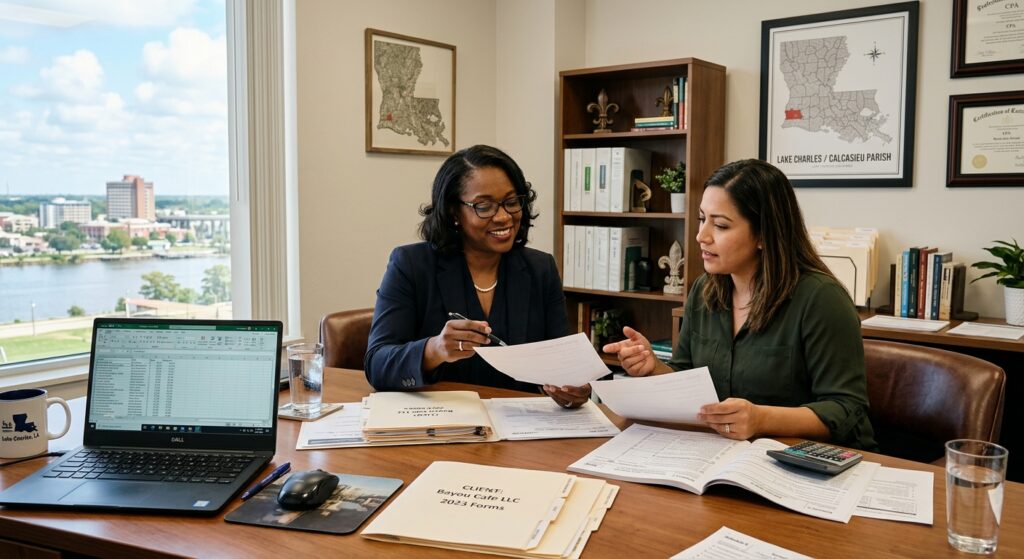
Lake Charles Louisiana Tax Preparation: 2026 Guide for Local Residents & Small Businesses
Filing taxes in Lake Charles, Louisiana doesn’t have to be stressful. Whether you’re a lifelong resident, a new arrival working in the the energy sector, or a small business owner rebuilding and growing in Calcasieu Parish, understanding how Louisiana and federal taxes work in 2026 can save you time, money, and frustration.
This guide walks you through the essentials of Lake Charles Louisiana tax preparation so you can decide what you can handle yourself and when it makes sense to work with a local tax professional.
How Louisiana Taxes Work in 2026
Louisiana’s tax system combines federal rules with state-specific income tax, sales tax, and property tax considerations that directly affect Lake Charles residents.
1. Louisiana state income tax basics
Louisiana taxes individual income separately from federal income tax. You’ll typically file both a federal Form 1040 and a Louisiana state income tax return (Form IT-540 for residents). While exact brackets and rates can change each year, Louisiana continues to use a tiered system with different rates for portions of your income.
Key points for 2026:
- You’re generally considered a Louisiana resident if Lake Charles is your home and you live here for more than half the year.
- Louisiana starts from your federal adjusted gross income (AGI) and makes state-specific additions and subtractions to arrive at your Louisiana taxable income.
- Certain types of income (like some retirement income) may be partially or fully excluded on your Louisiana return, even if they’re taxable federally.
2. Sales and use tax in Lake Charles
Lake Charles residents feel the impact of taxes not just on April 15 but every time they shop. Louisiana has one of the higher combined sales tax rates in the country when you add state and local rates together.
- State sales tax applies across Louisiana.
- Local sales tax is added by parishes and municipalities, including Lake Charles.
- If you buy taxable goods online or from out-of-state sellers that don’t collect Louisiana sales tax, you may owe use tax on your Louisiana return.
3. Property tax in Calcasieu Parish
Compared with many other states, Louisiana’s property tax burden is relatively low, but homeowners in Lake Charles still need to understand their responsibilities:
- Property taxes are primarily administered at the parish level (Calcasieu Parish for Lake Charles).
- Residential homeowners may be eligible for a homestead exemption, which reduces the taxable value of your primary residence.
- Property tax payments can sometimes be deductible on your federal return, subject to the federal cap on state and local tax (SALT) deductions.
Who Needs Tax Preparation Help in Lake Charles?
Some Lake Charles residents can use simple tax software and be fine. Others benefit from working with a local tax professional who understands both federal law and Louisiana’s unique rules.
Residents with straightforward returns
You might be able to file on your own if:
- You have one W-2 job, minimal investment income, and no business income.
- You rent (rather than own) your home and don’t itemize deductions.
- You don’t have complex credits (like foreign tax credits or multi-state income).
When professional tax preparation is strongly recommended
Consider paying for professional Lake Charles Louisiana tax preparation if any of these apply:
- You’re self-employed or work as an independent contractor in Lake Charles.
- You own a small business (LLC, S corporation, or partnership) operating in Louisiana.
- You own rental property, especially multiple units or properties in different parishes or states.
- You experienced a major life change in 2025 or 2026 (marriage, divorce, new child, inheritance, sale of a business, or disaster losses).
- You received K-1s from partnerships, S corporations, or trusts.
- You have multi-state income (for example, you work offshore or across state lines but live in Lake Charles).
Key Deadlines for 2026 Tax Filing
Most Lake Charles residents will follow the standard federal filing calendar, but certain dates can shift slightly each year.
| Deadline | What it typically covers |
|---|---|
| Mid-April 2026 | Federal and Louisiana individual income tax returns for the 2025 tax year; first estimated tax payment for 2026 |
| Mid-June 2026 | Second estimated tax payment for 2026 |
| Mid-September 2026 | Third estimated tax payment for 2026 |
| Mid-October 2026 | Extended individual returns (if you filed for an automatic extension) |
| Mid-January 2027 | Fourth estimated tax payment for 2026 |
If severe weather or other emergencies affect Lake Charles, the IRS and the Louisiana Department of Revenue sometimes announce disaster-related deadline extensions. Always verify current-year deadlines with the IRS and the Louisiana Department of Revenue before filing.
Common Deductions and Credits for Lake Charles Taxpayers
Maximizing deductions and credits is one of the best ways to lower your overall tax bill. Knowing which ones commonly apply to Lake Charles residents helps you gather the right records before you sit down to file.
1. Federal deductions and credits
- Standard vs. itemized deductions – Many Louisiana taxpayers now take the standard deduction. You might itemize if you have high mortgage interest, charitable contributions, or medical expenses.
- Child Tax Credit – Families with qualifying children may receive a significant credit that directly reduces tax owed.
- Earned Income Tax Credit (EITC) – Designed for lower- to moderate-income workers; especially important for Lake Charles families working hourly or seasonal jobs.
- Retirement contributions – Contributions to traditional IRAs or employer plans (like 401(k)s) may reduce your federal taxable income.
2. Louisiana-specific benefits
Louisiana has its own list of deductions and credits that are separate from your federal return. These may include, among others:
- Certain retirement income exclusions (for qualifying public pensions and Social Security).
- Credits related to residential energy efficiency or property improvements, depending on current Louisiana programs.
- Potential credits linked to natural disaster recovery, if available for specific years and events affecting Lake Charles.
Because these programs can change, always consult the latest instructions on the Louisiana Department of Revenue website or speak with a tax professional who focuses on Louisiana returns.
3. Deductions for self-employed and small business owners
If you run a business in Lake Charles, even a one-person side hustle, you may be eligible for additional deductions:
| Category | Examples for Lake Charles businesses |
|---|---|
| Operating expenses | Supplies, software subscriptions, business insurance, utilities for an office |
| Vehicle expenses | Mileage for client visits within Lake Charles or trips to nearby parishes for business |
| Home office | Portion of rent, mortgage interest, and utilities if you qualify under IRS rules |
| Professional services | Fees paid to bookkeepers, accountants, and tax preparers |
| Depreciation | Equipment, vehicles, or buildings used in your Lake Charles business |
Proper recordkeeping is critical. Keep receipts, mileage logs, invoices, and bank statements organized through the year so your preparer can correctly claim all eligible deductions.
DIY vs. Professional Lake Charles Tax Preparation
Choosing between preparing your own return and hiring a professional often comes down to complexity, time, and risk tolerance.
Questions to ask before filing on your own
- Do you understand how both federal and Louisiana rules apply to your situation?
- Have you had any IRS or Louisiana notices in the past that could signal recurring issues?
- Do you have adequate time before the deadline to research questions and double-check your work?
- Are you confident that you’re capturing all eligible deductions and credits?
If you answer “no” to several of these, meeting with a Lake Charles tax preparer may be worth the investment.
Benefits of working with a local Lake Charles tax professional
A local preparer brings more than software knowledge to the table. They provide:
- Local insight into Lake Charles and Calcasieu Parish economic conditions that the software doesn’t see.
- Familiarity with industry-specific issues common in the region (energy, construction, hospitality, real estate, and professional services).
- Guidance on estimated tax payments if you’re self-employed or own a growing business.
- Help with prior-year corrections and responding to federal or state notices.
- Year-round support for planning, not just filing.
How to Choose a Lake Charles Tax Preparer
 Free Tax Write-Off Finder
Not all tax professionals offer the same services or expertise. When you’re comparing options in Lake Charles, ask these questions:
- What are your credentials?
Look for CPAs, Enrolled Agents (EAs), or experienced preparers whose practice is focused on tax. - Do you specialize in individuals, small businesses, or both?
Match the preparer’s primary focus to your situation. - Are you familiar with my industry?
For example, if you’re a contractor, real estate investor, or self-employed professional, make sure they handle those types of clients regularly. - How do you structure your fees?
Ask if fees are flat, hourly, or based on the complexity of schedules and forms. - What support do you provide if I receive an IRS or Louisiana notice?
Will they help you respond, and is there an extra cost? - How do you protect my data?
Ensure they use secure portals or encrypted methods when handling sensitive documents.
You can verify federal tax preparer credentials and PTIN registration with the IRS’s online directory and confirm a CPA’s status through the Louisiana State Board of CPAs.
Documents You Should Gather Before Your Appointment
Organizing documents in advance helps keep your appointment efficient and your return accurate. For a typical Lake Charles household or small business, start with:
- Personal information: Social Security numbers (or ITINs) and birthdates for you, your spouse, and any dependents.
- Income documents: W-2s, 1099s (for contract work, interest, dividends, retirement, and unemployment), K-1s, and any records of cash or app-based income.
- Business and rental records: Profit-and-loss statements, expense logs, mileage logs, and 1099s issued by your Lake Charles clients.
- Property information: Mortgage interest statements (Form 1098), property tax bills, records of major home improvements.
- Deduction and credit records: Charitable donation receipts, medical expense summaries, childcare provider information, education expenses (Form 1098-T).
- Prior-year return: Your 2024 and 2025 federal and Louisiana returns, particularly if this is your first time working with a new preparer.
Special Considerations for Lake Charles Small Business Owners
Small business owners in Lake Charles face additional complexity. Whether you operate as a sole proprietor, LLC, S corporation, or partnership, your tax situation likely involves:
- Separate business records – Avoid mixing personal and business accounts.
- Sales tax collection and remittance – If you sell taxable goods or services, you may need to collect and remit Louisiana and local sales tax.
- Payroll compliance – If you have employees, you must handle federal and state payroll tax withholdings and filings.
- Quarterly estimated tax payments – Many profitable owners must pay throughout the year to avoid penalties.
A Lake Charles tax preparer who works regularly with small businesses can also help you with:
- Selecting or reviewing your business entity type for tax efficiency.
- Setting up or improving your bookkeeping system.
- Planning for future expansion, equipment purchases, and retirement contributions.
How to Get Started with Lake Charles Louisiana Tax Preparation
If you’re ready to get your 2026 taxes under control, here’s a simple roadmap:
- Assess your situation – Decide whether your return is simple enough for DIY filing or complex enough to justify professional help.
- Gather your documents – Use the document checklist above and add any items specific to your situation.
- Choose your preparer – Research Lake Charles tax professionals, looking for those with experience in your type of work or business and solid client reviews.
- Schedule early – Lake Charles preparers get busiest as the April deadline approaches, so try to book January through early March if possible.
- Ask planning questions – Don’t just focus on last year. Ask what you can do differently in 2026 to reduce taxes and avoid surprises.
Remember that good tax preparation is not just about filing a return—it’s about understanding how tax rules affect your life and business decisions throughout the year. With the right approach and the help of a knowledgeable Lake Charles tax professional when needed, you can file confidently and keep more of what you earn.

Helpful Resources
- Internal Revenue Service (IRS) – Official federal tax forms, instructions, and guidance.
- Louisiana Department of Revenue – State forms, online filing, and up-to-date Louisiana tax rules.
- Calcasieu Parish Local Government (example) – Information on property taxes, local ordinances, and parish-level services.
If you’re searching for reliable, year-round Lake Charles Louisiana tax preparation support, consider reaching out to a local firm that focuses on individuals and small businesses so you can make informed decisions all year long, not just at tax time.

