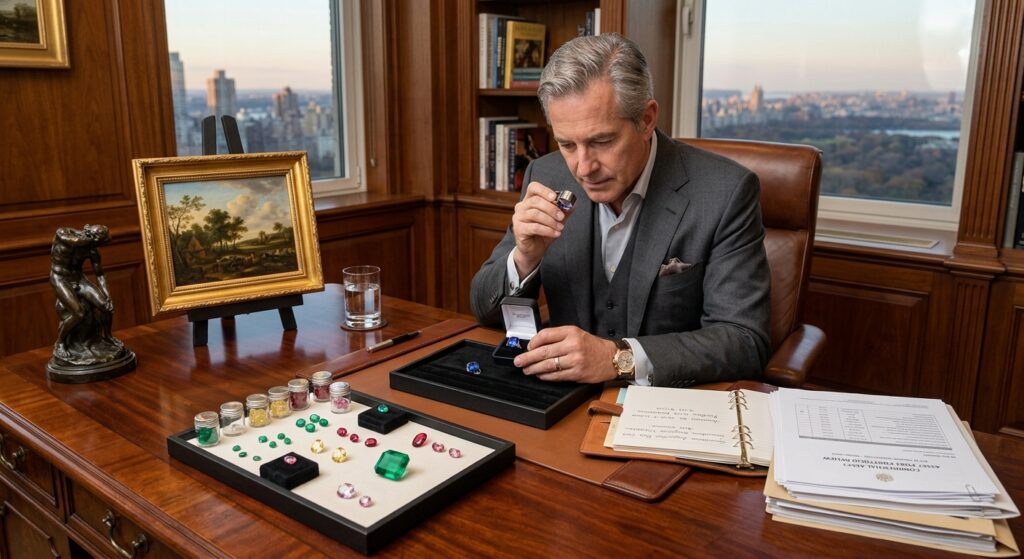
Wealthy Individual Collectibles Strategies: 2026 HNW Guide
For high-net-worth individuals, wealthy individual collectibles strategies are no longer just a passion play — they are a serious component of portfolio diversification in 2026. From rare colored gemstones selling at 10 times their auction estimate to fine art commanding eight-figure prices at IRS-recognized capital asset auctions, the opportunity is real. However, so is the tax liability. The IRS taxes gains on collectibles at up to 28%, a rate significantly higher than the standard long-term capital gains rate. Knowing how to manage your wealth strategy as a high-net-worth individual can mean the difference between outsized returns and an unexpected tax bill.
This information is current as of 3/26/2026. Tax laws change frequently. Verify updates with the IRS or FTB if reading this later.
Table of Contents
- Key Takeaways
- What Are Collectibles and How Does the IRS Define Them?
- What Is the 2026 Tax Rate on Collectibles for High-Net-Worth Individuals?
- How Can High-Net-Worth Investors Minimize Collectibles Tax?
- What Types of Collectibles Are Trending in 2026 for HNW Portfolios?
- How Should You Integrate Collectibles Into an HNW Portfolio?
- What Are the Estate Planning Strategies for Collectibles?
- Uncle Kam in Action: The Art Collector Who Saved $340,000
- Related Resources
- Next Steps
- Frequently Asked Questions
Key Takeaways
- The IRS taxes collectibles gains at a maximum rate of 28% in 2026, higher than standard capital gains.
- Colored gemstones, fine art, and rare jewelry are top collectible investment categories for 2026 HNW portfolios.
- The 3.8% Net Investment Income Tax (NIIT) can stack on top of the 28% rate for HNW filers exceeding $200,000 (single) or $250,000 (MFJ).
- Strategic holding periods, charitable donations, and estate planning can dramatically reduce collectibles tax liability.
- Collectibles held in IRAs face unique IRS restrictions — professional guidance is essential.
What Are Collectibles and How Does the IRS Define Them?
Quick Answer: The IRS defines collectibles under Section 408(m) of the Internal Revenue Code as physical items including art, antiques, gems, jewelry, precious metals (outside approved IRAs), stamps, coins, alcoholic beverages, and rugs. Any gain from their sale is subject to special tax treatment in 2026.
The IRS provides a specific legal definition for collectibles. This matters because the tax treatment differs sharply from stocks or real estate. Understanding this definition is the first step in any wealthy individual collectibles strategy for 2026.
For 2026, the IRS Publication 550 confirms that collectibles include a broad range of tangible personal property. The classification applies whether you buy the item at auction, through a private dealer, or directly from an artist.
IRS-Recognized Collectible Categories in 2026
The following asset types are classified as collectibles by the IRS. Each category carries the 28% maximum long-term capital gains rate when sold at a profit:
- Works of art and antiques
- Gems and jewelry (including colored gemstones)
- Precious metals (gold, silver, platinum) held outside a qualified IRA
- Stamps and coins
- Rugs and other textiles
- Alcoholic beverages (rare wine, whiskey)
- Musical instruments and sports memorabilia
Why the Definition Matters for HNW Investors
The IRS collectibles classification triggers the special 28% rate. However, short-term gains on collectibles held less than one year are taxed as ordinary income. For high-net-worth individuals in the top 37% bracket, this means strategic holding periods are critical. You should always hold a collectible for more than one year before selling. That move alone can reduce your effective rate from 37% down to 28%.
Furthermore, the definition also covers certain interests in partnerships, S corporations, or trusts that own collectibles. Therefore, wealthy individual collectibles strategies must account for entity-level holdings too. Discuss your entity structure with a tax strategist to ensure the correct treatment applies at both the entity and personal level.
Pro Tip: Gold ETFs and mutual funds that invest in gold are also treated as collectibles by the IRS. In 2026, gold trades above $4,500 per ounce. However, gains from gold ETFs face the same 28% rate as physical gold.
What Is the 2026 Tax Rate on Collectibles for High-Net-Worth Individuals?
Quick Answer: For 2026, the maximum long-term capital gains rate on collectibles is 28%. High-net-worth individuals may also owe an additional 3.8% Net Investment Income Tax (NIIT), bringing the effective rate to 31.8% at the federal level.
This is the most critical number in any wealthy individual collectibles strategy. The IRS Topic 409 confirms that collectibles face a maximum rate of 28% for long-term gains. This rate is higher than the 20% maximum rate on most other long-term capital gains. Therefore, the tax burden on a $1 million collectibles gain is significantly higher than the same gain from a stock portfolio.
2026 Collectibles Tax Rate Comparison Table
| Asset Type | Max Long-Term Rate (2026) | NIIT Applies? | Max Combined Federal Rate |
|---|---|---|---|
| Collectibles (art, gems, jewelry) | 28% | Yes | 31.8% |
| Stocks / Bonds (most assets) | 20% | Yes | 23.8% |
| Real Estate (Section 1250) | 25% (unrecaptured depreciation) | Yes | 28.8% |
| Qualified Small Business Stock | 0% (if exclusion applies) | Sometimes | 0% – 28% |
The NIIT Stacking Problem for HNW Individuals
The 3.8% Net Investment Income Tax applies to investment income above $200,000 (single filers) or $250,000 (married filing jointly) for 2026. It stacks directly on top of the 28% collectibles rate. Consequently, a high-net-worth individual selling a painting for a $2 million gain could face a federal rate of up to 31.8% — before state taxes.
Moreover, state-level capital gains taxes add further liability. Pennsylvania, for example, taxes capital gains as ordinary income at a flat 3.07% rate. Therefore, a Pennsylvania-based collector faces a combined state and federal rate potentially exceeding 34% on collectibles gains. Planning ahead is essential. Working with a proactive tax strategy team can help you time sales and structure transactions to keep your effective rate as low as possible.
Did You Know? In 2026, a Tiffany & Co. necklace featuring a Paraiba tourmaline and diamonds sold at Christie’s New York for $4.2 million — 10 times its low estimate. A matching pair of earrings also sold for 10x their estimate. This underscores the growing investment potential of rare jewelry and gems.
How Can High-Net-Worth Investors Minimize Collectibles Tax?
Quick Answer: HNW investors can minimize collectibles tax in 2026 by holding items over one year, using charitable contribution strategies, harvesting capital losses, timing sales to lower-income years, and leveraging Qualified Opportunity Zones (OZ 1.0 ends in 2026).
Tax minimization is the core of any effective wealthy individual collectibles strategy. Because the rates are elevated relative to other investments, proactive planning is non-negotiable. Fortunately, several powerful tools are available to HNW investors in 2026. Your goal is to reduce your taxable gain, defer recognition, or eliminate the gain entirely through strategic planning.
Strategy 1: Long-Term Holding Period
The simplest and most overlooked strategy is patience. Holding a collectible for more than one year converts a short-term gain (taxed at ordinary rates up to 37%) into a long-term gain (capped at 28%). For a $500,000 gain, this single move saves $45,000 in federal taxes. Furthermore, holding for five to ten years often coincides with peak appreciation in art and fine jewelry markets. Industry experts confirm that branded luxury jewelry has historically experienced mid- to high-single-digit annual price increases over long holding periods. Therefore, time works in your favor both financially and from a tax perspective.
Strategy 2: Charitable Contribution of Appreciated Collectibles
Donating appreciated collectibles to a qualified charity (such as a museum or educational institution) allows you to deduct the fair market value without recognizing the capital gain. This is one of the most tax-efficient moves available to wealthy individuals. However, the deduction for donations of appreciated tangible personal property to charity is generally limited to 30% of your adjusted gross income (AGI), with a five-year carryover. You must obtain a qualified appraisal from a certified appraiser for donations exceeding $5,000. Use IRS Form 8283 to report non-cash charitable contributions of collectibles on your tax return.
Additionally, a Charitable Remainder Trust (CRT) can provide deferred income, an upfront partial deduction, and avoidance of immediate capital gains. The CRT sells the collectible tax-free internally, reinvests the proceeds, and pays you an income stream over time. This approach suits HNW individuals who want to monetize art or jewelry without a large immediate tax hit.
Strategy 3: Capital Loss Harvesting
Capital losses from other investments offset collectibles gains dollar for dollar. For example, if you realize a $300,000 gain from selling a painting and have $150,000 in unrealized stock losses, you can harvest those losses to cut your taxable collectibles gain in half. This is a critical year-end planning opportunity. Work with your tax advisor to review your entire portfolio before selling any major collectible item. Coordinating across asset classes — including real estate, equities, and collectibles — ensures you don’t leave loss-harvesting opportunities on the table.
Pro Tip: Opportunity Zone 1.0 deferrals expire at the end of 2026. If you have deferred collectibles gains in an OZ 1.0 fund, those gains will be recognized on your 2026 return. Plan now to offset or manage that recognition event before year-end.
Strategy 4: Income Timing and Installment Sales
Structuring a collectibles sale as an installment sale under IRS Publication 537 allows you to spread the gain over multiple years. This strategy works especially well when you expect your income to be lower in future years. Each installment payment triggers only a proportional portion of the total gain. As a result, you may avoid the NIIT threshold or reduce the amount subject to the 28% rate in any single year. However, installment sales require careful contract structuring and must be negotiated upfront with the buyer.
What Types of Collectibles Are Trending in 2026 for HNW Portfolios?
Quick Answer: In 2026, colored gemstones, rare luxury jewelry, fine art, and precious metals are the top collectible categories trending among HNW investors. Record-breaking auction prices and surging gold values above $4,500/oz are driving demand.
The collectibles market in 2026 is thriving. Wealthy individual collectibles strategies are evolving fast, as more HNW investors view tangible assets as a hedge against market volatility and geopolitical uncertainty. The TEFAF Maastricht 2026 fair — the world’s premier art and antiques fair — attracted more than 50,000 visitors and reported strong sales across multiple categories, including eight-figure transactions in rare books and fine art.
Colored Gemstones and Luxury Jewelry
Colored gemstones — especially Paraiba tourmalines, unheated sapphires, Burmese rubies, and Colombian emeralds — are commanding record prices in 2026. Unlike lab-grown diamonds, rare colored gems cannot be replicated. Scarcity drives value. Auction experts at Christie’s note that private clients are willing to pay extraordinary premiums for exceptional goods. In 2026, gold prices above $4,500 per ounce have further amplified interest in gold-heavy jewelry as a tangible store of value.
Industry analysts expect colored gemstones to appreciate faster than gold over the next five to ten years. Branded luxury jewelry has historically delivered mid- to high-single-digit annual price increases. Furthermore, over a five to ten year holding period, resale values often exceed the original purchase price — making jewelry both a wearable asset and a financial one.
Fine Art
Fine art remains one of the most established collectibles categories for HNW investors. In 2026, the global art market continues to see strong demand across blue-chip artists. Works by recognized artists with institutional provenance carry the lowest liquidity risk. TEFAF Maastricht 2026 reported sales including a rare pair of Claude Monet paintings — reunited after 130 years — offered at €20 million ($23.1 million). For tax purposes, art qualifies as a collectible. Therefore, gains from art sales face the same 28% maximum rate.
Precious Metals
Physical gold, silver, and platinum are recognized collectibles under the IRS definition. In 2026, gold’s sustained price above $4,500 per ounce has attracted significant interest. However, holding physical gold in a Gold IRA is subject to specific IRS storage rules. The IRS requires that gold held in an IRA be stored at an approved third-party depository — home storage is a taxable distribution. Gains from physical metals held outside retirement accounts are taxed at the 28% collectibles rate.
Pro Tip: Gold ETFs and mutual funds holding physical gold are taxed as collectibles by the IRS. In 2026, this means gains from popular gold funds face the 28% rate — not the standard 20% long-term capital gains rate.
How Should You Integrate Collectibles Into an HNW Portfolio?
 Free Tax Write-Off Finder
Quick Answer: HNW investors should treat collectibles as a 5–15% alternative asset allocation, focus on liquid categories (art, jewelry), document provenance carefully, and integrate purchase timing with annual tax planning to manage gain recognition effectively.
Integrating collectibles into a high-net-worth portfolio requires both investment discipline and tax awareness. Wealthy individual collectibles strategies work best when the collector is proactive — not reactive. You should define your allocation target, select categories with strong liquidity and provenance, and build in tax planning milestones from the moment of acquisition.
Step-by-Step Integration Framework
- Step 1: Set Your Allocation. Most wealth advisors recommend 5–15% of a liquid portfolio in alternative tangible assets, including collectibles.
- Step 2: Prioritize Liquidity. Fine art and high-quality jewelry at top auction houses offer the best secondary market liquidity. Sports memorabilia and wine can be more illiquid.
- Step 3: Document Everything. Obtain a certified appraisal at acquisition. Keep records of provenance, purchase price, restoration costs, and insurance valuations. These support your cost basis and charitable deduction claims.
- Step 4: Plan the Exit at Purchase. Know your target holding period and intended disposition method (sale, donation, bequest) before you buy.
- Step 5: Coordinate with Your Tax Team. Schedule annual reviews with your tax preparation team to track unrealized gains, plan sales timing, and harvest losses from other positions.
Collectibles vs. Other HNW Investments: A Comparison
| Investment Type | Typical Return (Long-Term) | Tax Rate (2026) | Liquidity | Income Generated |
|---|---|---|---|---|
| Luxury Jewelry / Gems | Mid- to high-single digits annually | 28% + NIIT | Moderate (auction) | None |
| Fine Art | Varies widely | 28% + NIIT | Low to moderate | None |
| Physical Gold | Inflation hedge; above $4,500/oz in 2026 | 28% + NIIT | High | None |
| Equities (Stocks) | 7–10% historical average | 20% + NIIT | High | Dividends |
| Rental Real Estate | 4–8% cash-on-cash return | 20–25% + NIIT | Low to moderate | Rental income |
As the table above shows, collectibles have a higher tax rate and lower income generation compared to other assets. However, they offer non-correlation with stock markets and potential for extraordinary returns in specific categories. Therefore, they serve best as a diversifier rather than a core holding for most high-net-worth investors.
What Are the Estate Planning Strategies for Collectibles?
Quick Answer: The most powerful estate planning tool for collectibles in 2026 is the stepped-up cost basis at death. Heirs inherit at the fair market value on the date of death, eliminating all accrued capital gains. Charitable bequests, family trusts, and annual gifting strategies also play key roles.
Estate planning is arguably the most powerful element in any wealthy individual collectibles strategy. The IRS rules around inheritance create extraordinary opportunities for HNW families who plan ahead. Conversely, failing to plan can expose heirs to significant estate and income tax bills on collections built over decades. Integrating your collectibles into a broader estate tax strategy is essential.
The Stepped-Up Basis Advantage
Under current 2026 law, assets inherited at death receive a stepped-up cost basis to their fair market value on the date of death. This means all accrued capital gains are effectively eliminated for income tax purposes. For example, suppose you purchased a painting in 2001 for $200,000. In 2026, it is worth $3 million. If you sell it today, you pay tax on a $2.8 million gain. However, if you hold it until death, your heir inherits it at $3 million basis. They can sell it immediately with no capital gains tax on that appreciation.
This strategy is especially powerful for collections with decades of appreciation. Therefore, many HNW collectors strategically hold their highest-appreciated pieces as legacy assets rather than selling. The estate tax exemption for 2026 is approximately $13.9 million per person (verify the most current figure at IRS.gov Estate Tax). For married couples, the combined exemption is approximately $27.8 million, meaning most families can pass significant collections to heirs completely free of estate tax.
Trusts and Family Gifting Strategies
Several trust structures are particularly useful for collectibles in 2026. Each offers different tradeoffs between control, income, and tax savings:
- Grantor Retained Annuity Trust (GRAT): Transfer appreciating collectibles to a GRAT, retain an annuity stream, and pass future appreciation to heirs tax-free if the asset outperforms the IRS hurdle rate (Section 7520 rate).
- Charitable Remainder Trust (CRT): Contribute appreciated collectibles to a CRT, avoid immediate capital gains, receive a charitable deduction, and draw an income stream for life.
- Irrevocable Life Insurance Trust (ILIT): Use the income tax savings from collectibles strategies to fund life insurance inside an ILIT, providing tax-free wealth to heirs to offset estate taxes.
- Annual Gift Exclusion: In 2026, you can gift up to $19,000 per recipient annually ($38,000 for married couples) free of gift tax. Gifting lower-value collectibles over time can reduce your taxable estate.
Fractional Interests and Valuation Discounts
Transferring fractional interests in collectibles to heirs or trusts can create legitimate valuation discounts for gift and estate tax purposes. A fractional interest in a painting — say, a 40% undivided interest — is worth less than 40% of the whole painting’s value because no single owner controls the asset. Valuation discounts of 15–35% are common for fractional interests in collectibles, confirmed by qualified appraisals. This advanced strategy requires careful legal structuring. Always work with a qualified estate attorney alongside your tax team.
Pro Tip: The IRS scrutinizes valuations of collectibles closely. Always use a qualified appraiser who meets IRS standards under Treasury Regulation 1.170A-17. For donations over $5,000, attach Form 8283 to your return. A poorly documented appraisal is one of the top audit triggers for HNW collectibles owners.
Before moving to your next steps, review your full collectibles portfolio with a specialist who understands both the investment and tax dimensions. Our team of high-net-worth tax advisors can help you map your estate strategy around your collection.

Uncle Kam in Action: The Art Collector Who Saved $340,000
Client Snapshot: A Philadelphia-based software entrepreneur and avid art collector, age 58, had built a fine art collection over 25 years. His portfolio included works by several prominent contemporary artists valued at approximately $4.2 million, acquired for an original cost of $980,000.
Financial Profile: Annual income of $1.4 million from business operations and passive investment income. The collection represented his largest single alternative asset position.
The Challenge: He planned to liquidate three major paintings to fund a family foundation. Total proceeds would be approximately $2.1 million, with embedded gains of roughly $1.7 million. At the full 28% collectibles rate plus the 3.8% NIIT, his potential federal tax liability exceeded $540,000 — before Pennsylvania’s flat income tax rate was applied.
The Uncle Kam Solution: Our team implemented a three-part wealthy individual collectibles strategy for 2026:
- First, we structured the donation of two of the three paintings directly to a Donor-Advised Fund (DAF). This eliminated capital gains on $1.2 million of the appreciation and generated a charitable deduction against his high ordinary income year.
- Second, we orchestrated a capital loss harvest from underperforming private equity positions totaling $420,000. These losses offset the remaining $500,000 gain on the third painting sold at auction.
- Third, we restructured his remaining collection into a GRAT, transferring future appreciation to his children with minimal gift tax exposure.
The Results for 2026:
- Tax Savings: $340,000 in federal and state taxes avoided.
- Charitable Impact: Over $1.2 million in art donated to support his family foundation’s mission — fully funded at zero tax cost.
- Investment in Uncle Kam: $18,000 in advisory fees.
- First-Year ROI: 18.9x return on advisory investment.
This outcome was only possible because of proactive 2026 tax planning. Without strategy, nearly $540,000 would have gone to taxes — funding nothing of personal value. See more outcomes like this at Uncle Kam Client Results.
Related Resources
- High-Net-Worth Tax Strategies — Who We Serve
- 2026 Tax Strategy Services for Wealthy Investors
- Personalized Tax Advisory for High-Income Clients
- Uncle Kam Tax Guides — Advanced Planning Resources
- The MERNA™ Method: Our Proven Wealth Optimization Framework
Next Steps
The 2026 tax landscape for collectibles is complex but navigable with the right plan. Here is what you should do now:
- Get a current appraisal on all major collectibles in your portfolio. Know your embedded gains before you make any decisions.
- Review your capital loss positions across your entire investment portfolio before selling any collectibles in 2026.
- Consult your estate attorney about stepped-up basis planning and whether a GRAT or CRT fits your legacy goals.
- Schedule a tax strategy session with our team at Uncle Kam Tax Strategy to map out your 2026 collectibles plan.
- Act before year-end: OZ 1.0 deferrals expire December 31, 2026. If you have deferred gains in an Opportunity Zone fund, plan for that recognition event now.
Frequently Asked Questions
Are wealthy individual collectibles strategies only for ultra-high-net-worth investors?
No. While some strategies — such as GRATs and CRTs — are most effective for very large estates, many tactics apply to collectors across a wide range of wealth levels. The 28% collectibles rate applies to anyone who sells a collectible at a gain. However, loss harvesting, installment sales, and charitable donations are accessible to most investors with meaningful collections. If your collectibles are worth $250,000 or more, formal tax planning likely pays for itself many times over. Work with a qualified tax advisor to assess which strategies fit your specific situation.
Can I hold collectibles inside a self-directed IRA to avoid the 28% rate?
This is a complex area with significant risk. Under IRS Section 408(m), certain collectibles are prohibited inside IRAs. Specifically, art, antiques, rugs, gems, jewelry, stamps, and most coins are prohibited collectibles for IRA purposes. If you place a prohibited collectible inside an IRA, the IRS treats the full amount as a taxable distribution in the year of acquisition. The penalty can easily exceed the tax savings you hoped to achieve. Certain gold, silver, and platinum coins and bullion meeting specific purity standards are permitted. Always consult a qualified tax professional before placing any tangible asset inside a self-directed IRA.
How do I report collectibles gains on my 2026 tax return?
Report collectibles gains on Schedule D (Form 1040) and the related Form 8949. Long-term collectibles gains appear in Part II of Schedule D. The IRS computes your tax using the Unrecaptured Section 1250 and 28% Rate Gain Worksheet included in the Schedule D instructions. You must report the date of acquisition, date of sale, cost basis (including any transaction costs and restoration expenses), and net proceeds. Keep all purchase receipts, auction records, insurance appraisals, and provenance documentation. These records support your cost basis in any IRS audit.
What happens if I inherit a collection in 2026?
If you inherit collectibles in 2026, your cost basis is stepped up to the fair market value on the date of the decedent’s death. This is one of the most valuable tax benefits in the entire Internal Revenue Code. It means all the appreciation that occurred during the original owner’s lifetime is completely eliminated for income tax purposes. However, the estate may still owe federal estate tax if the total taxable estate exceeds the 2026 exemption (verify the current amount at IRS.gov Estate Tax). Once you inherit, you start a new holding period. If you sell after more than one year, your gain (if any above the stepped-up basis) is taxed at the 28% long-term collectibles rate.
Is it true that a like-kind exchange (1031 exchange) works for collectibles?
No. Since the Tax Cuts and Jobs Act (TCJA), like-kind exchanges under Section 1031 apply only to real property. Prior to 2018, personal property — including certain collectibles — could qualify for 1031 treatment. That is no longer the case for 2026. Therefore, selling one painting to buy another triggers a taxable event. You cannot defer the collectibles gain using a 1031 exchange. The only viable gain-deferral tools for collectibles today are installment sales, Opportunity Zone funds (for gains reinvested within 180 days), and charitable vehicles such as CRTs. Plan your dispositions accordingly and consult our tax filing team to ensure proper reporting.
How do I find a qualified appraiser for my collectibles?
For tax purposes, you need a qualified appraiser as defined by IRS Treasury Regulations. The appraiser must have education and experience in the type of collectible being valued, cannot be the buyer or seller, and must perform the appraisal no earlier than 60 days before the contribution (for charitable gifts) and no later than the due date of the return. Look for appraisers who are members of the Appraisers Association of America or the American Society of Appraisers. For donations over $5,000, a qualified appraisal and completed Form 8283 are mandatory to claim the deduction. Inadequate documentation is one of the top reasons the IRS disallows charitable deductions for collectibles. Always retain the appraisal report permanently with your tax records.
Last updated: March, 2026

