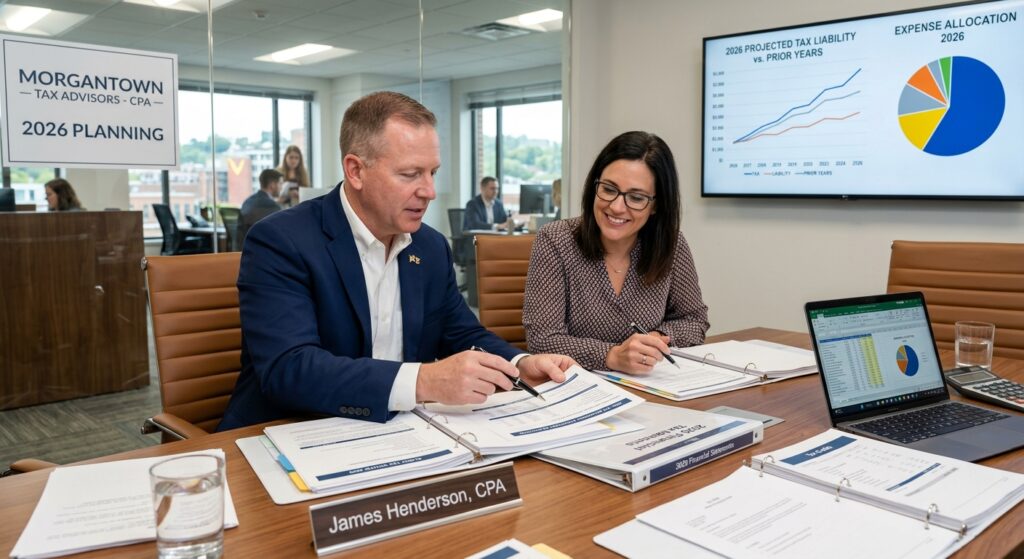
Expert Morgantown CPA Tax Strategies for Business Owners in 2026: Maximize Savings with WV Tax Advantages
Finding a knowledgeable Morgantown CPA can transform your business finances in 2026, especially with West Virginia’s brand-new 5% income tax cut and unprecedented federal deductions now available under the OBBBA. Business owners in Morgantown face unique opportunities this year—both at the federal level and through state advantages that savvy CPAs know how to leverage.

Table of Contents
- Key Takeaways
- Why a Morgantown CPA Matters for 2026 Tax Planning
- How Can You Benefit from West Virginia’s 2026 Income Tax Cut?
- What Federal Deductions Are Available for Business Owners in 2026?
- How Can You Reduce Self-Employment Tax as a Morgantown Business Owner?
- Should You Structure Your Business as an LLC, S Corp, or C Corp in 2026?
- What Retirement Planning Strategies Should You Use for Maximum Tax Efficiency?
- How Do You Calculate Quarterly Estimated Tax Payments in 2026?
- Uncle Kam in Action: Morgantown Business Owner Success Story
- Next Steps
- Frequently Asked Questions
- Related Resources
Key Takeaways
- West Virginia approved a 5% income tax cut across all brackets in March 2026—Morgantown businesses benefit immediately.
- The OBBBA introduced tips deduction, overtime premium deduction ($12,500 single/$25,000 MFJ), and car loan interest deduction (up to $10,000).
- Self-employment tax remains at 15.3%—but strategic entity structuring and deductions can cut your federal tax bill significantly.
- Working with a Morgantown CPA ensures compliance with IRS requirements while maximizing every available deduction.
- Quarterly estimated tax payments must be calculated accurately to avoid penalties and cash flow surprises.
Why a Morgantown CPA Matters for 2026 Tax Planning
Quick Answer: A Morgantown CPA knows your local tax environment and can integrate WV state tax benefits with federal strategy to reduce your overall liability by 15-30%.
Business owners who try to navigate 2026 taxes alone often miss thousands in savings. A professional Morgantown CPA understands the intersection of federal law, West Virginia state requirements, and local business practices in your community. This expertise becomes invaluable when new legislation—like the OBBBA changes—creates both opportunities and compliance challenges.
The 2026 tax year is particularly significant. Multiple new deductions and credits are available, yet many are temporary (sunsetting after 2028). A Morgantown CPA helps you understand which deductions apply to your business and creates a coordinated plan so you capture savings before they expire.
Federal vs. State Tax Planning Coordination
Federal tax strategy alone is incomplete. West Virginia has its own income tax structure, and Morgantown businesses benefit from knowing how federal deductions interact with state filing. When you work with a Morgantown CPA, you gain someone who can optimize both returns simultaneously.
For instance, if your business qualifies for special 2026 deductions under federal law, your state taxable income drops accordingly. West Virginia’s new 5% income tax cut means less state liability on that already-reduced income. Layering these benefits requires expertise specific to your location.
Compliance vs. Optimization: Why Both Matter
Compliance means filing correctly by the deadline. Optimization means structuring your business and income to minimize what you owe. A Morgantown CPA does both. You avoid penalties through accurate filings, and you reduce taxes through strategic planning. This dual approach protects your business and your bottom line.
Pro Tip: Engage your Morgantown CPA by Q1 each year, not at tax time. Quarterly planning allows you to make mid-year adjustments and capture deductions you might otherwise miss.
How Can You Benefit from West Virginia’s 2026 Income Tax Cut?
Quick Answer: West Virginia’s legislature approved a 5% cut across all income tax brackets effective 2026, reducing your state liability directly—a windfall for Morgantown business owners paying WV income tax.
In March 2026, West Virginia’s legislature passed a groundbreaking tax relief bill. This 5% income tax cut applies across all tax brackets, making West Virginia more competitive for business owners and employees alike. For Morgantown businesses, this translates to immediate savings on state income tax when you file 2026 returns in April 2027.
What This Means in Dollars for Your Business
If your business generates $100,000 in net income subject to West Virginia state tax, the 5% cut means approximately $5,000 less in state taxes (calculated on your business’s effective rate tier). For higher-income businesses, the savings scale proportionally. A Morgantown CPA ensures you capture this benefit on your 2026 return by properly documenting and allocating income.
Combined with federal deductions now available under 2026 law, the state tax cut amplifies your overall savings. For example, if federal deductions reduce your taxable income by $20,000, that reduction flows to your state return, lowering WV income tax on top of federal savings.
Business Structure and WV Tax Implications
Sole proprietorships, partnerships, S corporations, and LLCs are taxed differently under West Virginia law. The state’s new 5% cut applies to all income subject to the state tax. Your Morgantown CPA determines which business structure minimizes your WV tax burden while also optimizing federal taxes.
- Sole Proprietorship: You report all business income on your personal WV tax return, benefiting directly from the 5% cut.
- LLC/Partnership: Pass-through taxation means income flows to owners’ personal returns, subject to the 5% cut.
- S Corporation: You pay yourself a reasonable salary (W-2) plus distributions; only the salary portion is subject to WV income tax.
What Federal Deductions Are Available for Business Owners in 2026?
Quick Answer: The OBBBA introduced four major new deductions in 2026: tips deduction, overtime premium deduction ($12,500/$25,000), car loan interest deduction (up to $10,000), and enhanced senior deduction ($6,000/$12,000).
The One Big Beautiful Bill Act (OBBBA), passed in 2025 and effective for 2026 tax year, fundamentally changed what business owners can deduct. These deductions are available above-the-line, meaning you claim them even if you don’t itemize. For Morgantown CPAs and their clients, understanding these new provisions is critical.
Tips Deduction for Service Industry Business Owners
If you own a restaurant, bar, salon, or other service business where employees receive tips, the 2026 tips deduction allows employees to deduct tips paid to coworkers from their taxable income. Modified Adjusted Gross Income (MAGI) limits apply. To qualify, MAGI must be $150,000 or less for single filers and $300,000 or less for married couples filing jointly. The deduction phases out above these thresholds.
Overtime Premium Deduction (Up to $12,500/$25,000)
Business owners and employees earning overtime can now deduct qualified overtime compensation. The deduction cap is $12,500 for single filers and $25,000 for married couples filing jointly. “Qualified” overtime refers to the premium portion (time and a half portion above regular wage). Income limits: deduction available if MAGI is $150,000 (single) or $300,000 (MFJ) or less; phases out above those thresholds.
Car Loan Interest Deduction (Up to $10,000)
A significant new benefit: business owners who purchased vehicles in 2025 or later can deduct qualified car loan interest up to $10,000 annually. The vehicle must be new, assembled in the United States, and used primarily for personal transportation. The loan must originate after December 31, 2024. Income limits: MAGI of $100,000 (single) or $200,000 (MFJ); deduction phases out above these thresholds and phases down if MAGI exceeds $149,000 (single) or $249,000 (MFJ).
Pro Tip: The car loan interest deduction is temporary, sunsetting after 2028. If you’re considering a vehicle purchase, consult your Morgantown CPA about timing to maximize this benefit.
How Can You Reduce Self-Employment Tax as a Morgantown Business Owner?
Quick Answer: Self-employment tax remains 15.3% on net earnings, but strategic deductions, entity structure choices, and retirement contributions can reduce the income subject to this tax by 20-40%.
Self-employment (SE) tax is assessed at 15.3% on net business income: 12.4% for Social Security (capped at $168,600 in wages for 2026) and 2.9% for Medicare (no cap). For Morgantown self-employed business owners, this represents a significant liability. However, deductions and entity choices reduce the net income subject to SE tax.
Understanding SE Tax Calculation and Deductions
You calculate SE tax on Schedule SE using your net profit from Schedule C (for sole proprietors) or K-1 (for partnership/LLC members). Legitimate business deductions lower this net profit. Common deductions include home office expenses, equipment, supplies, contractor payments, and health insurance premiums. Our Self-Employment Tax Calculator helps estimate your 2026 liability based on projected income and deductions.
To illustrate: if your business generates $100,000 in gross revenue and you claim $30,000 in deductions, you pay SE tax on $70,000 net profit. That’s $10,710 in SE tax. But with strategic deductions totaling $50,000, your net is $50,000 and SE tax drops to $7,650—a savings of $3,060.
Entity Structuring to Minimize SE Tax
Electing S corporation status (available to LLCs and sole proprietors) can reduce SE tax substantially. Here’s why: as an S corp owner, you must pay yourself a reasonable W-2 salary subject to employment taxes. However, distributions above that salary are NOT subject to SE tax. This creates a planning opportunity.
Example: Your S corp nets $100,000. You take a reasonable salary of $60,000 (subject to 15.3% SE tax = $9,180). The remaining $40,000 is distributed and avoids SE tax. Total SE tax: $9,180. Compare to sole proprietorship SE tax on full $100,000: $15,300. Savings: $6,120. Your Morgantown CPA ensures your salary is “reasonable” (defensible to the IRS) while maximizing distribution benefits.
Should You Structure Your Business as an LLC, S Corp, or C Corp in 2026?
 Free Tax Write-Off Finder
Quick Answer: For most Morgantown business owners, an LLC taxed as an S corporation offers the best balance of liability protection, self-employment tax savings, and operational flexibility. A Morgantown CPA performs a cost-benefit analysis specific to your business.
The right entity structure depends on your business type, expected income, profit-sharing arrangements, and growth plans. Three main options exist for small businesses: sole proprietorship (or single-member LLC), partnership/multi-member LLC, S corporation (LLC or Corp taxed as S corp), and C corporation.
2026 Entity Structure Comparison Table
| Entity Type | Self-Employment Tax | Liability Protection | Best For |
|---|---|---|---|
| Sole Proprietorship | 15.3% on all net income | None (personal liability) | Low-risk consulting, side businesses |
| LLC (Default Taxation) | 15.3% on all net income | Strong (limits personal liability) | Small businesses needing liability shield |
| LLC Taxed as S Corp | 15.3% on W-2 salary only (distributions exempt) | Strong (LLC structure) | Profitable businesses (typically $60K+ net income) |
| C Corporation | No SE tax; corporate tax + personal tax on dividends | Strong | High-growth businesses, retained earnings needed |
How to Choose the Right Structure
Your Morgantown CPA evaluates several factors: annual net income, liability risk (industry-specific), number of owners, need for reinvested profits, and long-term business goals. An LLC taxed as an S corp typically wins for service-based Morgantown businesses with net income above $60,000, as SE tax savings exceed compliance costs (Form 2553 election and payroll processing).
What Retirement Planning Strategies Should You Use for Maximum Tax Efficiency?
Quick Answer: In 2026, you can contribute $7,500 to traditional IRAs (or $8,000 if age 50+) and significantly more to Solo 401(k)s or SEP IRAs depending on business structure—each offers tax deductions and long-term growth.
Retirement contributions are among the most powerful tax reduction tools available. Contributions to qualified plans reduce your taxable income dollar-for-dollar, lowering both federal and state taxes. For Morgantown business owners, the right retirement strategy can save $5,000-$20,000+ annually in taxes while securing retirement savings.
Retirement Plan Options for 2026
- Traditional IRA: Contribute up to $7,500 (under 50) or $8,000 (50+). Contributions are tax-deductible if you don’t have a 401(k) at work or your income is below certain thresholds.
- Solo 401(k): Self-employed individuals and S corp owners can contribute up to $69,000 (2026 limit). This includes your employee deferral plus employer contribution based on self-employment income.
- SEP IRA: Simple to set up. You contribute up to 25% of net self-employment income, capped at $69,000 annually. Ideal for sole proprietors without employees.
- SIMPLE IRA: For businesses with employees. You and employees can defer up to $16,500 annually, plus an employer match (required or non-elective).
Your Morgantown CPA coordinates these contributions with your quarterly tax payments to avoid over-withholding or under-withholding. Strategic timing of contributions in Q4 can reduce your estimated tax payment for the following year.
How Do You Calculate Quarterly Estimated Tax Payments in 2026?
Quick Answer: Estimated tax payments are due quarterly (April 15, June 15, Sept 15, and Jan 15 following year) based on your 2026 projected income, standard deduction, credits, and deductions. Underestimation results in penalties and interest.
Business owners without withholding (self-employed, partnership owners, S corp shareholders) must make quarterly estimated tax payments to avoid penalties. These payments cover both federal income tax and self-employment tax. Calculating accurately prevents cash flow surprises and IRS penalties.
How to Calculate Quarterly Estimated Payments
Your Morgantown CPA typically uses one of two methods: (1) IRS Form 1040-ES safe harbor, which bases estimates on 2025 tax liability, or (2) projection method, which forecasts 2026 income and calculates new tax liability. The safe harbor method avoids penalties if your 2026 tax is similar to 2025. The projection method is more accurate for businesses with changing income.
Example calculation: Your 2025 federal income tax was $15,000. Using the safe harbor, your 2026 estimated payments would be $15,000 ÷ 4 = $3,750 per quarter. If you project 2026 income to be higher, you might increase to $4,000 per quarter. Each quarter’s payment is made by the 15th of April, June, September, and January.
Adjusting Quarterly Payments Mid-Year
Business income fluctuates. If Q1 and Q2 are stronger than expected, adjust Q3 and Q4 payments upward. Conversely, if business slows, reduce payments to avoid overpaying (though a refund is possible). Your Morgantown CPA reviews actual results quarterly and recommends adjustments to keep you compliant without cash flow strain.
Pro Tip: Pay estimated taxes via IRS Direct Pay (free, online) or the Electronic Federal Tax Payment System (EFTPS). Both provide confirmation and are linked to your account for transparency.
Uncle Kam in Action: Morgantown Business Owner Success Story
Client Profile: Sarah, a 39-year-old marketing consultant in Morgantown, had been operating her business as a sole proprietor for five years, generating steady revenue of $180,000 annually with $50,000 in deductible business expenses. Her effective tax rate was climbing, and she felt her tax liability was unsustainable.
The Challenge: Sarah paid approximately $19,500 in federal income tax and $18,000 in self-employment tax annually on her net income of $130,000. Additionally, she wasn’t maximizing retirement contributions and was unaware of the new 2026 deductions available under the OBBBA. She also didn’t realize that West Virginia’s new 5% income tax cut could benefit her—she’d never worked with a local CPA.
The Uncle Kam Solution: In Q1 2026, Sarah engaged a Morgantown CPA through Uncle Kam’s network. The analysis revealed three opportunities:
- Entity Restructuring: Convert her sole proprietorship to an LLC taxed as an S corporation (Form 2553 election). By taking a reasonable W-2 salary of $90,000 and distributing the remaining $40,000, Sarah reduced self-employment tax liability from $18,000 to $13,800 (on the $90,000 salary only). SE tax savings: $4,200 annually.
- Retirement Planning: Establish a Solo 401(k) with contributions of $25,000 (employer contribution based on S corp net profit). This reduced her 2026 taxable income by $25,000, saving $6,250 in federal taxes (at 25% marginal rate) plus $1,500 in WV state taxes ($25,000 × 6% effective WV rate post-5%-cut).
- New Deductions: Sarah’s business equipment purchases in 2025 qualified her for the new car loan interest deduction. She deducted $8,000 in qualifying interest, saving an additional $2,000 in federal taxes plus $480 in state taxes.
The Results: Sarah’s 2026 tax liability was projected at:
Federal income tax (reduced by retirement contributions and new deductions): $11,250 (down from $19,500, a $8,250 savings). Self-employment tax (S corp structure): $13,800 (down from $18,000, a $4,200 savings). West Virginia state tax (5% cut benefit): $6,500 (down from $7,800 due to reduced income and state cut, a $1,300 savings). Total first-year savings: $13,750. The CPA’s fee was $2,000 for entity restructuring and annual compliance—a 588% return on investment.
Long-Term Impact: The LLC/S corp structure and Solo 401(k) continue benefiting Sarah year after year. She now contributes $25,000+ annually to retirement (building wealth tax-free), maintains liability protection via LLC structure, and anticipates ongoing savings exceeding $10,000 annually. By working with a Morgantown CPA who understands federal and state planning, Sarah transformed her tax position and business sustainability.
Next Steps
- Schedule a consultation with a Morgantown CPA to review your current business structure and tax strategy for 2026.
- Gather your 2025 tax return and recent business financial statements to enable a detailed analysis.
- Discuss whether you qualify for new 2026 deductions (tips, overtime, car loan interest) and explore entity restructuring options.
- Establish a retirement plan (Solo 401(k) or SEP IRA) if you haven’t already; contributions can still be made for 2026 through April 15, 2027.
- Implement a quarterly estimated tax payment schedule to avoid penalties and manage cash flow.
Frequently Asked Questions
Q: Is working with a Morgantown CPA worth the cost?
A: Absolutely. A Morgantown CPA typically costs $1,500-$3,000+ annually for small business services but can save $5,000-$30,000+ in taxes through optimized strategy, deduction capture, and entity structuring. The return on investment is typically 200-500%. Additionally, a CPA provides peace of mind regarding IRS compliance and reduces audit risk.
Q: Can I switch from a sole proprietorship to an LLC/S corp mid-year?
A: Yes, but timing and filing requirements matter. You can form an LLC any time; however, the S corp election (Form 2553) has specific deadlines. For the most advantageous tax treatment in 2026, work with your Morgantown CPA immediately. If you haven’t filed your 2025 return yet, you can structure 2026 optimally from day one. If you’ve already filed 2025, the CPA can still help optimize 2026 forward.
Q: How do the new 2026 deductions (tips, overtime, car interest) apply to my business?
A: These deductions apply to you personally, not to your business entity, if you have qualifying income. If you own a service business and pay tips to employees, you (the owner) or the employee can deduct tips. If you earned overtime or purchased a qualifying vehicle with a loan, you can deduct the applicable portion. Your Morgantown CPA reviews your specific situation and identifies applicable deductions. Note: these deductions sunset after 2028, making 2026-2028 a valuable window.
Q: What is West Virginia’s 5% income tax cut and when does it apply?
A: West Virginia’s legislature passed a 5% income tax cut across all brackets in March 2026. This means the state reduces income tax rates by 5% for residents and businesses subject to WV income tax. The benefit applies to 2026 tax year income (filed in 2027). The exact implementation date and any phase-in schedule will be clarified by WV tax authority guidance, but the benefit is immediate for Morgantown businesses filing 2026 returns.
Q: How do I know if S corp status is right for my business?
A: Generally, S corp status makes sense if your net business income exceeds $60,000-$80,000. Below that threshold, the additional compliance costs (payroll processing, Form 1120-S, additional tax return) often outweigh SE tax savings. Your Morgantown CPA performs a cost-benefit analysis, comparing your current tax liability to projected liability under S corp status. They provide a specific recommendation with numbers.
Q: What happens if I don’t make quarterly estimated tax payments?
A: The IRS assesses penalties and interest on unpaid quarterly estimates. The penalty is typically 0.5% per month of the underpayment, calculated from the original due date. By April 15, 2027, when you file your 2026 return, interest compounds. If you owe a large amount unexpectedly, you face financial strain. Working with your Morgantown CPA to calculate and pay estimates on time prevents this problem entirely.
Q: Can I deduct home office expenses if I run a business from home?
A: Yes, if your home office is used regularly and exclusively for business. You can deduct either 5% of home expenses (simplified method) or calculate actual expenses (utilities, rent/mortgage interest, insurance, depreciation). Your Morgantown CPA determines which method is more beneficial for your situation. The home office deduction is a powerful tax reduction often overlooked by business owners.
Q: What records should I keep for my Morgantown CPA?
A: Keep receipts for all business expenses, invoices showing income, bank and credit card statements, quarterly estimated tax payment records, payroll records (if applicable), mileage logs (if claiming vehicle expenses), and documentation of any significant transactions. Organized records allow your CPA to work efficiently and identify additional deductions. The IRS can audit up to three years back; maintaining records for at least that period is essential.
Related Resources
- Comprehensive Tax Strategy Planning for Business Owners
- LLC vs S Corp: Entity Structuring Services
- Tax Services for Business Owners
- Self-Employment Tax Planning
- 2026 Tax Preparation and Filing Services
Last updated: March, 2026
This information is current as of 3/23/2026. Tax laws change frequently. Verify updates with the IRS or a qualified Morgantown CPA if reading this later.

