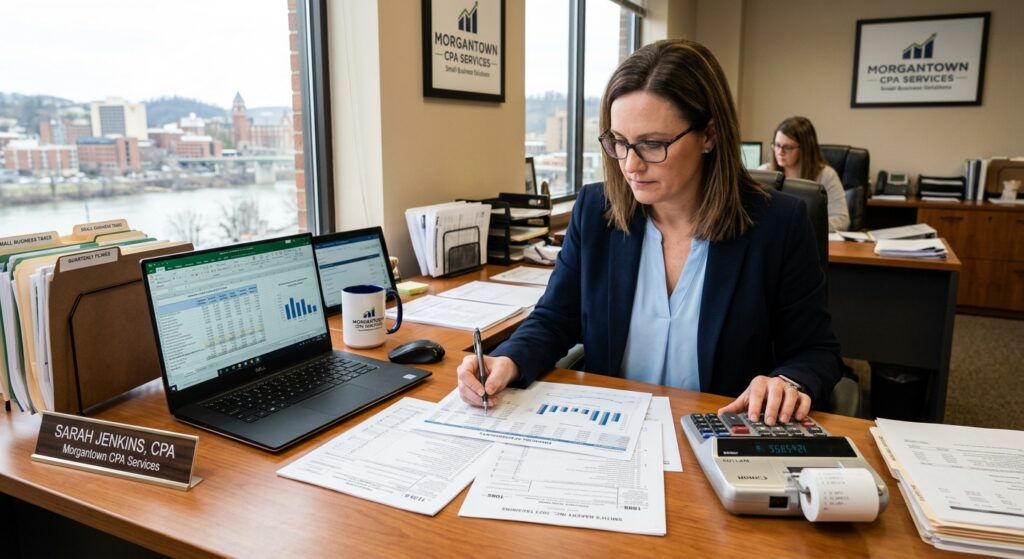
Complete Guide to Finding a Morgantown CPA for Small Business Tax Preparation in 2026
Managing taxes for your Morgantown small business doesn’t have to be overwhelming. A Morgantown CPA specializing in small business tax preparation can help you navigate both federal and West Virginia tax obligations, uncover deductions you might miss, and implement strategies that significantly reduce your tax liability for 2026.
Table of Contents
- Key Takeaways
- Why Your Morgantown Small Business Needs a CPA
- Key Tax Challenges for Small Businesses in Morgantown, WV
- What a Morgantown CPA Actually Does for Your Business
- How to Estimate Your Small Business Tax Liability (The Right Way)
- Questions to Ask Before Hiring a Morgantown CPA
- New Tax Deductions and Breaks Available for 2026
- Uncle Kam in Action: Real Results for Morgantown Business Owners
- Next Steps
- Frequently Asked Questions
Key Takeaways
- A Morgantown CPA helps you identify deductions specific to your industry and business type.
- West Virginia’s 5% income tax reduction (pending 2026) may benefit eligible small business owners.
- 2026 brings new federal deductions for tips, overtime, and car loan interest that many miss.
- Professional tax preparation typically saves business owners 2–5 times the cost of the service.
- Entity structure decisions (sole proprietor vs. LLC vs. S Corp) significantly impact your 2026 tax bill.
Why Your Morgantown Small Business Needs a CPA
Quick Answer: A Morgantown CPA reduces errors, uncovers hidden deductions, optimizes your entity structure, and handles compliance so you focus on growing your business.
Running a small business in Morgantown is demanding. Between payroll, inventory, customer management, and growth, taxes often fall to the back burner until April arrives and you realize you’re scrambling to gather documents. This is where a CPA becomes invaluable.
Without professional guidance, business owners commonly leave money on the table. Studies show that self-prepared returns miss an average of $3,000 to $7,000 in deductions annually. When you hire a tax strategy professional, they work year-round to identify opportunities specific to your situation, not just during tax season.
Peace of Mind and Compliance
A Morgantown CPA ensures you’re filing all required forms correctly and on time. The IRS imposes penalties for late filing and underpayment. These penalties compound quickly, turning a simple oversight into a costly mistake. Your CPA monitors deadlines, manages quarterly estimated tax payments, and ensures you’re compliant with both federal and West Virginia requirements.
Beyond compliance, a CPA provides strategic advice. They understand how business decisions like hiring your first employee, purchasing equipment, or restructuring your entity impact your 2026 tax obligation and cash flow. This proactive planning prevents surprises at year-end.
Local Expertise Matters
Morgantown is home to diverse business sectors healthcare providers, university-related businesses, retail, construction, and professional services. Each industry has unique tax considerations. A local CPA familiar with Morgantown’s business landscape understands these nuances and applies them to your situation.
Pro Tip: Ask your prospective CPA about experience with businesses in your industry. This ensures they understand your specific challenges and opportunities.
Key Tax Challenges for Small Businesses in Morgantown, WV
Quick Answer: Morgantown business owners navigate both federal taxes and West Virginia state taxes, navigate industry-specific deductions, manage 1099 contractor expenses, and prepare for the state’s new 5% income tax reduction.
Morgantown business owners face a unique tax environment. You’re subject to federal income tax, self-employment tax, and West Virginia state income tax. Additionally, depending on your business type, you may deal with sales tax, payroll withholding, and industry-specific regulations.
One significant recent development: West Virginia’s legislature approved a 5% reduction in state income tax rates across all brackets, pending the governor’s signature. This change could mean meaningful relief for 2026 for eligible business owners, but implementation details vary based on business structure.
1099 Contractor Expense Management
If your business hires independent contractors, you’re managing 1099s, which means tracking different expenses and income streams. This complexity increases audit risk if not handled properly. A Morgantown CPA ensures you’re correctly classifying workers and deducting legitimate business expenses.
Entity Structure Decisions
The choice between sole proprietor, LLC, S Corporation, and C Corporation status directly impacts your 2026 tax bill. For example, S Corp owners can reduce self-employment tax through strategic salary and distribution planning. However, this requires careful compliance with IRS reasonable compensation rules. A CPA specializing in entity structuring helps you choose the optimal structure for your situation.
What a Morgantown CPA Actually Does for Your Business
Quick Answer: CPAs prepare tax returns, identify deductions, provide quarterly planning, advise on entity restructuring, and monitor compliance throughout the year.
A Morgantown CPA provides far more than just tax filing services. Here’s what the relationship typically includes:
Tax Return Preparation and Filing
Your CPA prepares all required tax forms Form 1120-S for S Corps, Form 1065 for partnerships and LLCs, Schedule C for sole proprietors, and state forms. They handle e-filing, track filing deadlines, and manage IRS correspondence.
Deduction Identification
CPAs systematically identify deductions aligned with IRS rules. Common business deductions include home office expenses, vehicle mileage, equipment purchases, professional services, rent, utilities, and insurance. Additionally, your CPA highlights new deductions available for 2026 such as the overtime deduction (up to $12,500 for married filers) and the new tips deduction.
Quarterly Tax Planning
Rather than waiting until April, a Morgantown CPA works with you quarterly. They estimate taxes owed, ensure you’re making quarterly estimated payments on time, and adjust strategy based on year-to-date performance. This prevents underpayment penalties and cash flow surprises.
Pro Tip: Quarterly meetings with your CPA reveal optimization opportunities in real-time, allowing you to adjust business decisions throughout the year rather than react after year-end.
How to Estimate Your Small Business Tax Liability (The Right Way)
Quick Answer: Estimate by calculating your net business income, applying the appropriate tax rate, and accounting for quarterly payments and credits available in 2026.
Many Morgantown business owners want a rough idea of their 2026 tax obligation before meeting with a CPA. Here’s a simplified approach (though a professional should refine this):
Step-by-Step Estimation Process
- Calculate gross income: Total all revenue from your business for the year.
- Subtract business deductions: Deduct all legitimate business expenses (supplies, equipment, rent, contractor fees, insurance, utilities).
- Determine net income: Gross income minus deductions equals your business net income.
- Apply self-employment tax: For sole proprietors and partnerships, multiply net income by 92.35%, then apply the 15.3% self-employment tax rate. This creates your self-employment tax obligation.
- Determine federal income tax bracket: Use your net income to identify your 2026 federal tax bracket. For example, for married filing jointly, the 12% bracket applies to income between $23,200 and $94,300.
- Calculate estimated federal tax: Multiply your net income (adjusted for any deductions like the standard deduction of $31,500 for married filers) by your applicable tax rate.
- Account for West Virginia state taxes: Apply West Virginia’s state income tax rate to your state taxable income. Watch for updates regarding the pending 5% tax reduction.
- Add quarterly payments: Divide your total estimated tax by four to determine quarterly estimated payment amounts (due April 15, June 15, September 15, and January 15).
For more accurate calculations tailored to your specific situation, use our small business tax calculator to get a realistic estimate for 2026.
Common Estimation Mistakes
Many business owners underestimate taxes because they forget about self-employment tax (15.3% combined rate), miss available deductions, or don’t account for state taxes. Others overestimate by not recognizing new deductions like the 2026 overtime deduction (up to $25,000 for married filers) or the universal charitable deduction available for non-itemizers.
Questions to Ask Before Hiring a Morgantown CPA
 Free Tax Write-Off Finder
Quick Answer: Ask about industry experience, service scope, pricing, communication style, and their approach to proactive tax planning versus reactive filing.
Choosing the right Morgantown CPA is critical. Here are essential questions to ask during your initial consultation:
Pre-Meeting Checklist for CPA Evaluation
- Do you have experience with businesses in my industry (healthcare, construction, retail, etc.)?
- Do you provide ongoing advisory services, or is your primary focus tax filing?
- How do you bill (hourly, flat fee, contingency)? What’s included in your service package?
- Can you explain how you’d optimize my entity structure for 2026? Do you recommend quarterly planning?
- How do you stay current with 2026 tax law changes, like the new tips and overtime deductions?
- What credentials do you hold (CPA, EA, etc.)? Are you a member of AICPA or the West Virginia Society of CPAs?
- How often can we meet or communicate? Do you prefer in-person, phone, or digital collaboration?
- Can you provide references from clients in similar situations?
New Tax Deductions and Breaks Available for 2026
Quick Answer: 2026 introduces new deductions for tips, overtime, car loan interest, and expanded charitable deductions many business owners don’t know about these yet.
The One Big Beautiful Bill Act (passed in 2025 and effective for 2026 returns) introduced several new deductions that can significantly reduce your tax bill. Many business owners and their tax preparers are still getting up to speed on these, creating an opportunity for early adopters:
2026 New Deductions Comparison Table
| Deduction Type | 2026 Limit (Single) | 2026 Limit (Married Filing Jointly) | Phase-Out MAGI |
|---|---|---|---|
| Overtime Deduction | $12,500 | $25,000 | $150k/$300k |
| Tips Deduction | Up to 100% of tips received | Up to 100% of tips received | $150k/$300k |
| Car Loan Interest | Up to $2,500 | Up to $2,500 | $100k/$200k |
| Senior Deduction (65+) | $6,000 | $12,000 | $75k/$150k |
Additionally, the new Universal Charitable Deduction (UCD) allows non-itemizers to deduct up to $1,000 (single) or $2,000 (married filing jointly) of charitable contributions. This is a game-changer for small business owners who haven’t historically itemized.
Did You Know? If your business includes employees and you pay overtime, you could claim up to $25,000 in deductions for 2026 if married filing jointly. Many employers forget this entirely, missing significant tax relief.

Uncle Kam in Action: Real Results for Morgantown Business Owners
Let’s look at a real example of how professional tax planning transforms a Morgantown business owner’s situation.
Client Snapshot: Sarah, a 44-year-old construction business owner in Morgantown, had been running her LLC for five years. She was pulling $180,000 annually in income but had never optimized her business structure or pursued quarterly tax planning. She simply paid her estimated taxes and then scrambled each April.
The Challenge: Sarah’s LLC structure was costing her significantly in self-employment taxes (15.3%). Additionally, she wasn’t tracking all deductible business expenses systematically. She was also unaware that her construction business qualified for several specialized deductions specific to the industry. Her previous accountant was primarily a filing service, not a tax strategist.
The Uncle Kam Solution: Our analysis showed that Sarah’s situation warranted an S Corporation election for 2026. After converting to S Corp status and implementing a reasonable salary structure, her self-employment tax exposure was reduced significantly. Additionally, we identified $18,500 in previously missed deductions related to her construction equipment depreciation, vehicle expenses, and contractor payroll. We also incorporated quarterly planning meetings to catch optimization opportunities in real time.
The Results: For 2026, Sarah’s tax liability decreased by $24,350 compared to her previous structure. Our fee for tax preparation and quarterly advisory services was $3,500. This represents a 595% return on investment in the first year alone. More importantly, Sarah now has a year-round tax strategist who ensures she’s capturing every available deduction and opportunity. View more client success stories.
This is typical of what we see with Morgantown business owners. When you move from a filing-focused accountant to a tax strategy partner, the value is immediate and substantial.
Next Steps
Now that you understand the value of a Morgantown CPA for your small business, here’s how to move forward:
- Gather your documents: Collect business tax returns from the past two years, a list of 2026 income and expenses to date, and notes on any major business changes planned.
- Schedule a consultation: Contact a local Morgantown CPA for a free 15-minute initial conversation to discuss your situation and whether they’re a good fit.
- Ask about 2026 optimization: Specifically inquire about entity structure optimization, new deduction opportunities, and quarterly planning services.
- Explore advisory services: Look for tax advisory and planning services that go beyond basic filing these provide the greatest long-term value.
Frequently Asked Questions
How much does a Morgantown CPA cost for small business taxes?
Pricing varies widely based on complexity. Simple sole proprietor returns may cost $500–$1,500. S Corp or partnership returns with quarterly planning typically run $2,000–$5,000 annually. Some CPAs charge hourly rates ($150–$400/hour), while others use fixed fees. The key is that professional tax preparation typically saves 2–5 times the cost through reduced taxes and avoided penalties. Treat this as an investment, not an expense.
Can I use an online tax service instead of a Morgantown CPA?
Online services can work for very simple returns (sole proprietor with minimal income and few deductions). However, they lack the strategic advisory component. A Morgantown CPA can identify optimization opportunities you’d miss using software like entity restructuring, quarterly planning, and industry-specific deductions. The difference often amounts to thousands in savings annually.
Should I elect S Corp status for my Morgantown business?
S Corp election can save significant self-employment taxes for owners earning over $60,000 annually, but it requires careful compliance (reasonable salary rules, payroll processing, additional filings). The decision depends on your income level, business type, and risk tolerance. A Morgantown CPA can model both scenarios and recommend the optimal structure for 2026.
What about West Virginia’s new tax reduction? Will that help my business?
West Virginia’s approved 5% income tax reduction across all brackets will benefit eligible small business owners, though implementation details are pending the governor’s signature. The impact varies by business structure and income level. A local Morgantown CPA can clarify how this affects your 2026 taxes once the details are finalized.
How do I know if my business is missing deductions?
Review your past tax returns and compare deductions to similar businesses. If you’re deducting less than 20–30% of gross revenue, you’re likely missing opportunities. Also check if you’ve claimed home office expenses, vehicle mileage, equipment depreciation, contractor fees, and the new 2026 deductions (overtime, tips, car loan interest). A CPA review usually reveals $3,000–$10,000 in missed deductions for small businesses.
When should I hire a Morgantown CPA?
The best time to hire a CPA is Q1 or Q2 of the current year (not April 14). This allows time for strategic planning before year-end. However, if you’re mid-year and haven’t optimized yet, hiring now still provides value you can implement changes for the remainder of 2026 and next year. Don’t wait until tax season crunch; that’s reactive, not strategic.
How often should I meet with my Morgantown CPA?
Ideally, quarterly meetings (once each quarter) allow your CPA to monitor your situation and adjust strategy. Some businesses meet once or twice annually; others meet monthly during busy seasons. At minimum, meet before Q1, Q2, and Q4 to address estimated taxes and year-end planning.
Related Resources
- Tax Planning Services for Business Owners
- 2026 Tax Preparation and Filing Services
- The MERNA™ Tax Strategy Method for Business Owners
- IRS Schedule C: Profit or Loss from Business
- IRS Topic 557: Self-Employment Tax
Last updated: March, 2026

