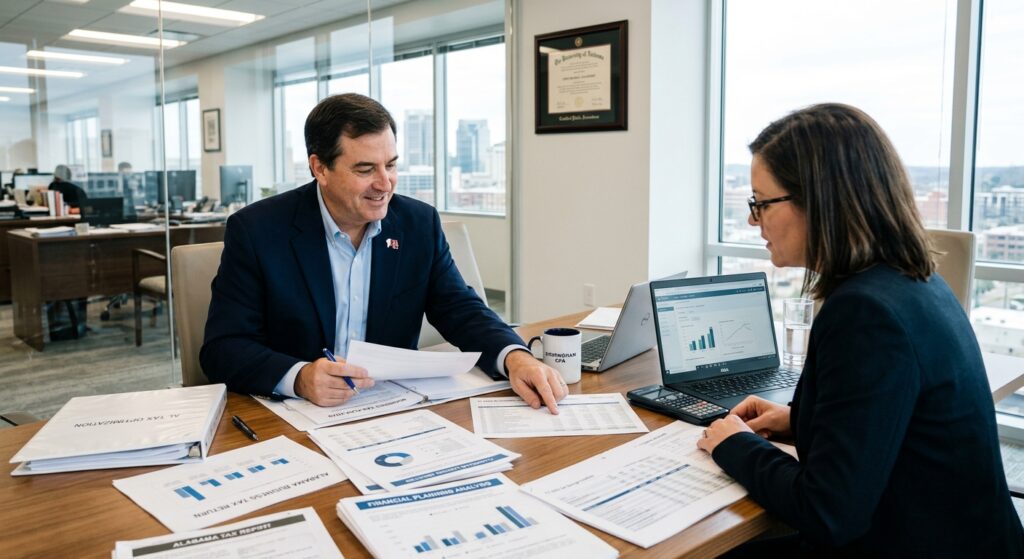
2026 Alabama CPA Guide: Tax Planning Strategies for Business Owners, Self-Employed Professionals, and Real Estate Investors
Finding the right Alabama CPA is one of the most important decisions you’ll make as a business owner, self-employed professional, or real estate investor. For the 2026 tax year, the stakes are higher than ever—with new deductions, expanded tax brackets, and complex planning opportunities introduced by the One Big Beautiful Bill Act, having expert guidance can save you thousands in federal and state taxes.
Table of Contents
- Key Takeaways
- What Does an Alabama CPA Do?
- 2026 Standard Deductions and Tax Brackets
- How Much Self-Employment Tax Will You Owe?
- Key Tax Deductions and Planning Strategies
- How to Choose the Right Alabama CPA for Your Situation
- Uncle Kam in Action
- Next Steps
- Frequently Asked Questions
Key Takeaways
- For 2026, the standard deduction is $31,500 for married filing jointly and $15,750 for single filers.
- Self-employment tax remains at 15.3% of net earnings from self-employment.
- The SALT deduction cap is now $40,000 through 2029, up from $10,000 previously.
- New deductions for seniors ($6,000), tips, and overtime are available in 2026.
- A qualified Alabama CPA helps you maximize deductions and stay compliant with tax laws.
What Does an Alabama CPA Do and Why Should You Work With One?
Quick Answer: An Alabama CPA provides tax preparation, audit services, and strategic tax planning to help reduce your liability, ensure compliance, and maximize profits for business owners and self-employed professionals.
A certified public accountant in Alabama combines technical expertise with deep understanding of both federal and state tax law. The primary role of an Alabama CPA extends far beyond simply filing your tax return. These professionals provide ongoing strategic guidance designed to minimize your tax burden while keeping your business compliant with IRS regulations and Alabama state requirements.
For 2026, an Alabama CPA becomes even more critical given the complexity of new tax law changes. The One Big Beautiful Bill Act introduced permanent standard deduction increases, new deductions for seniors and service workers, expanded SALT deduction caps, and new investment vehicles like Trump Accounts. Without expert guidance, you could miss significant opportunities to reduce your tax liability.
Core Services an Alabama CPA Provides
- Tax Preparation and Filing: Preparation of federal and state returns using current 2026 tax law.
- Tax Planning: Year-round strategy to minimize tax liability through entity selection, timing of income, and strategic deductions.
- Bookkeeping and Accounting: Maintenance of financial records ensuring accurate income reporting on Schedule C.
- Audit Support: Representation before the IRS if your return is selected for audit examination.
- Business Advisory: Guidance on entity structure (LLC, S-Corp, C-Corp) based on your income level and business type.
Pro Tip: The right Alabama CPA should have credentials from the American Institute of Certified Public Accountants (AICPA) and continuing education in the latest tax law changes, particularly the 2026 tax provisions.
Why Specialized Knowledge Matters in 2026
The 2026 tax year has introduced significant changes that require specialized knowledge. The standard deduction of $31,500 for married filing jointly (up from prior year amounts) provides a starting point for tax planning. However, many high-income business owners and real estate investors benefit more from itemizing deductions when combined with the expanded SALT deduction cap of $40,000 through 2029. Only an Alabama CPA with current knowledge can properly evaluate your specific situation and determine the optimal filing strategy.
Additionally, new deductions introduced for the 2026 tax year include a $6,000 deduction for taxpayers age 65 and older, up to $12,000 for married couples where both are over 65. Service workers can deduct up to $12,500 of qualified tips, while those with overtime income can deduct up to $12,500 (or $25,000 if married filing jointly). Understanding these opportunities and ensuring you qualify for them requires ongoing professional engagement.
What Are the 2026 Standard Deductions and Federal Tax Brackets?
Quick Answer: For 2026, the standard deduction is $31,500 for married filing jointly, $15,750 for single filers, and seniors age 65+ get an additional $6,000. Federal tax brackets remain at 10%, 12%, 22%, 24%, 32%, 35%, and 37%.
Understanding your baseline deduction is the foundation of tax planning. The permanent standard deduction established by the One Big Beautiful Bill Act means that for 2026 and beyond, you have certainty about how much income you can exclude before calculating tax liability. This is significantly different from the uncertainty of prior years when deductions were set to sunset.
| Filing Status | 2026 Standard Deduction | Age 65+ Additional Amount |
|---|---|---|
| Married Filing Jointly | $31,500 | $6,000 (per person) |
| Single | $15,750 | $6,000 |
| Head of Household | $15,750 | $6,000 |
Should You Itemize or Take the Standard Deduction?
For most individuals, the standard deduction is beneficial. However, high-income business owners and real estate investors often benefit from itemizing. Key itemizable deductions in 2026 include state and local taxes (SALT) up to $40,000, mortgage interest on loans up to $750,000, charitable contributions, and medical expenses exceeding 7.5% of adjusted gross income.
Real estate investors, in particular, should work with an Alabama CPA to evaluate whether itemization, combined with depreciation deductions and other real estate-specific benefits, exceeds the standard deduction. For a married couple filing jointly with $50,000 in SALT deductions and $30,000 in mortgage interest, itemizing would generate $80,000 in total deductions, significantly exceeding the $31,500 standard deduction.
2026 Federal Tax Brackets Explained
The seven federal tax brackets established by the Tax Cuts and Jobs Act remain in place for 2026: 10%, 12%, 22%, 24%, 32%, 35%, and 37%. These brackets determine how much tax you owe based on your taxable income after deductions. Understanding which bracket you’ll fall into helps with strategic income planning—particularly for self-employed professionals who can control the timing of when they recognize income.
Did You Know? Many high-income business owners can reduce their effective tax rate by strategic deferral of income or acceleration of deductions. An Alabama CPA can model different scenarios to show you the tax impact before year-end, allowing you to make informed decisions about timing.
How Much Self-Employment Tax Will You Owe on Your Business Income?
Quick Answer: Self-employment tax in 2026 is 15.3% of net earnings from self-employment (12.4% for Social Security, 2.9% for Medicare). This is separate from income tax and applies to Schedule C business income.
Self-employment tax is one of the largest tax obligations for independent contractors, freelancers, and self-employed professionals in Alabama. For 2026, the self-employment tax rate remains at 15.3%. This tax is calculated on your net earnings from self-employment (business revenue minus deductible expenses) and funds Social Security and Medicare.
To understand your self-employment tax obligation, you must report all business income on Schedule C and subtract all legitimate deductible business expenses. The resulting net profit is then subject to the 15.3% self-employment tax. For example, if you have $100,000 in business revenue and $40,000 in deductible expenses, your net earnings are $60,000. You’ll owe approximately $8,472 in self-employment tax (after applying the deduction for one-half of SE tax), in addition to your regular income tax obligation on that same amount.
How to Calculate Your Estimated Self-Employment Tax
Estimated self-employment tax payments are required throughout the year if your net self-employment income exceeds $400. These quarterly payments are due on April 15, June 15, September 15, and January 15 (of the following year). An Alabama CPA can help you determine the correct quarterly payment amount based on your projected annual income.
Use our Self-Employment Tax Calculator to estimate your 2026 self-employment tax obligation based on your expected business income and deductions.
Reducing Self-Employment Tax Through Entity Structure
One of the most powerful strategies an Alabama CPA can employ is recommending the optimal business entity structure. If you’re currently operating as a sole proprietor and your net business income exceeds $60,000, you may benefit from electing S-Corporation taxation. An S-Corp allows you to split your business income between W-2 wages (which are subject to self-employment tax) and distributions (which are not). This can result in significant self-employment tax savings—often $5,000 to $15,000+ annually depending on your income level.
Pro Tip: S-Corporation election is most beneficial when your net income after deductions exceeds $60,000. Below that threshold, the administrative burden of maintaining an S-Corporation typically outweighs the tax savings. Your Alabama CPA should perform a detailed analysis based on your specific numbers.
What Are the Key Tax Deductions and Planning Strategies for 2026?
 Free Tax Write-Off Finder
Quick Answer: 2026 deductions include business expenses (Schedule C), SALT up to $40,000, mortgage interest, charitable contributions, medical expenses over 7.5% of AGI, and new deductions for tips, overtime, and seniors age 65+.
The intersection of deduction opportunities and strategic planning is where an Alabama CPA’s value becomes most evident. For business owners, every dollar of deductible business expense reduces your taxable income dollar-for-dollar. Common deductible business expenses include home office deductions, vehicle expenses, professional development, software subscriptions, and contractor payments.
| Deduction Category | 2026 Limits/Details | Who Benefits |
|---|---|---|
| SALT Deduction | Up to $40,000 (phases out above $500K MAGI) | High-income professionals, real estate investors |
| Senior Deduction | $6,000 single / $12,000 MFJ if age 65+ | Retirees and older business owners |
| Tips Deduction | Up to $12,500 (income limits apply) | Service industry workers |
| Overtime Deduction | Up to $12,500 single / $25,000 MFJ | Wage earners with overtime compensation |
| QBI Deduction | Up to 20% of qualified business income | Self-employed and business owners |
Maximizing Business Expense Deductions
Business owners often leave significant deduction opportunities on the table simply because they’re not aware of what qualifies as a deductible business expense. An Alabama CPA conducts a comprehensive review of your income and expenses to identify missed opportunities. Common deductions that business owners frequently overlook include home office deductions, education and professional development expenses, equipment depreciation, and insurance premiums.
The home office deduction, for example, can save you $2,000 to $5,000 annually depending on your office square footage and home values in Alabama. If your business maintains a dedicated office space exclusively for business purposes, you can deduct a portion of your home mortgage interest, property taxes, utilities, and insurance proportional to your office size.
Special Deductions for Real Estate Investors
Real estate investors benefit from deductions unique to the real estate industry. These include depreciation of the building (not the land), repairs and maintenance, property taxes, insurance, mortgage interest, property management fees, and advertising for tenants. Depreciation alone typically generates significant tax deductions. A $300,000 rental property can generate approximately $9,000 in annual depreciation deductions, reducing your taxable income dollar-for-dollar.
Pro Tip: New real estate investors should work with an Alabama CPA to ensure their rental property is properly structured for tax purposes. Cost segregation studies can accelerate depreciation deductions in the early years of property ownership, creating significant tax savings.
How Do You Choose the Right Alabama CPA for Your Business and Tax Situation?
Quick Answer: Choose an Alabama CPA with current credentials, relevant industry experience, proficiency with tax planning (not just tax filing), and a proactive approach to identifying tax savings opportunities for your specific business type.
Not all CPAs are created equal. The difference between a competent Alabama CPA and an excellent one often amounts to $10,000 to $50,000+ in annual tax savings. Your goal should be to find a professional who serves as a strategic tax advisor, not just a tax return preparer.
Essential Credentials and Qualifications
- CPA License: Verify the accountant holds a current, active CPA license from the Alabama State Board of Accountancy.
- AICPA Membership: AICPA members commit to continuing education and ethical standards.
- CPE Credits: For 2026, Alabama CPAs must maintain 40 hours of continuing professional education every two years, with at least 20 hours in accounting and auditing.
- Specialized Credentials: Look for specialists—CFF (Certified Financial Forensics), PFS (Personal Financial Specialist), or other designations relevant to your situation.
Questions to Ask Before Hiring an Alabama CPA
Before engaging a CPA, ask these critical questions to ensure they’re the right fit for your situation:
- How many clients in my industry do you serve? (Look for experience, not just a vague “yes.”)
- What was the average tax savings you identified for clients like me in 2026?
- Do you conduct quarterly tax planning sessions or only prepare returns annually?
- How do you charge: hourly, flat fee, or percentage of income? (Transparent pricing is important.)
- Will you represent me before the IRS if I’m audited?
- How do you stay current with 2026 tax law changes? (Request evidence of CPE completion.)
Pro Tip: The best Alabama CPAs often recommend a comprehensive tax strategy engagement that includes quarterly planning sessions rather than just annual tax return preparation. This proactive approach allows you to adjust your business decisions throughout the year to minimize taxes.

Uncle Kam in Action: How Strategic CPA Guidance Saved a Business Owner $28,400 in Taxes
Marcus owns a marketing consulting firm in Montgomery, Alabama, with annual net business income of approximately $180,000. For three years, he filed his taxes as a sole proprietor, paying estimated self-employment tax quarterly without strategic planning. His previous accountant simply prepared his tax return each year—a reactive, not proactive approach.
In 2026, Marcus engaged Uncle Kam’s tax advisory team, which included a CPA with specialized knowledge of service-based businesses. The initial consultation identified three major tax planning opportunities:
Opportunity 1: S-Corporation Election Marcus’s net income of $180,000 made him an ideal candidate for S-Corp taxation. By electing S-Corp status and paying himself a reasonable W-2 salary of $110,000, he could distribute $70,000 in profits subject only to income tax (not 15.3% self-employment tax). This strategy alone saved him $10,710 in self-employment tax annually.
Opportunity 2: Home Office Deduction Marcus worked from a dedicated 300-square-foot home office. At an estimated $200 per square foot in his neighborhood, the annual home office deduction generated approximately $3,200 in additional deductions (20% of the home’s depreciable basis, property taxes, utilities, and insurance).
Opportunity 3: SALT Deduction Optimization Marcus paid $18,000 in Alabama state income taxes and $12,000 in property taxes. The 2026 SALT cap of $40,000 allowed him to deduct the full $30,000, compared to the previous $10,000 cap. This represented an additional $20,000 in deductible expenses.
Combined Results: The tax planning yielded approximately $33,910 in additional deductions and tax reductions (combining the SE tax savings, home office deduction, and SALT optimization). At Marcus’s 24% marginal federal tax rate plus Alabama state taxes, this resulted in total tax savings of $28,400 in 2026 alone. Marcus recovered his CPA engagement fee within the first quarter.
This example demonstrates why strategic entity structuring with professional guidance is so important. Without Uncle Kam’s analysis, Marcus would have continued overpaying taxes by approximately $28,000+ annually—money that could be reinvested in business growth, retirement savings, or other financial goals.
Next Steps: Finding Your Alabama CPA and Optimizing Your 2026 Taxes
Taking action on your tax situation doesn’t require waiting until April to file your return. The most successful business owners and self-employed professionals work with their CPAs throughout the year to optimize their tax outcomes. Here are your action steps:
- Step 1: Schedule a Tax Planning Consultation Contact your Alabama CPA or a qualified tax professional in your area to discuss your 2026 tax situation. Bring your 2025 tax return and estimated 2026 income figures.
- Step 2: Evaluate Your Entity Structure If you’re a sole proprietor earning more than $60,000 in net income, ask your CPA whether S-Corp election could save you money. Request a detailed analysis showing potential SE tax savings.
- Step 3: Document All Business Expenses Implement a system to track all business expenses throughout 2026. Monthly bookkeeping ensures accuracy and helps your CPA identify deduction opportunities.
- Step 4: Review Real Estate and Investment Opportunities If you’re a real estate investor, ask your CPA about cost segregation studies and depreciation strategies that could accelerate deductions.
- Step 5: Schedule Quarterly Tax Planning Sessions Commit to quarterly check-ins with your CPA to review your progress and make mid-year adjustments if needed.
Frequently Asked Questions About Alabama CPAs and 2026 Tax Planning
What is the difference between a CPA and a tax preparer?
A CPA is a licensed professional who has passed rigorous exams and maintains continuing education requirements. CPAs can provide tax planning, auditing, consulting, and represent you before the IRS. A tax preparer may prepare returns but lacks the credentials, oversight, and legal authority of a CPA. For complex situations like self-employment income or real estate investments, a CPA’s expertise is invaluable.
How much should I expect to pay for CPA services in Alabama?
CPA fees vary widely based on complexity. A simple sole proprietor return might cost $500-$1,500. A more complex business with S-Corp election, multiple properties, and quarterly planning could cost $3,000-$8,000+ annually. However, the tax savings typically far exceed the fee. Look for CPAs who can demonstrate ROI (return on investment) through documented tax savings.
Can I do my own taxes instead of hiring a CPA?
Technically, yes. However, the IRS estimates that many self-employed individuals leave 20-30% of available deductions on the table. If your business generates $100,000 in net income and you miss even $20,000 in deductions, you’re overpaying taxes by approximately $5,000-$6,000 annually (depending on your tax bracket). A CPA engagement paying for itself within one year is common.
What documents should I bring to my CPA appointment?
Bring your prior year tax return, estimated quarterly tax payment receipts, income statements from all sources, receipts for business expenses, mortgage statements, property tax statements, 1099 forms from clients, business financial statements, and a summary of significant financial events in 2026. The more organized your records, the more efficiently your CPA can work and the lower your fee will be.
Are CPAs required to maintain client confidentiality?
Yes. CPAs are bound by professional ethics rules and can communicate with clients using privileged communications in some situations. This means your CPA cannot disclose your financial information to third parties without your permission, except as required by law.
What if the IRS audits my return?
Your CPA can represent you before the IRS during an audit examination, provided they have the appropriate power of attorney (Form 2848). This professional representation ensures that your deductions are properly defended and your rights are protected. CPAs’ experience with audits and understanding of IRS procedures is invaluable during this process.
Should I worry about the IRS’s 2026 staffing challenges?
While the IRS faces staffing reductions, audits for high-income individuals and businesses continue. The best protection is maintaining accurate records and working with a CPA to ensure your return is defensible. The combination of proper documentation and professional preparation reduces audit risk and prepares you if one occurs.
Can I use my CPA’s guidance for financial planning beyond just taxes?
Many CPAs offer broader business solutions beyond tax preparation, including bookkeeping, financial statement preparation, retirement planning, and business advisory services. A CPA familiar with your entire financial picture can provide comprehensive guidance that goes far beyond tax compliance.
Related Resources
- Self-Employed Taxes: A Complete 2026 Guide
- Real Estate Investor Tax Strategies
- Tax Planning for Business Owners
- Entity Structuring: LLC vs S-Corp vs C-Corp
- The MERNA Method: Strategic Tax Optimization
Last updated: March, 2026
This information is current as of 3/23/2026. Tax laws change frequently. Verify updates with the IRS or your Alabama State Board of Accountancy if reading this later.

