Podcast Creator Tax Deductions 2026: Complete Guide to Maximizing Your Write-Offs
For 2026, podcast creators have unprecedented opportunities to reduce taxable income through podcast creator tax deductions and strategic write-offs. The One Big Beautiful Bill Act expanded deduction opportunities, reinstated 100% bonus depreciation for equipment, and provided new pathways for immediate expensing under Section 179. Whether you’re a full-time podcaster or running a side hustle, understanding these deductions can mean thousands in annual tax savings.
Table of Contents
- Key Takeaways
- What Equipment Deductions Can Podcast Creators Claim?
- How Does Section 179 Expensing Work for Podcasters?
- What Is 100% Bonus Depreciation and How Does It Apply?
- Can You Deduct Your Home Office as a Podcaster?
- What Operating Expenses Can Podcasters Deduct?
- What Business Entity Should You Choose for Your Podcast?
- Uncle Kam in Action
- Next Steps
- Frequently Asked Questions
Key Takeaways
- 100% bonus depreciation is available for podcast equipment purchased in 2026, allowing immediate full write-offs instead of multi-year depreciation.
- Section 179 expensing lets you immediately deduct up to $1.1+ million in qualifying equipment in 2026.
- Home office deductions using simplified method ($5 per square foot) or actual expense method are available to all podcasters with dedicated workspaces.
- Podcast operating expenses including hosting, software subscriptions, and professional services are fully deductible as business expenses.
- Choosing the right business entity (LLC, S-Corp, or sole proprietorship) can reduce self-employment taxes by 15-20% annually.
What Equipment Deductions Can Podcast Creators Claim?
Quick Answer: Podcast creators can deduct all equipment purchases including microphones, audio interfaces, headphones, recording software, and hosting platforms. With 100% bonus depreciation now available for 2026, you can write off the entire cost immediately rather than spreading deductions across multiple years.
For 2026, the IRS allows immediate deduction of podcast equipment through two primary mechanisms: bonus depreciation and Section 179 expensing. The reinstatement of 100% bonus depreciation is particularly advantageous for podcasters who’ve invested in high-quality recording setups.
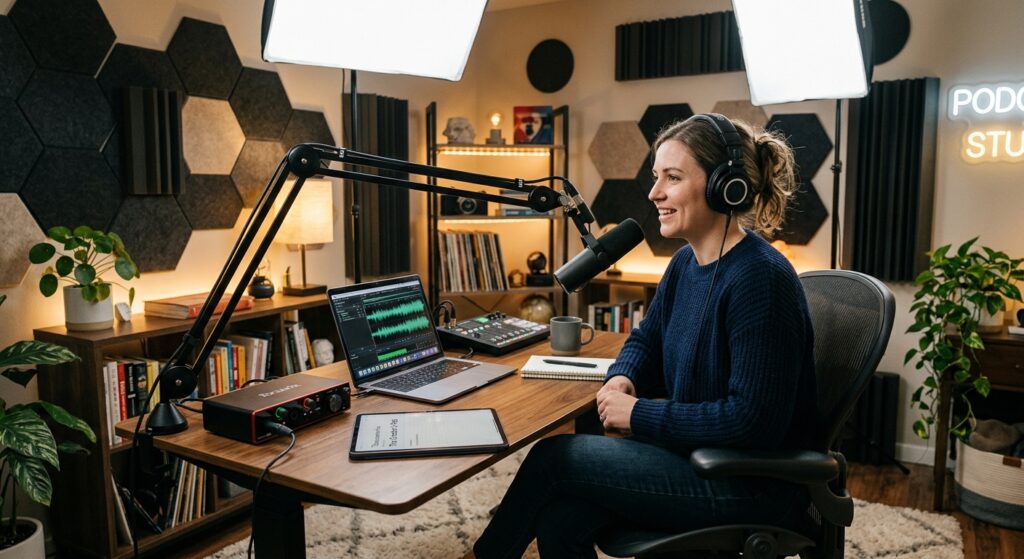
Equipment eligible for these deductions includes: microphones (USB and XLR), audio interfaces, mixers, headphones and monitoring equipment, recording software and plugins, hosting platforms and CDN services, editing software (Adobe Audition, Descript), cables and connectivity equipment, boom arms and shock mounts, and ring lights and camera equipment for video podcast production.
How 100% Bonus Depreciation Works in 2026
Previously, bonus depreciation was phased down annually under the Tax Cuts and Jobs Act, eventually reaching 0%. The 2025 tax law reversed this decline, restoring 100% bonus depreciation for assets placed in service during 2026. This means podcast equipment purchased and placed in service in 2026 can be fully written off in that same tax year, dramatically improving your cash flow and reducing taxable income.
Example scenario: A podcaster purchases a complete home studio setup for $8,000 in March 2026, including an Audio-Technica microphone ($350), Focusrite Scarlett interface ($200), mixing software ($400), and hosting upgrade ($7,050 annually). Under 100% bonus depreciation, they can deduct the entire $8,000 in 2026, reducing their taxable income dollar-for-dollar.
Documentation Requirements for Equipment Deductions
The IRS requires clear documentation of all equipment purchases. Maintain receipts, invoices, and purchase orders showing the date of acquisition and cost. Additionally, keep records demonstrating that equipment is used primarily for podcast production. For equipment with mixed personal and business use, document the percentage of business use and claim only that proportional deduction.
How Does Section 179 Expensing Work for Podcasters?
Quick Answer: Section 179 of the IRS tax code allows you to immediately deduct up to $1.1 million in qualifying equipment purchases in 2026, provided your total asset purchases don’t exceed $2.75 million. This applies perfectly to podcast equipment and provides an alternative to bonus depreciation.
Section 179 expensing complements bonus depreciation and provides additional flexibility for podcast equipment purchases. While bonus depreciation applies automatically to most assets, Section 179 allows you to elect immediate deduction for specific items, giving you control over which deductions to claim in which years. The IRS Publication 946 details tangible property depreciation rules and Section 179 eligibility.
Section 179 Limits and Thresholds for 2026
The 2026 Section 179 expensing limit is $1,110,000, with a total asset acquisition limit of $2,750,000. This means you can deduct up to $1.11 million in equipment in 2026. Once total acquisitions exceed $2.75 million, the Section 179 deduction phases out dollar-for-dollar for every dollar above that threshold.
For most podcasters, these limits aren’t constraining. Even a comprehensive home studio setup rarely exceeds a few thousand dollars, well below the $1.11 million individual limit. However, if you’re purchasing broadcast-quality equipment or upgrading an entire production facility, understanding these thresholds prevents missing deduction opportunities.
Types of Podcast Equipment Eligible for Section 179
Qualified Section 179 property for podcast creators includes tangible personal property essential to production operations. Recording equipment (microphones, interfaces, mixers) absolutely qualifies. Audio software and plugins (if on disc or delivered physically) qualify, though cloud-based subscriptions are treated differently. Computer hardware and servers directly used for podcast production qualify. Furniture and fixtures (desk, shelving) used exclusively for podcast operations qualify. Video equipment (cameras, lighting) qualifies if your podcast includes video distribution.
Items that don’t qualify under Section 179 include building components and improvements (though may qualify under bonus depreciation differently), vehicles over 6,000 lbs (subject to different rules), and property used outside the US.
What Is 100% Bonus Depreciation and How Does It Apply?
Quick Answer: 100% bonus depreciation, reinstated for 2026, allows you to deduct the full cost of eligible podcast equipment in the year of purchase. This immediate deduction improves cash flow and reduces 2026 taxable income without requiring multi-year depreciation schedules.
Bonus depreciation underwent significant changes through the Tax Cuts and Jobs Act (2017), which temporarily increased it to 100% but scheduled a phased decline. The 2025 tax law reversed this decline, restoring 100% bonus depreciation permanently. For podcast creators, this means equipment placed in service in 2026 can be deducted in full that year.
The advantage of bonus depreciation over traditional depreciation is timing. Rather than claiming 20% of a $5,000 microphone setup annually over five years, you claim the entire $5,000 in 2026. This front-loads tax deductions, reducing your 2026 tax liability and improving cash flow during your business growth phase. IRS Publication 225 explains depreciation and amortization methods.
Bonus Depreciation vs. Section 179: Which Should You Choose?
Both bonus depreciation and Section 179 provide immediate deductions, but they differ in application and flexibility. Bonus depreciation applies automatically to qualifying property without any election required—it applies whether you want it to or not. Section 179 requires affirmative election and provides more control over timing, allowing you to claim deductions in specific years when you might benefit most from reduced income.
For most podcasters, the automatic nature of bonus depreciation is advantageous. However, if you have significant podcast losses or expenses in one year, electing Section 179 instead for another year can optimize your total tax position. Working with a tax strategy professional helps determine the optimal approach for your specific situation.
Pro Tip: Combine bonus depreciation with cost segregation studies for equipment upgrades exceeding $50,000. This segregates property into components with different depreciation rates, potentially accelerating deductions further.
Can You Deduct Your Home Office as a Podcaster?
Quick Answer: Yes, podcast creators can deduct home office expenses using either the simplified method ($5 per square foot) or the actual expense method. You must use a dedicated space used regularly and exclusively for podcast production to qualify.
The home office deduction is one of the most valuable write-offs for podcasters working from home. The IRS recognizes that you’re using a portion of your primary residence for business purposes and allows deductions to reflect this business use. However, the space must meet specific criteria: it must be used regularly and exclusively for podcast production. A bedroom that’s used for sleeping cannot qualify, even if you occasionally record there.
Simplified Method vs. Actual Expense Method
The simplified method is straightforward: measure your dedicated podcast studio space in square feet and multiply by $5. A 10×10-foot dedicated studio space (100 square feet) yields a $500 annual deduction. This requires minimal record-keeping and is ideal for podcasters with modest home studios.
The actual expense method calculates your home’s business-use percentage and deducts that percentage of all home expenses: mortgage interest or rent, property taxes, utilities, insurance, repairs, maintenance, and depreciation. A podcaster using a 120-square-foot studio in a 2,000-square-foot home claims 6% of all home expenses. This method produces larger deductions but requires detailed record-keeping and annual calculations.
Example: Using actual expense method, a homeowner in the actual expense method scenario with $8,000 annual property taxes, $3,000 utilities, $2,000 insurance, and $1,200 maintenance has $14,200 total home expenses. With a 6% business-use percentage, they deduct $852 annually—significantly more than the simplified method’s $600.
Deductible Home Office Expenses Beyond Space Allocation
Beyond the base home office deduction, podcast creators can deduct additional expenses directly attributable to podcast production. Office furniture and equipment (desk, chair, shelving) are deductible. Broadband internet service is deductible (either in full if used exclusively for podcasting or proportionally if mixed use). Podcast-specific software subscriptions and hosting platforms are fully deductible. Phone service for podcast-related calls is deductible. Decorative improvements to the studio (acoustic panels, soundproofing materials) are deductible.
What Operating Expenses Can Podcasters Deduct?
 Free Tax Write-Off Finder
Quick Answer: Podcast operating expenses including hosting services, editing software, platform subscriptions, guest compensation, marketing, and professional services are fully deductible as ordinary and necessary business expenses. These must be documented and directly related to podcast production or distribution.
Operating expenses are the ongoing costs required to produce and distribute your podcast. Unlike equipment (capitalized and depreciated), operating expenses are deducted immediately in full. This distinction makes detailed tracking essential for maximizing tax savings. The IRS defines ordinary and necessary business expenses on Topic 504.
Hosting, Production, and Distribution Costs
| Expense Category | Typical Costs | Deductibility |
|---|---|---|
| Podcast Hosting | Buzzsprout, Podbean, Anchor: $5-$50/month | 100% deductible |
| Editing Software | Adobe Audition, Descript: $10-$35/month | 100% deductible |
| CDN/Distribution | Spotify for Podcasters, iHeartRadio: Free-$20/month | 100% deductible |
| Guest Compensation | Per-appearance fees or stipends | 100% deductible |
| Transcription Services | Rev, Descript: $0.10-$0.25 per minute | 100% deductible |
Hosting platforms store your audio files and distribute episodes to major platforms like Spotify, Apple Podcasts, and Google Podcasts. These monthly subscriptions are ordinary and necessary expenses fully deductible in 2026. Professional editing software is similarly deductible as are Content Delivery Network (CDN) services that optimize distribution.
Marketing, Promotion, and Professional Services
Marketing expenses for promoting your podcast are fully deductible. Social media advertising targeting podcast promotion is deductible. Guest acquisition and coordination fees are deductible. Professional photography for podcast artwork is deductible. Website hosting and design for podcast landing pages are deductible. Professional tax and accounting services related to your podcast business are deductible.
Important distinction: marketing expenses promoting your overall business identity might be deductible only proportionally if you operate multiple business activities. For a podcaster with a single podcast focus, 100% of podcast-related marketing is deductible.
Pro Tip: Keep detailed records of all software subscriptions. Many podcasters forget to deduct monthly SaaS subscriptions because they’re small amounts, but tracking these catches hundreds in annual deductions.
What Business Entity Should You Choose for Your Podcast?
Quick Answer: Podcast creators typically choose between sole proprietorship (simplest), LLC (liability protection with pass-through taxation), or S-Corp election (self-employment tax savings). S-Corp status can save 15-20% on self-employment taxes for podcasters earning $50,000+.
Your business entity choice affects tax liability, liability protection, and administrative requirements. Most podcasters start as sole proprietors (default if no formal structure exists) but should evaluate S-Corp election as income grows. Using our LLC vs S-Corp Tax Calculator for South Carolina helps compare potential savings based on your projected income and expenses.
Sole Proprietorship: Simple Default Structure
If you haven’t formed a formal business entity, you’re automatically a sole proprietor. This requires no paperwork or filing fees. You report podcast income and expenses on Schedule C (self-employment income) attached to your Form 1040. All podcast income is subject to 15.3% self-employment tax, calculated on your net profit after deductions.
Example: A podcaster earning $60,000 in gross podcast revenue with $15,000 in deductible expenses has $45,000 net income. The 15.3% self-employment tax on $45,000 equals $6,885. This sole proprietor liability includes both the employer and employee portions of Social Security and Medicare taxes. For growing podcasts, this self-employment tax burden becomes substantial.
LLC: Liability Protection with Pass-Through Taxation
An LLC (Limited Liability Company) provides liability protection separating personal assets from business liabilities. If you’re sued related to podcast content, your personal home and savings are protected (typically). An LLC is treated as a pass-through entity by default—income flows through to your personal tax return. This avoids the double taxation of C Corporations but doesn’t reduce self-employment taxes compared to sole proprietorship.
LLCs in most states cost $50-$250 to form and $0-$150 annually to maintain (varies by state). For growing podcasts with professional liability exposure (interviewing controversial guests, making health/financial claims), an LLC provides valuable protection with minimal tax disadvantage.
S-Corp Election: Self-Employment Tax Savings
An S-Corp election (available for LLCs and corporations) can reduce self-employment taxes significantly. With S-Corp status, you pay yourself a “reasonable salary” subject to self-employment tax, and take distributions from remaining profits that avoid self-employment tax. For a podcaster earning $100,000, paying yourself $60,000 salary and taking $40,000 distributions saves approximately $5,300 annually in self-employment taxes (15.3% × $40,000 = $6,120 savings minus increased payroll tax compliance costs).
Example calculation: Podcaster earning $100,000 net profit. As sole proprietor: $15,300 self-employment tax (15.3% × $100,000). As S-Corp with $60,000 salary + $40,000 distribution: Salary subject to payroll taxes ($60,000 × 15.3% = $9,180) plus $40,000 distribution avoiding self-employment tax = $9,180 total self-employment taxes. Savings: $6,120 annually minus $500-$1,000 additional accounting/payroll costs = net savings of $5,000+.
Pro Tip: S-Corp election typically makes sense when net podcast income exceeds $50,000-$60,000. Below that threshold, the administrative complexity and payroll costs outweigh tax savings. Evaluate S-Corp conversion when your podcast reaches profitability.

Uncle Kam in Action: Sarah’s Podcasting Success Story
Client Snapshot: Sarah is a full-time marketing executive who started a weekly business podcast with her co-host in 2024. The podcast grew to $72,000 in sponsorship revenue in 2026 with $18,000 in annual operating expenses.
The Challenge: Sarah was filing her podcast income on Schedule C as a sole proprietor. With $54,000 net profit ($72,000 revenue minus $18,000 expenses), she was paying 15.3% self-employment tax ($8,262) on top of federal income tax. She felt her growing podcast success was being heavily taxed, and she worried about liability if podcast content triggered listener disputes.
The Uncle Kam Solution: Uncle Kam’s team analyzed Sarah’s situation and recommended an LLC formation with S-Corp election for 2026. We helped her structure reasonable compensation at $35,000 salary (subject to payroll taxes) and distributions of $19,000 (avoiding self-employment tax). Additionally, we ensured she claimed all podcast deductions: home office deduction ($400/year), podcast hosting ($480/year), editing software ($300/year), and professional guest compensation ($2,500/year).
The Results: Sarah achieved self-employment tax savings of $5,100 annually through S-Corp status. Combined with identified deductions of $3,680 she hadn’t been claiming, her total 2026 tax savings reached approximately $4,800. Her federal tax liability dropped from $18,600 (as sole proprietor at 24% bracket) to $13,800, plus reduced self-employment taxes. Investment: $1,200 for LLC formation and initial S-Corp setup, recovering the cost in her first year.
“I never realized I was leaving thousands on the table,” Sarah reflected. “The LLC formation gives me peace of mind about liability, and the S-Corp election made a huge difference in my bottom line. Uncle Kam made the process simple and the savings immediate.” Sarah now participates in Uncle Kam’s client results case studies helping other podcasters understand tax strategy.
Next Steps
Take action on your podcast tax strategy immediately:
- Audit your equipment expenses: Review all 2026 podcast equipment purchases and categorize them for bonus depreciation or Section 179 expensing. Don’t miss the deadline for placing equipment in service before year-end.
- Document your home office: Measure your dedicated podcast studio space and decide between simplified ($5/sq ft) or actual expense method for maximum deductions.
- Gather operating expense records: Compile all hosting, software, and subscription charges for 2026. Create a spreadsheet tracking monthly expenses for Schedule C accuracy.
- Evaluate entity structure: If podcast income exceeds $50,000, consult our entity structuring services to determine if S-Corp election saves you money.
- Schedule a tax review: Connect with a tax professional to review your specific podcast business situation and confirm all 2026 deductions are properly documented.
Frequently Asked Questions
Can I Deduct Equipment Purchased Before 2026?
Equipment purchased in prior years and not yet deducted can be claimed using depreciation methods available in the year of purchase. The 100% bonus depreciation available in 2026 applies only to assets placed in service during 2026. However, if you have older equipment that hasn’t been depreciated, you may have catch-up depreciation available. Consult with a tax professional to review your equipment acquisition history.
What’s the Difference Between a Podcast Expense and a Capital Asset?
Operating expenses (hosting, software subscriptions, guest fees) are deducted entirely in the year incurred. Capital assets (microphones, interfaces, computers) are deducted through depreciation or expensing over time. The IRS uses a useful life test: does the item provide value beyond one year? A $200/month hosting subscription is an expense (benefits only the current year). A $2,000 microphone (useful for 5+ years) is a capital asset. This distinction drives your 2026 tax deduction timing strategy.
Do I Need to Keep Receipts for Equipment Deductions?
Yes, the IRS requires documentation supporting all deductions. Keep receipts, invoices, credit card statements, and bank records showing date of purchase, cost, and description of equipment. For bonus depreciation or Section 179 claims, prepare Form 4562 with detailed asset lists. Documentation isn’t required to claim the deduction initially, but having it protects you in an IRS audit. The burden of proof shifts to you if deductions are questioned.
Can I Deduct Podcast Expenses If I’m Not Yet Profitable?
Yes, you can deduct legitimate business expenses even in loss years. However, the IRS scrutinizes hobby vs. business determination. If your podcast shows losses for three or more consecutive years, the IRS may classify it as a hobby and disallow losses. Maintain records showing you’re operating it as a legitimate business: separate business bank account, promotional efforts, professional record-keeping, and realistic profit expectations. Document your intent to eventually profit.
Should I Use Bonus Depreciation or Section 179 for 2026?
For most podcast creators, bonus depreciation is optimal because it applies automatically without election. Section 179 requires active election on Form 4562. However, if you have significant podcast losses or expect higher income in future years, Section 179 election gives you timing flexibility. Consider Section 179 if you want to defer deductions to years when you’d benefit more. Otherwise, let bonus depreciation apply automatically in 2026.
How Do I Calculate Self-Employment Tax Savings with S-Corp Status?
Calculate your net podcast profit (revenue minus deductions). Multiply by 15.3% to get your sole proprietor self-employment tax. Then model S-Corp scenario: assign 50-60% as salary (subject to 15.3% payroll taxes) and 40-50% as distribution (avoiding self-employment tax). Compare payroll tax costs on your projected salary against self-employment tax savings. Factor in $500-$1,500 annual accounting costs for S-Corp compliance. If savings exceed accounting costs, S-Corp election is worthwhile. Generally, this breakeven occurs around $60,000 net income.
Can I Deduct Personal Podcast Podcast Guest Appearances?
If you’re the podcast owner/operator, all operating expenses including guest compensation are deductible. If you’re a guest contributor who incurs travel or preparation costs to appear on other podcasts, those are potentially deductible against your overall business income, but direct deduction against podcast guest appearance income depends on your tax situation. Generally, travel and preparation costs as a guest appearing on others’ shows are miscellaneous business expenses. Review our general FAQ section for additional guest-related tax scenarios.
This information is current as of 3/22/2026. Tax laws change frequently. Verify updates with the IRS or consult a tax professional if reading this later. Uncle Kam’s tax prep and filing services ensure your 2026 podcast return complies with current law.
Related Resources
- LLC vs S-Corp Tax Calculator for South Carolina
- Self-Employed Tax Strategies for 1099 Contractors
- Entity Structuring Services and Recommendations
- Tax Strategy Planning for Business Owners
- Ongoing Tax Advisory and Planning Services
Last updated: March, 2026

