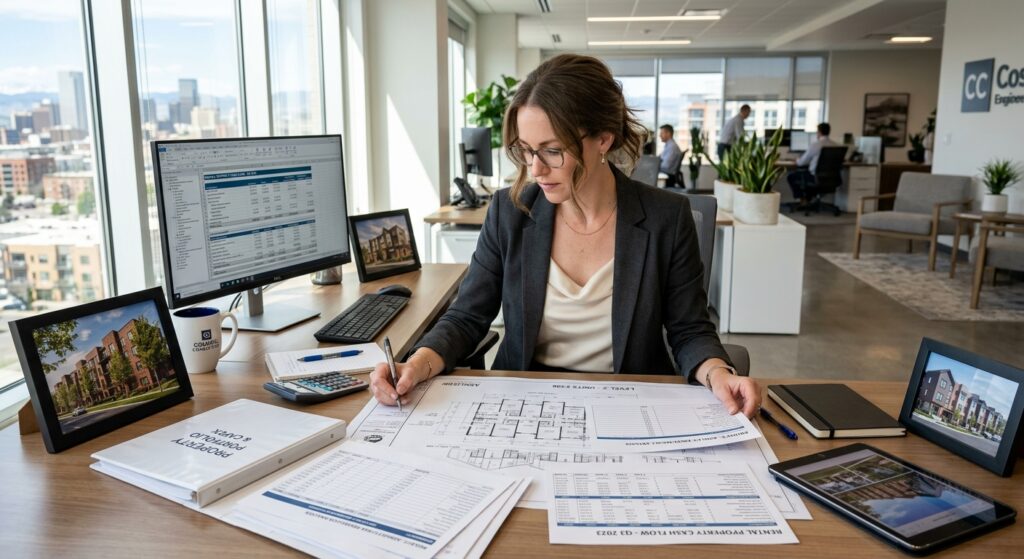
Cost Segregation Study for Rental Property: 2026 Guide
For real estate investors, a cost segregation study for rental property in 2026 offers one of the most effective strategies for dramatically increasing cash flow and reducing taxes. By leveraging tools like 100% bonus depreciation and precise engineering-based analysis, you can unlock immediate tax savings and keep more of your rental income.
Table of Contents
- Key Takeaways
- What is a Cost Segregation Study for Rental Property?
- How Does a Cost Segregation Study Work in 2026?
- Who Should Consider a Cost Segregation Study?
- Tax Savings: Real Example
- IRS Documentation and Audit Defense
- Common Mistakes and How to Avoid Them
- Frequently Asked Questions
- Related Resources
Key Takeaways
- Cost segregation reclassifies rental property components into shorter depreciation schedules, accelerating deductions.
- For 2026, 100% bonus depreciation is available for qualifying assets, maximizing year-one tax savings.
- Engineering-based cost segregation studies are essential for IRS compliance and audit defense.
- If you purchased or improved property in previous years, “catch-up” depreciation is still available through Form 3115.
What is a Cost Segregation Study for Rental Property?
A cost segregation study breaks down a rental property into its component parts, assigning each asset to its appropriate IRS-defined class. Instead of depreciating the entire property over 27.5 years (residential) or 39 years (commercial), a cost segregation study reclassifies assets such as landscaping, appliances, floor coverings, and site improvements into 5, 7, or 15-year property. This dramatically accelerates your depreciation deductions.
| Component Example | Depreciation Life | Qualifies for Bonus Depreciation? |
|---|---|---|
| Appliances & Carpeting | 5 years | Yes |
| Sidewalks, Landscaping | 15 years | Yes |
| Interior Lighting | 5-7 years | Yes |
How Does a Cost Segregation Study Work in 2026?
- Engage a qualified provider: Always use engineers or specialists with IRS knowledge.
- Site inspection: The provider inspects and documents all property elements.
- Component valuation: Assigns proper cost to each asset group.
- Report delivery: You receive an engineering report supporting all cost allocations and classifications. This supports your return in case of audit.
- Tax return prep: Work with your tax advisor to maximize year-one deductions. If claiming “catch-up” depreciation, your CPA will use Form 3115 to adjust for prior years.
In 2026, with the return of 100% bonus depreciation (under the One Big Beautiful Bill Act), all new 5, 7, or 15-year assets qualify for full expensing the first year.
Who Should Consider a Cost Segregation Study?
- Owners of single-family/multifamily rentals or commercial property purchased for $500,000 or more
- Property owners with recent or upcoming renovations over $250,000
- Real estate professionals looking to offset significant taxable income
- High-income individuals seeking immediate cash flow and tax relief
| Property Value | Recommended? |
|---|---|
| Under $500,000 | Case-by-case |
| $500,000 to $1,000,000 | Generally recommended |
| Over $1,000,000 | Strongly recommended |
Tax Savings: Real Example
 Free Tax Write-Off Finder
Suppose you purchase a $1.2M rental property in 2026.
Land value: $200,000 (not depreciable).
Building basis: $1,000,000 (depreciable).
- Normal Depreciation (27.5 years): $1,000,000 ÷ 27.5 = $36,363/year.
- With Cost Segregation & 100% Bonus Depreciation: Study reclassifies $250,000 (25%) of assets to 5, 7, or 15 years. Full $250,000 deductions in year one (bonus depreciation), plus $27,272 regular depreciation on the remaining $750,000.
- Year-One Tax Deduction: $250,000 + $27,272 = $277,272 (vs. $36,363 if no study done).
- Cash Flow Impact: If in 37% federal bracket, you save an additional $89,000 on 2026 taxes.
IRS Documentation and Audit Defense
- Use only engineering-based, detailed cost segregation reports; avoid cheap software-generated studies
- Maintain site inspection notes, construction contracts, and blueprints
- Use Form 3115 for catch-up depreciation from prior years
- Work with a tax specialist familiar with complex IRS rules and real estate professional status
Quality documentation is more important than ever—while IRS staffing is constrained, audit focus remains high for aggressive depreciation claims.
Common Mistakes and How to Avoid Them
- Using non-engineering providers or “cheap” studies
- Poor documentation—missing invoices or site notes
- Waiting too long; failing to use Form 3115 for catch-up
- Ignoring passive loss rules or state differences
- Failing to coordinate with your CPA/tax advisor

Frequently Asked Questions
Can I do cost segregation for a property bought years ago?
Yes. You can apply a study to older properties using the IRS “catch-up” method (Form 3115). No need to amend prior returns for depreciation. Bonus depreciation, however, only applies to new or qualifying improved property.
How long does a cost segregation study take?
Typically 3–8 weeks, depending on property size and documentation.
Will the IRS challenge my study?
Engineering-based, well-documented studies rarely fail audit—cheap, non-engineering studies are often reclassified, resulting in lost deductions and penalties.
Does this work for smaller rentals?
It depends. If under $500k, weigh cost/benefit: some smaller properties or renovations may still qualify for big added deductions (especially in 2026 with 100% bonus depreciation in play).
Related Resources
- Uncle Kam’s Real Estate Tax Strategies
- Engineering-Based Cost Segregation Explained
- Ultimate Rental Property Tax Guide
- IRS: Cost Segregation Audit Techniques Guide (ATG)
Last updated: March, 2026

