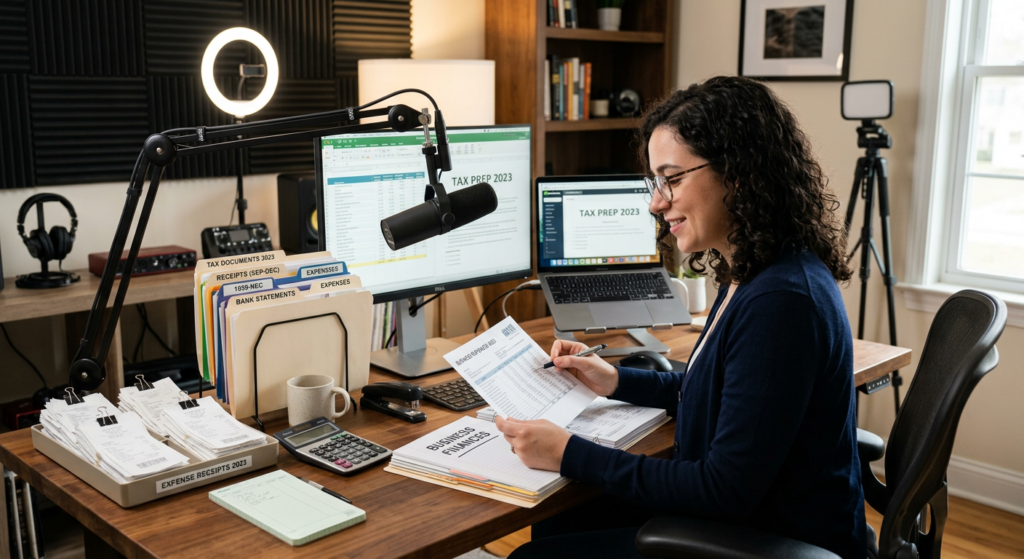
2026 Tax Deductions for Digital Creators: Complete Guide to Schedule C, Self-Employment Tax & Content Income Strategies
For digital creators navigating the 2026 tax year, understanding tax deductions for digital creator income is essential for protecting your bottom line. Whether you earn revenue through YouTube ad revenue, Twitch sponsorships, digital product sales, or content creation services, the IRS treats your income as self-employment earnings requiring Schedule C reporting. This guide walks you through every deductible expense, from equipment purchases to home office costs, while explaining how new 2026 OBBBA tax provisions can reduce your overall tax burden and maximize your after-tax income.
Table of Contents
- Key Takeaways
- What Are Tax Deductions for Digital Creators?
- How Do You Report Digital Creator Income on Schedule C?
- What Are the Self-Employment Tax Obligations for Digital Creators in 2026?
- Can Digital Creators Deduct Home Office Expenses?
- What Equipment and Software Expenses Are Deductible?
- What New 2026 Tax Breaks Apply to Digital Creators?
- Next Steps
- Frequently Asked Questions
Key Takeaways
- Digital creators report income on Schedule C and pay self-employment tax of 15.3% on net earnings in 2026.
- Deductible expenses include equipment, software, advertising, home office, and platform fees.
- 2026 OBBBA provides new deductions for tips and overtime income earned as a creator.
- Digital assets and crypto transactions must be reported on Form 1040 for 2026.
- Proper documentation of all income sources prevents IRS audits and maximizes refunds.
What Are Tax Deductions for Digital Creators?
Quick Answer: Tax deductions for digital creators are ordinary and necessary business expenses that reduce your taxable income on Schedule C. These include platform fees, equipment, software subscriptions, home office costs, and advertising expenses directly tied to earning your content creation income.
The IRS recognizes digital content creation as a legitimate business activity. When you earn money as a YouTuber, TikTok creator, online course instructor, or freelance designer, the government treats that income exactly like any other business income. This means you can deduct reasonable business expenses that help generate that revenue.
For the 2026 tax year, tax deductions for digital creator activities fall into seven main categories. First, platform-specific costs include YouTube’s Creator Fund fees, Patreon service charges, and marketplace commissions. Second, equipment costs encompass cameras, microphones, lighting, computers, and any tools directly used in content production. Third, software expenses include editing programs, thumbnail creators, scheduling tools, and analytics platforms. Fourth, home office deductions allocate rent or mortgage interest and utilities based on your dedicated workspace. Fifth, advertising costs cover paid promotion across social media, search engines, and creator networks. Sixth, professional services include accounting fees, legal consultations, and tax preparation. Seventh, educational expenses cover courses, conferences, and training that improve your content creation skills.
Why Digital Creators Need Schedule C Knowledge
Digital creators often face unique tax situations compared to traditional employees. Unlike W-2 workers, you receive income from multiple platforms without automatic tax withholding. This means the IRS expects you to understand your tax obligations and file accordingly. Understanding tax deductions for digital creators puts you in control of your tax outcome rather than leaving money on the table.
Many creators unknowingly overpay taxes by failing to claim legitimate deductions. Studies show content creators leave an average of $8,000 in unclaimed deductions annually. By understanding the full scope of available deductions, you can reduce your taxable income significantly and keep more of what you earn in 2026.
How Do You Report Digital Creator Income on Schedule C?
Quick Answer: Report all digital creator income on Schedule C (Form 1040) using your actual business name. List gross income from all platforms, deduct business expenses, and report net profit. File Schedule SE with your return to calculate self-employment tax obligations.
Schedule C is where the IRS expects to see your digital creator business activity for the 2026 tax year. This form requires you to report gross income from all sources: YouTube AdSense, sponsorship deals, affiliate commissions, digital product sales, and any other revenue streams tied to your content. The form operates on simple logic: gross income minus business expenses equals taxable profit.
Reporting Multiple Platform Income
Most digital creators earn money from multiple platforms. YouTube creators might earn from AdSense, sponsorships, Patreon, and digital course sales simultaneously. On Schedule C, you report the total of all these streams as one gross income number. You don’t need separate lines for each platform; instead, combine all revenue into the single “gross receipts” line.
However, tracking income by source remains important for business analysis. Use a spreadsheet or accounting software to categorize earnings by platform even if you combine them on Schedule C. This record-keeping helps during an audit and supports your business decisions.
Documenting Business Expenses on Schedule C
Schedule C contains expense categories where you deduct business costs. You must have documentation for every deduction claimed. The IRS requires you to maintain receipts, invoices, credit card statements, and bank records for at least three years. For major purchases like equipment, keep photos and depreciation schedules as well.
| Schedule C Expense Category | 2026 Deductible Examples for Digital Creators |
|---|---|
| Advertising | Paid social media promotion, Google Ads, sponsorships to grow audience |
| Car/Truck Expenses | Mileage to filming locations, equipment pickup, networking events |
| Depreciation | Cameras, computers, lighting over $2,500 (not immediately expensed) |
| Office Expenses | Software subscriptions, editing tools, analytics platforms |
| Professional Services | Accountant fees, tax preparation, legal consultations |
| Rent/Utilities | Home office allocation, studio space rental |
| Supplies | Props, backgrounds, cables, memory cards under $2,500 |
What Are the Self-Employment Tax Obligations for Digital Creators in 2026?
Quick Answer: Digital creators owe 15.3% self-employment tax (12.4% Social Security + 2.9% Medicare) on net profits exceeding $400 annually. Use Schedule SE to calculate your liability, and consider estimated quarterly payments throughout 2026.
Self-employment tax represents your Social Security and Medicare contributions as a self-employed individual. Unlike W-2 employees who split these payroll taxes with employers, digital creators pay the entire 15.3% yourself. This creates a significant tax liability that catches many creators off guard if they don’t plan ahead.
Let’s work through an example: A digital creator earning $50,000 in net income for 2026 owes approximately $7,065 in self-employment tax. This represents 15.3% of the net profit calculated on Schedule C. The IRS requires you to file Schedule SE with your annual return to report this calculation.
Understanding Estimated Quarterly Payments
The IRS expects tax payments throughout the year via estimated quarterly payments. Digital creators earning significant income must file Form 1040-ES quarterly to avoid underpayment penalties. For 2026, estimated payments are due April 15, June 15, September 15, and January 15 of the following year.
Calculate quarterly estimated taxes by dividing your annual expected income tax and self-employment tax by four. Use our self-employment tax calculator to estimate your exact quarterly obligation for 2026 based on your projected income.
Pro Tip: Set aside 30-35% of your gross digital creator income monthly for taxes. This simple rule ensures you have sufficient funds when quarterly payments and annual taxes are due. Many successful creators use a separate savings account specifically for tax obligations, preventing the common problem of spending tax money on business reinvestment.
Can Digital Creators Deduct Home Office Expenses?
Quick Answer: Yes. Digital creators with a dedicated home office space can deduct either the simplified method ($5 per square foot, maximum 300 sq ft) or actual expense method (utilities, insurance, rent/mortgage interest, maintenance). The space must be used regularly and exclusively for business.
The home office deduction represents one of the most valuable tax deductions for digital creators who operate from home. The IRS permits two calculation methods: simplified and actual expense. Understanding the difference helps maximize your deduction for the 2026 tax year.
Simplified Method: Fast and Easy
The simplified method allows $5 per square foot of dedicated office space. If your home office measures 200 square feet, you can deduct $1,000 annually ($5 × 200). The maximum deduction is $1,500 annually (300 square feet × $5). This method requires no receipts or expense tracking, making it simple for creators who want minimal paperwork.
Actual Expense Method: Maximize Deductions
The actual expense method typically yields larger deductions for digital creators. Calculate the percentage of your home used for business (office square footage ÷ total home square footage). Then multiply that percentage by your annual home expenses: mortgage interest (not principal), property taxes, utilities, insurance, maintenance, and depreciation.
Example: Your home office is 200 sq ft, and your total home is 2,000 sq ft (10% business use). Annual mortgage interest is $10,000, property taxes are $3,000, utilities are $2,400, and insurance is $1,200. Total deductible home expenses would be $1,660 ($16,600 × 10%). This exceeds the simplified method.
What Equipment and Software Expenses Are Deductible?
 Free Tax Write-Off Finder
Quick Answer: Digital creators can deduct equipment under $2,500 immediately (Section 179) or depreciate larger purchases over years. Software subscriptions, editing tools, and analytics platforms are fully deductible in the year purchased. All expenses must be ordinary, necessary, and directly related to content creation.
Equipment and software represent significant expenses for digital creators, and proper tax treatment can save thousands annually. The IRS distinguishes between immediate expensing (items under $2,500) and capital assets requiring depreciation (items $2,500 and above).
Immediately Deductible Items (Section 179)
Equipment and supplies under $2,500 are immediately expensed on Schedule C. This includes microphones, lighting kits, tripods, memory cards, backdrop materials, and cables. Software subscriptions like Adobe Creative Cloud, Canva Pro, and analytics tools are fully deductible in the year purchased.
- Editing software (Adobe Premiere, Final Cut Pro, DaVinci Resolve licenses)
- Thumbnail creation tools (Photoshop, Canva subscriptions)
- Audio editing (Audacity pro version, Adobe Audition)
- Video hosting and analytics (Tubebuddy, VidIQ, Streamlabs)
- Stream management (OBS Studio, Streamlabs, Xsplit)
- Social media scheduling (Buffer, Hootsuite, Later)
Capital Assets Requiring Depreciation
Equipment costing $2,500 or more must be depreciated over several years. This includes professional cameras, high-end microphone systems, and computer workstations. You use Form 4562 to report depreciation on your tax return. Most equipment depreciates over 5 years under modified accelerated cost recovery system (MACRS).
Example: A creator purchases a $3,500 professional camera. Instead of deducting the entire amount in one year, you deduct approximately $700 annually for five years. This spreads the deduction across multiple tax years, matching the asset’s useful business life.
What New 2026 Tax Breaks Apply to Digital Creators?
Quick Answer: The 2026 OBBBA introduces tax deductions for tips and overtime income earned by digital creators. While not credits, these deductions reduce taxable income. Digital asset transactions (crypto, NFTs) require new Form 1040 disclosures. Standard deductions for 2026 are $16,100 (single) and $32,200 (married).
The One Big Beautiful Bill Act (OBBBA) enacted in 2025 brings significant changes affecting digital creators for 2026. Understanding these new provisions helps you plan tax strategy effectively and claim every available deduction.
Tips and Overtime Deductions for Content Creators
Digital creators earning tips through Patreon, YouTube Super Chats, or direct fan support can claim a deduction for tip income. Similarly, if you provide overtime services (rush editing, premium content creation), that overtime compensation is deductible. These are deductions, not tax credits, meaning they reduce your taxable income by the deduction amount multiplied by your tax bracket.
Important limitation: For self-employed digital creators, the tip deduction is limited by subtracting allocable business deductions including self-employment tax, health insurance premiums, and retirement plan contributions. This means the net benefit is smaller for self-employed creators than for W-2 employees.
Digital Asset Reporting Requirements
For 2026, the IRS requires all taxpayers to disclose digital asset transactions on Form 1040. The question asks: “Did you receive, sell, exchange, or otherwise dispose of a digital asset during 2026?” If you earned cryptocurrency, NFTs, or digital collectibles as payment for content creation, you must check yes and report the transaction.
The IRS intentionally uses broad language to capture all digital asset activity. Receiving crypto as sponsorship payment, mining, staking rewards, or airdrop distributions must be reported. The fair market value on the date received is your income. This applies even if you didn’t sell the asset in 2026.
Pro Tip: Keep detailed records of every digital asset received, including the date, amount, and fair market value on receipt date. Use specialized crypto accounting software like CoinTracker or Zenledger to automatically track transactions across multiple wallets and exchanges. This documentation proves essential during an IRS audit and ensures accurate tax reporting.

Uncle Kam in Action: How One YouTube Creator Reduced Tax Liability by $12,400
The Client Profile: Sarah is a full-time YouTube creator earning approximately $85,000 annually from AdSense, sponsorships, and a digital course. She operated as a sole proprietor but felt overwhelmed by tax obligations and had been claiming minimal deductions.
The Challenge: Sarah calculated she owed roughly $18,000 in federal and self-employment taxes for 2025, leaving her with only $67,000 after taxes. She assumed her income was mostly spent on equipment and couldn’t be reduced further. Additionally, she worried about being audited because she’d never properly documented business expenses.
The Uncle Kam Solution: Our team performed a comprehensive tax deduction analysis for digital creators. We identified overlooked deductions: (1) Home office deduction using actual expense method: $2,100 annually, (2) Professional software subscriptions: $1,800 annually, (3) Equipment and supplies: $3,500 annually, (4) Advertising and promotional costs: $1,900 annually, (5) Home insurance and utilities allocation: $1,200 annually, (6) Professional services and accounting: $1,400 annually. Total identified deductions: $12,100.
The Results: By properly documenting and claiming tax deductions for digital creator income, Sarah’s taxable profit reduced from $85,000 to approximately $72,900. This $12,100 deduction reduction saved approximately $3,100 in federal income taxes plus $1,860 in self-employment taxes, totaling $4,960 in tax savings for 2025. For 2026, with ongoing deduction optimization, we project similar or greater savings. Sarah now sets aside 28% of gross income for taxes instead of the 35% she previously allocated, improving cash flow for business reinvestment.
Key Takeaway: Most digital creators significantly underutilize available deductions. Investing in proper tax planning and documentation yields immediate, substantial savings while reducing audit risk. Sarah’s investment in professional guidance resulted in over $4,900 in first-year tax savings.
Next Steps
Maximize your 2026 tax deductions for digital creator income with these actionable steps:
- Implement expense tracking: Start categorizing income by platform and expenses by type using accounting software like QuickBooks Self-Employed or Wave. This creates documentation proving deductions legitimate during audits and informs better business decisions.
- Calculate quarterly estimated taxes: Download Form 1040-ES and calculate required quarterly payments. Using our self-employment tax calculator, determine exact quarterly amounts based on your projected 2026 income to avoid underpayment penalties.
- Audit deductions against tax code: Review our complete deduction list and identify which apply to your specific content creation business model. Digital creators have different deduction opportunities based on whether they earn from YouTube, Twitch, TikTok, or other platforms.
- Schedule tax planning consultation: Digital creator taxation requires specialized knowledge. Speak with a tax strategist about optimizing your business structure and deduction strategy for maximum after-tax income in 2026.
- Document digital asset transactions: If you receive cryptocurrency or NFTs, create a spreadsheet tracking receipt date, amount received, and fair market value. This documentation supports your Form 1040 digital asset disclosures and proves deductibility of expenses.
Frequently Asked Questions
Can I claim the home office deduction if I also use my computer for personal activities?
The IRS requires your home office space to be used “regularly and exclusively” for business. If you use the same desk for both content creation and personal banking, the space doesn’t qualify. However, you can partition your home workspace to create a dedicated office area that qualifies. Many creators use room dividers or designate specific corners of rooms exclusively for business use, making the entire room space eligible for deduction.
What happens if I don’t track receipts for deductions?
The IRS requires substantiation for every deduction claimed. Without receipts, credit card statements, or bank records, you cannot prove the deduction’s legitimacy during an audit. The burden of proof falls on you to demonstrate the expense was ordinary, necessary, and business-related. Many creators lose deductions during audits simply because documentation is missing. Start maintaining organized records immediately using folders, spreadsheets, or receipt scanning apps like Expensify.
How do I determine if an expense is deductible?
An expense is deductible if it meets three criteria: (1) it’s ordinary in your industry (content creators typically spend on equipment and software), (2) it’s necessary to generate income (you wouldn’t spend on it otherwise), and (3) it’s not personal (purely benefiting your content creation business). Software used 100% for content creation is deductible. Groceries or gym memberships are not. Borderline expenses should be discussed with a tax professional.
Should digital creators form an LLC for tax purposes?
An LLC provides legal liability protection and potentially simplifies taxes through pass-through entity treatment. However, sole proprietors can claim the same deductions as LLCs. The tax benefit of an LLC depends on your specific situation, including income level and state taxes. Many creators benefit from LLC formation, but it’s not required to claim deductions. Consult an entity structuring specialist to determine if LLC formation makes sense for your digital creator business.
Can I deduct entertainment and meals as a digital creator?
Meals and entertainment expenses are only deductible if they’re directly related to business entertainment with clients, sponsors, or collaborators. Eating lunch while working alone doesn’t qualify. If you take a sponsor or fellow creator to dinner to discuss content collaboration, that meal is 50% deductible (meals are always 50% deductible). Keep receipts showing attendees and business purpose discussed.
How should I handle affiliate commission income?
Affiliate commissions earned through content are reported as self-employment income on Schedule C, just like YouTube AdSense or sponsorship payments. Platform commissions or fees associated with earning affiliate income (if applicable) are deductible business expenses. The net amount (commission minus direct costs) appears as part of your gross income on Schedule C.
Should I pay estimated quarterly taxes if my income is irregular?
Yes. Even with irregular income, the IRS expects quarterly estimated tax payments if you expect to owe $1,000 or more annually. Many digital creators face inconsistent monthly income but exceed this threshold over the year. Calculate estimated tax based on your projected annual income and divide by four. If your Q1 and Q2 income falls short, you can adjust Q3 and Q4 payments based on actual year-to-date earnings.
What 2026 changes should digital creators know about?
For 2026, the standard deduction increased to $16,100 (single) and $32,200 (married). The OBBBA introduced tips and overtime deductions that apply to digital creators earning supplemental income. Digital asset reporting on Form 1040 now requires creators to disclose all crypto and NFT transactions. Updated IRS guidance on modified accelerated cost recovery system (MACRS) affects depreciation calculations for equipment purchases. Self-employed health insurance deductions and retirement contribution limits adjust annually for inflation.
What records should I maintain for three years after filing?
Keep all receipts, invoices, bank statements, credit card statements, and documentation for claimed deductions. The IRS can audit returns up to three years after filing (or six years if income is underreported by 25%+). Maintain a copy of your filed Schedule C, Schedule SE, and supporting documentation in organized folders or digital storage. Digital receipts photographed or scanned are acceptable to the IRS if the original digital file is also retained.
Related Resources
- Complete Tax Write-Offs Guide for Content Creators
- Self-Employed Tax Planning for 1099 Contractors
- Tax Strategy Services for Small Business Owners
- 2026 Tax Preparation and Filing Services
- Business Tax Solutions and Bookkeeping
Last updated: March, 2026
Disclaimer: This information is current as of 3/16/2026. Tax laws change frequently. This article provides general tax information and should not be construed as personalized tax advice. Consult with a qualified tax professional or CPA before making tax decisions specific to your situation. Uncle Kam is not a law firm, and this content does not constitute legal advice.

