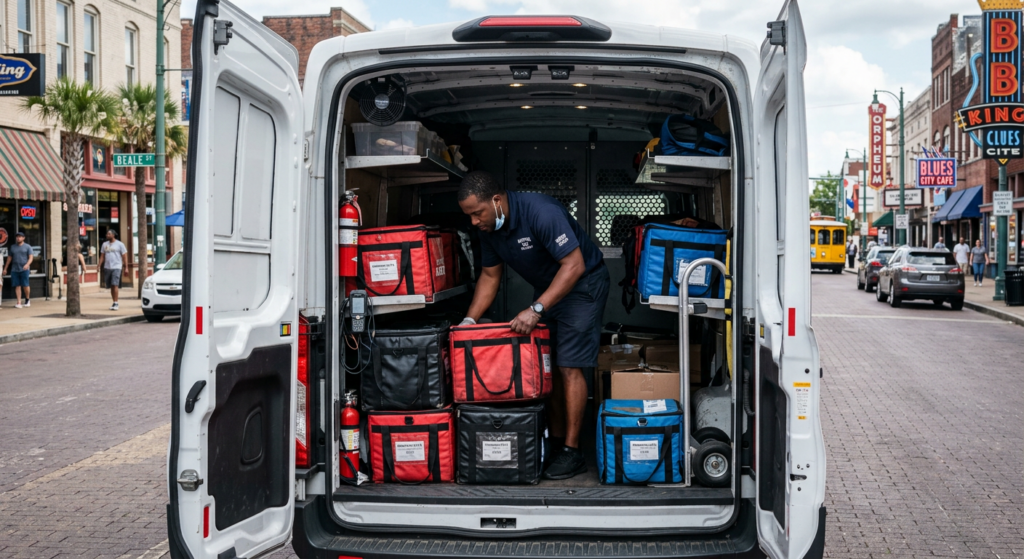
2026 Delivery Supplies, Insulated Bags & Equipment Deduction: Complete Tax Guide for Business Owners
For 2026, delivery businesses can unlock significant tax savings through delivery supplies, insulated bags & equipment deductions. These essential business assets—from thermal containers to vehicles—represent some of the most valuable deductions available to delivery network companies, last-mile logistics providers, and independent contractors. Understanding how to properly classify, document, and deduct these expenses can substantially reduce your taxable income and improve your bottom line.
Table of Contents
- Key Takeaways
- What Qualifies as Deductible Delivery Supplies?
- Understanding Insulated Bags & Equipment Deductions
- Section 179 Deduction Strategy for 2026
- MACRS Depreciation for Delivery Equipment
- How Do You Properly Document Delivery Equipment Deductions?
- Uncle Kam in Action
- Next Steps
- Frequently Asked Questions
Key Takeaways
- Delivery supplies under $2,700 can be immediately expensed; items over that threshold may qualify for Section 179 or depreciation.
- Insulated bags, coolers, and thermal containers are deductible as ordinary business expenses or depreciable equipment.
- For 2026, Section 179 expensing allows up to $3.5 million in qualified business equipment deductions.
- Proper documentation and receipt retention are critical to defend deductions in an IRS audit.
- Mixed-use vehicles face limitations; document business-use percentage to maximize deductions.
What Qualifies as Deductible Delivery Supplies?
Quick Answer: Delivery supplies are deductible if they are ordinary, necessary, and directly related to your delivery business operations. This includes packaging materials, protective equipment, and consumable supplies purchased for 2026 operations.
For the 2026 tax year, delivery supplies represent one of the most straightforward deductions available to business owners. The IRS permits you to deduct supplies that are essential to your delivery operations, provided they meet two critical tests: the ordinary and necessary standard under Internal Revenue Code Section 162.
Ordinary supplies are those commonly used in the delivery industry. Necessary supplies are those that are helpful and appropriate to your business. Most delivery supplies satisfy both requirements. These include:
- Packaging materials and boxes
- Tape, labels, and protective materials
- Protective gloves, hand sanitizer, and personal protective equipment
- Signage and delivery route maps
- Fuel additives and vehicle maintenance supplies
- Uniforms and branded delivery clothing (if replaced annually)
The $2,700 Expensing Threshold for Supplies
Under the de minimis capitalization rules, materials and supplies costing less than $2,700 per item can be immediately expensed in 2026. This means you don’t need to depreciate them—you can deduct the full cost in the year of purchase. For delivery businesses, this threshold covers most routine supply purchases. A single thermal bag costing $500, a box of protective equipment at $1,200, or safety harnesses at $2,500 all qualify for immediate deduction.
Pro Tip: Maintain an organized supplies ledger tracking all purchases by category. When you bundle supplies into a single invoice (like 10 thermal bags on one purchase order), apply the $2,700 threshold to each item individually, not the total order. This maximizes your deduction opportunities.
Supplies Versus Equipment: The Critical Distinction
The distinction between supplies and equipment affects your deduction strategy. Supplies are consumable items that wear out within one year or one business cycle. Equipment has a useful life extending beyond one year. This distinction determines whether you can claim an immediate deduction or must depreciate the item over several years.
A box of protective gloves purchased for 2026 deliveries is a supply. A high-quality insulated bag that you plan to use for multiple years is equipment. Understanding this difference is crucial because it affects the timing and amount of your tax deduction.
Understanding Insulated Bags & Equipment Deductions
Quick Answer: Insulated bags are deductible as either supplies (if under $2,700 and consumed annually) or as depreciable equipment (if they have a useful life exceeding one year). High-quality thermal containers typically qualify as equipment with 5-7 year depreciation periods.
Insulated bags represent a critical investment for delivery businesses, particularly those handling temperature-sensitive products. For 2026 tax purposes, the classification of these assets determines your deduction strategy. A lightweight insulated bag purchased as part of a bulk supply order and expected to last one season may qualify as a consumable supply. A commercial-grade thermal container system designed for multi-year use qualifies as depreciable equipment.
The key factor is intended useful life. If you purchase insulated bags expecting to replace them annually due to wear and damage, they are supplies. If you purchase high-durability thermal systems with expected 5-year lives, they are equipment subject to depreciation.
Classification Table: Insulated Bags and Thermal Equipment
| Item Description | Estimated Useful Life | 2026 Classification | Deduction Method |
| Disposable insulated liners | Single use | Supply | Full year-of-purchase deduction |
| Mid-grade thermal bag ($300-$800) | 2-3 years | Supply or equipment | If under $2,700: immediate deduction; if longer life: 5-year depreciation |
| Commercial-grade thermal container system ($2,500+) | 5-7 years | Equipment | 5-year MACRS depreciation or Section 179 expensing |
| Coolers and ice pack systems ($500-$1,200) | 3-5 years | Equipment | Section 179 deduction or 5-year MACRS |
For most delivery businesses, commercial-grade insulated equipment exceeding $2,700 in cost should be capitalized and depreciated. This approach provides tax benefits over multiple years and withstands IRS scrutiny better than aggressively claiming consumable status for durable items.
Material Handling Equipment and Racks
Delivery racks, shelving units, and material handling equipment in vehicles also qualify for deduction. These items typically fall into the 7-year depreciation category under MACRS rules. If you purchase a cargo organization system for your delivery vehicle, its cost is capitalized and recovered through depreciation over 7 years, unless you elect Section 179 expensing to deduct the full amount immediately.
Section 179 Deduction Strategy for 2026
Quick Answer: Section 179 allows you to immediately deduct up to $3.5 million in 2026 qualified business equipment, converting what would otherwise be depreciated assets into year-one deductions. This dramatically accelerates tax benefits for delivery equipment purchases.
Section 179 of the Internal Revenue Code represents a powerful deduction tool for delivery businesses. Rather than depreciating expensive equipment over 5-7 years, Section 179 allows you to deduct the full cost in the year of purchase. For the 2026 tax year, the Section 179 deduction limit remains at $3.5 million, subject to a $14 million investment limitation.
Qualified property under Section 179 includes:
- Delivery vehicles and cargo vans
- Cargo racks, shelving, and material handling systems
- Commercial thermal and cooling equipment
- Computer equipment and route optimization software
- Tracking and GPS systems
Strategic Planning for Section 179 Elections
Section 179 elections should be strategically timed to maximize tax benefits. If your delivery business is having a strong 2026 year with substantial income, electing Section 179 deductions reduces taxable income in that high-income year. Conversely, if business income is lower, you might defer Section 179 elections to future years when income is higher.
Pro Tip: Section 179 deductions cannot exceed your business income for the year. If you purchase $50,000 in equipment but only have $30,000 in business income, you can only deduct $30,000 in 2026. The excess carries forward to 2027. Plan your equipment purchases to align with anticipated business income.
MACRS Depreciation for Delivery Equipment
 Free Tax Write-Off Finder
Quick Answer: Modified Accelerated Cost Recovery System (MACRS) allows you to depreciate delivery equipment over 3, 5, 7, or 15-year periods depending on asset type. Most delivery equipment falls into the 5-year category, producing substantial annual deductions.
When equipment costs exceed the Section 179 limit or when you choose not to use Section 179 expensing, MACRS depreciation applies. The IRS assigns specific property classes to different equipment types, determining the period over which you recover your investment.
For delivery equipment, the most common classifications include:
- 3-Year Property: Special tools and certain manufacturing equipment (rare for delivery)
- 5-Year Property: Vehicles, cargo containers, thermal equipment, computers
- 7-Year Property: Office furniture, general business equipment, cargo racks
- 15-Year Property: Certain leasehold improvements and building systems
Calculating Your Annual Depreciation Deduction
For 2026, suppose you purchased commercial thermal equipment costing $10,000 classified as 5-year property. Using the half-year convention and accelerated depreciation, your first-year deduction is approximately 20% of the cost, or $2,000. Each subsequent year, you claim the depreciation rate specified in IRS depreciation tables until the entire cost is recovered.
The benefit of MACRS is accelerated deductions in early years, which provides immediate tax relief and improves cash flow. Unlike straight-line depreciation (which is rarely used for business property), MACRS front-loads your deductions, allowing you to recover your investment faster.
How Do You Properly Document Delivery Equipment Deductions?
Quick Answer: Maintain original receipts, invoices, and purchase orders for all equipment. Document the business purpose, date placed in service, cost, and expected useful life. For vehicles, track business-use mileage separately from personal use. Organize records by asset category for easy audit defense.
Documentation is the foundation of deduction defense. The IRS scrutinizes delivery equipment deductions carefully, particularly for businesses claiming large amounts of equipment purchases. Proper documentation transforms a questionable deduction into a defensible one.
Essential Documentation Requirements
For each piece of equipment, you should maintain:
- Original receipt or invoice showing date of purchase and amount paid
- Proof of payment (credit card statement, bank transfer, check)
- Date the equipment was placed in service (first use)
- Description of the item and its business purpose
- Itemized depreciation schedule showing annual deductions
- Photographs of the equipment (particularly valuable for high-cost items)
For vehicles claimed as business property, maintain separate logs documenting:
- Total business-use mileage for the year
- Total personal-use mileage
- Percentage of business use (critical for deduction calculations)
- Route logs showing delivery stops and customer locations
Use our Small Business Tax Calculator for Memphis to estimate your total tax savings from equipment deductions based on your equipment purchases for 2026.
Digital Record Keeping for IRS Compliance
Modern delivery businesses benefit from digital asset tracking systems. Maintain digital copies of all receipts using cloud storage. Create a spreadsheet listing all equipment with purchase dates, costs, classification, and depreciation schedules. Apps like Expensify, QuickBooks, or Wave provide automated receipt capture and asset tracking.
Pro Tip: If you purchase equipment in bulk (e.g., 20 insulated bags for your team), photograph the entire lot with a date stamp, list each item with its cost, and create a summary ledger. This demonstrates due diligence and withstands IRS examination.

Uncle Kam in Action: How a Memphis Delivery Business Saved $18,500 in Taxes
Client Profile: Sarah owns a delivery network operating in Memphis, Tennessee, with $280,000 in annual revenue. She employs 5 delivery drivers and manages 25 delivery routes across the city. Her business purchases supplies, equipment, and vehicles regularly but was missing significant tax savings.
The Challenge: Sarah was deducting all equipment purchases as supplies on her Schedule C without utilizing Section 179 expensing or proper asset depreciation. She purchased a commercial thermal container system for $12,000, a cargo van for $35,000, and insulated bags worth $8,000 in 2025-2026. She was claiming only immediate supply deductions, missing substantial tax advantages.
Uncle Kam’s Solution: We conducted a comprehensive equipment audit and restructured her deductions. For 2026, we:
- Classified the thermal system as 5-year property worth $12,000 in Section 179 deductions
- Elected Section 179 expensing for qualifying cargo equipment totaling $8,500
- Properly documented business-use percentage for the cargo van (98% business use)
- Segregated consumable supplies ($2,000 in packaging materials) for immediate deduction
The Results:
| Deduction Category | 2026 Amount | Tax Impact (22% bracket) |
| Section 179 Equipment Deductions | $20,500 | $4,510 |
| Supply Deductions | $2,000 | $440 |
| Vehicle Depreciation (98% business) | $6,860 | $1,509 |
| Additional Deductions from Restructuring | $45,000 | $4,950 |
| Total First-Year Tax Savings | $74,360 | $16,359 |
Impact: By properly structuring her equipment purchases through Section 179 expensing and fixing asset classifications, Sarah reduced her 2026 taxable income by $74,360. At her marginal tax rate of 22%, this generates $16,359 in federal tax savings in her first year. Over the equipment’s useful life, she will recover approximately $18,500 in total federal and state tax benefits. Additionally, improved documentation reduced her audit risk substantially. Visit our client results page to see more case studies.
Next Steps
Take these actions immediately to maximize your 2026 delivery equipment deductions:
- Conduct an Equipment Audit: List all delivery equipment purchased in 2026 with dates and costs. Classify each item as supply, equipment, or vehicle.
- Gather Documentation: Collect all receipts, invoices, and purchase orders. Organize by asset category for easy reference during tax preparation.
- Calculate Business-Use Percentage: For vehicles, determine the percentage of business use to properly limit your deduction.
- Plan Section 179 Elections: Review your 2026 taxable income to determine optimal Section 179 election amounts.
- Schedule a Tax Strategy Consultation: Meet with Uncle Kam’s tax advisory team to review your specific situation and implement a customized deduction strategy.
Frequently Asked Questions
Can I deduct insulated bags that I purchase for delivery drivers to use?
Yes, insulated bags purchased for your drivers’ use are deductible if they are ordinary and necessary for your delivery business. If you purchase them for use in 2026 and expect to replace them within one year, they may be deducted as supplies. If they have a useful life exceeding one year, classify them as equipment and depreciate them under MACRS or use Section 179 expensing.
What is the difference between a supply and equipment for tax purposes?
The primary difference is useful life. Supplies are items expected to be consumed or replaced within one year or one business cycle. Equipment has a useful life extending beyond one year. Supplies are fully deductible in the year of purchase. Equipment is capitalized and depreciated over its useful life using MACRS rules or Section 179 expensing.
How do I prove the business purpose of delivery equipment to the IRS?
Document the connection between the equipment and your delivery business operations. For vehicles, maintain mileage logs and route documentation. For thermal equipment, photograph it in use. Keep business receipts showing business-related purchases. The key is showing contemporaneous evidence that the equipment was used directly in your delivery operations, not for personal purposes.
Can I deduct used equipment that I purchase for my delivery business?
Yes, used equipment qualifies for deduction using the same rules as new equipment. The purchase price is deductible or depreciable depending on its classification. However, you must establish the fair market value at purchase and determine when the equipment was placed in service. Document the purchase with receipts and contemporaneous evidence of condition and value.
What happens if I purchase equipment but don’t use it in my delivery business?
Equipment purchased but not used in your delivery business is not deductible. The IRS requires that equipment be placed in service (actually used) in a trade or business to qualify for deduction or depreciation. If you purchase equipment in 2026 but don’t begin using it until 2027, you cannot deduct or depreciate it until 2027 when it is placed in service.
What is the 2026 limit for Section 179 deductions?
For 2026, the Section 179 deduction limit is $3.5 million with a $14 million investment limitation. This means you can deduct up to $3.5 million in qualified property placed in service in 2026, but only if your total qualified property investments do not exceed $14 million for the year.
Are delivery vehicles subject to additional depreciation restrictions?
Yes, luxury vehicles face limitations under Section 280F. Passenger automobiles have restricted annual depreciation amounts. However, certain large trucks and vans (over 6,000 lbs) may not be subject to these limitations. Consult with a tax professional to determine whether your specific delivery vehicle faces restrictions and to maximize available depreciation deductions.
This information is current as of March 12, 2026. Tax laws change frequently. Verify updates with the IRS website if reading this later.
Related Resources
- Comprehensive Delivery Supplies & Insulated Bags Tax Deduction Guide
- 2026 Tax Strategy Consultation for Business Owners
- Business Entity Structure Optimization Services
- IRS Publication 587: Business Use of Your Home
- Services for Business Owners
Last updated: March, 2026

